Alternative sugars in chocolate

Coconut blossom sugar, date sugar, maple sugar, lucuma, beet sugar... are these sugars really 'healthier'? Spencer investigates.
Print / PDFSugar is – rightly – much maligned. We’d like to see higher taxes on sugar. We’d like to see more restrictions on how products high in added sugar are labelled, sold and marketed. We’d also like to see far more transparency on sugar sourcing. And this is in spite of the fact that over 90% of the craft chocolate bars we sell have some “added” (or “free”) sugars.
We’ve written about sugar before – explaining why we’d like it taxed more, how it’s abused (and creates cravings) and even the extraordinary story of artificial sweeteners (yes, they were discovered because a researcher mistakenly thought he’d been asked to “taste” rather than “test” a white powder given to him).
However we are still regularly asked about transparency in sugar and about “alternative sugars”. So we’ve done another deep dive – firstly to try and dispel some of the myths about healthy sugars (spoiler alert, almost all of these “healthy” sugars are either marketing hype and/or confuse a sweetener with an inclusion). And then next week, we’ll try to put a spotlight on some of the reasons Big Food (and Big Chocolate) is so wedded to sugar (hint: it’s not just that we like sweetness) and why Big Food is so keen to avoid any scrutiny on sugar (another spoiler alert: sugar has a gruesome supply chain).
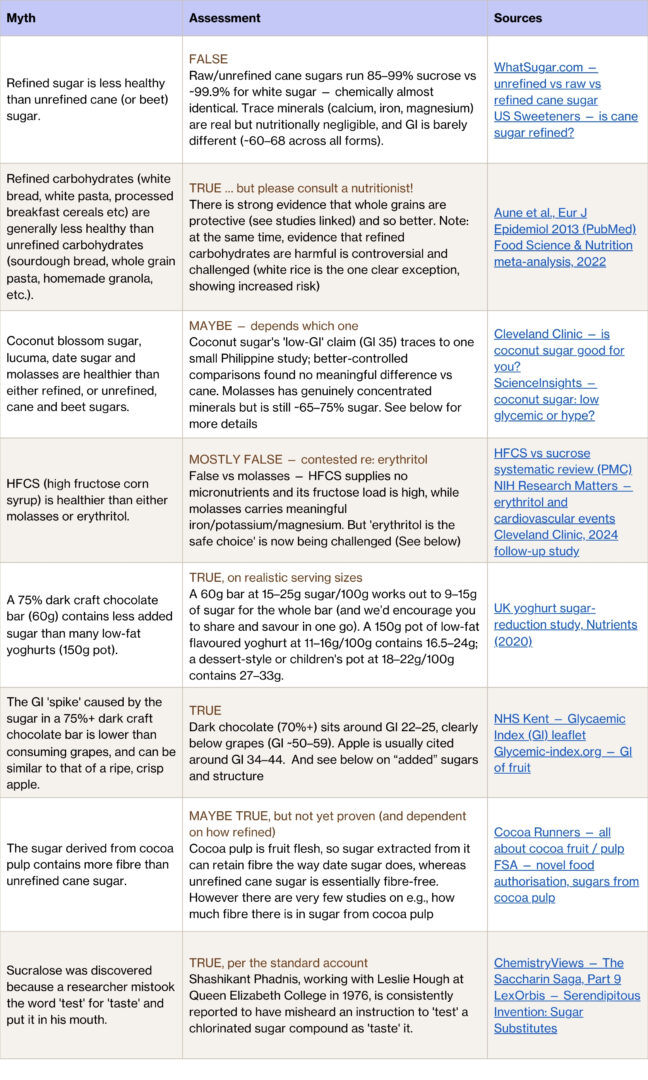
Both posts run long, so grab a couple of bars to savour while you read — then test your nonsense-detecting skills on the health claims below – which ones do you think are true? (Answers below.)
- Refined sugar is less healthy than unrefined cane (or beet) sugar
- Refined carbohydrates (white bread, white pasta, processed breakfast cereals etc) are generally less healthy than unrefined carbohydrates (sourdough bread, whole grain pasta, home made granola, etc.)
- Coconut blossom sugar, lucuma, date sugar and molasses are healthier than either refined, or unrefined, cane and beet sugars
- HFCS (high fructose corn syrup) is healthier than either molasses or erythritol
A 75% dark craft chocolate bar contains less added sugar than many low‑fat yoghurts - The glycaemic response (GI “spike”) from a 75%+ dark craft chocolate bar is lower than that from grapes, and can be similar to that of a ripe apple
- The sugar derived from cocoa pulp contains more fibre than unrefined cane sugar
- Sucralose was discovered because a researcher mistook the word “test” for “taste” and put it in his mouth.
In addition to (hopefully) surprising you with some of these answers there’s some good news too.
The first is that not all sugar is always bad. The second, related point, is that what matters most is often not the total amount of sugar in a food, but how much of it is “added” (confusingly, these added sugars are also, in some cases, called “free” sugars) — which is exactly why eating an apple is so much better for you than drinking apple juice.
The third is that the sugar added to dark craft chocolate can be a genuinely good thing, for two reasons. The first is that a little sugar in craft chocolate helps bring out the complexity of flavour in craft chocolate. And it’s this length and complexity of flavour that encourages savouring and sharing in craft chocolate. This is the antithesis of the way sugar, in large amounts, is added to mass-produced chocolate to engineer scoffing and overconsumption. The second reason, ironically, is partly thanks to cocoa butter. Craft chocolate contains enough fat and fibre to slow the impact of its relatively modest amount of added sugar. Its overall glycaemic effect can therefore be closer to that of a whole apple than apple juice, producing a gentler rise in blood glucose rather than a sharp spike.
The fourth piece of good news is that there are strong social and environmental reasons to seek out “responsibly sourced” sugar. If you want a reason to favour something like coconut blossom sugar or lucuma over refined cane sugar with no stated origin, the socio-economic considerations are far stronger than any pseudo-health benefits (see the next blog on sugar and transparency).
An introduction, and some definitions of sugar types and the difference between “free” and “added” sugars
Before diving more deeply into more detail here, it’s worth stepping back and clarifying some definitions and setting the scene on how, and how much, sugar we consume.
Consumption – some scary figures
The average UK adult eats around 40-50g of “free” sugar a day — roughly 15-20 kg a year — way more than the 30g the government recommends. Almost all of this “free” sugar is added before the consumer buys the goods – in the manufacturing and processing of breakfast, cereals, processed pastries, soft drinks, packaged biscuits, crisps, “puddings”, snack bars, etc. Remarkably little is added by consumers cooking at home, making drinks, etc. And the overwhelming majority of this added sugar — estimated at over 90% — is simple sucrose refined from either sugar cane or sugar beet.
Source of the (free) sugar used in the UK
Supply-chain data suggests that 50–60% of UK sugar comes from home-grown sugar beet, processed solely by British Sugar. Another 20–25% is refined cane sugar, imported and refined mainly by Tate & Lyle Sugars, the UK’s only cane refiner. The remainder arrives as refined beet sugar imported from the EU, or already inside manufactured and imported foods. High-fructose corn syrup, honey, and lactose or galactose used as sweeteners make up a small, single-digit share between them. “Alternative” sugars — coconut blossom sugar, lucuma and the like — are smaller again: more a footnote in the numbers than a meaningful slice of the nation’s sugar supply.
Note: These figures are “indicative” and gathered from recent government supply estimates. Precise shares vary by year and by whether the measure is production, new supply or consumption.
Chemistry Overview (See below for more details)
Chemically, almost all of these sugars boil down to the same two molecules: glucose and fructose. Coconut blossom sugar, maple syrup, date syrup, even cocoa-pulp sugar differ from refined cane and beet sugar mainly in how much water and “other stuff” they carry alongside the sugar itself — flavour compounds, acids, minerals, bits of plant material. Lucuma is a genuine outlier, since it’s a dried fruit powder rather than a sugar or syrup in the conventional sense. Even high-fructose corn syrup is fundamentally glucose and fructose, typically in proportions close to the roughly 50:50 split sucrose breaks down into once digested — the difference being that HFCS arrives as a liquid with the two sugars already unbound, rather than joined together as a solid crystal.
Two categories sit outside this picture entirely. Sugar alcohols, or polyols, such as erythritol, are chemically distinct from sucrose, with different sweetness levels and different metabolic effects. So are “intense” sweeteners like aspartame and sucralose (see here) — synthetic compounds with no sugar in them at all. All of these activate the same sweet-taste receptors on the tongue. What happens next, in the gut and beyond, is where they diverge.
“Free” sugars (not really free.. and added a lot)
Sugar type, though, may be the less useful distinction. Nutrition science draws a sharper line between sugars that are “free” and sugars still locked inside a food’s structure — “intrinsic” sugar. A medium apple contains about 15-20g of sugar, four to five teaspoons by weight, but that sugar stays trapped within the apple’s cells, and its fibre and water content shape how quickly it’s eaten and absorbed. A spoonful of apple-juice concentrate used as a sweetener counts as free sugar regardless of what the label calls it. So does the sugar in a glass of apple juice, even with nothing added, because juicing strips away the fibre and cell structure that kept it “intrinsic” in the first place. UK rules reflect this: pure fruit juice can’t contain added sugar, but nectars and juice drinks can.
Unfortunately the exact definitions are a little complex and confusing. Added sugars and free sugars overlap, but they are not interchangeable. That is to say: all added sugar is free sugar; not all free sugar has been added. The sugar in pure fruit juice, honey and syrup counts as free sugar even when nothing was added during manufacture.
And this explains the challenge in deciphering ingredients lists and nutritional labels. “Sugars” means total sugars — free, intrinsic, everything — with no way to separate them out. A plain yoghurt can show several grams of sugar that’s entirely lactose, with nothing added. An apple contains sugar too, but that doesn’t make it equivalent to apple juice, apple-juice concentrate, or anything sweetened with either.
Health claims
Marketing folks in alternative sugars (often subsidiaries of “big sugar”), along with “nutritionists” make all sorts of health claims. At best these claims obfuscate and distract, and – at worst – badly mislead. These claims tend to fall into three categories. The first is about fibre. The second is about minerals. And the third is around sugar spiking (ie that an “alternative” sugar is somehow gentler on blood sugar, has a lower glycemic index, etc).
Almost none of these claims for almost all these “alternative” sugars survives contact with the evidence. And those claims that have some basis in reality, see these “sugars” behaving less like a flavour enhancer or sweetener and more like “inclusions”.
Part of the confusion here comes from an expectation that “unrefined” is better than “refined” sugar because this is true of the way that unrefined carbohydrates (e.g. wholemeal bread, whole grain pasta, etc.) are better than “refined” carbohydrates (e.g. processed white bread, white pasta). The focus on ultra-processed foods may also encourage the idea that adding words like “unrefined” and “natural” is also somehow “better”. But unlike,white versus brown rice, the idea that white / refined is less healthy than brown / unrefined for the vast majority of the sugar we consume is wrong.
Scroll down to the bottom of this blog for a detailed review of some of the myths around “alternative” sugars.
But before then, some good news.
An alternative, and more optimistic case – the case for a little sugar to help savouring
Mary Poppins had it right: a little sugar can make a craft chocolate bar shine. Sugar has physical as well as sensory roles, contributing bulk, texture and flow. Big Chocolate uses it firstly to bulk out, conceal, build mouth feel and to cut costs. At the same time, sugar is a key tool to encourage scoffing via “the bliss point”, sensory specific satiety and hyper palatability (come to a tasting to find out more).
For Craft chocolate makers sugar is a very different tool. Its critical role is often to balance bitterness, acidity and astringency, changing how the cocoa’s aromas and flavours are perceived. Much as a pinch of salt or squeeze of lemon can bring a savoury dish into focus, the right amount of sugar can make a bean’s character easier to appreciate.
Craft makers therefore calibrate sugar as carefully as they do roasting and conching. Seventy per cent is only a broad guide: the difference between a 70%, 72% and 78% bar can substantially alter its balance, intensity and length — and which flavours come most clearly to the fore. The craft lies in finding the proportion that best serves both the bean and the intended style.
At its best, this complexity encourages savouring and, hopefully, sharing. Slower, more attentive eating can help us feel satisfied with less. That contrasts with many ultra-processed, mass-produced bars, formulated around immediately appealing combinations of sugar and fat, an easy melt and rapidly changing textures that encourage one bite to follow another.
Part 2: fruit, vegetables and the food matrix
Structure changes how sugar behaves in the body – and is arguably as important, if not more important than the total amount of sugar. Sugar still locked inside a plant’s cells counts as intrinsic; sugar released from that structure — by juicing, or otherwise — counts as free, whether or not anything has technically been “added.” Whole fruit and unsweetened juice from the same fruit can carry similar amounts of sugar, yet act very differently in the body: one is still bound up in the food matrix, the other is not.
Soluble fibre such as pectin can form a gel in the small intestine that slows sugar reaching the bloodstream. Whole plant foods also have a food matrix: intact cell walls that must break down before their sugars are fully accessible, a job that chewing and digestion do gradually rather than all at once.
A whole orange has a GI around 40 and roughly 3g of fibre, while orange juice is typically higher, often around 48 to 50 depending on the source and preparation. A large prospective study of 187,382 adults found whole fruit linked with lower type 2 diabetes risk, while fruit juice was linked with higher risk (see source below).
Blending is very different from juicing. As long as pulp and skin stay in, a smoothie keeps more of the fibre and usually a lower glycaemic response; the key change is the retention or removal of fibre, not simply mechanical processing. Tested dark chocolate bars seem to follow the blending pattern rather than the juicing one. Bars tested at 70%+ cocoa by the University of Sydney’s Glycemic Index Research Service have measured GIs in the low-to-mid 20s — lower than many fruits, most bread, and virtually any other dessert.
This is a testing programme, not a single study: GI varies by the specific bar, especially for mass-market bars made less bitter with added ingredients such as alkalised cocoa powder. Cocoa butter may play a role here, although it is not “low-calorie”; human studies show it is highly digestible, so its effect is more about fat structure and gastric emptying than reduced absorption. Cocoa solids also carry fibre, magnesium and polyphenols, depending on farming and crafting, and there is some lab evidence that fibre can inhibit enzymes involved in carbohydrate breakdown.
Note: real-world trial evidence is limited and not clear cut. Some studies show improved insulin sensitivity with regular dark chocolate or high-polyphenol cocoa, while others show smaller or less consistent effects. And the effect isn’t universal: mass-produced milk chocolate, with less cocoa and more added sugar, doesn’t show the same buffering. I’m not aware of tests on craft chocolate dark milks such as Zotter’s, Standout’s or Pump Street’s, but the amount of “added” sugar can be lower than in a 70% dark chocolate bar, as the milk itself contributes sweetness too.
Summary
None of this is an argument for more sugar. Quite the opposite: we favour higher sugar taxes and tougher rules on how HFSS products are sold. The industrial food system relies on sugar on the one hand to encourage scoffing through its ruthless engineering of “bliss points”,sensory specific satiety and hyper‑palatability and on the other hand cheaply bulk out, preserve and cover up commoditised ingredients.
In a dark craft chocolate bar, a little sugar is a flavour tool, not an industrial crutch. It’s used to reveal the extraordinary complexity of great beans and to encourage savouring (and sharing).
To a craft chocolate maker, that little sugar helps bring out the balance, length, complexity and intensity (BLIC) of flavour in their beans and bars. That’s why makers favour responsibly sourced refined cane sugar: it sweetens without adding competing flavours. Coconut blossom sugar, lucuma, molasses and most “alternative sugars” bring their own strong notes. Those can be interesting — much like inclusions — but without careful thought they risk obscuring the hundreds of flavours in the cocoa itself, and their nutritional advantages are, candidly, negligible (see below).
One last bonus: these dark craft chocolate bars may well have a lower glycaemic impact than almost anything else on the desert trolley.
And if you want more details about alternative sugars, please read on:
Myth busting
Myth no1: Refined is not as good as unrefined Cane (or Beet) Sugars
Looking unrefined and “more natural” doesn’t make cane sugar any healthier. White, turbinado, demerara, muscovado — all different stages of cane refining — vary in flavour and colour, but are still almost pure sucrose. A teaspoon of turbinado carries only trace minerals, irrelevant next to its 4.6g of sugar. Fibre lives in the plant’s cell walls and stays there when the syrup is spun off — even “raw” cane sugar has none.
Blackstrap molasses made from cane sugar is the one real exception, keeping meaningful iron, calcium and magnesium. But it’s still a sugar syrup, and it doesn’t work in craft chocolate.
Beet sugar follows the same rule as cane. Refined or not, it’s chemically almost identical to cane — both close to pure sucrose — and it has no molasses exception either: beet molasses is bitter, fit only for animal feed. The real differences between cane and beet sit elsewhere: over 95% of US sugar beet is genetically modified for herbicide tolerance, cane isn’t — though the DNA doesn’t survive refining either way. And some cane sugar is whitened using bone char, an animal-derived filter, which beet sugar never uses. That’s why beet is reliably vegan, and cane isn’t always.
Myth no 2: Coconut sugar and lucuma have a lower GI spike
Coconut sugar’s reputation rests on a 2010 Philippine study of just 10 people, which produced the widely quoted glycemic index of 35. Independent testing at the University of Sydney found 54 instead — barely under the “low GI” cutoff of 55, and not far off white sugar’s 60–65. A 2022 trial in 43 people with type 2 diabetes found no meaningful difference between coconut and cane sugar’s effect on blood glucose. So if you like the flavour of coconut in your chocolate, coconut sugar is fine – but it’s not any healthier.
Lucuma is still shakier. Its marketed GI of 5–25 has never been measured in a published human study — an estimate repeated into fact. The claim that it “regulates blood sugar” comes from a single 2009 test-tube study, which found an extract could inhibit a digestive enzyme in isolation, never tested in an actual person. That is to say – there is no published human GI study to back up any claims; the only study was about in-vitro enzyme work supplemented with marketing extrapolation. In addition, lucuma’s mineral content is negligible: under 1% of the daily value for calcium, iron or potassium per tablespoon. As it’s derived from a fruit, it may have some fiber – but this again isn’t well documented.
Less mythical: maple syrup, date sugar and stevia; sweeteners or inclusions?
Maple syrup seems genuinely, albeit also modestly, better. Its GI of around 54 is real and independently measured, and a tablespoon supplies roughly a third of the daily value for manganese, plus zinc, calcium, riboflavin and over 20 antioxidant compounds unique to maple sap. Still added sugar — just a slightly better one. (Real honey arguably does even more.)
Date sugar is very different. Date sugar isn’t refined, rather it’s whole dried dates ground to powder. This means that it keeps about 0.5–1.5g of fibre per tablespoon, plus potassium, magnesium, calcium and polyphenols in the same proportions as the fruit. Unfortunately date sugar doesn’t dissolve easily, so it is mainly used in baking or as an inclusion in chocolate (and also chocolate covered dates are AWESOME).
Stevia is also different. Technically it’s a plant leaf, not a sugar (although it’s now mainly used in the form of purified steviol glycosides). It’s been extensively tested in humans. A 2019 meta-analysis (nine RCTs, 462 participants) found a significant drop in systolic blood pressure, though no significant effect on fasting glucose. However, stevia’s metallic, liquorice-like aftertaste puts many people off.
Less mythical, but complicated: erythritol and other sugar alcohols
Technically, sugar alcohols are not sugars. They are the reduced counterparts of sugars: the aldehyde or ketone group in the parent molecule has been converted into an additional hydroxyl group. Many begin with a particular carbohydrate — xylitol with xylose, sorbitol with glucose and maltitol with maltose — while commercial erythritol is normally produced by fermenting glucose. They activate the same sweet-taste receptor as sucrose, although with different intensities. Chemically, and for food labelling, they belong to their own category: polyols. When an ingredient or nutrition label declares them, they appear separately.
Polyols occur naturally in small amounts in fruit, vegetables, mushrooms and fermented foods. The much larger quantities used in sweetened products are manufactured, usually by fermenting or hydrogenating carbohydrate feedstocks such as glucose, xylose or maltose. Maize starch is a common starting material, but far from the only one. The principal food polyols — erythritol, xylitol, sorbitol, maltitol, mannitol and isomalt — generally provide less energy and produce a smaller rise in blood glucose than sucrose. For UK and EU labelling, most are assigned 2.4 kcal/g, compared with sucrose’s 4; erythritol is assigned zero, although physiological estimates sometimes put it at around 0.2.
That gentler blood-sugar response does not arise from one common mechanism. Some polyols are only partly absorbed and are then metabolised more slowly than ordinary sugar. Erythritol is the important exception: most is absorbed in the small intestine, barely metabolised and excreted unchanged in the urine. With sorbitol, maltitol, mannitol, isomalt and xylitol, more of the unabsorbed portion reaches the colon, where it draws in water and may be fermented by gut bacteria. Large quantities can therefore cause bloating, gas, cramps or diarrhoea. Erythritol is fermented very little and generally causes less gas, although a large dose can still have osmotic and laxative effects. This is why UK and EU products containing more than 10% added polyols must warn that excessive consumption may produce laxative effects.
Recent studies by the Cleveland Clinic have raised unresolved safety questions. Higher blood levels of erythritol and xylitol were associated with cardiovascular events, while small experiments found increased platelet activity after consuming either sweetener. These are credible warning signals, but not proof that they cause heart attacks or strokes: both remain authorised and long-term trials are still lacking. In the world of craft chocolate, they are occasionally used (e.g. Zotter). However they do impart a distinctive taste and texture that not everyone enjoys.
Cocoa pulp sugar: not the same as 100% chocolate!
Cocoa pulp — the sweet-sour mucilage around the beans — is part of the magic of cocoa fermentation, and often “used up” during fermentation. Because of its sweetness, some manufacturers now market sugar derived from it as a “100% fruit juice” sweetener, riding the clean-label wave, hinting at some health benefits and claiming a waste-reduction win.
The waste claim only sometimes holds up. Some cocoa varieties / pods — CCN51 among them — carry an unusually high pulp content, so there’s a genuine surplus to capture. But farmers in Brazil, Ecuador and Honduras have long turned cocoa pulp into jam and fermented drinks. And in other parts of the world the pulp, and cocoa husks, are used as a fertilizer.
The health claim is even more problematic. Labelling chocolate as sweetened with fruit sugar is true in a narrow sense. But sugar is sugar regardless of which fruit it comes from. Cocoa pulp sugar is still overwhelmingly sucrose, glucose and fructose. And once the pulp is pressed into syrup, it loses much, if not all, of the fibre etc.
Bottom line: cocoa pulp sugar is just another sugar, albeit one with interesting flavour notes — try the bars from Awki or Chocolate Tree, both clear that these aren’t 100% bars.
Sources
Cane, beet and molasses
USDA FoodData Central, Sugars, turbinado (FDC ID 170674): https://fdc.nal.usda.gov/food-details/170674/nutrients
NHS, Sugar: the facts: https://www.nhs.uk/live-well/eat-well/food-types/how-does-sugar-in-our-diet-affect-our-health/
WHO, Guideline: Sugars intake for adults and children (2015): https://www.who.int/publications/i/item/9789241549028
The Sugar Association, GMO Statement: https://www.sugar.org/about/positions-principles/gmo-statement/
Sweet taste biology and the bliss point
Columbia Zuckerman Institute, How Does Sugar Drive Consumption? Columbia Scientists Discover Gut-brain Sugar Sensor in Mice (2020): https://zuckermaninstitute.columbia.edu/how-does-sugar-drive-consumption-columbia-scientists-discover-gut-brain-sugar-sensor-mice
HHMI, Scientists Unveil the Structure of the Receptor Responsible for How We Taste Sweetness (2025): https://www.hhmi.org/news/scientists-unveil-structure-receptor-responsible-how-we-taste-sweetness
Wikipedia, Bliss point (food): https://en.wikipedia.org/wiki/Bliss_point_(food)
NPR, How The Food Industry Helps Engineer Our Cravings (Michael Moss, Salt Sugar Fat): https://www.npr.org/sections/thesalt/2015/12/16/459981099/how-the-food-industry-helps-engineer-our-cravings
Wikipedia, Sensory-specific satiety: https://en.wikipedia.org/wiki/Sensory-specific_satiety
Alternative sweeteners
Wikipedia, Coconut sugar: https://en.wikipedia.org/wiki/Coconut_sugar
Healthline, 6 Surprising Benefits of Lucuma Powder: https://www.healthline.com/nutrition/lucuma-benefits
WebMD, Maple Syrup: Health & Nutrition Information: https://www.webmd.com/diet/maple-syrup-good-for-you
TODAY, Is Maple Syrup Good For You?: https://www.today.com/health/diet-fitness/is-maple-syrup-good-for-you-rcna135306
Food Network, Is Date Sugar Healthy?: https://www.foodnetwork.com/healthyeats/food-and-nutrition-experts/is-date-sugar-healthy
Anker, Rafiq & Jeppesen, Effect of Steviol Glycosides on Human Health with Emphasis on Type 2 Diabetic Biomarkers: A Systematic Review and Meta-Analysis of RCTs (2019), Nutrients: https://pmc.ncbi.nlm.nih.gov/articles/PMC6770957/
Man-made sweeteners
FDA, Aspartame and Other Sweeteners in Food (saccharin delisting history): https://www.fda.gov/food/food-additives-petitions/aspartame-and-other-sweeteners-food
Everything Everywhere / Saveur, histories of saccharin, cyclamate, aspartame and sucralose discovery dates — worth cross-checking against a peer-reviewed source (e.g. Science History Institute) before publishing, as popular accounts vary slightly on exact years
Fruit, chocolate and glycemic response
News-Medical, Differences Between Natural Whole Fruit and Natural Fruit Juice: https://www.news-medical.net/health/Differences-Between-Natural-Whole-Fruit-and-Natural-Fruit-Juice.aspx
PMC, Postprandial Glycemic Response to Whole Fruit versus Blended Fruit in Healthy, Young Adults: https://pmc.ncbi.nlm.nih.gov/articles/PMC9657402/
Glycemic Index (Sydney database)-sourced figures for dark chocolate, cross-referenced across signos.com, logifoodcoach.com and glycemic-index.net — worth a direct pull from glycemicindex.com before publishing to cite the primary database rather than secondary aggregators
PMC, Effects of Cocoa Antioxidants in Type 2 Diabetes Mellitus (procyanidin/alpha-amylase inhibition mechanism): https://pmc.ncbi.nlm.nih.gov/articles/PMC5745494/
PMC, Sugar-Free Dark Chocolate Consumption Results in Lower Blood Glucose in Adults With Diabetes (mixed RCT evidence): https://pmc.ncbi.nlm.nih.gov/articles/PMC8832613/
Cocoa pulp history
PMC, Chemical and archaeological evidence for the earliest cacao beverages: https://pmc.ncbi.nlm.nih.gov/articles/PMC2141886/
Cocoa Runners, Fermenting Beer Led Our Ancestors To Discover Chocolate: https://cocoarunners.com/chocopedia/fermenting-beer-lead-our-ancestors-to-discover-chocolate/
Food Dive, Barry Callebaut introduces cacao fruit ingredients brand: https://www.fooddive.com/news/barry-callebaut-introduces-cacao-fruit-ingredients-brand/587950/
LAbelling