Why your bread got cheaper and your chocolate got smaller
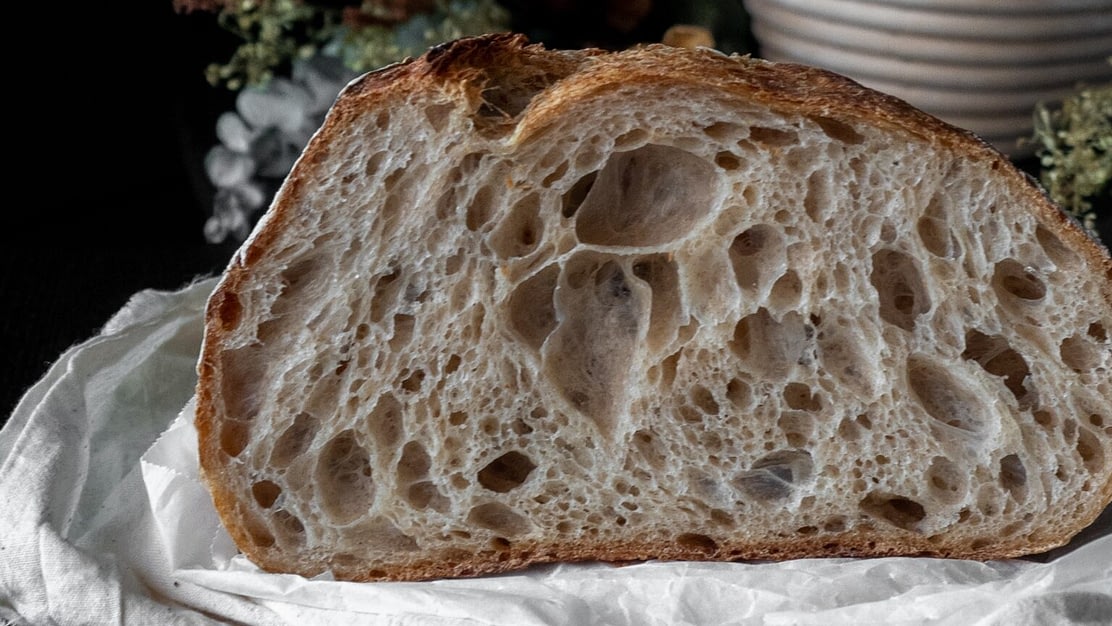
Wheat and cocoa have very different stories. Here's why chocolate is still 'cheap' - but for very different reasons to other staples.
Print / PDFIntroduction
When the first chocolate bar for eating was created by Fry’s in 1847, a loaf of bread cost about 10% of the average British worker’s daily income. At the same time, bread was so central to many working family’s diets that it could absorb around 25–50% of household income. Today an 800g sliced white loaf costs around £1.40–£1.45, or roughly 1% of median full-time UK daily earnings, down from nearer 2% in the 1930s.
Mass market chocolate’s affordability has followed a similar trajectory. Over the last hundred years, a typical mass market chocolate bar’s cost has fallen from over almost 1.5% of a UK worker’s daily earnings to half of this (0.6-7%).
Note: producing “like for like” statistics here is hard, but fortunately Mars in the UK, and Hershey in the US, have useful data series and there is broader coverage of bread prices; see the blog for how this has been calculated and normalised.
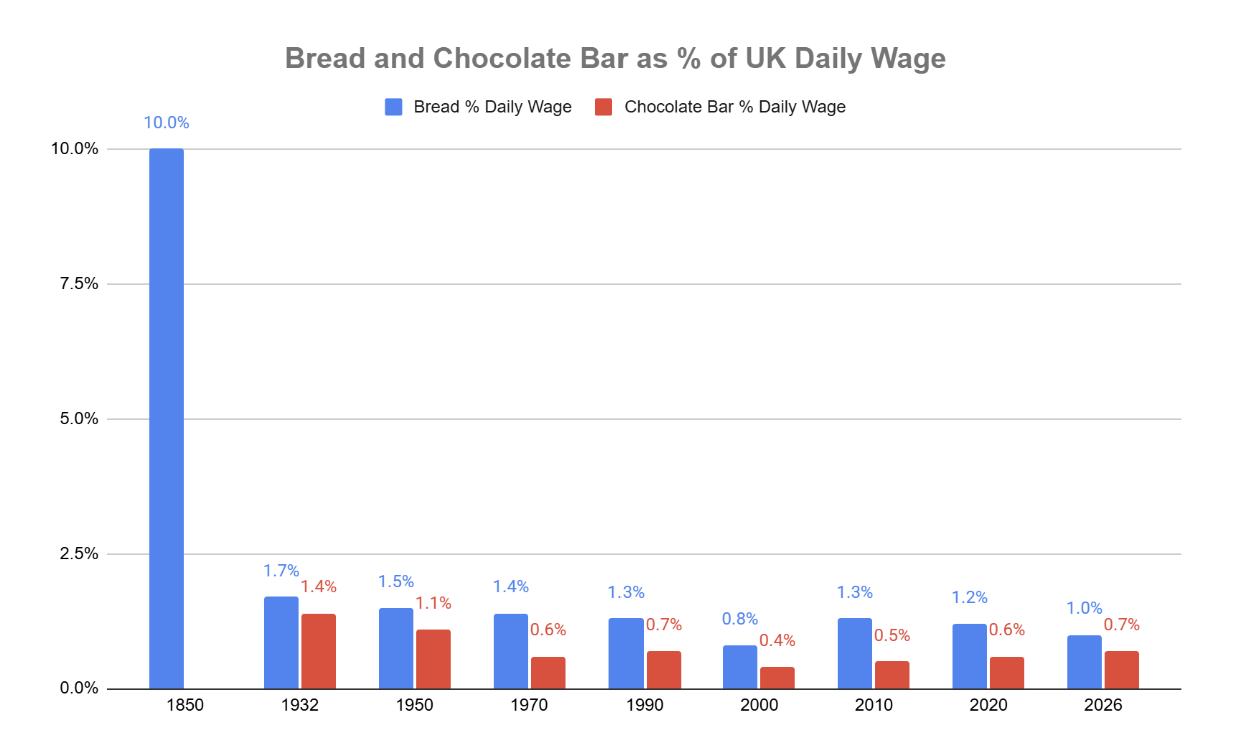
Source: ONS, BofE, Mayhew’s London Labour, Pashley’s Pauperism, and historic UK Board of Trade agricultural logs, Hersheys, Mars
(Note: for more, and more explanation of assumptions e.g. working day, shrinkflation, etc. of these stats please see below).
There are some common forces underpinning these dramatic increases in affordability. Rising real wages and overall income (including social support) are a major factor. In addition, dramatically more efficient retail and transportation economics (railways, containers, etc.) have benefitted both wheat/bread and cocoa/chocolate.
In addition, bread has benefited from a host of technological advances throughout its supply chain, in particular a combination of new farm machinery, the “green revolution” and some extraordinary new manufacturing processes.
- Mechanisation of farming: in the 1830s, harvesting a single bushel of wheat took a British farmer around three to four hours of labour (a bushel is an old measure, equivalent to 27 kg or 40 modern loaves). By the late 1980s it took less than two minutes, and today a combine harvester can cut and thresh a bushel’s worth in under a couple of seconds.
- Norman Borlaug and the “Green Revolution” – higher yielding wheats, artificial fertilizers and post-WW2 pesticides have enabled wheat yields per acre to increase three- to fivefold in the last five decades.
- New bread making technologies – in particular the Chorleywood Bread Process (1961) – have cut the time from flour to loaf from around 14–20 hours to about three, and laid the groundwork for cheaper, lower-protein home-grown wheat buttressed with more sugar, salt and other flavourings and additives.
This is not to argue in favour of excessive use of pesticides and fertilisers. Similarly, the ultra processing of bread is clearly a major health issue. And it’s not to gloss over the extraordinary challenges and pressures on wheat farmers worldwide. Many (most?) wheat farmers are squeezed between two concentrated oligopolies; a small number of commodity traders (known in the trade as ABCD – ADM, Bunge, Cargill and Louis Dreyfus) purchase, and control, over 70% of the world’s wheat (and also corn, palm oil and a host of other key crops). And on the other side are four agrochemical giants (Bayer, Corteva, Syngenta and BASF) who dominate the sale of most of the world’s commercial seed and pesticides, while a separate group of producers dominates fertiliser.
The factors that underpin cheap chocolate over the past century are very different. Cocoa has not (yet) enjoyed anything like wheat’s “green revolution”. Cocoa farming is still a highly manual process; there has been nothing like the invention of, for example, the combine harvester. And although chocolate manufacture via the invention of couverture has achieved some efficiencies, ironically the time taken to produce Fry’s 1847 stoneground bars is less than it takes to many of today’s mass market “conched” chocolate bars.
Sadly the affordability of mass produced chocolate rests far more on squeezing farmers, aggressive deforestation and a combination of “shrinkflation” and substitution of cocoa, and cocoa butter, for cheaper (and far less healthy) ingredients (for more on this, please see below).
To be cynical, mass market chocolate, especially in West Africa, is running out of forests and farmers. In 1960 forest covered nearly half of Côte d’Ivoire; by 2020 it was under a tenth – with cocoa farming being a major driver of deforestation. And the position of “virgin rainforest” is even worse – down from over 30% to below 2%. Hopefully when the EU Deforestation Regulation (EUDR) finally comes into effect, this will help stop further deforestation (see here for more details). At the same time, cocoa trees in West Africa are ageing and ravaged by various diseases. For example, swollen shoot virus can halve a tree’s yield within two years before eventually killing it. So Ghana has cut out more than 250 million trees since 1946 to try and contain this disease.
It’s not only the cocoa trees in West Africa that are ageing. So are the farmers who tend them. Few younger adult farmers are entering the industry. The average age of a Ghanaian cocoa farmer is estimated to be 55–64, in a country where the life expectancy is only 62-66 for men. The children of cocoa farmers, seeing poor harvests and daily income of less than a US$1 per day, are instead trying to find work in a city, or in illegal gold mining (“galamsey”).
At the other end of the age spectrum, child labour remains a major issue. Over 25 years ago, a documentary reported by the BBC exposed enslaved children, bought in Burkina Faso, Mali and Togo, working on Ivorian cocoa farms. Big Chocolate promised to fix this when facing legislation in the US congress (Harkin Engel). Unfortunately, this legislation was passed and today, two decades on, in 2018/19, 1.56 million children were still in child labour in the cocoa sectors of Côte d’Ivoire and Ghana. This year’s El Nino, further increases in fuel and fertiliser prices, renewed local wars and/or another price collapse could make this even worse. (And no, Tony’s is NOT the answer; for example in its own 2024/25 reports it notes that “59.4% of farmers at our 3 longest-term partner cooperatives are earning below the living income benchmark” – see here for more).
Chocolate processing has achieved some efficiencies in manufacturing (see below for more). But arguably the bigger savings have come from shrinkflation and ingredient substitution, that is to say finding alternatives like palm oil, vegetable fats, etc. to replace far more expensive cocoa butter. Indeed the word ‘chocolate’ has even had to be replaced by “chocolate flavourings” in many snacks – and all the major couverture suppliers are exploring “alternative” cocoa made from everything from grape seeds to pomegranate waste. So again, commodity chocolate is running out of road.
At the same time, there is a more optimistic, “glass half full” perspective. Cocoa has enormous room to improve. Better disease control, replanting, stronger planting material, training, more accurate weather forecasts and, above all, giving younger growers a reason to focus on quality could all raise yields and incomes. These don’t involve deforestation and should help cocoa farmers send their kids to school rather than working alongside them on cocoa farms. Plus we know from other sectors that consumers will pay more for flavour and quality. And in chocolate’s case, because on the farm it’s still so manual and not automated, there is arguably more room to move away from the “commoditization” brought about by mechanisation in many other crops. But this requires a rethink of chocolate as a commodity ingredient and a move from “scoffing” to “savouring”.
Craft chocolate is based on the twin, reinforcing ideas of flavour quality with transparency and traceability. It focuses on long-term relationships that pay farmers more and reward investment in their farms. Craft chocolate is also healthier – higher-cocoa, less processed chocolate keeps more of cacao’s valuable phytonutrients. And a few squares savoured and shared (your “second stomach” at work) can easily beat another pudding (see here and here) . So craft chocolate tastes better, is better for you, better for the farmers and better for the planet. And even though the price of a craft chocolate bar is £2-3 more than a supermarket or mass market brand, when you add in all the other “costs” (health, environment, etc.) it’s well worth it.
On the farm: from scythe to combine harvester versus child labour
In the late 17th and early 18th centuries, a farm worker in the UK using a scythe needed three to four hours to reap and hand-thresh a bushel of wheat (a standardised 60lb, or 27kg). That’s enough for about 40 modern loaves. Today a high-capacity combine harvester on a British farm can cut and thresh a bushel’s worth in one to two seconds.
Or to use some statistics from the United States. In the 1830s, it took a US farmer roughly 250–300 hours of labour to produce 100 bushels of wheat. By 1987 it took about three hours. That’s around 1.8 minutes per bushel, an 80- to 100-fold gain in labour productivity.
Cocoa farming hasn’t progressed in anything like the same way. Each pod’s ripeness has to be checked, and then “cut” individually with a machete or long knife. This requires some skill so as not to damage the flower cushions that will bear next season’s crop. And it can’t be mechanised (unlike not just wheat but also e.g., soy, maize, palm oil, tea or coffee). Then the pods need to be opened up, and again this is almost always done by hand, after which the wet beans and pulp are scooped out by hand. After removing the pulp and beans, the beans then undergo five to ten days of fermentation in heaps or boxes, with regular “turning” (again by hand.) Next the fermented beans need to be dried. In West Africa, much of commodity cocoa is dried on the nearest flat spaces – often a road (and potentially causing many of the lead issues in cocoa -see here). Craft Chocolate is dried more carefully on racks to avoid overdrying, dampness from rain, etc. Again it’s all very manual and largely unchanged for over 100 years as this picture from a leading farm in Brazil shows with cocoa still being transported by donkey.
Yields: Cocoa hasn’t (yet?) benefited from the “Green Revolution”
From 1944, the American agronomist Norman Borlaug, working in Mexico on rust resistance (a wheat disease), started his experiments that culminated in the breeding of short-strawed, disease-resistant “semi-dwarf” wheats. In addition to being far more disease resistant, dwarf wheat could also support heavy doses of fertiliser without collapsing. Borlaug put their potential at double or triple that of the old wheats. By 1963, 95% of Mexico’s wheat was dwarf wheat, and the harvest was six times larger than in 1944 (albeit off more land). In the US, wheat averaged 13.5 bushels an acre in 1920 and about 50 by 2020, roughly 3.7 times as much from the same land. Borlaug received the Nobel Peace Prize in 1970 and is known as the Godfather of the Green Revolution (for a more nuanced view, please see Charles Mann’s “The Wizard and the Prophet”).
Other crops have seen even more dramatic rises through a combination of higher yielding crops, fertilisers, pesticides, smarter watering, and a host of other scientific advances. For example, in the first decades of the 20th century, American corn yields hovered at about 26 bushels an acre. Then from the late 1930s, hybrid seed, fertiliser and mechanisation arrived together, and by 2024 yields had reached a record 179.3 bushels an acre, over seven times more. Tomatoes tell a similar story. In a Dutch greenhouse they now yield 600–700 tonnes a hectare, around 15 times the average American field yield of 1961–90.
Cocoa desperately needs a “green revolution”. In West Africa, where most of the world’s cocoa is grown, average yields have hovered around 500–600 kg per hectare for two decades – and are now declining thanks to ageing trees, weather issues and disease. There are signs of what should be possible; for example, in fertiliser trials in Côte d’Ivoire, yields rose from about 600 kg to around 1,000 kg per hectare by the third year, a gain of roughly two-thirds. Evidence from Ghana suggests mature trees can produce 50% more, or more again, with better nutrition, pruning and disease control (note: CoCoBod’s internal studdies suggest that pests and diseases regularly take 30–40% of the potential crop).
The nearest thing cocoa has to a “green revolution” variety is Ecuador’s CCN-51 (Colección Castro Naranjal 51). Agronomist Homero Castro Zurita developed it near Naranjal in Guayas in the early 1960s, when witches’ broom disease was devastating the region. First planted in 1965, it only really took off commercially in the mid-1980s. CCN-51 is promoted as higher yielding, early bearing and relative disease tolerances. Figures of 1,300–1,800 kg per hectare are often cited, and 1,500–2,300 kg under well-managed, irrigated conditions. In one Ecuadorian comparison, CCN-51 produced about 0.80 tonnes per hectare against 0.44 for Nacional – although part of this came from denser planting and higher yields from younger trees.
Note: this ignores the issue of the “flavour” of CCN51. CCN51 was NOT bred for flavour, and is often criticised for being metallic and acidic, and having little length (one Craft Chocolate maker compares it to car battery acid). However, Höganäs in Ecuador and Sweden is doing its best to dispel this reputation (see here).
In the factory: Chorleywood versus the conche
For most of the 19th and early 20th centuries, British bread was almost entirely baked by local, smallish bakers. In the 1850s, an overnight “sponge” would ferment for 12–16 hours, so going from flour to loaf took something like 14–20 hours.
During the Second World War and the years of rationing that followed, Britain suffered ongoing bread shortages. Much of the problem was the wheat: British-grown wheat had too little protein to make a good loaf by traditional methods, so bakers depended on costly imports from North America. To address this, the government and the baking industry in 1961 its scientists launched the Chorleywood Bread Process to enable the use of British wheat and reduce costs. Traditionally, dough is left to ferment for hours while yeast slowly builds the gluten that lets bread rise. Chorleywood used technology, specifically intense mechanical mixing, to achieve this result far faster. Flour, water, yeast, salt, a little fat and an oxidising agent (usually vitamin C) are blasted in a high-speed mixer for about three minutes, with pressure controlled to set the size of the air bubbles. After 45–50 minutes’ “proving” and under half an hour in the oven, flour can become a sliced, wrapped loaf in about three-and-a-half hours. Note: because less protein is lost than in a long fermentation, bakers could use cheaper, lower-protein British wheat instead of more expensive imports. More than 80% of UK bread is now made this way and underpins bread’s “affordability”. Note: this is definitely not an argument for ultra-processed, pappy sliced white bread, far better to spend a little more on a far healthier bread (e.g. Pump Street Sourdough or Maisy’s).
Chocolate was the pioneer for almost all the technologies underpinning modern junk foods (see here). One great example is “factory automation” – by the 1820s, steam power was being used for cocoa processing, pioneered at Deptford for the Royal Navy’s cocoa rations, arguably the first example of factory automation for food (biscuits were also made in the same space). In 1847 J. S. Fry & Sons made the first mass-produced eating bar, a quick-to-make paste of cocoa powder, sugar and cocoa butter pressed into moulds, again made in steam powered factories.
However the modern chocolate requires very different manufacturing processes to Fry’s first bars. In 1879 Rodolphe Lindt’s conche turned Fry’s gritty, rustic product into smooth, melting chocolate. Lindt’s traditional conching could take one to four days, with 72 hours as a “standard”. Modern factories have made some efficiencies to reduce this 72 hours: milk chocolate is typically conched for 6–16 hours, and dark chocolate sometimes for over 20. Continuous systems can move more than a tonne of chocolate an hour, with a conching time of just 15–20 minutes. Automated dosing, precision refining, tempering machines and cooling tunnels have offered further efficiencies.
But that is a four- to twelve-fold cut in conching time, not a Chorleywood-style reinvention of the whole process. The bigger economies of scale have come from chocolate makers increasingly using couverture. Rather than roasting, grinding and conching their own beans, more and more chocolate makers buy ready-made couvertures in bulk from a few giant processors who use the above industrial approaches. And just as a small number of companies dominate the sourcing of commodity cocoa (in particular Olam, Callebault and Cargill) a small number of companies dominate couverture manufacture.
So who pays? … first farmers
According to Fairtrade, when cocoa prices were high in the 1970s, cocoa made up as much as 50% of the value of a chocolate bar. By the 1980s that had fallen to 16%, and today farmers receive around 6% for their commodity cocoa. Other analyses put it slightly higher, at under 8% of the retail price – but whether its % or 8%, most of the upside is going to traders, manufacturers and retailers.
Commodity prices for cocoa since the 1970s have broadly been declining, or at best flat, in nominal terms with some massive recent spikes, and in real terms, been falling (other than during these spiked. This real price reduction has almost entirely been borne by the farmers. Across six surveys of cocoa households in Côte d’Ivoire and Ghana, 30–58% earned below the World Bank’s extreme poverty line (US$2.15 dollars a day), and 73–90% fell short of a living income. One Ghanaian study found 91% of cocoa farmers earning below the living-income benchmark. Perhaps most sobering, the same modelling suggests that even doubling the cocoa price would leave 53–65% of households below a living income. Small farms, bad harvests, disease and declining yields compound the ongoing squeeze on commodity cocoa prices.
Secondly … deforestation
For the last fifty years, the easiest way for farmers in West Africa to make more money is to grow more cocoa by “opening up” more land (aka deforestation). This also reduces the need for expensive fertilisers – slash and burn deforestation, thanks to burning the trees, gives fertile soil for a few years. Côte d’Ivoire’s forest cover fell from around 12 million hectares in 1960 to under 3 million by 2020, with cocoa the main driver. That’s from nearly half the country to under a tenth. Between 2000 and 2020, cocoa caused 37.4% of forest loss in the country’s protected areas. In effect, the rainforest has quietly subsidised cheap chocolate. And this deforestation is also resulting in desertification, compounding the problems of global warming (see here for why “upgrading” to craft chocolate is one of the most environmentally friendly food choices you can make).
Thirdly- consumers; shrinkflation
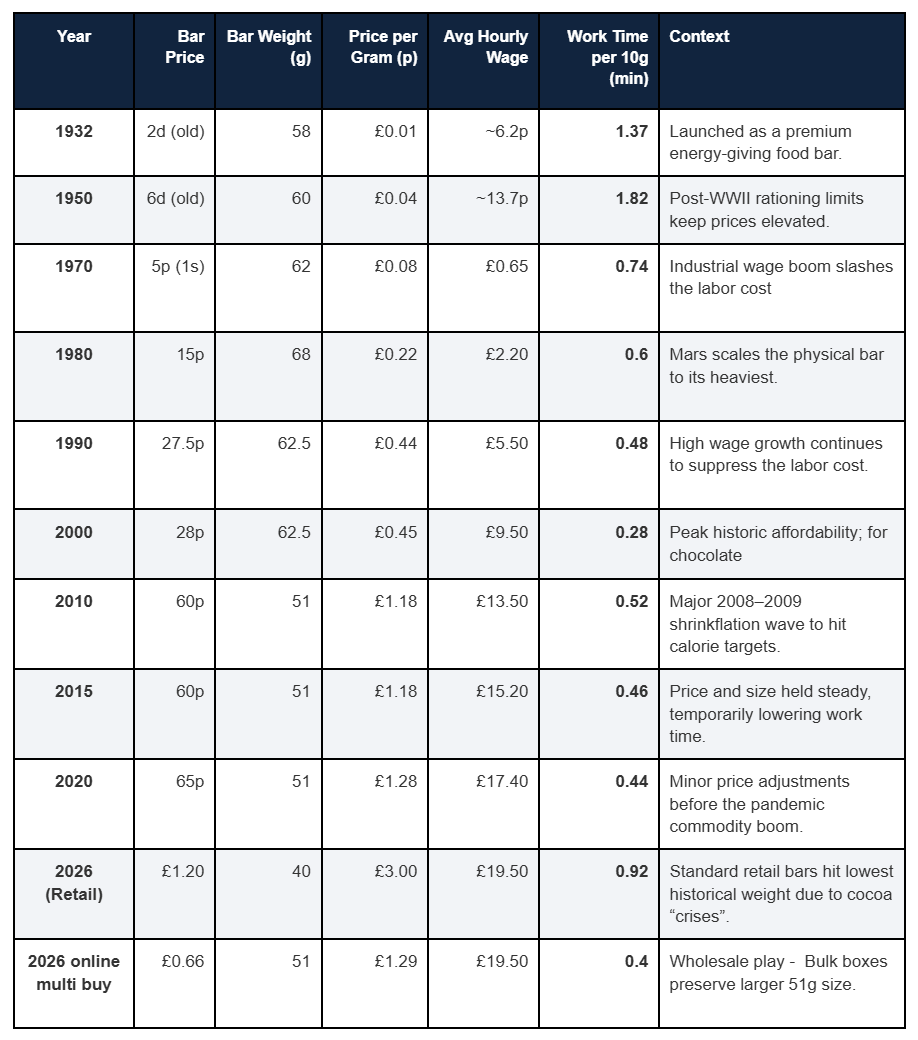
Shrinkflation has also enabled the price of mass market chocolate bars to hold princess of sold bars to under £1. Ironically regulation has helped Big Chocolate with shrinkflation. In 2016 Public Health England asked the food industry to cut calories by 20% by 202, through reformulation, smaller portions and nudging shoppers towards lower-calorie products. The Mars bar went from 62.5g in 2000 to 51g in 2010, and down to around 40g for some retail bars today.
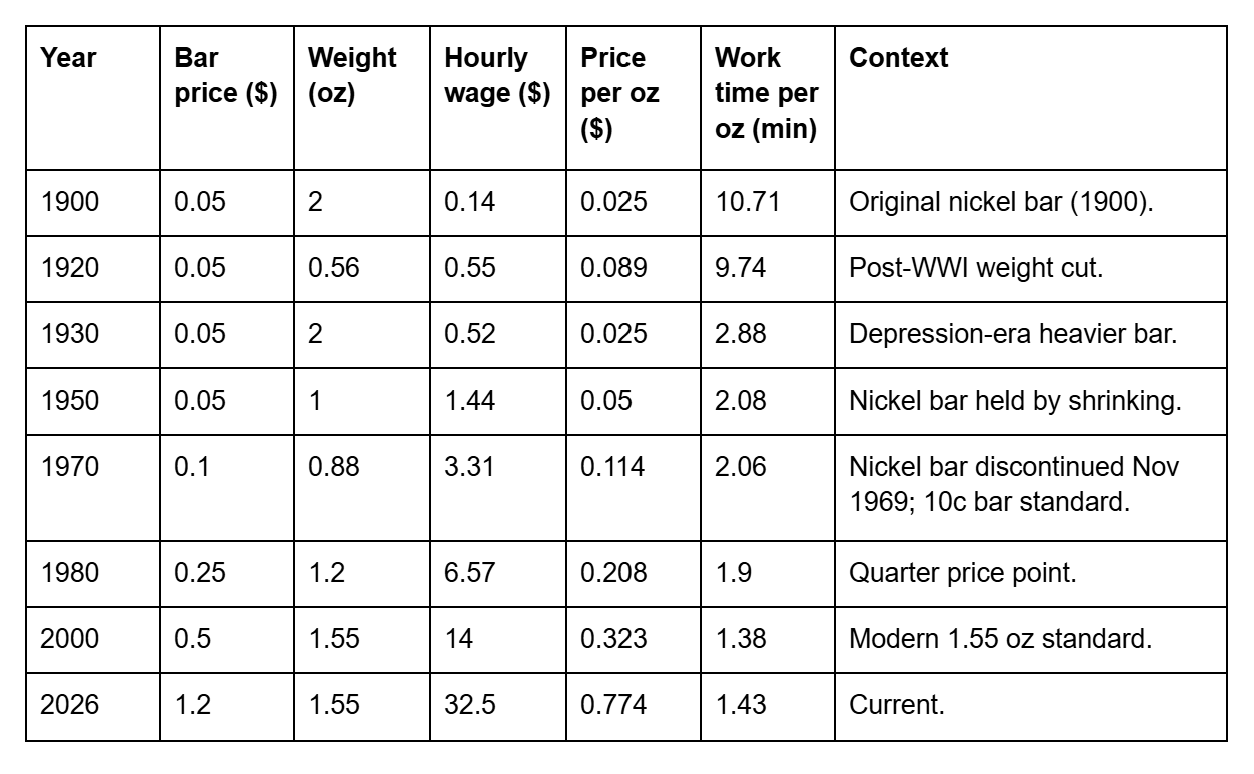
Chocolate Bar Historical Affordability Index – Mars/ Hershey (UK/US)
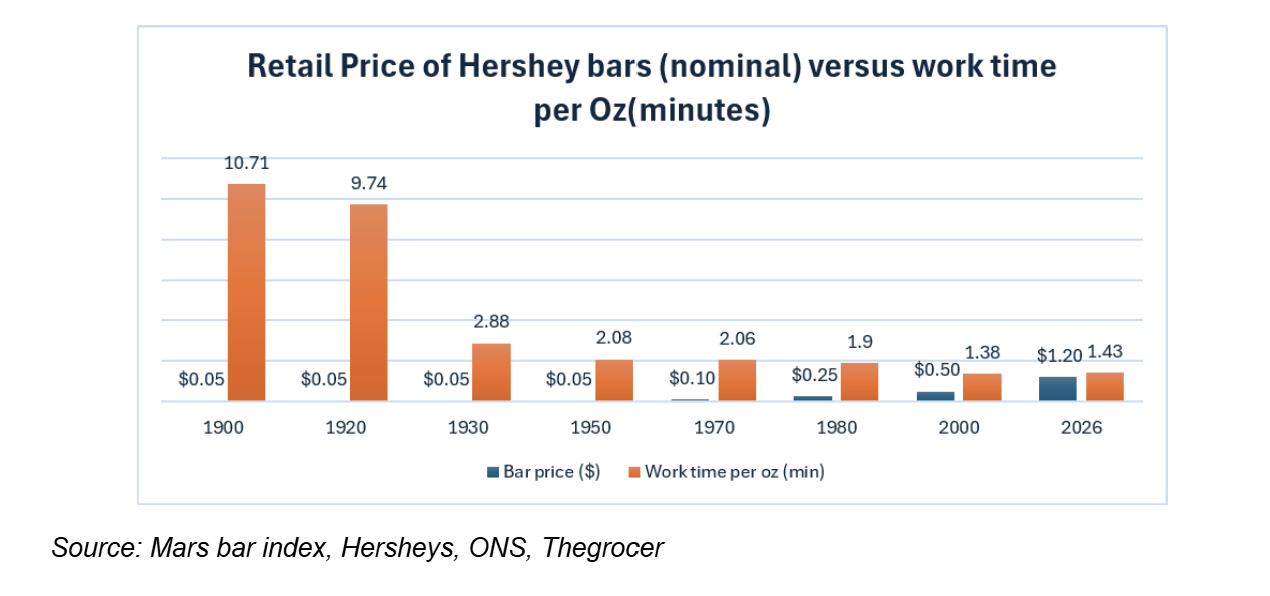
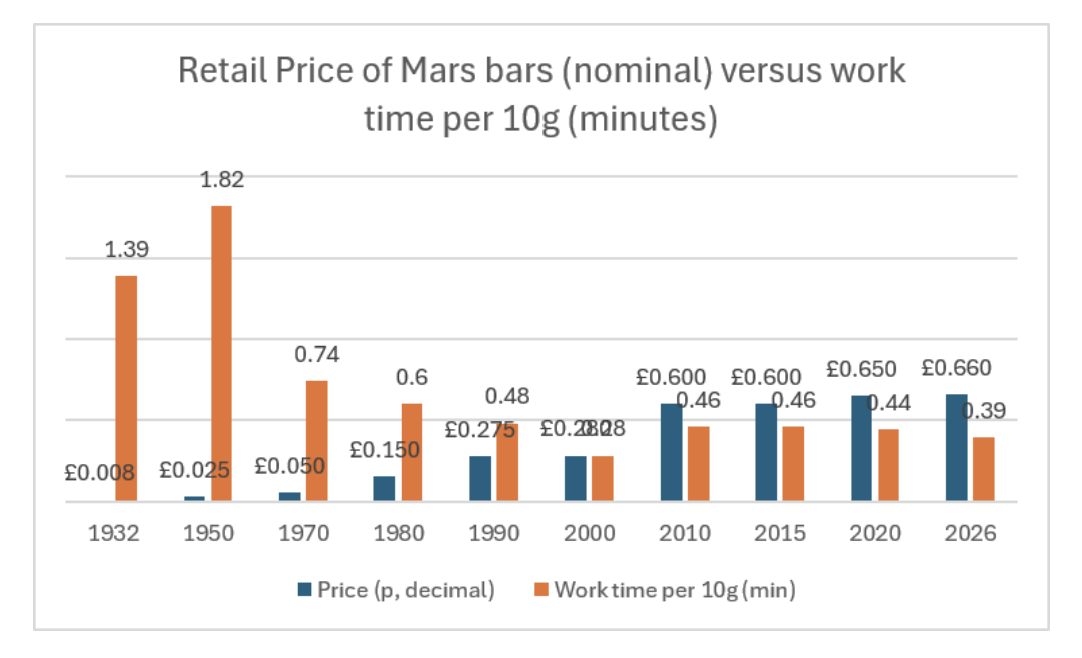
Source: Mars bar index, Hersheys, ONS, Thegrocer
Fourthly – consumers, reformulation versus adulteration
Throughout all of its history, cocoa and chocolate has suffered from adulteration and “extension” and adulteration. Some of this was to reduce cocoa’s bitterness, diminish graniness and improve solubility for drinking chocolate. But much of this was to reduce costs and hide other faults.
As chocolate moved from being drunk to be eaten, reformulation and the search for cheaper, alternative ingredients continued. The shift to chocolate bars and eating, rather than drinking chocolate, shifted cocoa butter from being a waste product to an increasingly expensive and critical ingredient (Van Houten’s Dutch press improved the solubility of drinking chocolate by “pressing” out much of the cocoa butter, and then 20 years later Joseph Fry realised that adding this cocoa butter into the “cakes” for drinking chocolate, with some sugar, could create a stable solid bar that made a great treat – see here for more). Rapidly cocoa butter demand increased, so what had been a waste product from van Houten’s press became the most expensive ingredient in most chocolate bars. Consequently, makers tried all sorts of “alternatives” including almond oils, olive oils and even egg yolks.
Ironically what really helped makers reduce ingredient costs whilst also “turbo charging” chocolate’s growth was Daniel Peter and Nestle’s invention of milk chocolate. Daniel Peters’ invention of milk chocolate, combined with Lindt’s conche, created what was arguably the world’s first “bliss point” and hyperpalatable food (see here for more on this). And it needed less cocoa butter as milk was the primary fat, and could be further bulked out with sugar. For example, Cadbury’s “crumb” process, invented in 1911, and the bedrock of Dairy Milk, is made by “cooking” milk with sugar and cocoa liquor before being dried into a solid crumb and is typically over 50% sugar with just 10-15% cocoa liquor / solids.
Makers also soon realised that other fats too could be incorporated into bars – creating one of the most notoriously misunderstood arguments about the definitions of chocolate, and whether British (and Portuguese) milk chocolate could really be called chocolate. By 1973, when Britain joined the European Community, British makers were, under UK law, allowed to replace up to 5% of their chocolate with vegetable fats such as shea, illipe, sal and palm oil. At the time, these cost about a tenth as much as cocoa butter. Other European countries’ definitions of chocolate insisted that chocolate could only be made with cocoa butter. A standoff ensued as Cadbury refused to change its recipe, and for 27 years its chocolate could not be sold in many European countries. The 2000 Chocolate Directive finally allowed the same 5% across the EU – much to the distress of the French.
Fifthly – fully reformulation?
The next step in reformulation is already occurring – the creation of “synthetic” chocolates, and use of other cocoa based waste products (e.g. the shell) to make “chocolate” like products. Germany’s Planet A Foods makes ChoViva from fermented, roasted sunflower seeds, plant fats and sugar, and it now appears in around 120 products in ten countries. In 2026, Nestlé and Mars both launched their first ChoViva products in Germany. Cargill and Voyage Foods launched NextCoa, made from grape seeds, in North America. And in the UK, Fermtech is using a solid state koji fermentation process to turn cocoa shells into a “naturally tasting” cocoa replacement.
A more optimistic approach
At the same time, there is a more optimistic, “glass half full” perspective. Cocoa has enormous room to improve. Better disease control, replanting, stronger planting material, training, more accurate weather forecasts and, above all, giving younger growers a reason to focus on quality could all raise yields and incomes. These don’t involve deforestation and should help cocoa farmers send their kids to school rather than working alongside them on cocoa farms. Plus we know from other sectors that consumers will pay more for flavour and quality. And in chocolate’s case, because on the farm it’s still so manual and not automated, there is arguably more room to move away from the “commoditization” brought about by mechanisation in many other crops. But this requires a rethink of chocolate as a commodity ingredient and move from “scoffing” to “savouring”.
Craft chocolate is based on the twin, reinforcing ideas of flavour quality with transparency and traceability. It focuses on long-term relationships that pay farmers more and reward investment in their farms. Craft chocolate is also healthier – higher-cocoa, less processed chocolate keeps more of cacao’s valuable phytonutrients. And a few squares savoured and shared (your “second stomach” at work) can easily beat another pudding (see here and here).
So Craft Chocolate tastes better, is better for you, better for the farmers and better for the planet. And even though the price of a craft chocolate bar is £2-3 more than a supermarket or mass market brand, when you add in all the other “costs” (healthcare, environment, etc.) it’s well worth it.
Sources and notes:
Bristol Museums. Fry’s chocolate.
Smithsonian National Museum of American History. J. S. Fry & Sons Cocoa Tin.
UK Parliament. Factories Bill, Hansard, 3 March 1847.
Office for National Statistics. Average price: Bread, white loaf, sliced, 800g—series CZOH.
Office for National Statistics. Employee earnings in the UK: 2025.
Illinois Agriculture in the Classroom. Timeline of Farm Machinery and Technology.
Borlaug, N. E. The Green Revolution, Peace, and Humanity. Nobel Lecture, 1970.
USDA National Agricultural Statistics Service. Crop Production Historical Track Records, April 2025.
Tucker, G. Chorleywood Bread Process—how it’s changed industry. Campden BRI, 2019.
Federation of Bakers. Production methods.
UN Trade and Development. Fairer and more competitive food markets are key to ending global hunger, 2024.
International Cocoa Organization. Harvesting and post-harvest processing.
International Cocoa Organization. Processing Cocoa.
CocoaRadar. The Crisis in Cocoa for Industry and Farmers, 2026.
ETH Zurich. Cocoa Swollen Shoot Virus Disease.
Disease Pandemics and Major Epidemics Arising From New Encounters between Indigenous Viruses and Introduced Crops, 2020.
Ghana Cocoa Board. President Akufo-Addo launches National Cocoa Rehabilitation Programme, 2020.
Cocoa production in West Africa, a review and analysis of recent developments, 2015.
Theobroma cacao L. cultivar CCN 51: a comprehensive review on origin, genetics, sensory properties, production dynamics, and physiological aspects, 2022.
Oxford Institute of Population Ageing. Cocoa and Continuity: Ageing in the Ghanaian Cocoa Sector, 2024.
Ghana News Agency. Cocoa industry will collapse if urgent interventions are not made, 14 July 2026.
UNEP / GRID-Geneva. Forest / Côte d’Ivoire.
Kalischek, N. et al. Cocoa plantations are associated with deforestation in Côte d’Ivoire and Ghana. Nature Food 4, 384–393, 2023.
Council of the European Union. EU deforestation-free products regulation.
NORC at the University of Chicago. Assessing Child Labor in West Africa Cocoa Farming, 2020.
US Department of Labor. Second Annual Report, Appendix 1: Harkin–Engel Protocol.
Tony’s Open Chain. Impact Report 2024/25, p. 51: methodology; p. 52: living-income results.
van Vliet, J. A., Slingerland, M. A., Waarts, Y. R. and Giller, K. E. A Living Income for Cocoa Producers in Côte d’Ivoire and Ghana? Frontiers in Sustainable Food Systems, 2021.
Fairtrade Foundation. Fairtrade and Cocoa: Commodity Briefing, 2016.
Lindt & Sprüngli. History.
Bühler Group. Conching Systems.
Hershey Community Archives. Hershey’s Milk Chocolate: Bar Wrappers Over the Years.
Public Health England. Sugar reduction: achieving the 20%, 2017.
Better Retailing. Mars Wrigley’s latest shrinkflation slashes Mars bar sizes by nearly a quarter without lowering prices, April 2026.
European Parliament and Council. Directive 2000/36/EC relating to cocoa and chocolate products intended for human consumption.
UK Government. The Cocoa and Chocolate Products (England) Regulations 2003.
Cargill. Cargill and Voyage Foods to bring NextCoa cocoa-free confectionery alternatives to North America, 2026.
Planet A Foods. Nestlé partnership, March 2026.
Fermtech. About.
Rankin, C. W. et al. Lead contamination in cocoa and cocoa products: isotopic evidence of global contamination. Environmental Health Perspectives, 2005.
From Cocoa to Chocolate: Effect of Processing on Flavanols and Methylxanthines and Their Mechanisms of Action. International Journal of Molecular Sciences, 2022.
EFSA NDA Panel. Scientific Opinion on cocoa flavanols and maintenance of normal endothelium-dependent vasodilation, 2012.
Hall, K. D. et al. Ultra-Processed Diets Cause Excess Calorie Intake and Weight Gain: An Inpatient Randomized Controlled Trial of Ad Libitum Food Intake. Cell Metabolism, 2019.
Cocoa Runners. CCN-51: Are we barking up the wrong (fruit) tree?.