The Magic of Fermentation

Many of our most pleasurable foods, and drinks, are the result of the magic of fermentation – wine, coffee, bread, cheese, beer and – of course – chocolate.
And I thought I had a reasonable handle on how fermentation worked, at least for cocoa and chocolate.
Quick overview, and come to a tasting for more: once a cocoa pod is opened, the pulp and beans are placed into a box or just laid in a heap. The sugars in the pulp first kick off a largely low-oxygen (i.e. anaerobic), yeast-led fermentation where the sugars in the pulp are converted principally into ethanol and carbon dioxide. Then, after a few days, as the pulp breaks down and drains, and as the mass is turned, oxygen enters (ie aerobic). Acetic-acid bacteria then oxidise much of that ethanol to acetic acid, generating LOTS of heat. The combined heat, ethanol and acetic acid kill the bean’s embryo, preventing germination. Note: this is one of the many reasons that ‘raw’ chocolate is nonsense – see here).
At the same time this process creates and releases flavour precursors — including amino acids, peptides and reducing sugars — that react during roasting to produce many of chocolate’s caramel, nutty and roasted notes, while fermentation itself can contribute fruity and floral character.
However at a recent Chocolate Taste and Flavour Masterclass at (the amazing) Naughty Dog coffee roastery, Gwilym (co-owner with Petra) asked a simple question that initially stumped me. Gwilym pointed out that fermentation is technically defined as being anaerobic (indeed as far back as the 19th century Pasteur described fermentation as “La vie sans l’air — life without air”). So why in chocolate do we so often describe both an anaerobic and an aerobic phase as “fermentation”?
After a long train ride to the British Society of Flavourists’ Beer Conference in Munich (very useful timing given beer’s key role in fermentation science) my “quick and simple” answer to Gwilym’s question is that the magic of cocoa “fermentation” was practically worked out millennia before modern science worked out the biochemistry of fermentation (including the role of oxygen). So chocolate people still use “fermentation” as a practical name for the whole post-harvest transformation. But in terms of strict biochemistry, fermentation should be defined as the first few days when the pulp’s sugars are turned into ethanol – and this happens with cocoa pulp smothering out any oxygen. The next, oxygen-dependent stage is not fermentation in that narrow biochemical sense: acetic-acid bacteria oxidise ethanol into acetic acid. But it is integral to what cocoa producers call fermentation. And this next step is enabled by the fermentation; without it, there wouldn’t be the acids and heat that are critical to transform the seed and trigger all the groundwork for chocolate’s complex flavours.
These two steps also help explain lots of experiments in coffee, and now also chocolate, to develop new (aka “funky”) flavours. Following coffee’s lead, craft chocolate makers such as Rogério at Mestiço Brazil, are exploring oxygen-restricted approaches after the initial yeast-led stage – and if you would like to taste and discuss the fruits / bars from these experiments, join our Farm to Bar tasting at the London Chocolate Fair on Saturday, or Tim Spector’s newly announced session on Friday evening. In addition, at the fair, Pump Street Chocolate will have bars which are the result of pioneering work by Chris Brennan with sourdough yeasts and cocoa, and we’ll have bars from Warren at Fu Wan that use wine and beer yeasts (as opposed to natural yeasts) to develop amazingly different flavours (if you can’t wait, we also have some of these for regular sale). Plus we’ll explore with Maxwell Dashwood on Sunday how coffee growers are using different approaches to fermentation to impact flavour (See). Or if wine is more to your palate, come to our tasting with Peter McCombie where we’ll talk about new fermentation techniques with specific yeasts to help counteract rising alcohol levels in wine.
As part of my quick refresher on the history of fermentation, I was also amazed at how yeasts, and fermentation overall, is being used in multiple different ways – for example, to address all sorts of environmental challenges, to produce produce low alcohol beers (and wines) and – more cautiously – human health. Below I’ve listed some useful articles, books and podcasts on these topics. Plus I’ve tried to answer Gwilym’s original question with a deep dive into cocoa fermentation, along with a whistle-stop history of how scientists such as van Leeuwenhoek, Lavoisier, Pasteur and Buchner worked out the science behind fermentation in the 18th, 19th and 20th centuries.
For a taster as to how bio-chemists, medical doctors and practitioners in wine, cocoa, coffee, etc. continue to push the envelope of what fermentation can do above and beyond flavour – see below.
- In the wine industry, selected yeast strains are being used to divert some grape sugars away from turning into ethanol and towards other metabolites (such as glycerol and organic acids). The aim here is to counteract the higher alcohol levels in many wines resulting (in part) from global warming (higher temperatures means more sugar in the grapes, which means higher alcohol levels in the fermented wine).
- Beer has had a head start here; from the 1970s, German brewers developed low- and no-alcohol beers through controlled fermentation, modified mashing and the use of selected maltose-negative yeasts. These yeasts cannot ferment maltose, the principal fermentable sugar in beer wort, so they can produce beer-like flavour with far less alcohol (with wine it’s far harder as grapes’ “just” have sugar whereas beer contains a more complex range of carbohydrates). And since then many more yeasts have been developed to create lower alcohol beers – and low alcohol beer now account for 1 in 40 sales of beer in the US (ie 2.5% of US beer sales by volume), more than double their share in 2021 – in an overall beer market declining by 5%.
- Armed with insights from fermentation science, major pharmaceutical companies (most notably Pfizer) “industrialised” it at scale. Pfizer built fermentation expertise in citric acid from 1919, then drew on that experience to help pioneer deep-tank fermentation to scale up production of penicillin during, and after, the Second World War (for more examples of fermentation’s importance in drug development, please see below).
- Chocolate companies are exploring anaerobic techniques to maintain polyphenol levels while still reducing astringency during fermentation. For example; Mars has filed a patent application concerning airtight, starter-culture-assisted cocoa fermentation, claiming flavour advantages. And theoretically Rogerio’s fermentation at Mestico may hold polyphenol levels constant without running the risk of greater astringency.
- “Koji”-style fermentation is also being used to turn waste products (e.g., cocoa shells) into additives that reduce the need for cocoa in various by-products by start-ups like Fermtech.
- Tim Spector and the ZOE team have helped bring public attention to the relationships among diet, the gut microbiome and metabolic health – so we are excited that he’ll be talking about his upcoming book on the Friday of the London Craft Chocolate Fair, and I’m looking forward to hearing more about how “zombie” microbes, long presumed to be inactive, are also key for our gut health.
Craft chocolate is all about transparency and flavour. So it’s great to see more transparency, openness and discussion on fermentation. And it’s also great to see how farmers and makers are using fermentation as a technique to create length, depth and complexity in flavour. All sorts of synthetic fruity flavours can be injected into snacks and confectionery with various additives; but these invariably fail to achieve much length or complexity.
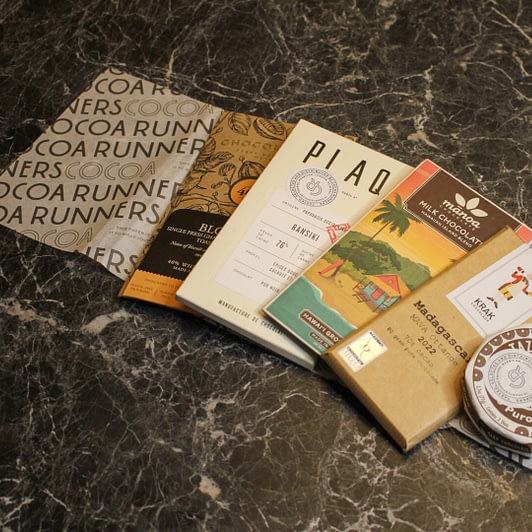
By contrast, a well-managed fermentation can produce something far more memorable; flavours that evolve, broaden and take you on a “flavour wave”. Fermentation embeds these flavours in the chocolate bar’s own matrix rather than the way a chemical additive creates a single note. Try the bars of fermentation “twists”, for example, Friis Holm, Fu Wan, Mestiço and Pump Street to see not only how much flavour they can contain, but how those flavours compare and contrast to one another.
Thanks again to Gwilym for asking so thought provoking a question – and to all our makers and farmers for their bars, and to our speakers at the upcoming fair who will explore the fruits (and bars) of their fermentation in person.
Etymology
Etymologists trace fermentation to the Latin fermentum — leaven, or an agent of transformation — probably a contraction of fervimentum, from fervere, “to boil.” The logic is that this described the apparent “boiling” and “bubbling up” of wine must, beer wort, cocoa pulp, kefir, yoghurt, sourdough and the rest, as carbon dioxide escaped.
It entered English in the late 14th century (c. 1350–1400), via Old French fermentation, from that same Latin root. German took the Latin word too — but German also has its own, older word for the same process, Gärung, which has nothing to do with Latin at all: it comes from Old High German jesan, the same root that gives English “yeast”. (At the same time, the Germans “win” the world’s oldest continuously operating brewery at Weihenstephan in Freising, Munich, dating back to 1040). And all these terms were being used hundreds of years before biochemistry of fermentation was established.
History
At least as early as 7000 BCE in China, at Jiahu, and 6000 BCE in Georgia, humans had worked out that a sweet liquid, after a process involving lots of bubbling, could create alcohol. In Georgia, this meant grape must; at Jiahu, the evidence is for a mixed fermented drink made from rice, honey and fruit, possibly including grapes.
Ditto beer – although beer was in some ways a more complex technological hurdle. Making beer requires two distinct stages: first, malting and mashing, which use cereal enzymes to convert starch into fermentable sugars; and then allowing yeast to convert those sugars into alcohol and carbon dioxide. Despite this, beer can be dated to 3,400–3,500 BCE in both Mesopotamia and China, and possibly to 11,000 BCE at Raqefet Cave in Israel.
Cocoa fermentation can “only” be dated back to 3,500 BCE, at Santa Ana–La Florida in modern Ecuador. There is also intriguing evidence from pottery shards and vessel shapes in Honduras that cacao may initially have been fermented to make a light alcoholic drink – perhaps a kind of chicha. If so, the pleasures of fermenting the seeds themselves may have been discovered as a consequence: first as a by-product of a pulp-based drink, and eventually as the basis for cacao beverages and, much later, chocolate (for more see here).
History: from observation to chemistry
The invention of microscopes (and telescopes) in the 17th century gave scientists the tools to analyse fermentation in far more detail. Antonie van Leeuwenhoek in 1680 credited as the first to see, then draw, small globular particles that are now recognised as yeast cells, when he examined fermenting material through his microscope. However he wasn’t able to establish if these yeast cells were the cause, or result of, fermentation.
Antoine Lavoisier built on this work, measuring the inputs and outputs of alcoholic fermentation to show how sugar was transformed principally into alcohol and carbon dioxide, effectively making “fermentation” a quantifiable chemical reaction. But again, he was unable to demonstrate cause and effect.
In 1837, Charles Cagniard de la Tour, Theodor Schwann and Friedrich Kützing independently, and in different places, suggested that yeast was a living organism. They observed that yeast reproduced by “budding” and connected this growth to alcoholic fermentation. However, the famous chemist Justus von Liebig challenged this view, proposing instead that decomposing matter triggered the chemical breakdown of sugar – and kicking off a fierce dispute that still rumbles on.
Beer and the development of fermentation science
During the 19th century, Europe’s passion, and thirst, for beer drove a wave of innovation and fermentation – turning it from family tradition to more of a controlled, industrialisable, process. An early part of this was the development in 1843 of calibrated saccharometer, with tables connecting the density of wort, its attenuation and the alcohol eventually produced, by the Bohemian chemist Carl Joseph Napoleon Balling.
However the key scientific breakthrough in understanding fermentation was by Pasteur, starting with lactic fermentation in 1857 and turning to alcoholic fermentation soon after. Essentially Pasteur showed that fermentation was living microorganisms at work, not decaying. Effectively he showed that it was yeast that made alcohol – and other microbes made lactic or acetic acid that could, for example, spoil the beer. And in his Études sur la bière he argued for cleaner equipment, careful handling, less airborne contamination, controlled heat, etc. Brewing moved from family lore to science and the microscopic life inside it.
However even after Pasteur, there were lots of variations in brewer’s yeast. There wasn’t a single, standardised strain. Some gave reliable beer; others caused off-flavours, haze or spoilage. Again, it was a brewing company that solved this. In 1883, at the Carlsberg Laboratory, Emil Christian Hansen isolated and propagated a pure brewing-yeast culture. The strain was then known as Carlsberg bottom yeast no. 1 and later associated with the name Saccharomyces carlsbergensis; lager yeast is now generally classified as Saccharomyces pastorianus. Carlsberg then shared its pure-culture method and yeast with other brewers, helping to make consistent lager production possible far beyond Copenhagen.”
What Pasteur showed at a higher level is that “fermentation” wasn’t a single process, but a family of them, each with its own organism and outcome. Pasteur called it “life without air” — hence Gwilym’s point that fermentation is defined as anaerobic. But it’s worth pointing out that while some aspects are anaerobic, yeast needs oxygen to grow, just not to turn sugar into alcohol.
Bread, kefir and other everyday ferments
Outside of beer and wine, fermentation was also key for many other foods.
For example, bread was clearly an example of pre-historic fermentation. Leavened dough doesn’t preserve like a fermented liquid, so the archaeological record is thinner than beer’s or wine’s. The clearest physical evidence comes from Old Kingdom Egypt. In 2019, food archaeologist Seamus Blackley extracted dormant yeast from ceramic vessels roughly 4,500 years old and used it to bake bread – confirmation that Egyptians were relying on wild yeast fermentation by around 2500 BCE. Some researchers argue bread and beer share a common ancestor: same grain, water and wild yeast, diverging only in how much water was used (see the wonderful book “Drunk” by Edward Slingerland).
Ditto dairy fermentation. Dairy fermentation is also very old, and even less precisely dated. For example, the super popular fermented drink Kefir is now traced to the North Caucasus, passed down through kefir grains that local tradition credited to the Prophet Muhammad (note: there is no hard data, or dates, to this origin story). However there is now some archaeological evidence; in 2024 DNA sequencing of a 3,600-year-old dairy find buried with mummies at the Xiaohe cemetery in China’s Tarim Basin identified it as kefir cheese, made with the same bacterial species used today. By around 1600 BCE, kefir fermentation had already spread deep into Bronze Age Eurasia, likely carried along the same trade routes as the region’s textiles.
Vegetables and soy went through a parallel history of their own – kimchi, sauerkraut, miso, soy sauce, natto – each domesticating a different mould, yeast or bacterium for a different raw material (and see Tim’s various books for more on these).
The 20th century – from microorganisms to enzymes
During the 20th century, scientists built upon Pasteur’s discovery that yeast causes fermentation to show how yeast’s chemistry and biochemistry work.
In 1897, Eduard Buchner found that crushed yeast cells, with no living cells left, could still turn sugar into alcohol and carbon dioxide. He called the active material zymase, later understood to be a system of enzymes. Living yeast, Buchner showed, made the machinery – but the machinery could carry on working outside the cell.
In 1906, Arthur Harden and William Young showed that this enzyme system also needed inorganic phosphate and coenzymes. That insight enabled scientists to break down fermentation into its individual steps. Over the following decades, Gustav Embden, Otto Meyerhof and Jakub Parnas mapped the full pathway – glycolysis – in which glucose becomes pyruvate, then acetaldehyde and ethanol, regenerating the NAD⁺ needed to keep it running.
The impact reached beyond the lab – again, led by beer. Søren Sørensen introduced the pH scale at the Carlsberg Laboratory in 1909. Øjvind Winge’s work on yeast genetics turned it into a model organism. In 1996, Saccharomyces cerevisiae became the first eukaryote to have its genome fully sequenced — a brewer’s yeast, underpinning modern genetics.
Industrialisation of fermentation – and some potential future developments
Fermentation was “industrialised” during the late 20th century. Arguably the most influential example is penicillin. Wartime demand rapidly outstripped what Fleming’s mould could produce in flasks, so Pfizer switched to deep-tank, submerged fermentation, opening the world’s first large-scale penicillin factory in Brooklyn in March 1944. Most of the penicillin treating D-Day casualties came out of those tanks.
Citric acid followed a similar path. In 1917, the chemist James Currie found that Aspergillus niger mould could produce citric acid directly from sugar. Again, Pfizer began commercial production in 1919, ending the food industry’s dependence on imported Italian lemons.
MSG in Japan is another example. Kikunae Ikeda isolated glutamate from kombu dashi in 1908 and patented the process behind what became Ajinomoto’s MSG. Initially the process they used to make MSG was chemical, extracting glutamate by acid hydrolysis of wheat gluten, not fermentation. But in the 1950s a more efficient method, using microbial fermentation, was developed when Kyowa Hakko scientists identified bacteria, Corynebacterium glutamicum, that excrete it directly. Industrial-scale glutamate fermentation followed through the 1960s.
In parallel, following the successful scaling of penicillin by Pfizer, pharmaceutical companies have continued to leverage insights from fermentation science. Merck scaled up streptomycin in the 1940s giving the world its first drug effective against tuberculosis. Upjohn found a mould that converted progesterone into cortisone in 1952, collapsing the cost of steroid drugs. Sandoz’s ciclosporin, a drug that made organ transplants survivable, came from a soil fungus discovered in the early 1970s. In 1987 Merck fermented the first statin, Mevacor, from another mould. Five years earlier (in 1982), Eli Lilly had gone further, using fermentation to design a genetically engineered E. coli to ferment human insulin.
Today fermentation is being applied by biochemists and food scientists not just to improve familiar foods and drinks, but also to rethink what counts as an ingredient. Waste streams and by-products – cocoa shells, grape marc, brewers’ spent grain, fruit pomace – can become substrates for microbes, which break down otherwise inedible or low-value material and turn it into flavourings, acids, proteins, functional ingredients or new foods. Cocoa shells, for example, are now being fermented to make a cocoa-powder substitute, retaining much of their chocolate aroma while making more of the bean usable (see Fermtech in the sources).
Fermentation science also continues to reshape other aspects of many products. For example, selected yeasts and bacteria can help make lower-alcohol wines and beers, by reducing residual sugar while preserving some of the flavour, texture and balance that alcohol and sugar usually provide. And through precision fermentation – using microbes as tiny production systems – startups are trying to make specific ingredients such as dairy proteins, fats and flavour compounds without the animal itself. In other words, get ready for vegan plant-based cheeses that – hopefully – will behave, melt and taste more like “real” cheeses (and not just be confined to frozen pizzas).
Fermentation has come a long way from the natural (accidental?) “souring” of grain or fruit to create alcoholic drinks, yogurts, bread, kimchi, etc. Fundamentally fermentation involves microorganisms transforming raw materials. Today, the improved understanding scientists, nutritionists and farmers have of fermentation is being applied way beyond making alcohol and bread. Potentially modern fermentation science can open up new ways to extract value from waste products that were previously thrown away, reduce reliance on conventional commodity inputs way beyond vitamin C, and design foods with different nutritional benefits.
At the same time, it’s hard to beat nature. As Craft Chocolate shows, cocoa fermentation still can’t be beaten for creating bars with BLIC (balance, length, intensity and complexity) – and it’s AMAZING to savour the distinctions different yeasts and fermentation approaches can yield.
Cocoa fermentation and chocolate
Schwan, R. F. & Wheals, A. E. (2004). “The Microbiology of Cocoa Fermentation and Its Role in Chocolate Quality.” Critical Reviews in Food Science and Nutrition, 44(4), 205–221. DOI: 10.1080/10408690490464104.
De Vuyst, L. & Weckx, S. (2020). “The Functional Role of Yeasts, Lactic Acid Bacteria and Acetic Acid Bacteria in Cocoa Fermentation Processes.” FEMS Microbiology Reviews, 44(4), 432–453. DOI: 10.1093/femsre/fuaa014.
Afoakwa, E. O. (2016). Chocolate Science and Technology. 2nd ed. Wiley-Blackwell.
Afoakwa, E. O. (2014). Cocoa Production and Processing Technology. CRC Press. DOI: 10.1201/b16550.
Beckett, S. T., Fowler, M. S. & Ziegler, G. R., eds. (2017). Beckett’s Industrial Chocolate Manufacture and Use. 5th ed. Wiley-Blackwell. DOI: 10.1002/9781118923597.
Schwan, R. F. & Fleet, G. H., eds. (2015). Cocoa and Coffee Fermentations. CRC Press. DOI: 10.1201/b17536.
Afoakwa, E. O., Paterson, A., Fowler, M. & Ryan, A. (2008). “Flavor Formation and Character in Cocoa and Chocolate: A Critical Review.” Critical Reviews in Food Science and Nutrition, 48(9), 840–857. DOI: 10.1080/10408390701719272.
Aprotosoaie, A. C., Luca, S. V. & Miron, A. (2016). “Flavor Chemistry of Cocoa and Cocoa Products—An Overview.” Comprehensive Reviews in Food Science and Food Safety, 15(1), 73–91. DOI: 10.1111/1541-4337.12180.
Fernández-Niño, M. et al. (2021). “Dissecting Industrial Fermentations of Fine-Flavour Cocoa Through Metagenomic Analysis.” Scientific Reports, 11, 8638. DOI: 10.1038/s41598-021-88048-3.
Panak Balentić, J. et al. (2018). “Cocoa Shell: A By-Product with Great Potential for Wide Application.” Molecules, 23(6), 1404. DOI: 10.3390/molecules23061404.
Fermentation science and history
Fruton, J. S. (2006). Fermentation: Vital or Chemical Process? Brill.
Barnett, J. A. (1998). “A History of Research on Yeasts 1: Work by Chemists and Biologists 1789–1850.” Yeast, 14(16), 1439–1451. DOI: 10.1002/(SICI)1097-0061(199812)14:16<1439::AID-YEA339>3.0.CO;2-Z.
Barnett, J. A. (2003). “A History of Research on Yeasts 5: The Fermentation Pathway.” Yeast, 20(6), 509–543. DOI: 10.1002/yea.986.
Geison, G. L. (1995). The Private Science of Louis Pasteur. Princeton University Press.
Pasteur, L. (1876). Études sur la bière: ses maladies, causes qui les provoquent, procédé pour la rendre inaltérable, avec une théorie nouvelle de la fermentation. Gauthier-Villars.
Pasteur, L. (1860). “Mémoire sur la fermentation alcoolique.” Annales de Chimie et de Physique, 3rd series, 58, 323–426.
Buchner, E. (1897). “Alkoholische Gärung ohne Hefezellen.” Berichte der Deutschen Chemischen Gesellschaft, 30, 117–124.
Kohler, R. E. (1972). “The Reception of Eduard Buchner’s Discovery of Cell-Free Fermentation.” Journal of the History of Biology, 5(2), 327–353. DOI: 10.1007/BF00346663.
Fruton, J. S. (1999). Proteins, Enzymes, Genes: The Interplay of Chemistry and Biology. Yale University Press.
Hansen, E. C. (1883). “Recherches sur la physiologie et la morphologie des ferments alcooliques. V. Méthodes pour obtenir des cultures pures de Saccharomyces et de mikroorganismes analogues.” Comptes rendus des travaux du Laboratoire de Carlsberg, 2, 92–105.
Goffeau, A. et al. (1996). “Life with 6000 Genes.” Science, 274(5287), 546, 563–567. DOI: 10.1126/science.274.5287.546.
Archaeology and origins
McGovern, P. E. (2009). Uncorking the Past: The Quest for Wine, Beer, and Other Alcoholic Beverages. University of California Press.
McGovern, P. E. (2003). Ancient Wine: The Search for the Origins of Viniculture. Princeton University Press.
McGovern, P. E. et al. (2004). “Fermented Beverages of Pre- and Proto-Historic China.” Proceedings of the National Academy of Sciences, 101(51), 17593–17598. DOI: 10.1073/pnas.0407921102.
McGovern, P. E. et al. (2017). “Early Neolithic Wine of Georgia in the South Caucasus.” Proceedings of the National Academy of Sciences, 114(48), E10309–E10318. DOI: 10.1073/pnas.1714728114.
Liu, L., Wang, J., Rosenberg, D., Zhao, H., Lengyel, G. & Nadel, D. (2018). “Fermented Beverage and Food Storage in 13,000-Year-Old Stone Mortars at Raqefet Cave, Israel: Investigating Natufian Ritual Feasting.” Journal of Archaeological Science: Reports, 21, 783–793. DOI: 10.1016/j.jasrep.2018.08.034.
Henderson, J. S., Joyce, R. A., Hall, G. R., Hurst, W. J. & McGovern, P. E. (2007). “Chemical and Archaeological Evidence for the Earliest Cacao Beverages.” Proceedings of the National Academy of Sciences, 104(48), 18937–18940. DOI: 10.1073/pnas.0708815104.
Zarrillo, S. et al. (2018). “The Use and Domestication of Theobroma cacao During the Mid-Holocene in the Upper Amazon.” Nature Ecology & Evolution, 2, 1879–1888. DOI: 10.1038/s41559-018-0697-x.
Liu, L. et al. (2019). “The Origins of Specialized Pottery and Diverse Alcohol Fermentation Techniques in Early Neolithic China.” Proceedings of the National Academy of Sciences, 116(26), 12767–12774. DOI: 10.1073/pnas.1902668116.
Wang, J., Jiang, L. & Sun, H. (2021). “Early Evidence for Beer Drinking in a 9000-Year-Old Platform Mound in Southern China.” PLOS ONE, 16(8), e0255833. DOI: 10.1371/journal.pone.0255833.
Modern fermentation and drinks
Bellut, K. & Arendt, E. K. (2019). “Chance and Challenge: Non-Saccharomyces Yeasts in Nonalcoholic and Low-Alcohol Beer Brewing—A Review.” Journal of the American Society of Brewing Chemists, 77(2), 77–91. DOI: 10.1080/03610470.2019.1569452.
Brányik, T. et al. (2012). “A Review of Methods of Low-Alcohol and Alcohol-Free Beer Production.” Journal of Food Engineering, 108(4), 493–506. DOI: 10.1016/j.jfoodeng.2011.09.020.
De Francesco, G., Turchetti, B., Sileoni, V., Marconi, O. & Perretti, G. (2015). “Screening of New Strains of Saccharomycodes ludwigii and Zygosaccharomyces rouxii to Produce Low-Alcohol Beer.” Journal of the Institute of Brewing, 121(1), 113–121. DOI: 10.1002/jib.185.
Xynas, B. & Barnes, C. (2023). “Yeast or Water? Producing Wine with Lower Alcohol Levels in a Warming Climate: A Review.” Journal of the Science of Food and Agriculture, 103(7), 3249–3260. DOI: 10.1002/jsfa.12421.
Ciani, M., Moretti, L., Gattucci, S. & Canonico, L. (2024). “The Chances for Using Non-Saccharomyces Wine Yeasts for Sustainable Winemaking.” 45th OIV Congress, IVES Conference Series. DOI: 10.58233/1pRdYwIE.
Buglass, A. J., ed. (2010). Handbook of Alcoholic Beverages: Technical, Analytical and Nutritional Aspects. 2 vols. Wiley.
Gerbi, V. & De Paolis, C. (2025). “The Effects of Climate Change on Wine Composition and Winemaking Processes.” Italian Journal of Food Science, 37(1), 246–260. DOI: 10.15586/ijfs.v37i1.2775.
Food systems and health
Katz, S. E. (2012). The Art of Fermentation: An In-Depth Exploration of Essential Concepts and Processes from Around the World. Chelsea Green.
Montgomery, D. R. & Biklé, A. (2015). The Hidden Half of Nature: The Microbial Roots of Life and Health. W. W. Norton.
Marco, M. L. et al. (2021). “The International Scientific Association for Probiotics and Prebiotics Consensus Statement on Fermented Foods.” Nature Reviews Gastroenterology & Hepatology, 18, 196–208. DOI: 10.1038/s41575-020-00390-5.
Wastyk, H. C. et al. (2021). “Gut-Microbiota-Targeted Diets Modulate Human Immune Status.” Cell, 184(16), 4137–4153.e14. DOI: 10.1016/j.cell.2021.06.019.
Derrien, M. & van Hylckama Vlieg, J. E. T. (2015). “Fate, Activity, and Impact of Ingested Bacteria Within the Human Gut Microbiota.” Trends in Microbiology, 23(6), 354–366. DOI: 10.1016/j.tim.2015.03.002.
Frías, J., Martínez-Villaluenga, C. & Peñas, E., eds. (2017). Fermented Foods in Health and Disease Prevention. Academic Press.
Park, I. & Mannaa, M. (2025). “Fermented Foods as Functional Systems: Microbial Communities and Metabolites Influencing Gut Health and Systemic Outcomes.” Foods, 14(13), 2292. DOI: 10.3390/foods14132292.
Gabriele, M., Peres Fabbri, L., Ventimiglia, M. & Łepecka, A. (2026). “From Waste to Worth: The Role of Fermentation in a Sustainable Future.” Foods, 15(4), 664. DOI: 10.3390/foods15040664.
Eastham, J. L. & Leman, A. R. (2024). “Precision Fermentation for Food Proteins: Ingredient Innovations, Bioprocess Considerations, and Outlook—A Mini-Review.” Current Opinion in Food Science, 58, 101194. DOI: 10.1016/j.cofs.2024.101194.
Mars, Incorporated (2015). Anaerobic Fermentation of Seeds of Fruit. US Patent Application US20150374007A1. Patent record.
Abertay University (2025). “Abertay Partners with Food Biotech Company to Develop Sustainable Cocoa Substitute.” 5 February. Abertay University. Accessed 17 September 2026.
Naureen, I. (2026). “Fermtech Nets £2.5M to Scale Cocoa-Shell Ingredient for Chocolate and Bakery Cost Savings.” Food Ingredients First, 8 April. Article. Accessed 17 September 2026.