Humour and Chocolate
One of my favourite history books is Sellar and Yeatman’s “1066 and All That”. Not only is it extremely funny, but it’s also a fantastic way to remember (and maybe even learn) all the key events and dates in British History (note: according to the book there are only two genuine dates in British history, and one is in the title of the book). If you haven’t yet read it, or not read it recently, it’s worth a punt. It’s less than 100 pages (including pictures) and can easily be read in a couple of hours.
The book is a fantastic example of how humour can be used to enthuse, and remind us, history that otherwise can be “just the dates, and some kings and queens”. Having said this, the book itself is now a product of history; it’s almost 100 years old and not all the jokes have passed the test of time.
Chocolate is not just delightful – it’s also fun. And, sometimes, it can be quite funny. Historians, playwrights, artists and, most recently, marketing and advertising executives, have seized upon humour as a means to highlight, caricature and amuse via chocolate. And just as some of Sellar and Yeatman jokes fall flat today, more than a few of chocolate’s historic “funny” anecdotes may raise an eyebrow rather than a laugh today.
Although unpacking a joke is one of the best ways to ruin its punchline, and even though sadly the writing below isn’t a patch on Sellars and Yeatman, hopefully one or two of the below (especially the videos) may at least surprise. They also provide a useful antidote to the overly simplified history of chocolate from evolving from an aristocratic drink to an every day treat.
16th century – early misunderstandings
The first recorded instance we have of Europeans coming across cocoa beans was on Columbus’ fourth voyage. Columbus’ son, Ferdinand, noted that the local population attached great value to any spilled beans, retrieving them “as if an eye had fallen out of their heads”. And even though he didn’t realise that these beans were used to make drinking chocolate, Ferdinand did realise that these “almonds” were so valuable that they were used as a currency.
Cocoa / Chocolate wasn’t an immediate “hit” and it took some time for Europeans to realise its potential (see here for more on the role of the Church) . Many decades after cocoa’s “discovery”, the former Dominican friar Thomas Gage (admittedly writing some time later) made fun of English sailors not realising the value of cocoa, jettisoning captured cargoes of cocoa beans overboard and dismissing beans as “sheep dung”.
17th century – early use cases in church
Fortunately for cocoa, Catholic Europe rapidly incorporated drinking chocolate into various rituals. During the middle ages, right through to the late 17th century, the Catholic Church recommended abstaining from animal based products on various dates (Lent, Saints Days, Fridays, etc.). It’s hard to find many details of this habit – although it does register in various theological disputes as to whether drinking “broke the fast”, and was bitterly disputed by the Dominicans seeking to upset a significant source of income for the Jesuits.
One of the few documented sources of chocolate being drunk in church again comes from Thomas Gage who gleefully recounts a pretty extraordinary story of a Bishop becoming more and more irritated by the wealthy ladies of his congregation preparing, pouring and drinking chocolate during his sermons. After many altercations and complaints, Gage suggests that the ladies took revenge on the Bishop by poisoning him, ironically via his very own drinking chocolate.
Late 17th century / early 18th century – chocolate and health
By the late 17th century, chocolate had moved from being drunk in church to being drunk everywhere from boudoirs to the dance floor. And as new occasions evolved, the need to prevent accidental spillage led to the development of the modern cup and saucer (see here). The French and Spanish argue whether this was first via the “trembleuse” (developed to counter aristocratic French ladies hands “trembling”, and spilling chocolate, as they drank in bed) or via the “mancerina” (developed to stop chocolate accidentally spilling during the dancing by Spanish ladies at court).
At the same time to justify these new drinking habits, more and more health claims were made for chocolate. Unlike today’s influencers, their 18th century forebears were willing to poke fun at themselves in making these claims. For example: Madame de Sévigné’s letters of 1671 poked fun at how she could pick and choose from chocolate’s conveniently versatile benefits. She describes taking it to help digest her dinner one day, then to provide nourishment so she could fast until evening the next. As she wrote: “That’s what I like about it: it acts according to my intention” (or to quote the French, “Voilà de quoi je le trouve plaisant, c’est qu’il agit selon l’intention”).
18th century chocolate as a widespread treat
Historians have traced chocolate’s growing trade and consumption through the 17th and 18th centuries in impressive detail, backed up with statistics. But perhaps a more telling example of chocolate’s emergence comes in Voltaire’s Candide, where Pangloss insists on always looking on the bright side, however bad the disaster. Discussing the New World’s supposed gift of syphilis to Europe, he argues that the disease was a necessary part of the “best of all possible worlds”: without the voyage to America, Europeans would have had “neither chocolate nor cochineal”.
Note: cochineal are insects that, when crushed, enabled Europeans to obtain a bright red dye; for more on this see here (and yes, sometimes we do have chocolates infused with cochineal from Mucho but sadly not at the moment – check!)
… and not just for aristocrats?
Trade statistics and household ledgers show how drinking chocolate became widespread amongst the aristocratic elites of both old and new worlds in the 18th century. But it’s hard to tell how far this treat was enjoyed by everyone else. Fortunately Mozart, and his librettist Lorenzo Da Ponte uses chocolate to poke fun at privilege in Così fan tutte and makes it pretty clear that Despina (the maid) was more than familiar with drinking chocolate – listen here (scroll in a bit to Act I, scene eight, with the breakfast thrown down in scene nine)
To put this into context, early in Act I, the maid Despina prepares breakfast chocolate for her mistresses, the sisters Fiordiligi and Dorabella. She complains that servants do all the work but enjoy none of the rewards:
È mezz’ora che sbatto;
il cioccolatte è fatto, ed a me tocca
restar ad odorarlo a secca bocca?
(translation: “I’ve been whisking for half an hour; the chocolate is ready, and am I supposed to stand here smelling it, with a dry mouth?)
Isn’t her mouth just like theirs, she asks? What entitles her mistresses to the drink while she gets only its aroma:
Non è forse la mia come la vostra,
o garbate signore,
che a voi dessi l’essenza, e a me l’odore?
“Isn’t my mouth just like yours, O gracious ladies, that you should have the substance, and I only the smell?”
She decides to help herself: “Per Bacco, vo’ assaggiarlo: com’è buono!” — “By Bacchus, I’ll taste it: how good it is!” Wiping her mouth as her mistresses approach, she presents their breakfast. But the sisters are distraught at their lovers’ departure, and Dorabella throws everything to the floor. “Diamine, cosa fate?” Despina protests: “What on earth are you doing?” Poor Despina, the maid, has spent half an hour preparing a pleasure she is not supposed to share, only to see it discarded in a fit of romantic despair – but fortunately she did take an earlier sip.
What really went on in 18th century chocolate houses?
The insurance behemoth, Lloyds of London, proudly writes in its history that it emerged from humble beginnings as one of many coffee houses that opened in the 17th century. Alongside coffee houses, chocolate houses also sprang up, providing places to meet, chat, conduct business and more. Note: the first coffee house in London is dated to 1652, predating the first recorded chocolate house, located in Queen’s Head Alley, off Bishopsgate which was mentioned in an advert from 1657 as offering “an excellent West India drink called chocolate … where you may have it ready at any time, and also unmade at reasonable rates”.
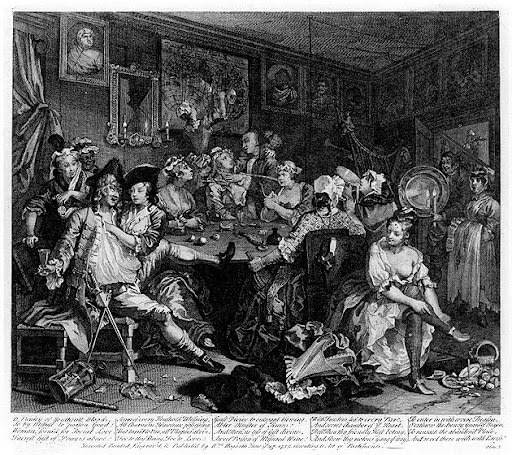
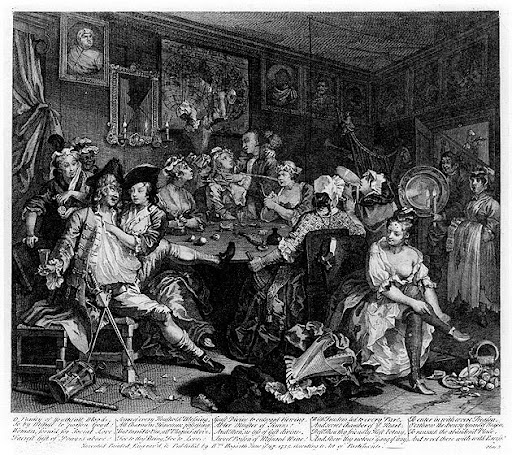
Very few of these chocolate houses have survived. One notable exception is the uber posh and uber aristocratic “Whites”, still going after 330+ years in London’s club heartland at 37-38 St James Street. For reasons that a little digging makes understandable, White’s downplays its origins as a chocolate house. Chocolate drinking houses, especially those of an aristocratic bent, evolved to become pretty raucous and notorious for gambling. Fortunately this history can’t be easily sidestepped. One of the greatest cartoonists of British history (and driving force behind the idea of artists’ copyright) was Hogarth. And Hogarth had great fun pointing fun at aristocratic excess in his A Rake’s Progress, Scene VI. In it, a gambling room becomes a setting for financial and moral collapse, with gamblers so absorbed in their bets and losses that most fail to notice the room is on fire. Although the Soane Museum identifies the setting as a Covent Garden gambling house rather than White’s, the museum does also suggest that the fire may allude to the blaze that destroyed White’s in 1733.
For the colour version, please see here.
Or here is a CC+ version from Wikimedia Commons
Who else really drank and chocolate in the 19th century?
Chocolate’s role in literally fuelling the British, and many other countries’ navies and armies is strangely overlooked. This is despite the Royal Navy pioneering one of the first instances of steam powered food factories in the 1820s to manufacture its drinking chocolate, and naval daily cocoa rations accounting for up to 30% of all the cocoa imported and consumed by Britain in the first decades of the 19th century. And the evolution of bars to eat, rather than drink, chocolate continued this tradition.
Fortunately, we’ve the great playwright George Bernard Shaw to remind us how soldiers understood the benefits, and importance, of chocolate. In Shaw’s Arms and the Man (1894), Bluntschli carries chocolate instead of ammunition: “I’ve no ammunition. What use are cartridges in battle? I always carry chocolate instead; and I finished the last cake of that yesterday.” Raina is outraged: “Do you stuff your pockets with sweets – like a schoolboy – even in the field?” But Bluntschli has a practical explanation: “You can always tell an old soldier by the inside of his holsters and cartridge boxes. The young ones carry pistols and cartridges; the old ones, grub.”
Raina dismisses Bluntschli as “a chocolate cream soldier”, but what begins as an insult becomes a term of affection and a bond. She slips a photograph of herself into the coat she lends him, inscribed “To my chocolate-cream soldier”. By the end of the play, her engagement to the supposedly heroic Sergius is over, and she agrees to marry Bluntschli instead. Chocolate and practicality win the day.
Kids…
Even though children undoubtedly did drink – and eat – chocolate before the 20th century, they became an increasingly important audience for chocolate, and chocolate marketeers. For example, white chocolate was originally introduced as a vitamin supplement called Nestrovit in the interwar years and even though Nestrovit was aimed at children who didn’t like drinking milk, it took quite a few years for Nestle to realise that selling Nestrovit (or as it was rebranded Galak and the MilkyBar) to kids as confectionery was even more lucrative (see here for the extraordinary story of Nestrovit).
By the postwar years, children had become an increasingly important audience for chocolate marketing. After an early career as a RAF pilot, Roald Dahl retreated to his small garden shed to produce multiple series of best selling books for both adults and children, including in 1964, Charlie and the Chocolate Factory. Perhaps more subtly than his books aimed purely at an adult audience, his humour in both Charlie and The Chocolate Factory, and also Glass Elevator, range from playful word games to some rather pointed lessons in behaviour.
Take Wonka’s “square sweets that look round”. Veruca Salt insists that they look square. Wonka opens the door, and the little faces painted on the sweets turn to see who is coming in: they do indeed “look (a)round”. But, as ever with Dahl, there is often a sting in the tail. When Veruca demands one of the factory’s nut-shelling squirrels and tries to take it herself, the squirrels test her just as they would a walnut. Finding her a “bad nut”, they send her down the rubbish chute. And the joke is at her parents’ expense too: the Oompa-Loompas remind us that “A girl can’t spoil herself, you know”.
Nonetheless, and as the recent remakes of Charlie and the Chocolate Factory show, Oompa Lumpas can always raise a laugh whether with Gene Wilder or Hugh Grant.
Adult humour
Chocolate has benefited from many amazing successful TV advertising campaigns – everything from James Bond like episodes to promote Milk Tray to Cadbury’s use of a drumming Gorilla, and from evocations of dinner parties to position After Eights as a posh way to end a meal to some pretty extraordinarily suggestive ads to promote a flake. See here for a selection.
Milk Tray – Cliff dive — labelled 1970
Dairy Milk – “Gorilla” — 2007 advert
After Eights After Eight adverts — Yorkshire Film Archive
Flake – Compilation of Flake adverts
The humour in most of these has been “pretty tongue in cheek” (especially for the flake adverts). Maltesers 2016 took humour, and sharing jokes, one stage further in their “Look on the Light Side” campaign. A series of disability-focused adverts drew on real experiences involving relationships, awkward encounters and a wedding, with friends using Maltesers as props to illustrate their stories — showing how chocolate can be part of sharing a laugh, not just something shared by kids
“New Boyfriend”.
“Dance Floor”.
“Theo’s Dog”.
And now for something completely different .. or not?
These jokes reveal a history rather messier than chocolate’s familiar journey from bitter drink to sweet bar.
Chocolate has moved from being a misunderstood “almond” to a solution to fasting in the Catholic church. And then it became a treat in French bedrooms, a symbol of aristocratic excess and also a more serious drink for merchants, and in particular sailors, soldiers and workers. Then as chocolate moved from a drink to an edible bar chocolate, in particular milk chocolate, it pioneered many of the key principles of “scoffing” (the bliss point, sensory specific satiety, hyper palatability). Advertising has turbocharged the appeal of these delights both to kids (think of the Milky Bar Kid) and now also adults (see the Malteser ads above).
And just as these ads, and earlier examples of humour with chocolate in plays and more, show a different side of chocolate, adverts about chocolate also provide a great way to explore cultural difference .. so next week / blog, we’ll explore what the characters used by Snickers in different countries for its “Hangry” ads say about them, and also what other classic chocolate ads show about different consumption habits by nation (and do please send it any favourites you have if you want them included).
(One final “spoiler”, I’ve not forgotten Monty Python’s “crunchy frog”, “just one more wafer thin mint” .. I’m just saving them for a little later too. But just in case, here they are:
Mr Creosote — “just one more wafer-thin mint”: long version, 6 minutes 45 seconds
Crunchy Frog — chocolate-box inspection: full sketch, 3 minutes 35 seconds
Warning: the Mr Creosote scene contains extensive vomiting and graphic comic gore.
Sources and further reading
Introduction: 1066 and All That
http://www.methuen.co.uk/
https://www.gutenberg.org/ebooks/78124
https://archive.org/details/1066allthatmemor0000sell
16th Century — Early Misunderstandings
https://www.historians.org/perspectives-article/a-taste-of-the-past/
https://quod.lib.umich.edu/e/eebo/A41427.0001.001/1:4.16?rgn=div2;view=fulltext
https://archive.org/details/newsurveyofwesti01gage
https://read.dukeupress.edu/jmems/article-abstract/39/1/183/98267/Thomas-Gage-and-the-English-Colonial-Encounter
17th Century — Early Use Cases in Church
https://ora.ox.ac.uk/objects/uuid:0f8f20ae-bfc2-497d-8d8c-a708faf77c2e/files/rmk61rh94n
https://archive.org/details/newsurveyofwesti01gage
https://mexfiles.net/2010/04/26/death-by-chocolate/
https://hekint.org/2024/07/11/chocolate-created-a-commotion-in-chiapa-cathedral/
https://strangehistory.net/2010/11/06/hot-chocolate-at-mass
Late 17th Century / Early 18th Century — Chocolate and Health
https://collections.vam.ac.uk/item/O157647/trembleuse-unknown/
https://www.denverartmuseum.org/en/object/2017.143
https://hispanicsociety.emuseum.com/objects/3535/mancerina-chocolate-cup-holder–naturalistic-flowers-seri
https://www.la-fontaine-ch-thierry.net/sevignechocolat.htm
https://www.gutenberg.org/files/43901/43901-h/43901-h.htm
18th Century — Chocolate as a Widespread Treat
https://www.gutenberg.org/files/19942/19942-h/19942-h.htm
https://www.owleyes.org/text/candide/read/chapter-iv-candide-found-old
https://standardebooks.org/ebooks/voltaire/candide/the-modern-library/text/chapter-4 (new — clean confirmation of the “neither chocolate nor cochineal” line, Chapter 4)
… And Not Just for Aristocrats?
https://www.teatroallascala.org/static/upload/lib/libretto-cosi-fan-tutte_2024-2025.pdf
https://www.vmii.org/k-588-cosi-fan-tutte/che-vita-maledetta
https://www.youtube.com/watch?v=d_CO3siUEc8
What Really Went On in 18th-Century Chocolate Houses?
https://publicdomainreview.org/essay/the-lost-world-of-the-london-coffeehouse
https://www.bbc.co.uk/news/uk-england-london-67405059
https://londonist.com/london/food-and-drink/chocolate-london
https://www.lloyds.com/about-lloyds/history/lloyds-buildings
https://www.lloyds.com/about-lloyds/History
https://en.wikipedia.org/wiki/White%27s
https://collections.soane.org/object-p45
https://clubland.substack.com/p/whites-in-hogarths-a-rakes-progress
Who Else Drank and Ate Chocolate in the 19th Century?
https://18thcenturydiary.org.uk/2011/02/chocolate-and-tea/
https://www.reddit.com/r/AskHistorians/comments/7pc530/why_does_it_seem_that_hot_cocoa_is_the_drink_of/
https://www.gutenberg.org/files/3618/3618-h/3618-h.htm
https://www.gutenberg.org/ebooks/3618
https://www.jstor.org/stable/pdf/40681776.pdf
https://www.routledge.com/Cocoa-and-Chocolate-1765-1914/Clarence-Smith/p/book/9780415758208 (
https://archive.org/details/cocoachocolatesh00bakeuoft
https://erebusandterrorfiles.blogspot.com/2019/04/victualling-victorias-navy-1-chocolate.html
https://en.wikipedia.org/wiki/Royal_Clarence_Yard (
Kids Nestrovit, Milkybar and Galak
https://www.nestle.com/about/history/nestle-company-history
https://www.nestle.com/brands/chocolate-confectionery/milkybar
https://www.nestle.co.uk/sites/g/files/pydnoa461/files/asset-library/documents/stories/individuals-families/milky-bar-history.pdf
https://www.thefoodhistorian.com/blog/before-nestle-a-history-of-white-chocolate
Roald Dahl and the Charlie Books
https://www.roalddahlmuseum.org/archive/roald-dahls-published-works/
https://www.bbc.co.uk/newsround/14902536
https://buckinghamshireculture.org/bucks-in-100-objects/roald-dahls-writing-chair/
https://en.wikipedia.org/wiki/Roald_Dahl
https://esl-bits.eu/Novellas.for.ESL.Students/Charlie-/23/text.html
https://www.sparknotes.com/lit/charlie/section12/
https://www.litcharts.com/lit/charlie-and-the-chocolate-factory/chapter-24
https://www.litcharts.com/lit/charlie-and-the-chocolate-factory/chapter-23 (new — confirms “square candies that look round” is Mike Teavee’s objection, Veruca agrees; worth a small wording fix, not a source gap)
Film Clips
https://www.youtube.com/watch?v=QkC8wPSmcPg
https://www.youtube.com/watch?v=P2CzCFpz83Y
https://www.fox35orlando.com/news/wonka-trailer-features-magic-chocolate-and-hugh-grant-as-an-oompa-loompa (new — Hugh Grant plays an Oompa-Loompa in Wonka (2023); needed for the Wilder/Grant correction)
Adult Humour
Milk Tray, Dairy Milk, After Eight and Flake
https://www.youtube.com/watch?v=RqlfWfhNiqk
https://www.youtube.com/watch?v=TnzFRV1LwIo
https://www.yfanefa.com/record/4779
https://www.youtube.com/watch?v=RAabUAJqeCY
Maltesers
https://www.channel4.com/press/news/mars-chocolate-uk-celebrates-diversity-new-ad-maltesers
https://www.thegrocer.co.uk/news/mars-kicks-off-disability-friendly-advertising-strategy/541550.article
https://www.adsoftheworld.com/campaigns/new-boyfriend-594d46a1-855d-4b66-84a8-1f5c7f161bc8
https://www.youtube.com/watch?v=YgUqmKQ9Lrg
https://www.youtube.com/watch?v=UB8–PFAJDE
https://www.youtube.com/watch?v=lYIEAIogarI
https://lovethework.com/work-awards/campaigns/the-light-side-of-disability-28234 (new — Cannes Lions record, confirms campaign name and agency, AMV BBDO)
And Now for Something Completely Different … or Not?
https://onlinelibrary.wiley.com/doi/10.1002/oby.22639
https://en.wikipedia.org/wiki/Sensory-specific_satiety