How much caffeine is really in your chocolate bar?

Coffee has long been credited with powering us awake since the Enlightenment, while chocolate was valued for being delicious, filling and nutritious. Yet some chocolate bars contain as much caffeine as an espresso. How much is in yours? Read on for more on this riddle.
Print / PDFPicture: Kurzi Kakao
Craft Chocolate is well known for being delightful – bursting with flavour, melting unctuously, sharing and savouring and much more. And there is all sorts of research and advice written – as well as TikTok, Instagram and YouTube videos – bursting with suggestions (and we’d recommend coming to a tasting, and checking out the flavour and texture “waves” here and here).
Craft Chocolate is also well known for nourishing – a few squares can go a long, long way. And that’s why the armies from the Aztec to American GIs and the British Royal Navy provided chocolate as a nourishing ration and treat. And again there is all sorts of work on the nutritional benefits of chocolate – see here for more.
Chocolate also stimulates and invigorates. The more notorious and salacious claims (i.e. that chocolate contains bio-chemical substances that perform as an aphrodisiac) have long been debunked (see here – although psychologically sharing and gifting craft chocolate can work wonders).
Ditto the idea that chocolate contains psychedelics is also nonsense. We’re all in favour of some mindful savouring, sharing, chanting etc when drinking craft chocolate after some yoga. But this is VERY different to a mindfulness retreat with some psilocybin or an ayahuasca ceremony – there REALLY are no naturally occurring psychedelics in even Craft Chocolate – see here.
At the same time, chocolate contains three related methylxanthine stimulants: theobromine, caffeine and (traces of) theophylline. Plants seem to have developed methylxanthines to protect themselves from insects and other predators. In high enough doses they can paralyse or even kill an insect. But at the right dose they offer us humans some other benefits, starting with “stimulation”.
Somewhat surprisingly, given all the other angles marketeers have used to stimulate interest in chocolate, chocolate’s ability to “stimulate” is relatively little researched in comparison to, for example, coffee.
Historians often credit caffeine for coffee’s spread and popularity. London’s very first coffee house, opened by Pasqua Rosée around 1652, advertised that coffee “will prevent Drowsiness, and make one fit for Business” – but warned not to drink it after supper, “for it will hinder sleep for 3 or 4 hours”. London’s 17th century coffeehouses were soon nicknamed “penny universities” (and Lloyd’s of London started life in one) and provided the inspiration for James Hoffmann’s famous Square Mile’s Penny University pop-up in Shoreditch in 2010. And writers from Wolfgang Schivelbusch to Michael Pollan have argued that caffeine helped power the Enlightenment and the Industrial Revolution.
Chocolate’s historic spread is explained differently (even though the first Chocolate Drinking House was opened close to Lloyds of London only a few years after Pasqua Rosee). Far more importance was placed on the way chocolate was delicious, filling and healthy, and on the way it didn’t break the fast, so could be drunk in Church – see here). A survey of more than 100 medicinal uses of cacao, from the Conquest to the early 20th century, by Dillinger and colleagues in 2000, found three benefits that came up most consistently: putting weight on the emaciated, aiding digestion, and rousing the “apathetic, exhausted or feeble”. An early Spanish account (by the so-called “Anonymous Conquistador”, apparently one of Cortés’s companions, published in 1556) claims that “he who drinks a cup of this liquid, no matter how far he walks, can go a whole day without eating anything else”. And indeed the origin of the cup and saucer (see here for the link to French aristocrats’ habit of drinking chocolate in bed first thing in the morning) hints at chocolate providing some invigorating support to start the day.
But in comparison to coffee and caffeine, chocolate has not (yet?) been appreciated, or even researched, as a stimulant – despite the fact that some chocolate bars can contain about as much caffeine as an espresso (or, depending on their origin, percentage and a few other factors less than half as much caffeine).
What we know about caffeine (and coffee)
Caffeine is among the most studied substances we eat or drink. Scientists have detailed how it blocks adenosine receptors, thereby inhibiting signals of sleepiness. And there is enough research that it’s relatively easy to offer general advice and insights about everything from caffeine levels by coffee type to the challenges of withdrawal – for example (and hoping that these aren’t too controversial!):
- A single espresso contains roughly 60–80mg of caffeine. A mug (200ml) of filter coffee is typically around 90–150mg – although these can vary a lot depending on, for example:
- Bean type – with robusta beans containing about twice the caffeine of arabica: roughly 2–2.7% versus 1–1.5% by dry weight.
- How the coffee is prepared (grind, brewing time and serving size all matter).
- Withdrawal can start in people regularly taking as little as 100mg a day who then stop. Headaches, fatigue and low mood often begin 12–24 hours after the last dose, peak around one to two days, and can last up to nine days.
- Over-consumption and over-reliance on caffeine may also cause other issues. For example, one study of around 3,000 US truck drivers found that heavy caffeine users reported more crashes (although they also slept less, so caffeine may be as much a sign of tiredness as a cause).
- Having said this, the European Food Safety Authority (EFSA) suggests up to 400mg a day is safe for most adults, and single doses of up to 200mg.
What theobromine does is far less understood and researched
Theobromine is caffeine’s close chemical cousin; it’s also a methylxanthine, but with one fewer methyl group – indeed the body turns a little caffeine into theobromine as it breaks it down. But it seems to behave differently, and is far less researched. Scientists suggest that theobromine also binds to adenosine receptors, but two to three times more weakly. At the same time it stays in the body longer: a half-life of around 7–12 hours, against caffeine’s 2.5–5. It relaxes smooth muscle, widening blood vessels and airways, and it is a mild diuretic.
Whether it invigorates is less clear. The few human studies are small:
- A 2004 study gave volunteers the caffeine and theobromine found in about 50g of dark chocolate. They reported feeling more energetic and did better on cognitive tasks. The effect matched cocoa powder itself, which suggests the methylxanthines do the work.
- A 2011 study (of 24 women) separated the two. Caffeine raised alertness. Theobromine on its own lowered blood pressure and made people slightly less calm – but did nothing for alertness. Together they behaved much like caffeine alone.
- A 2013 study (of around 80 adults) found that a modest dose of theobromine (250mg, roughly a generous serving of dark chocolate) had only mild effects, while higher doses (500–1,000mg) raised heart rate and worsened mood. The authors suggest that at normal intakes theobromine “may contribute” to chocolate’s appeal.
So it’s reasonable to “guess” that chocolate can give a boost, potentially from its pairing of a little caffeine with a lot of slower, gentler theobromine. And that may be why 100% devotees describe a steady energy rather than a jolt. But it remains a guess. And this doesn’t take into account other claims for the way chocolate may also increase dopamine and even oxytocin levels, nor how the sharing and gifting of chocolate can give a psychological boost).
How much theobromine (and caffeine) is in your chocolate?
The amount of theobromine and caffeine within chocolate isn’t just complex, it’s also relatively under researched. We know that the levels of caffeine and theobromine in a bar, and the ratio between them, can vary widely. However this isn’t listed on the nutritionals, nor widely measured. And there has been very little research into how genetics, processing and even percentages impact levels.
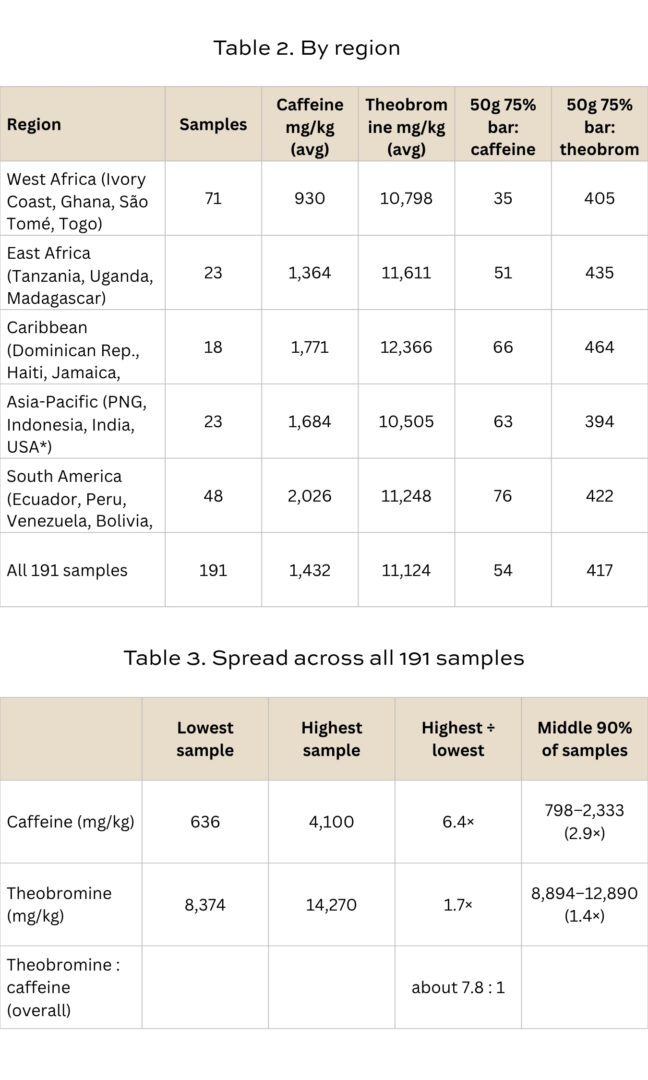
One of the most comprehensive datasets was gathered for a completely different purpose, ironically showing the challenges here. In the late 2000s the UK Food Standards Agency, funded public analysts to test 191 samples of cocoa liquor (in effect 100% chocolate) from around the world, so that enforcement labs could use theobromine to check how much cocoa a chocolate really contains. And they found that theobromine levels varied – with the highest sample having about twice the amount of the lowest (and, intriguingly, levels were generally lower than in surveys from decades before, possibly due to the spread of new hybrid varieties). Caffeine levels varied even more, with the most caffeinated sample having around six times as much as the least.
There seem to be some strong geographic links here (and possibly genetics too). Cacao from Ecuador, Venezuela and Peru averaged more than twice the caffeine of West African cacao. For example, cacao from Ghana had almost exactly the same theobromine as cacao from Ecuador – but only a little over a third of the caffeine. Intriguingly, weather and harvest may also play a role – studies in Ecuador found that cacao from the dry season had around a fifth more caffeine than cacao from the same farms in the rainy season.
Genetics seem to play an important role too, but as with all matters concerning cocoa genetics it’s again complicated. Scientists have long tried to tell cacao types apart by the ratio of theobromine to caffeine – suggesting that Criollo beans have only one or two parts theobromine to each part caffeine, while Forastero (the backbone of West African cacao) can have five to fourteen. Since 2008, when Motamayor and colleagues redrew cacao’s family tree into ten genetic groups (with more groups proposed since, especially in Ecuador, Colombia and Peru), studies in Ecuador and Colombia have looked further at caffeine levels. For example, one Colombian collection showed a fourteen-fold spread in caffeine, but less than threefold in theobromine. Unfortunately there has been no comprehensive research yet, and even the Heirloom Cacao Project, which DNA tests every cacao it designates, doesn’t appear to measure caffeine or theobromine (yet?).
Processing also seems to have a significant impact. During fermentation, some theobromine and caffeine migrate out of the bean into the pulp and shell. Losses vary widely between studies and between fermentation methods (see below for more detailed research, and here for more on fermentation). Roasting seems to matter less – both theobromine and caffeine appear fairly heat-stable. Percentages are also complicated as the amount of cocoa butter clearly makes a difference, as cocoa butter contains almost none of either.
The bottom line
To put this in context: a 50g bar of 75% Ecuadorian chocolate may have around 75mg of caffeine – about the same as a single (arabica) espresso. The same bar made with Ghanaian cacao may have around 35mg – about half that. Yet both would have much the same theobromine (around 410–420mg). (And these are upper limits – many bars also have added cocoa butter, which contains almost no caffeine.)
Some practical suggestions and implications
- If you are sensitive to caffeine, even a few squares of high percentage chocolate just before bedtime is probably not a good idea. A 20g serving of 70–85% dark chocolate could contain roughly 15–35mg of caffeine, depending on origin – up to around half an espresso – plus 150–190mg of theobromine. And theobromine’s long half-life means it may still be working at breakfast. (The sugar in many milk and mass market supermarket bars is a separate late-night issue.)
- At the same time, withdrawal symptoms from the caffeine in chocolate are probably not a major concern when savouring craft chocolate. To reach the 100mg-a-day linked to coffee withdrawal, you would need roughly one and a half to three bars of 75% chocolate every day
- Please experiment! Try bars from different origins – say Peru against Ghana – and notice how they make you feel. Ideally share them, and compare notes. See here for some selected boxes. And if you’d like to be part of some future research, write and let us know.
Caffeine and theobromine in cocoa by country of origin
Source: UK Food Standards Agency project Q01122 (Defra FA0202), “Measurement of theobromine content in cocoa for determining cocoa solids content in chocolate and chocolate products”, final report, August 2011 (Durham Scientific Services). Data from Appendix 4, Table 2: 191 samples of cocoa liquor, sampled over two years, supplied by Barry Callebaut, ADM and Cargill. Country averages, ranges, ratios and bar figures are our own calculations from the per-sample data.
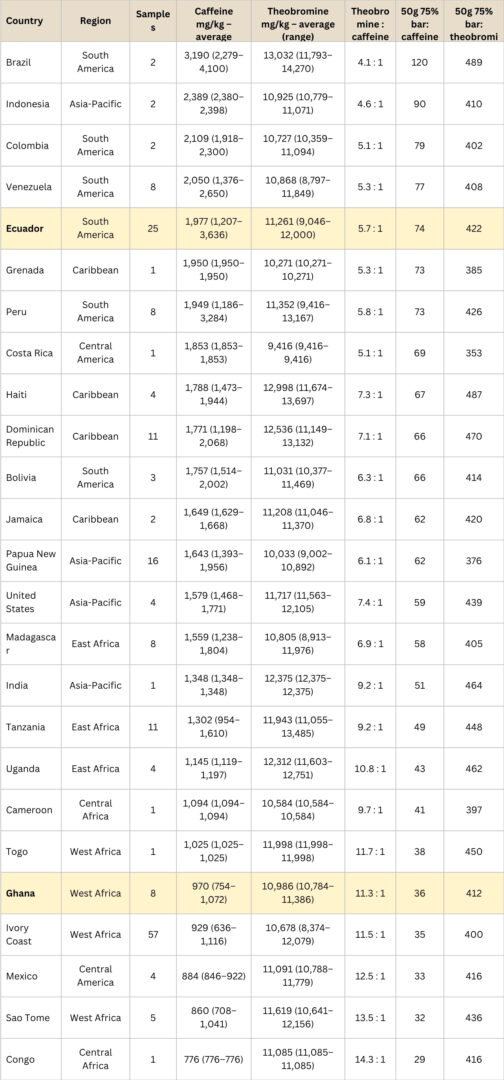
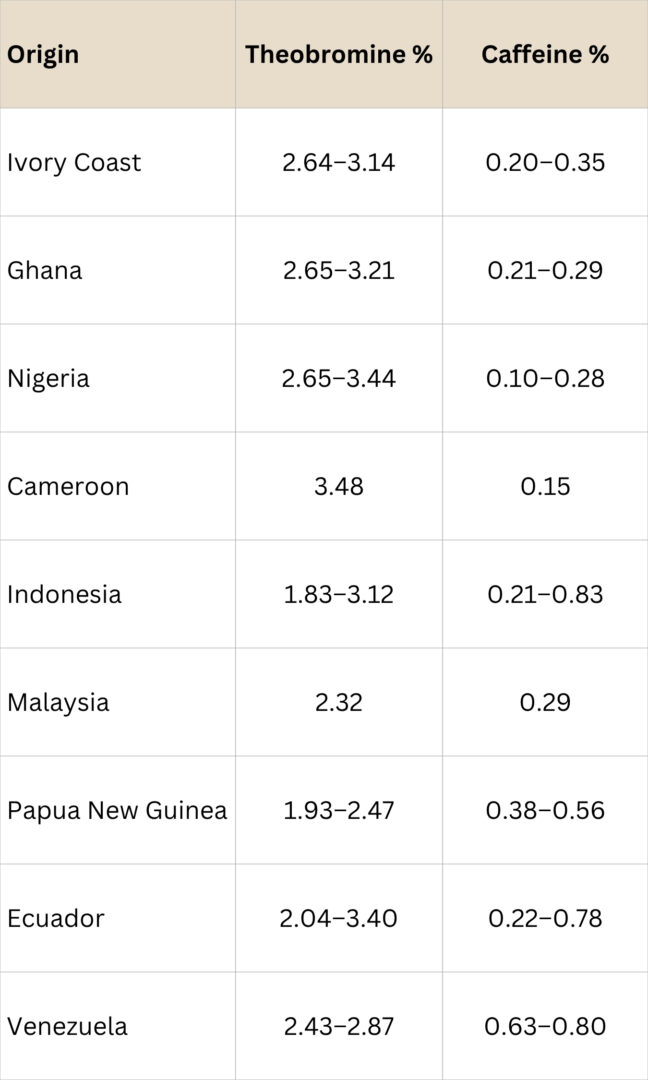
Table 4. Older industry figures (for comparison)
Ranges for dry, defatted, fermented nib from the German confectionery industry (BDSI Cocoa Atlas 2002), as quoted in the FSA report. Different basis from Table 1 (fat and moisture removed), so figures are higher – compare patterns, not numbers.
Caution: countries with fewer than 4 samples (Brazil, Indonesia, Colombia, Grenada, Costa Rica, Bolivia, Jamaica, India, Cameroon, Togo, Congo) are shown for completeness but are not reliable averages. The report lists “St Domingo” (9) and “Dominican Republic” (2) separately; they are combined here. “United States” is presumably Hawaii. One sample of unknown origin is excluded.
NOTES
- Theobromine is fairly steady everywhere: country averages range only from about 9,400 to 13,000 mg/kg.
- Caffeine varies far more: South American cacao averages about twice West African (2,026 vs 930 mg/kg).
- Ghana vs Ecuador: almost identical theobromine (10,986 vs 11,261 mg/kg), but Ghana has about half the caffeine (970 vs 1,977 mg/kg).
- The report does not identify bean varieties or genetics – the authors say genetic analysis was outside its scope.
- Samples came from three large processors, so they represent bulk/industrial cocoa rather than craft or single-estate beans.
- Richards & Wailes (2012) summarise this project. Their quoted theobromine mean (27,737 mg/kg) and range (19,803–39,168) match the report’s total-alkaloid figures, not theobromine (theobromine, dry fat-free: mean 24,572, range 17,700–31,329).
Sources
History and culture
Dillinger et al. 2000, Food of the gods: cure for humanity? Journal of Nutrition
Cornell University Library, Chocolate: Food of the Gods (Anonymous Conquistador)
Theobald, Colonial Williamsburg Journal, chocolate history
Cocoa Runners, How drinking chocolate shaped the cup & saucer
Pasqua Rosée, “The Vertue of the COFFEE Drink” handbill, c.1652 (via Open Culture)
Schivelbusch, Tastes of Paradise (1980; English 1992), Kirkus review
Pollan, This Is Your Mind on Plants (Penguin, 2021) Pollan, This Is Your Mind on Plants (2021)
Young & Foodish, Penny University (2010)
Nathanson 1984, Caffeine and related methylxanthines: possible naturally occurring pesticides, Science
Caffeine
EUFIC, Caffeine levels in different foods and drinks
EFSA, Caffeine
Juliano & Griffiths 2004, A critical review of caffeine withdrawal, Psychopharmacology
Filtness et al. 2020, caffeine and truck drivers, Safety Science (Loughborough release)
Theobromine
Smit et al. 2004, Methylxanthines are the psycho-pharmacologically active constituents of chocolate, Psychopharmacology
Mitchell et al. 2011, Differential contributions of theobromine and caffeine, Physiology & Behavior
Baggott et al. 2013, Psychopharmacology of theobromine in healthy volunteers, Psychopharmacology
Levels in cocoa
FSA project Q01122 / Defra FA0202, final report, August 2011 (Durham Scientific Services)
Richards & Wailes 2012, Journal of the Association of Public Analysts 40:01–12
INIAP (Ecuador), seasonal variation in cacao methylxanthines
Genetics
Motamayor et al. 2008, PLoS ONE
Davrieux et al. 2007, NIRS and theobromine:caffeine ratio (CIRAD)
Trognitz et al. 2013, Diversity of cacao trees in Waslala, Nicaragua, PLoS ONE
Osorio-Guarín et al. 2017, Frontiers in Plant Science
Colonges et al. 2022, Nacional and Amazonian cocoa from Ecuador, The Plant Genome
Argout et al. 2023, Pangenomic exploration of Theobroma cacao (bioRxiv preprint)
Motilal et al. 2026, Four new genetic lineages in Peru, PLOS ONE
Heirloom Cacao Project