Why we still don’t do Black Friday

This is not a blog filled with Black Friday offers, but we still believe craft chocolate is fantastic value
Print / PDFEveryone loves a bargain. Once again this year I’ve drawn up a list of “stuff” that I’m planning to buy when the Black Friday discounts start. It’s become a regular habit where I keep track of the prices. And if I buy anything outside a sale, I worry I’ve overpaid.
This is not a great customer experience. But it clearly works for retailers who can squeeze their suppliers to pay for the discounts. It also works for “big food” companies who can push harder and harder on farmers and their suppliers. Unfortunately it trains customers to focus on price above anything else. And it ignores what makes a craft chocolate bar great value: the savouring and the sharing, a fair price for the farmer, a standing rainforest, a healthier treat.
This year, because of the crash in the prices of commodity cocoa, your support is even more critical. Low prices, and great deals, will still be there for commodity chocolate, but it’s the farmers, and the rainforest, that “pay” the real costs of lower and lower prices.
What’s become even more challenging this year
Over the last couple of years we’ve written a LOT about how, and why, cocoa prices spiked (see here and here). We also stressed how little of those gains reached farmers. In the 2024/25 season, world prices were mostly between $8,000 and $12,000 a tonne, up from an average of around $2,300. Ivorian farmers were paid 1,800 and then 2,200 CFA francs a kilo, roughly $3,000–3,700 a tonne, up from 1,000 francs (about $1,650). So while cocoa prices rose four to five times, farmgate prices, at best, rose by half this amount, at best doubling. At the same time, farmers’ harvests and yields were far lower, so often their total income actually fell.
This year, for complicated reasons to do with “grindings” (see here), commodity cocoa prices have fallen back below $3,000 a tonne. They’re now a little higher. But for farmers, the fall has been brutal. Ivory Coast, the world’s largest producer, has cut its fixed farmgate price from a record 2,800 CFA francs a kilo last season to 1,200 francs, about $2.12. That is a 57% cut. Ghana’s price for 2026/27 is GH¢42,400 a tonne. It was presented as a 2.4% rise, but it’s still about 18% below where last season started.
During the 2023–25 “boom”, commodity cocoa farmers received relatively little of the gains. In the crash, many are still waiting to be paid months after they “sold” their beans, and were (and often still are) expected to absorb the full price fall.
Some analysts predict another spike if El Niño hits next year. But if prices do rise, it will be because harvests are failing. That makes things tougher still for farmers, and for the rainforest.
Who, and what, makes cheap chocolate so cheap
Over the last century, Big Food has done an incredible job of making our “daily bread” and our “chocolate treats” more affordable. A sliced white loaf now costs about 1% of a median UK worker’s daily earnings, down from nearly 2% in the 1930s. A mass-market chocolate bar has fallen from over 1.5% to roughly half that (see here).
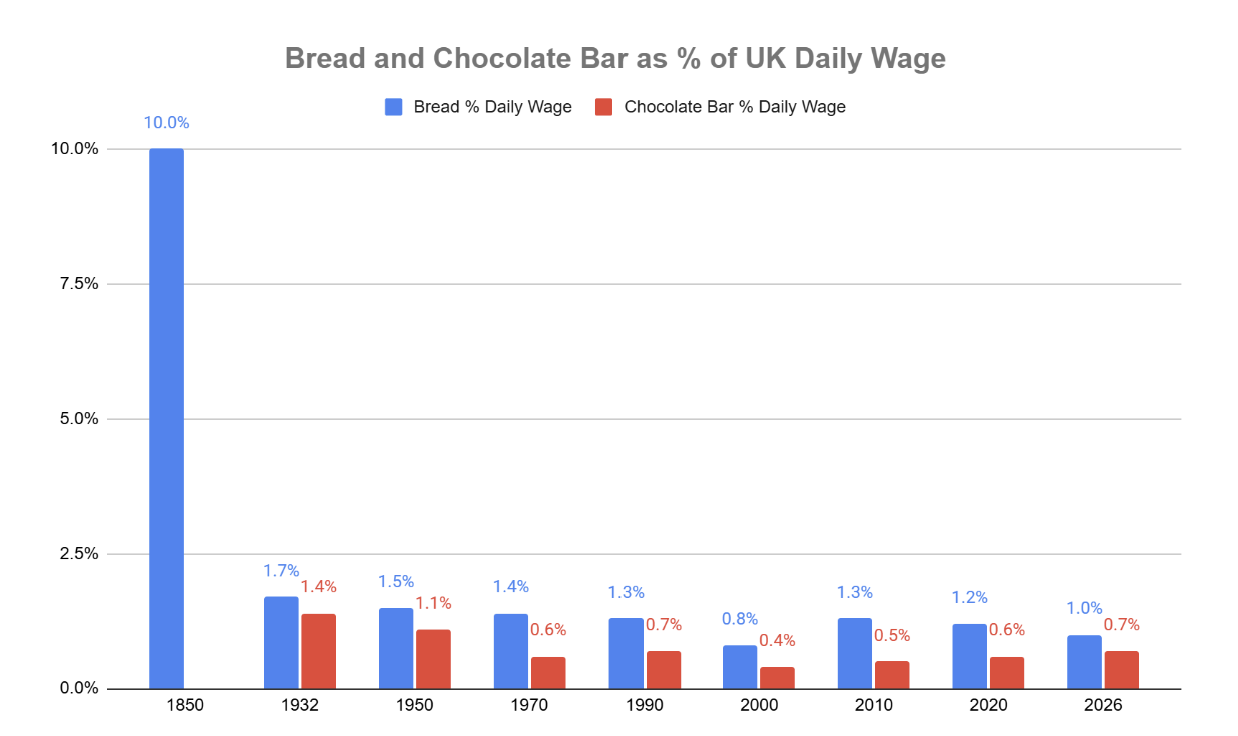
But the two became cheaper in very different ways. Bread/wheat benefited from efficiencies in both harvesting and baking, and from the “green revolution”. Chocolate has become more affordable through shrinkflation, ingredient substitutions and, above all, squeezing farmers and their land.
A Mars bar weighed 62.5g in 2000. Some are now around 40g. Alongside shrinkflation, more and more additives, bulking agents and above all sugar is replacing expensive cocoa. Take Tony’s: the primary ingredient in at least 14 of the 20 bars they sell in the UK is sugar (see here).
Mass-market chocolate also depends on paying West African cocoa farmers as little as possible. In 2021 Wageningen researchers put average incomes at about $1.23 a person a day in Côte d’Ivoire and $1.42 in Ghana. That’s up on the 50 and 84 cents the Cocoa Barometer estimated in 2015 (although the two studies measure income differently). But both are still way, way below the living-income benchmarks of $2.55 and $2.08. And these figures predate the boom, and this year’s price cuts. With that little money and so much uncertainty, there’s no capital to plant new trees or irrigate. There will still be extensive child labour. There’s also little reason for young people to take up cocoa farming, especially when illegal gold mining in places like Ghana pays far more.
Commodity cocoa has also relied on another “cost” to us all: cutting down the rainforest. In 1960 Côte d’Ivoire had around 12 million hectares of forest, nearly half the country. By 2020 it had under 3 million. Between 2000 and 2020, cocoa accounted for over a third of the forest lost in its protected areas. To make more money, and to replace tired soils and ageing trees, the cheapest option is to cut into what forest is left (and this “slash up and burn” agriculture also is cheaper than adding nitrogen, fertilisers etc. to the soil). (Note: EUDR may help a bit here; see here for more.)
Chocolate has become more affordable through shrinkflation, ingredient substitutions and, above all, squeezing farmers and their land.
And are consumers really getting lower prices?
Black Friday “deals” don’t always add up either. Which? tracks prices every year and keeps finding that most are the same price or cheaper at other times of the year; in its 2024 analysis, none were at their cheapest on Black Friday itself. Even where the deals are real, mass-market confectionery, where the main ingredient is sugar, isn’t good value for your health, for farmers or for the planet.
Why craft chocolate’s prices are a little higher… but still great value
Craft chocolate is more expensive than mass-market confectionery. And this is something to “lean into”. The differential is also not that much, and increasingly it is narrowing. Plus the reasons why craft chocolate “costs” more also make it far better value.
There are two main reasons for the higher prices. The first is the way craft chocolate is “crafted”. Craft chocolate is dedicated to flavour. That means small batches, without lots of sugar, cheap fats and additives (there’s a reason so many mass-produced bars list vanillin, lecithins, butter milk, preservatives, E numbers, PGPR, etc). Small batches don’t yield Big Chocolate’s economies of scale. Craft makers also often can’t afford the deep discounts, extended payment terms and listing fees that supermarkets demand.
The second, and bigger reason, is because great flavour comes from great beans. And great beans mean paying farmers far more, through transparent, long-term contracts. Those contracts matter most in a year like this one. When the market falls, the price agreed with the farmer doesn’t fall with it.
Many craft chocolate makers are small family businesses: husband and wife, or parent and child. Almost all of their beans come from smallholder farmers working in cooperatives. Much of the chocolate consumed in the UK is “remoulded”; it’s made from cocoa liquor processed by the Big Three processors (Cargill, Barry Callebaut and Olam / Ofi). And it’s hard to compete with marketing powerhouses like Mondelez, Nestlé, Hershey and Mars with their legions of sales teams devoted to special lower prices and promotions, “deals of the millennium”, “buy one get three free” offers etc., that can be supported by hefty margins.
Rob and Amy of Fresco have written a great post from the perspective of a craft chocolate maker that explains these points in more detail, and it’s well worth a read. To pick a couple of great “one liners”:
- Our goal isn’t to discover the least expensive way to make chocolate. It’s to discover the most delicious chocolate we can make from each cocoa origin.
- There simply isn’t a large margin built into the price of artisan chocolate to accommodate substantial discounts.
… And why craft chocolate is so much better value
Black Friday is all about price. It works well for plenty of brands and products. If it works for you, go for it (I have my list too).
But Black Friday doesn’t sit well with the transparency and long-term commitments that craft chocolate is built on. We think craft chocolate is already of great value. We don’t want to squeeze the margins of makers, and through them farmers (and rainforest). Price promotions send the wrong signal, and they undermine the trust built between farmers, makers and customers. It misses quality and flavour.
A craft bar typically costs £5–10, and for that you get literally the best bar money can buy. For the same quality in wine or whisky you’d add at least one zero, if not two. Craft beer, specialty coffee, tea or cheese often cost two to four times as much, especially when eating outside of the home. To quote the legendary Shawn Askinosie and his daughter Lawren: “when a product like chocolate is sold to the consumer for a dollar… almost always, someone is paying for it…” and “There’s not many instances where you can get the best of something for $10. And right now, in craft chocolate, you can spend $10 and truly get the absolute best of the best chocolate that there is in the world.” (And we’re delighted to say their bars are back in stock again!)
The gap with supermarket chocolate is also smaller than it used to be. During the price spike, supermarket “dark” bars (Lindt, Green & Black’s, own labels, supermarket “finests”) rose from around £1.95 to £3.45–3.95. Craft bars moved from £3.95–5.95 to £4.95–7.95. A craft bar now costs a couple of pounds more, not two or three times as much.
If you are after “value”, may we once again recommend our monthly subscription box? We designed this monthly box to help introduce subscribers to new beans, new makers and new bars in a manner offering as much value as we can. We don’t repeat bars in the Dark Only and Mixed (3 dark and one milk). We go “behind the bean / bar” with tasting notes, videos and emails. And even though the sum of the individual bars is way over £30 (sometimes even over £40), we’ve worked with makers to be able to offer this at a monthly price of £28.95 (plus P&P) (see here for more, and more of the benefits).
And there’s value in savouring and sharing, not scoffing
Mass-market chocolate is often consumed as a solo snack: something to unwrap on the move and finish as a treat, or as part of a meal deal and then consumed when tiktoking etc.
Craft chocolate can work this way. But it also, and more commonly, operates in a different way. A 70% bar typically has less than half the sugar of a mass-market bar, and it’s made to be savoured (not scoffed) a square or two at a time. Enjoying, and discussing, how the flavours evolve slows us down. It helps satisfy the “second stomach” without a pudding. It stops us being “gamed” by the bliss point, hyper palatability, sensory specific satiety, etc. (see here).
Craft chocolate is also made for sharing. And there’s a LOT of value in that. In the US much has been written about a drift towards “bowling alone” (Robert Putnam), eating alone (Derek Thompson) and a wider breakdown in social cohesion. In 2017 Robin Dunbar at Oxford wrote a wonderful, succinct paper showing that eating together does more than feed us. He showed firstly that people who eat with others often report being happier and more satisfied with their lives. And secondly he reported the meals that bring people closest involve more laughter and storytelling (see here). So savouring and sharing a craft chocolate bar with friends and family can unlock these values too. It’s a great counterpoint to a Black Friday impulse to buy and scoff in solitude.
A selling philosophy: another way to think about Black Friday
This year has been tough for many farmers and many makers. Securing beans has been harder and cash flow tighter. If craft makers can’t stay afloat, the farmers they work with lose their income too, and they stop protecting the rainforest.
So please excuse us for not tempting you with Black Friday deals. If you’re able to support craft chocolate this weekend, whether for yourself or under the tree, it really does make a difference: to the farmers, to the makers, and to us. Plus it tastes better, it’s better for your health and it’s better value.
Thanks
PS: and to all those celebrating Thanksgiving this weekend, we hope that this will involve some craft chocolate too
Sources and further reading
Sources
- Cocoa Runners, “Why your bread got cheaper and your chocolate got smaller”
- Trading Economics, cocoa futures news, Feb–Nov 2026
- The Cocoa Post, Ivory Coast 2023/24 farmgate price of 1,000 FCFA
- Reuters via ESM Magazine, Ivory Coast 2026/27 farmgate price
- Ghana News Agency, Ghana 2026/27 producer price
- Ghana Ministry of Finance, Press Briefing on Cocoa
- The Conversation via Citi Newsroom, “Why Ghanaian farmers have been unable to capitalise on record cocoa prices”
- Reuters, “How did Ivory Coast and Ghana’s cocoa sales crisis come about?” (Feb 2026)
- Wageningen University & Research, “Living income in cocoa”
- Waarts & Kiewisch (2021), “Balancing the Living Income Challenge”
- Cocoa Barometer 2015 (Fountain & Hütz-Adams)
- Fairtrade Foundation, Craving a Change in Chocolate (Feb 2019)
- Fairtrade International, Cocoa household income study 2025, at a glance
- EU Access2Markets, EUDR delay to December 2026
- Which?, “Are the Black Friday sales worth the hype?”
- Fresco, “Black Friday and the true value of craft chocolate”
- Dunbar (2017), “Breaking Bread: the Functions of Social Eating”
- Derek Thompson, “The Anti-Social Century”, The Atlantic (Feb 2025), and “You Are No Longer Invited to Dinner” (Sept 2026)
- Robert Putnam, Bowling Alone (2000), and for a more optimistic take, The Upswing (2020)
Cocoa price spike
- The rising price of cocoa
- Why are cocoa prices still going up, and what does it mean?
- Cocoa prices: an update from Spencer
- Cocoa prices 2026 update
Bread vs chocolate
Tony’s and sugar
EUDR
Bliss point, hyper-palatability, sensory-specific satiety
- The bliss point in craft chocolate
- Big Food vs craft chocolate: the fight against ultra-processed foods
- Savouring strikes back: healthiness, satiety, mindfulness, community, planet
- Bitterness or sweetness: how should you end a meal?
- Investigating ultra-processed chocolate
- These are not ultra-processed
- Is chocolate addictive?
- Talking about better health on the Zoe podcast
Previous Black Friday posts