Big Food vs Craft Chocolate: The fight against Ultra-Processed Foods
From scoffing to savouring: why craft chocolate is the delicious habit that your body (and the planet) will thank you for.
Print / PDF
From scoffing to savouring: why craft chocolate is the delicious habit that your body (and the planet) will thank you for.
For most of this year I’ve been grappling with a paradox. For the first time in history, we grow and process enough food for everyone to eat well – yet we face an epidemic of obesity and malnourishment, and we are destroying the soil. Politicians from the left and right now point the finger at Big Food and ultra-processed ‘food-like substances.’ But that explanation is too simple. The deeper problem isn’t just that our food is commoditised and ultra-processed – it’s that we scoff this stuff. We’ve forgotten how to savour: to seek length and complexity of flavour instead of being tricked by the Bliss Point into craving more sugar, salt, fat, and engineered textures.
This is a long argument about how craft chocolate can help us rediscover flavour, break the cycle of mindless scoffing, and return to mindful savouring. So in advance, apologies. I’ve tried to “chunk” it up, with summaries. But it’s a complex topic. However I do believe that craft chocolate is part of the answer. And savouring craft chocolate (and indeed all your foods) is not just fun but it’s also healthier than scoffing mass produced confectionery.
So here goes.
Long before social media companies had hooked us to our screens, “Big Food” had us scoffing all sorts of processed foods. Arguably one of the first scoffable processed foods was chocolate when it moved from being a drink to an edible treat (bars, biscuit toppings, etc.). Indeed many of the fundamentals underpinning Big Food were pioneered by chocolate – the consolidation and commoditisation of supply; the application of fertilisers, pesticides and yield control; the application of advanced manufacturing technologies; powerful mass advertising; etc. And we’ll cover chocolate’s pioneering role in all these areas in later blogs too. But this blog post is focused on the science of “scoffing” and its role in underpinning processed, and in particular, ultra -processed, foods (UPFs) (note see below for definitions, and translations of scoffing).
Ultra processed foods, and Big Food, have become a favourite bogeyman. Indeed one of the few areas that (almost all) politicians can agree on in the US (and UK) is that Big Food and Big Pharma are a big problem. Dr Casey Means, Trump and RFK’s choice for Surgeon General, has plenty of fans not just in “MAHA” (Make America Healthy Again) but with Democrats too. Casey Means’ message that ultra-processed foods, especially refined sugars, starches, and seed oils, combined with narrowly focused medical responses and today’s sedentary, high-stress lifestyles, have created a global health crisis resonates worldwide. And the statistics are clear wherever you look. We are in the midst of a growing obesity crisis with all sorts of spiralling health consequences. For example: over 70% of Americans (CDC/Lancet) and 60% of Brits overweight/obese and 45%+ (US) and 20% (UK) are either pre, or full blown, diabetic.
All sorts of initiatives are being tried. Some are “top down” from governments like the “sugar tax”, banning of fizzy drinks/sodas in school and advertising limits. Others are “bottom up” from nutritional experts like Tim Spector, the Van Tulleken twins or Michael Pollan. with recommendations to check the ingredients and eat real food. And we are all still hopeful of “silver bullets” like GLP1s (the technical name for drugs like Ozempic, Wegovy, etc.).
These initiatives have had some success in alerting to, and warning us away from, UPFs. But the battle is far from over. In part this is because Big Food has done a fantastic job of taking a leaf from Big Tobacco / Big Oil / Big Farmer in “deny, delay, obfuscate”. But to be fair to Big Food it’s also because the issue is far more complex than say cigarettes and tobacco. UPFs are about much more than “free choice”. Big Food has, for the first time in recorded history, enabled the world to have enough food and calories so that no one should have to go hungry. And many ultra-processed foods can be important for the health of everyone from people with allergies (think gluten-free) to the elderly needing specific formulations. Not all ultra processed foods are inherently bad.
It’s the combination of scoffing, and scoffing almost entirely ultraprocessed foods, that is the problem. Occasional scoffing is fine. Occasional “naughty” treats are fine. Some UPFs are good for people with dietary, and budgetary challenges. But having a majority of the population scoff a large majority of their calories via UPFs is NOT GOOD for either our health, or that of the planet.
Food is more than what we eat. Where, when, how and with whom we eat is also important. Almost 20% of American meals are now consumed either in cars or in other forms of transportation. Over 30% of people in the UK don’t have a table to eat around. All too many meals, foods and drinks are “scoffed” and ultra-processed. This compounds the problem.
Telling people not to “scoff” food they enjoy is problematic and, frankly, unworkable. At the moment, all too often our food advice is like telling a kid to start buying books rather than playing on their phones before teaching them how to read. We scoff because instinctively we are programmed to gorge on foods full of sweet, salty and fatty tastes and/or our love of specific textures and varieties. It’s natural to scoff. And it’s fine. Some of the time. Just not all, or most, of the time. Everyone deserves, and needs, their guilty treats (mine are biscuits where I add some chocolate on their top, only improved with a glass of wine). But having an occasional treat is very different to consuming many / most of your calories via scoffing ultraprocessed food-like substances.
One key way to break the link between ultraprocessed foods and scoffing is helping people to learn to savour real foods. Scoffing and savouring are different. They are a bit like running and swimming. Instinctively we all know how to run. And if we practise a bit, many of us will come to enjoy jogging. Swimming is different. Many people enjoy it, but they first have to learn how to swim. Or to put it another way, savouring is like learning to read or acquiring a new language or skill. Appreciating flavours and aromas is different to our instinctive love of sweetness, saltiness, fattiness – and our negative reactions to excessive bitterness and sourness. Sweet, Sour, Salty, Bitter, Fat and Umami are what scientists call our basic tastes – and they are instinctive. Just look at the way a baby responds to sweetness and bitterness from birth. And “Big Food”, starting with chocolate over 100 years ago, has done an amazing job of appealing to our instinctive tastes. Flavours are more complex; they are detected via our olfactory system (sense of smell via both noses and mouths) and they need to be “learnt”. Flavours are that explosion of delight as you enjoy an amazing strawberry you’ve just picked. Or an extraordinary cup of tea, coffee or glass of wine. Flavourful drinks and foods characterised by having “BLIC” – Balance, Length, Intensity and Complexity. You want to savour and share them.
Where chocolate, and in particular craft chocolate, plays an interesting role is that it provides a fantastic way to explore the difference between “scoffing” and “savouring” (and ultraprocessed versus craft chocolate). Craft chocolate is easy to share as (almost everyone) loves chocolate. Craft chocolate has an abundance of different flavours that take us all on amazing journeys. It’s a great way to explore different textures and intensities. It’s an ideal way to learn to savour. And it’s healthier for you and for the planet.
So on a longish blog below, I’ve tried to explore the following
- The basis of the revolution in food that we’ve undergone in the last 50-100 years, and in particular the role of “scoffing” in shifting us to more and more ultra processed foods (note: chocolate was a pioneer here, and this is covered in another blog)
- … the positives from this revolution, and some of the concerns
- The links, and confusion, between scoffing and ultra-processed foods (like chocolate snacks)
- Some great advice and actions to avoid excessive UPFs and scoffing from experts and governments … but how Big Food has blunted the power of many of these “top down” and “bottom up” initiatives (how, for example, reading the label isn’t as clear cut as we’d hope thanks to Big Chocolate’s expert lobbying on country of origin, processing agents, etc.)
- A deep(ish) dive into the difference between “taste” and “flavour” … and why scoffing is often instinctive and flavours require more savouring
- The link between flavour and health, and in particular phytonutrients / polyphenols in chocolate – and how complexity, intensity and length of flavour are arguably the most effective indication that the beans in your chocolate bar are high quality, grown in healthy soil, carefully crafted and still full of all the wonderful minerals, polyphenols etc. (and the same is true for many (all?) other foods and drinks too!)
- How craft chocolate offers a fun way to learn to “savour”, to practise the language of flavour and even identify bars that are “healthier” and better for the planet. Note: I realise this sounds grandiose, but do come to an in person tasting to see how in an hour you can “hone” your sense of flavour to do this and figure out where the beans in a bar of supermarket chocolate are likely to come from.
Again, this isn’t about being prescriptive and telling you what or how to eat. In particular, it’s NOT saying give up on all your favourite childhood treats. It’s more like giving you a new language or skill. It’s like learning the history and language (or some phrases) before going abroad on holiday. Plus savouring is a skill that has all sorts of other knock on benefits – savouring is also inherently social, it can help you be more mindful and “slow down” (see the upcoming post on the link between savouring and the Japanese proverb “hara hachibu” – or why you should stop eating when you feel 80% full).
Learning to savour, not just scoff, is a key best defence against Big Food. They’ve hijacked our instincts for sugar, salt, fat, and texture – but they can’t fake real flavour. Foods you savour aren’t just more interesting; they’re also richer in nutrients, better for your health, and better for the planet. By contrast, scoffing ultra-processed foods is a fast track to obesity, diabetes, and ill health. Bottom line: if we don’t help people learn to savour, we’re going into a gun fight with Big Food armed with a butter knife.
Chocolate was the first “scoffable” mass processed food. We’ve a lot to answer for. Fortunately craft chocolate offers a fantastic way to learn how to savour (and not just scoff) and showcase how savouring is the key to appreciate real foods that are healthier for you, your families and the planet. So crack open a bar and enjoy savouring!
Thanks
One final note about scoffing. In English, scoffing has a series of meanings; you can scoff at an idea or person – ie be scornful or dismissive. I’m using “scoff” in the context of food where it means to “eat quickly, greedily and without appreciation”. It’s not easy to translate, but here are some attempts!
- American: scarfe, gobble
- French: s’empiffrer, engloutir, dévorer
- Italian: ingozzarsi, abbuffarsi, pappare
- Spanish: atiborrarse, zampar(se)
- Japanese: がつがつ食べる (gatsu-gatsu taberu), むさぼり食う (musabori kuu), ばくばく食べる (baku-baku taberu)
- German: hinunterschlingen, futtern
The revolution in Big Food
The last hundred years have seen massive change in the “who”, “how”, “why” and “what” we eat thanks to six very different, but tightly connected, developments
- The commoditisation, and consolidation of supply of ALL of our staple foods by a handful of relatively unknown trading companies known as the ABCDs – ADM, Bunge, Cargill, Dreyfus. These four private companies increasingly control most of the grains, cereals, corn and soy we now consume. See the blog on pricing here for more details, but they control 70-90% of these basic crops that account for 50% plus of all the calories currently consumed.
- The development of manufacturing techniques (hydrogenation, extrusion, etc.) along with additives, processing agents, etc to “process” these commoditised ingredients into foods so that they are cheap, shelf stable, easy to transport, consistent and swappable.
- The amazing application of scientific advances inspired by WW1 and WW2 to create modern fertilizers (starting with the Haber Bosch process) and later pesticides, combined with Norman Borlaug’s “Green Revolution”, caused yields for all the critical crops to skyrocket (with little attention to nutrients or flavour).
- Mass marketing approaches to “brand” and make these products incredibly appealing (especially to kids).
- Wide availability so that where ever you look, however little time you have, you can access junk food
- The (ab)using and hijacking of some of our instinctive tastes to make us want to scoff, scarfe, gobble – and never be satisfied.
This fifth element – making ultraprocessed foods irresistible and inherently scoffable – is critical. Many of us are now aware that we are being “marketed” to, that many of the foods we snack on are “ultraprocessed” and damaging both our individual health and that of the planet overall. And no one makes us eat these foods. We eat them because they are designed to be irresistible and because they are inherently scoffable. We need more than understanding what’s wrong with ultra processed foods. We need to remind ourselves that good food is about savouring and worth taking our time over.
Big Chocolate was a pioneer of many of these building blocks (and we’ll cover these in another blog). And in particular chocolate was at the forefront of getting the world to scoff and the hijacking of our instinctive tastes. In the 1970s, Howard Mosowitz coined the phrase “the bliss point” (the optimised combinations of sugar, salt and fat plus textures to make us want to scoff more and more) and since then brands have been on a mission to create the “once you pop you just can’t stop” effect. But almost 100 years before this, Daniel Peter (with a little support from Henri Nestle) launched milk chocolate; arguably the first mass market, processed bliss point food. Similarly, the term “Sensory Specific Satiety” was coined in the 1980s (aka the “buffet effect” on overeating). But during the 1920s-1950s chocolate makers launched new products like Mars Bars, Twix, Kit Kats and Ferrero Rochet that are the epitome of “SSS”. The unctuousness of cocoa butter once it’s conched and tempered is a perfect example of what Kevin Hall and Tera Fazzino now describe as “hyperpalatability”, and what food scientists call Melt-in-the-Mouth Effect (a.k.a. “Vanishing Caloric Density”, where quick melting can trick the brain from realising how much is really being consumed). So hat’s off to Rudolphe Lindt’s “discovery” of how to make smooth chocolate bars by conching in 1879 (see here for more).
Craft chocolate also has many bars that are incredibly moreish – and build on the “bliss point” of Daniel Peter, sensory specific satiety, etc. But craft chocolate is also about savouring and about flavour.
Achievements, challenges and fighting back against UPFs
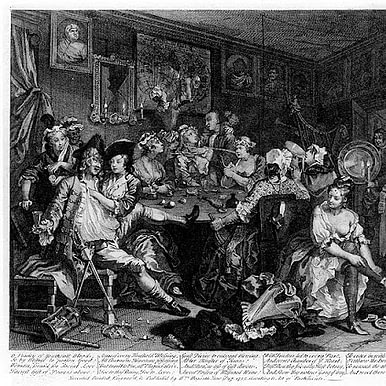
There is increasing recognition, even within the food industry, and by most consumers of all political hues, that many aspects of the current food system are unsustainable from a health and environmental perspective. Excessive scoffing of junk UPFs is literally destroying the planet and our health. We’re scoffing ourselves into an early grave – just look at obesity rates:
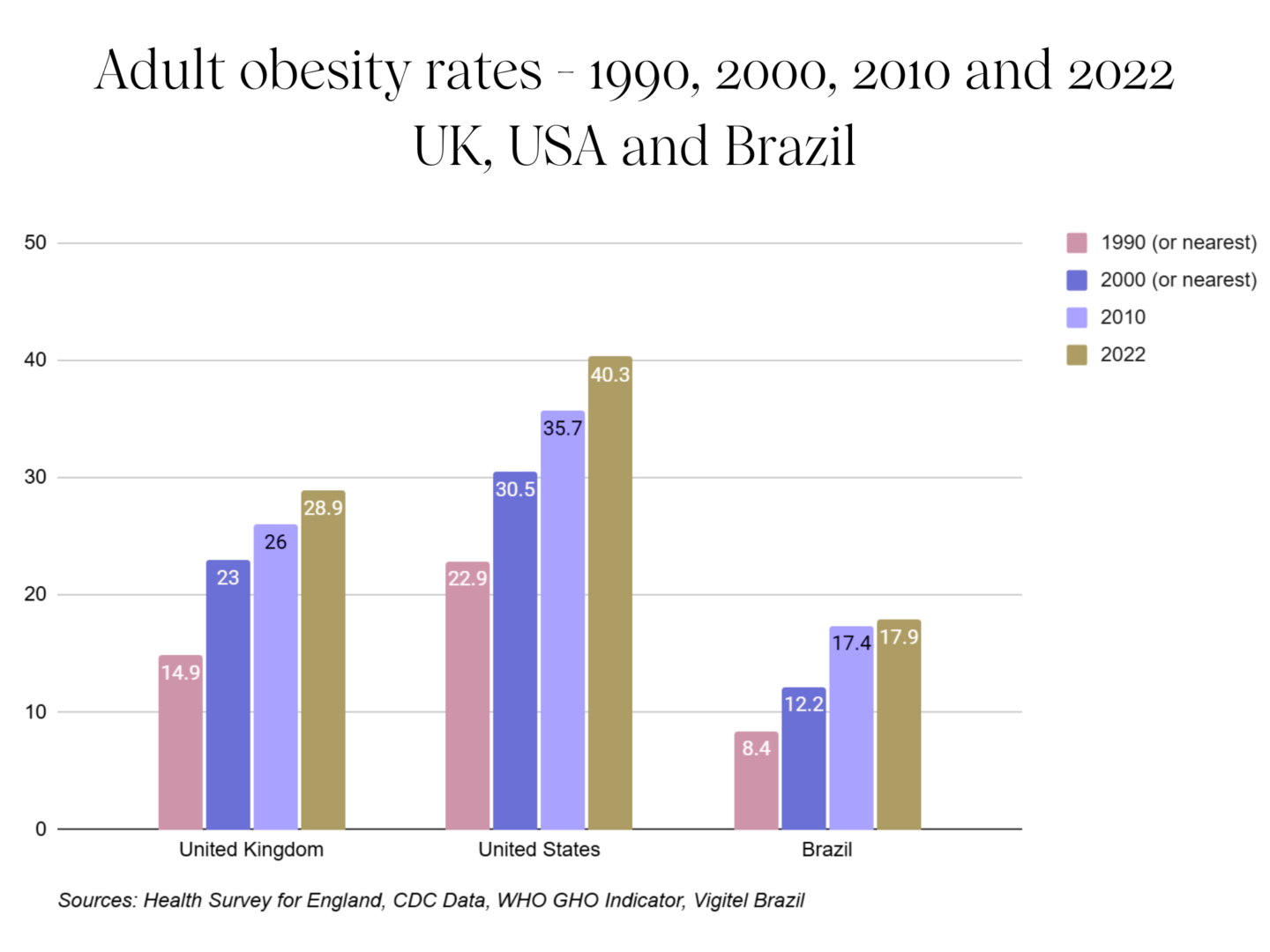
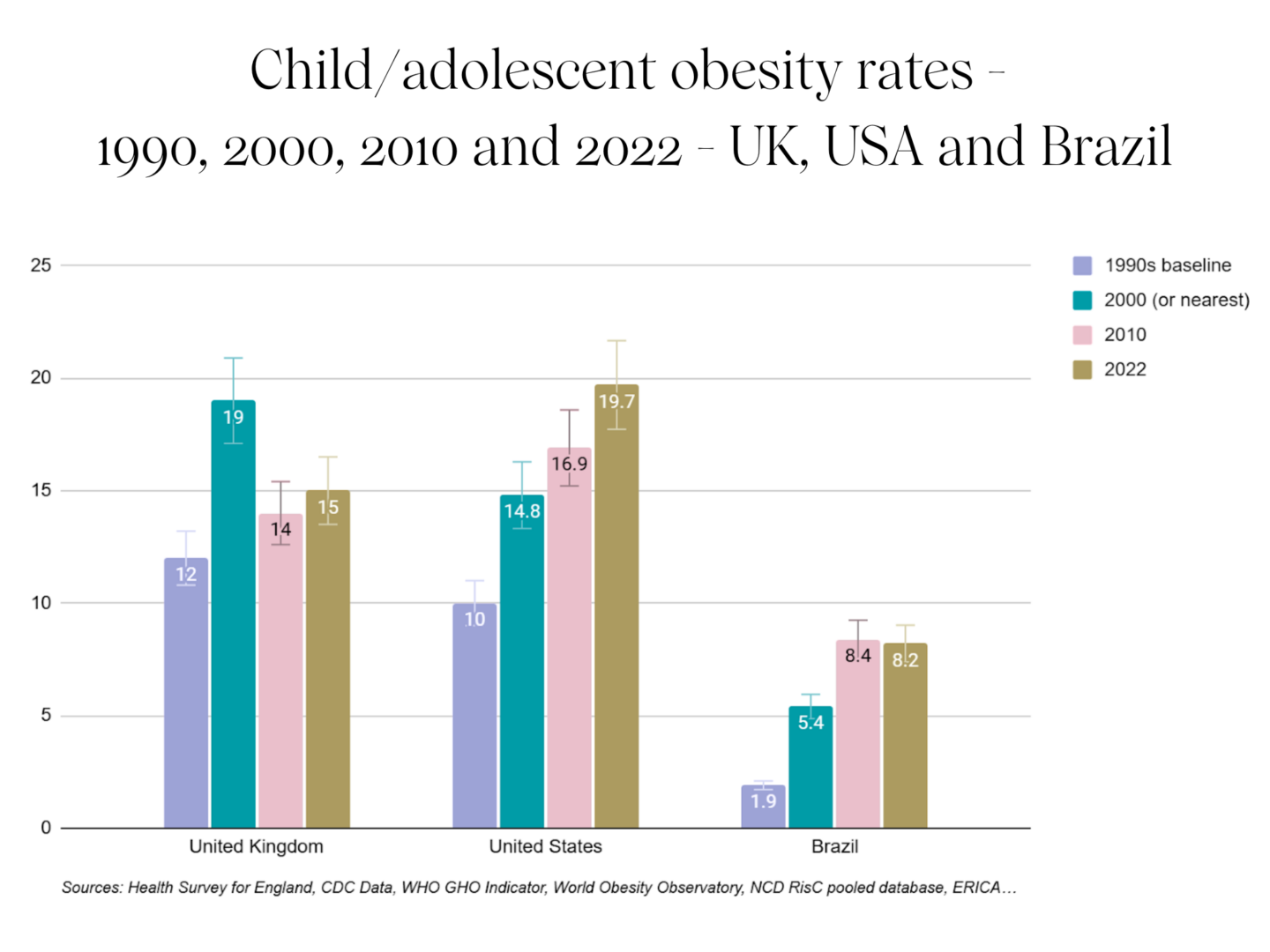
And obesity, as argued by everyone from Casey Means in MAHA to Chris Whittie here in the UK, is leading to all sorts of other chronic illnesses.
Broadly, there have been three different approaches to this problem. The wishful “silver bullet” approach. The “top down” government “can sort it”. And then finally, arm consumers with more tools. They all have a role. And it’s an uphill battle to fight against our instinctive love of sweetness, saltiness and fattiness in foods that make Big Food’s amazing returns.
Silver bullets
Silver bullets are wonderfully attractive. And the food industry has spawned huge industries here across diets, health foods, supplements, exercise, pharmaceuticals, medical procedures, etc. Eat less fat. Eat fewer carbs. Exercise more. Try the latest diet. And the latest silver bullet are GLP1 weight loss drugs like ozempic, wegovy, etc.. Perhaps GLP1s, and other new drugs, will help address the obesity epidemic. But these drugs don’t mean that people are switching to a healthy diet; they’re just eating less. Plus GLP1s don’t offer any solution to the degradation of soils, deforestation, desertification, farmer poverty and labour problems that are endemic to much of the world’s food supply.
If you want to get ahead of the curve and onto the next “silver bullet”, the next time you snap a picture of your food to post to instagram, see what smart AI can do here. Already there are various apps that can assess the macronutrients in the food on your plate to go along with the way your continuous glucose monitor can tell you about how your blood sugar is spiking. (Note: for more on this, and why image recognition, even powered by AI, can’t help with micro or phytonutrients as well as it can support macro nutrient analysis see last weeks blog).
Top down initiatives from government
Given that the most obvious cost of scoffing junk foods is being felt by governments and health services, there have been lots of top down initiatives to try and “fight back” . In the UK alone, in addition to the National Diet and Nutrition Surveys, we’ve had 5 White Papers, 10+ major Official Reviews (House of Lords, POSTNOTES, Marmot review) and dozens more initiatives like HAF, Healthy Start, School Food, Obesity Strategy and the Dimbleby Review, – all since 2010. And you know there is a problem when more is spent on supermarket diet foods and supplements than on the NHS’ entire A&E budget.
But Big Food is fighting an effective campaign against these initiatives. Lots of Big Food are / were part of “Big Tobacco” companies, so they’ve learnt the classic approach of “delay, deny, obfuscate” – and to argue for personal choice and cost. So for example, even though it’s not a silver bullet, it’s increasingly clear that whilst sugar is cheap, a great preservative and VERY tasty, it’s also causing all sorts of health issues (see here). Yet despite the clear successes of the many attempts to educate consumers and restrict clearly abusive sales techniques (school vending machines only selling soda, special offers, etc.) for the last three governments here in the UK, “round 2” of the anti HFSS measures have been stonewalled.
Bottom up initiatives
Many consumers are more than aware of the need to eat more healthily. And they are well served with super smart experts who are also expert at communicating – see the appendix for a list of works by the likes of Michael Pollan, Tim Spector, Chris Van Tulleken, Bee Wilson, Michael Moss, Marion Nestle, Stuart Gillespie, Joanna Blythman to name but a few. Here is some of the great advice they propose:
- Check the ingredients. As Michael Pollan advises “Don’t eat anything your great-grandmother wouldn’t recognize as food”. It’s probably a “food like substance”. And similarly, if sugar is the primary ingredient, think again.
- Check the packaging. As Chris van Tulleken points out, if it’s wrapped in plastic, shelf-stable, and brightly branded, it’s often a red flag for ultra-processed food.
- Choosing fresh, unpackaged, or simply labelled products is one way to avoid hidden additives and synthetic ingredients.
- Lobby for tighter food labelling requirements. For example, in 2011 the EU introduced Regulation 1169/2011 requiring far more specificity in where foods are grown and then processed.
The problem
Unfortunately not everyone reads labels. And although these suggestions and best practices help a LOT, “Big Food” has had a lot of time to “blunt” the power of these tools.
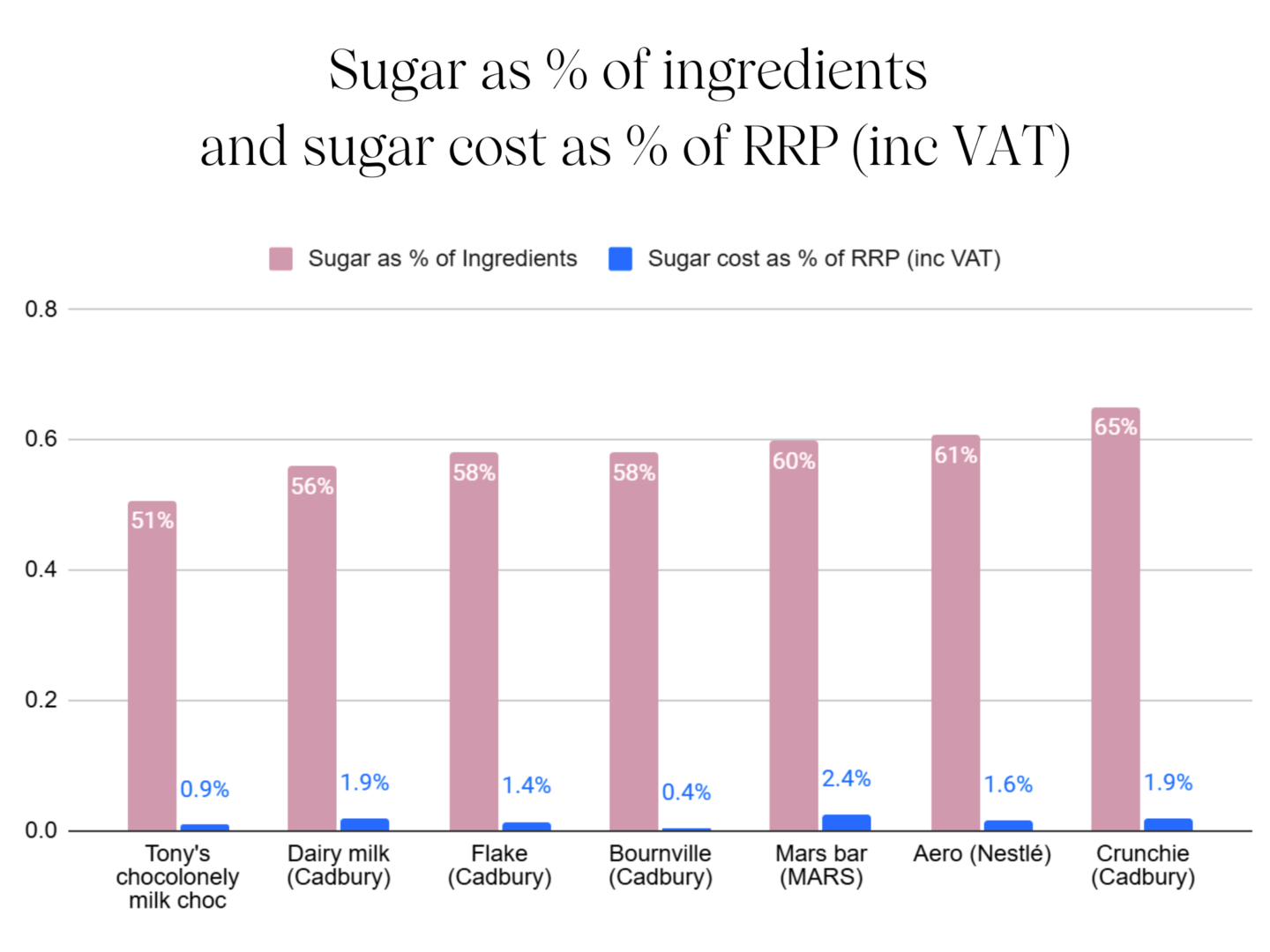
For example, as Joanna Blythman noted over a decade ago, Big Food secured an exemption for “processing agents” as being listed on the ingredients list. That’s why although many processed cheeses contain all sorts of inclusions like aluminium salts, these don’t need to be listed on the ingredients list. Read her book too for more on how the likes of “natural flavourings” are not at all what they seem. And to take an example from chocolate look at the ingredients list on a bar of Cadbury Dairy Milk. Sugar is over 50% of the bar’s ingredients, but using a “milk crumb” blend allows “milk powder” to appear first in the ingredient list – an example of composite ingredients reshaping ingredient order.
Or turning to origin labelling. Ever wondered why until recently many carrots were labelled “packaged” or “processed in the UK”? That’s because even if they were grown in Spain, if they were put into bags in the UK, they could be described as “Packaged in the UK”. This loophole has now been closed. But for chocolate, it was never even opened. Big Chocolate successfully lobbied the EU for an exemption to Origin Labelling in the 2010s on the grounds that i) this would mean they’d have to increase costs as they relied on being able to substitute different countries’ cocoa to purchase as cheaply as possible and ii) because the primary ingredient in most of their chocolate bars was sugar not cocoa.
Source: Websites review
So, back to savouring
If you want to cut down on sugary foods, you can of course read the label very carefully and also the nutritional breakdowns.
But you can also rapidly train yourself as you “savour” a food, to look out for those sugar (or salty or sour) peaks that make you want to have a second bite IMMEDIATELY (even before you’ve finished the first). These quick hits of taste really are very obvious. And as an added benefit, the more you cut down on sugar, the less you’ll crave it and the less you’ll need for a sugar “hit”.
And unlike labelling and sales techniques it’s far harder for Big Food to bamboozle us here. Indeed they are so heavily reliant on (ab)using our sense of taste that by getting us to be mindful of not just taste but also flavour, that flavour may be our secret weapon to fight back. Big food can do “artificial” flavours, but real flavour is far more complex and delightful, and it is reliant on farmers treating their crops as more than commodities, looking after the health of their soil and on makers crafting flavour out of great cocoa beans.
To mount this counter attack, to break the habit of scoffing more and more ultra processed food-like substances, we need to understand a bit more about both how taste and flavour “work”. Despite using the words interchangeably, and their complex relationship, our sense of taste and our sense of flavour are very very different.
In praise of taste – and why it’s different to flavour
Taste is one of life’s greatest delights. It’s a key tool for our evolution and survival, and is instinctive from birth. See how a baby responds to a finger dipped in sugar versus one dipped in a bitter solution. It’s defined as “biological sense” that responds, and tells us when something is sweet, sour, salty, bitter, umami and (arguably) fatty.
As a term, taste is also used more broadly to describe not just these basic tastes but also the likes of aromas, flavours, spiciness, mintiness, astringency and even textures. These are VERY different. Spiciness, mintiness and astringency are grouped under the heading of chemesthesis and are trigeminal (for more see here). Similarly texture and mouthfeel are very different, working more like touch.
We cover this as part of our regular chocolate tastings, and also in more depth in our day long Taste and Flavour Masterclasses. And it’s a lot easier to explain when we can give you some wonderful craft chocolate to experience, but below is a quick overview of what makes taste and flavour so different – and the difference between scoffing and savouring.
TLTR SUMMARY (Too Long To Read) If you want to “savour” this summary chart later, here is an attempted summary:
- If you feel like scoffing / gobbling and all you get is a quick “hit” of sweetness, salt and/or sourness, and you IMMEDIATELY want a second bite, you are probably being gamed by Big Food into scoffing an ultraprocessed food-like substance. By contrast if you can savour, and as you do this delight in all sorts of different sensations (ie flavours), you are far more likely to have some “real” food – that is also healthier for you. But this isn’t instinctive, and it requires some (fun) learning.
- Scientists working in, and for, Big Food are REALLY, REALLY good at hijacking our instinctive love for combinations of basic tastes and textures that give us a quick hit and wanting more.
- Nature, helped by craft chocolate makers (and artisans of many other foods and drinks), is great at revealing complexities of flavours that are long, balanced and intense.
- So invest a little time in developing your “language of flavour”. Acquire a new habit – when you eat anything, discuss it with your friends and family. And in particular, have a couple of squares of craft chocolate at the end of the meal to explore and discuss, discuss their “flavour waves”, “BLIC” (balance length intensity and complexity) and try to articulate what flavours and sensations you can detect.
Note: this isn’t to say that all “guilty” treats are “bad”; far from it. Lots of craft chocolate can be incredibly moreish (and scoffable). But craft chocolate is real food. It’s not packed with sugar, artificial ingredients, etc and it’s also not ultraprocessed (for more on what makes chocolate ultraprocessed, please see here). Craft chocolate can take you on a flavour journey with BLIC (balance, length, intensity and complexity) – and acknowledging this journey is a great way of knowing that this is better for you, and better for the farmers and planet.
High level comparison of how “taste” and “flavour” are different – and a few “so whats”
Read on to understand how you detect mouth flavours via your nose, why aromas and flavours can be so evocative, why flavours can be hard to put into words and why humans’ sense of smell is up there with bloodhounds. AND ABOVE all why it pays to be a bit more mindful!
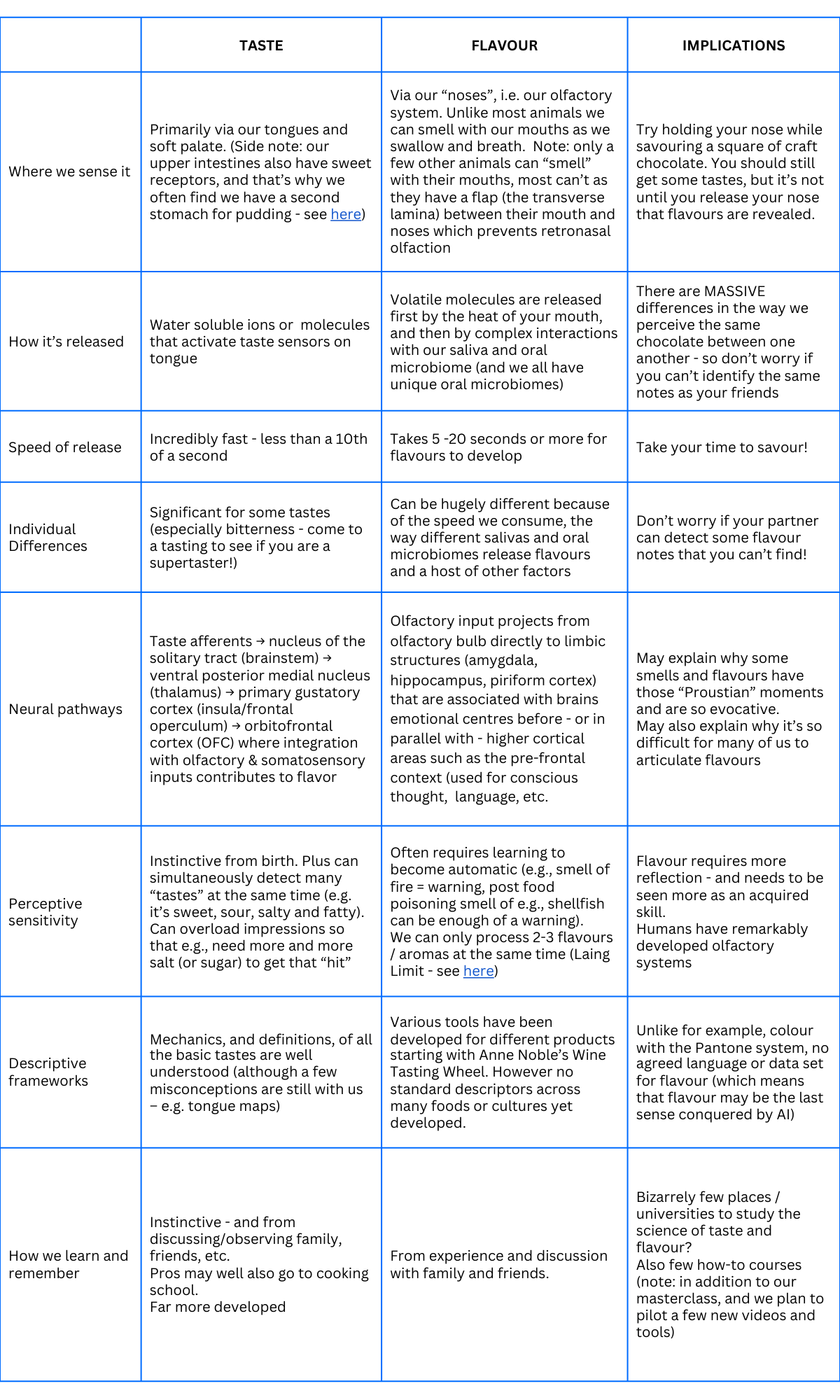
If you find the above table interesting, do come to our MasterClass .. we spend literally a day unwrapping all this and more.
Putting all of this together: From birth, we are programmed to like sweet, fatty, salty stuff that is easy to swallow. These tastes and preferences are instinctive. Over the past century, scientists in Big Food have done an extraordinary job in developing insights like the bliss point, hyper palateability and sensory specific satiety to hijack these basic instincts and to shift all our diets to one where we scoff ultraprocessed food-like substances.
At the same time as we eat more and more of these ultraprocessed foodlike substances and as we eat them “on the go” (in the US, the broadcaster CBS suggests that 19% of all adult meals and snacks are eaten in cars) and on our own (in the UK an estimated one third of UK adults eat on their own most of the time). So we are losing the ability to discuss and learn the language of flavour. We lack the time and company to savour. A question for you – when was the last time that you tried to describe to someone what you are eating with the flavours you’ve enjoyed in the meal (or coffee, tea, glass of wine, etc.)? Now think about a really great meal in a restaurant – what do you remember (in addition to the company)? Odds are it’s that the experience was marked by foods that had complexity, length, balance and intensity. That amazing tomato salad, that wonderful chocolate pudding, those delicious vegetables were full of FLAVOUR – they weren’t bought in a supermarket because they were cheap or on offer.
In addition to being more delicious, there is another reason to learn to appreciate flavour. Flavour is the way that nature shows us a food is full of nutrients, vitamins, minerals, phytonutrients and HEALTHY.
Summary:
Taste is instinctive, hardwired from birth, easy to describe (sweet, sour, salty, bitter, umami, fatty) and IMMEDIATE. Flavour, by contrast, is far richer—driven by aromas, textures, and chemesthetic sensations—and requires learning, reflection, and discussion to appreciate. Flavour is complex, and takes time. Big Food exploits our innate taste preferences to push ultraprocessed, “scoffable” foods, while craft chocolate and other real foods offer complexity, balance, and intensity that reward savouring. Developing a “language of flavour” not only enriches meals but also helps us reconnect with food’s true nutritional value.
The importance of flavour in nutrition
Flavour is nature’s way of communicating a food’s hidden nutritional complexity. Think of hand-picked berries or home-grown tomatoes—they burst with flavour and phytonutrients. That flavour isn’t just pleasant—it signals real nutritional value. In a landmark USDA-based study, Dr. Donald Davis found that between 1950 and 1999, many garden vegetables experienced statistically reliable declines of up to roughly 38% in protein, calcium, phosphorus, iron, riboflavin, and vitamin C.
On the flip side, regenerative farming can reverse that trend. Herb Young, after decades at Bayer, experimented with regenerative citrus production and found an astonishing 800% increase in nutrient density compared to conventionally grown fruit—a change he attributes to restored soil microbial health There’s more. Research by Fred Provenza and others has shown that animals—and even human infants—use flavour cues instinctively to guide them to foods that meet their nutritional needs. Their sensory systems help them ‘read’ which foods are health-supportive. To quote Fred : The nutritional and flavour quality of foods are intimately linked, yet flavour—fuelled by nutritional integrity—has declined dramatically alongside convenience, processed food.
And then there’s Clara Davis. In the 1920s she carried out a remarkable experiment with a group of orphaned infants in Chicago, many of whom arrived malnourished and suffering from rickets, scurvy, anaemia, and other diet-related illnesses. Davis offered them free choice among a wide range of unprocessed whole foods—meats, grains, fruits, vegetables, milk, even bone marrow—without any adult prompting or guidance.
What followed was extraordinary. Left to their own instincts, the children consistently selected diets that were not only varied but nutritionally complete. One child with rickets, for example, regularly chose cod liver oil until his bones strengthened, and then stopped. Another suffering from scurvy gravitated toward oranges and tomatoes until the deficiency was corrected. Over time, the children naturally adjusted their choices—sometimes seeking out iron-rich meats, sometimes vitamin-dense fruits, sometimes fatty cuts or marrow—depending on their bodies’ needs.
The key was flavour. With palates uncorrupted by refined sugar, artificial additives, or hyper-processed foods, the children could still ‘read’ nature’s signals. Within a few years, the group as a whole thrived: healthier, stronger, and free from the illnesses they’d arrived with. Davis’ study, controversial then and now, remains one of the most striking demonstrations that humans possess an innate capacity to select nourishing diets – if flavour is allowed to guide us.
Part of this is the way that Big Food has bred tomatoes, berries, carrots, etc. that are designed for fast and high yields, a standard look and feel, and to be transported across massive distances without blemishing, bruising or getting overripe. Flavour is very rarely a factor in how commodity crops are engineered, bred and developed.
Flavour is more than the variety of berry or tomato. It’s also a reflection of how the plant has been grown, whether it’s been smothered in pesticides and fertilizers – to quote Tim Spector, too much fertilizer / pesticides stops a plant from developing naturally and benefiting from the “struggles” that underpin nutritional complexity and flavour. Soil health also plays a key role here (come back soon for more on this with David Montgomery and Anne Bikle). Again, check out the claims of regenerative agriculture for yourself.
Compare a high quality extra virgin olive oil to a “supermarket standard”. Same for a carrot, or strawberry grown on an allotment compared to bland, “cheap” supermarket alternatives.
And craft chocolate, because of its nutritional complexity, is a fantastic tool to learn how to savour and articulate flavour. Plus it’s delicious. And–see below–it’s healthier for you too!
Summary: Flavour is nature’s signal of nutritional complexity: when crops are grown in healthy soil and without (excessive) pesticides, fertlizers, etc. they develop richer taste and higher nutrient density. They are the antithesis of the bland, depleted produce of industrial farming. Learning to savour flavour—whether in berries, olive oil, or craft chocolate—helps us reconnect with food’s true health benefits.
Chocolate and health
All sorts of claims are made for the health benefits of chocolate. And we’ve written about many of them (see here for heart health, here for polyphenols, here for teeth health).
We’re sceptical about a lot of the marketing hype. We don’t buy into the idea of “superfoods.” And we do believe that dark craft chocolate, enjoyed in moderation, can offer genuine benefits. Chocolate CAN BE high in everything from fibre to critical minerals, polyphenols to theobromine and much more. Plus a couple of squares of dark craft chocolate make a great dessert and to satisfy your second stomach (yes, you really do have one see here).
But these benefits aren’t in all chocolate and chocolate snacks. The way the chocolate has been crafted and grown, what else is in the product (what additives, preservatives, how much sugar, etc.) make a massive difference.
Checking the packaging and ingredients offers some clues. And you can do some personal measurement yourself via e.g. a continuous glucose monitor and even your phone camera (see last week’s blog post).
However there is an even more fun way to assess the quality, and the healthiness, of a chocolate bar. Your sense of flavour.
For example, there’s growing evidence that the polyphenols in dark chocolate, combined with a few other phytochemicals in chocolate, can:
- Reduce inflammation
- Help address insulin deficiency
- Improve heart health (but be wary of some of the earlier claims and history see here)
- Nourish gut health and microbiome diversity
- Lower blood pressure (also helped by the theobromine in chocolate)
However, even though chocolate is among the richest commonly consumed foods in terms of polyphenols, the impact of these polyphenols varies massively. Partly this is down to individual gut microbiomes (see the Zoe study here). But it’s also hugely dependent on how the beans have been farmed and processed. In particular polyphenol levels can be destroyed by “alkanisation” and by high temperatures – so how beans are fermented, dried and roasted is CRITICAL. Plus the cocoa percentage, and what else is added, makes a huge difference (so sorry milk and white chocolate lovers, there aren’t many polyphenols in these kinds of chocolate).
In particular dark chocolate has the potential to be super high in polyphenols …
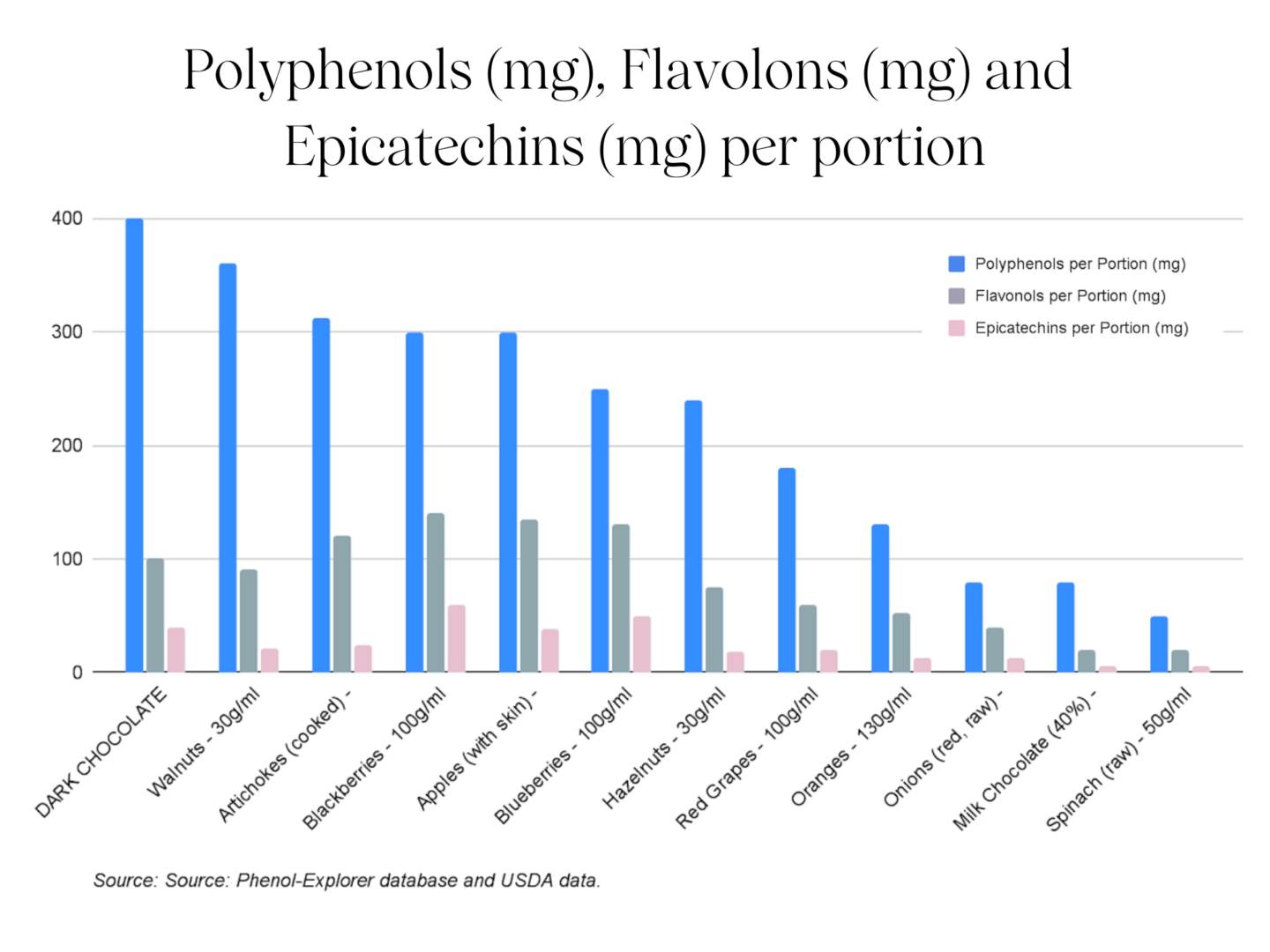
And the type of chocolate bean, the way the chocolate is processed (especially roasted) and what is added to it (e.g. milk or alkalisation) dramatically changes polyphenol levels.
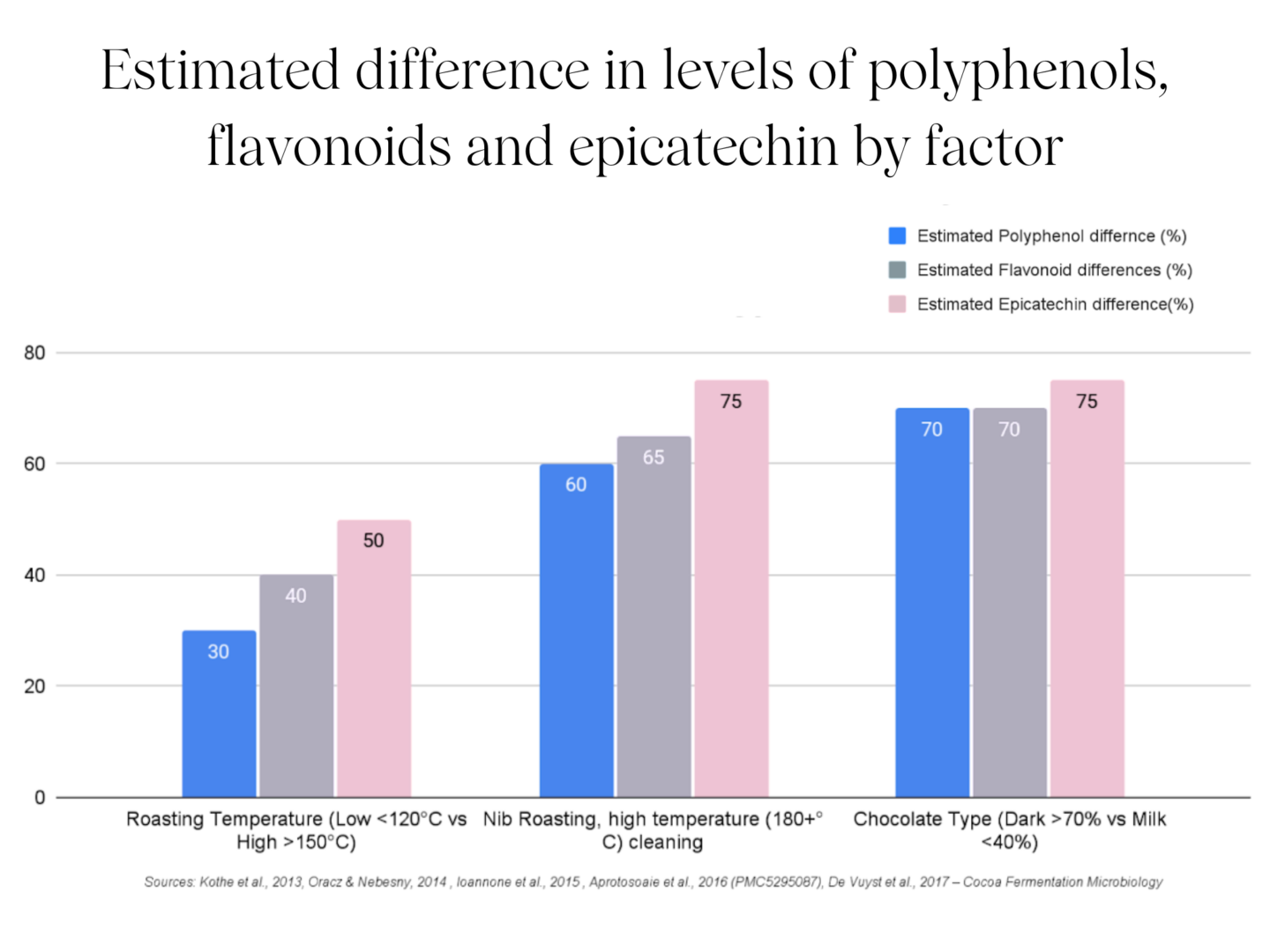
Craft chocolate is incredible at putting on its packaging details as to how beans are farmed, fermented, dried and roasted. Check out Standout, Baiani, Mestico and Fresco for some great examples. Big Chocolate is far more secretive. However a lot can be gleaned from a careful reading of their patent applications and various manufacturing interviews in the specialist press. If they are applying these processes and patents, the polyphenol count in their chocolates is likely to be low because of the heat applied during cleaning and roasting (see here for more). But roasting profiles, bean types, fermentations etc aren’t disclosed on the packaging of Big Chocolate, nor is it recorded in any public nutritional databases.
Fortunately there is another potential way to assess some of these secrets: our palate. It’s an excellent guide to judge roasting (and over roasting, poor fermentation and over drying). Once you learn to look for BLIC (balance, length, intensity and complexity of flavour), you can also – for example – start to identify over-roasting (and examples of other means to hide this, like adding vanilla or covering with sugar and additives). And so the next time you get a supermarket bar, you’ll be able to (literally) taste the difference – as almost all of these are roasted at far higher temperatures (and nib roasted). Come to a tasting to taste for yourself!
PS: please don’t fall for the claims of raw chocolate – see here for more. If you want to try an unroasted bar, please try Raaka or Conexions Virgin Roast.
Summary: Not all chocolate is healthy—its benefits depend on how the beans are grown, processed, and crafted. And if you want chocolate that truly delivers the benefits of polyphenols, flavonoids and epicatechins, you need to choose Craft Chocolate—free from additives, un-overheated or alkalised. Unfortunately, Big Chocolate can be masterful at confusing us with misleading marketing and packaging claims, so it’s not always obvious how the beans in a bar have been sourced and crafted; fortunately, your sense of flavour is the best guide.
How to savour
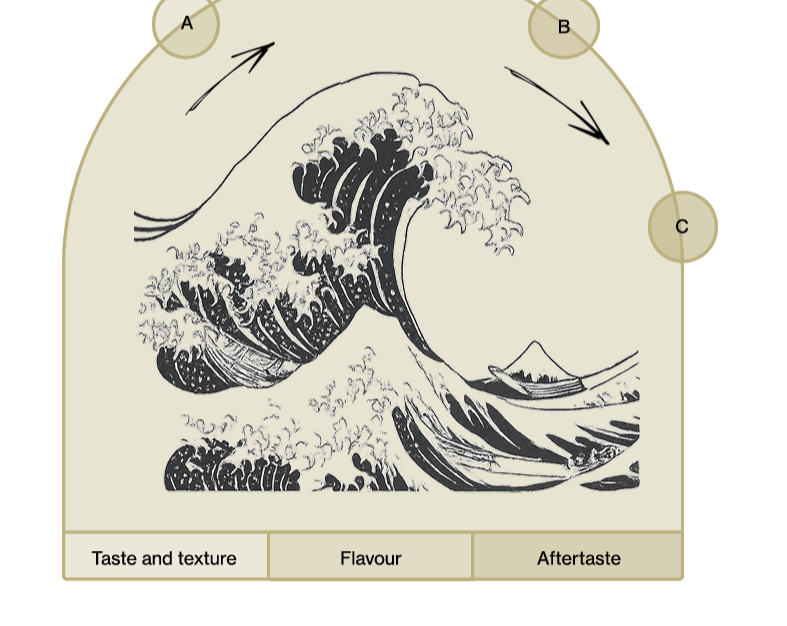
Below are some “crib sheets” that we’ve developed specifically for craft chocolate. If it seems similar to how you’ve been taught to appreciate coffee, tea, wine or cheese, that’s not accidental! Massive thanks to James Hoffmann, Professor Barry Smith, Rebecca Palmer and Peter McCombie for their support. It tries to break down savouring into a wave of three different, overlapping sensations.
- First: Taste and Texture
- Second: Flavour Wave(s)
- Third: Aftertaste and appreciation
See below for how we talk this wave through in our tastings
- Start by the sniffing, snapping and describing the look of the chocolate
- Let the chocolate melt .. and immediately start to describe the basic TASTES (sweet, sour, salty) and TEXTURES (smooth, grainy, silky, sandy, etc.) – NOTE: THESE SENSATIONS ARE IMMEDIATE!
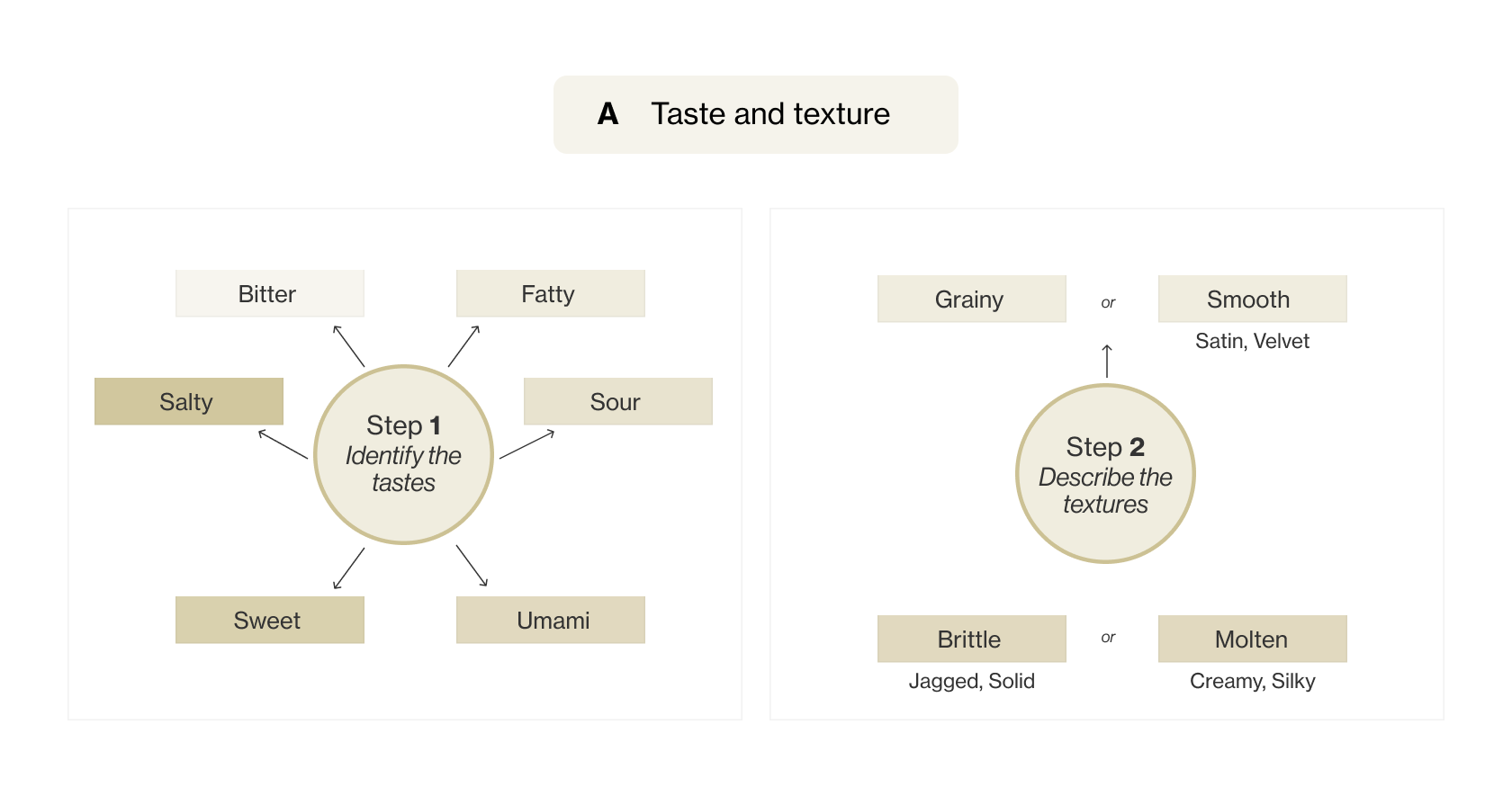
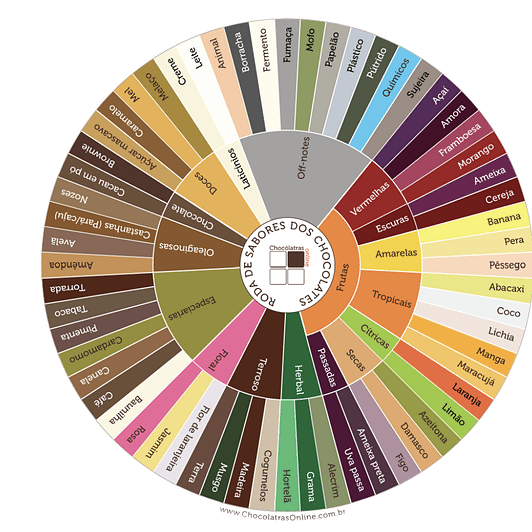
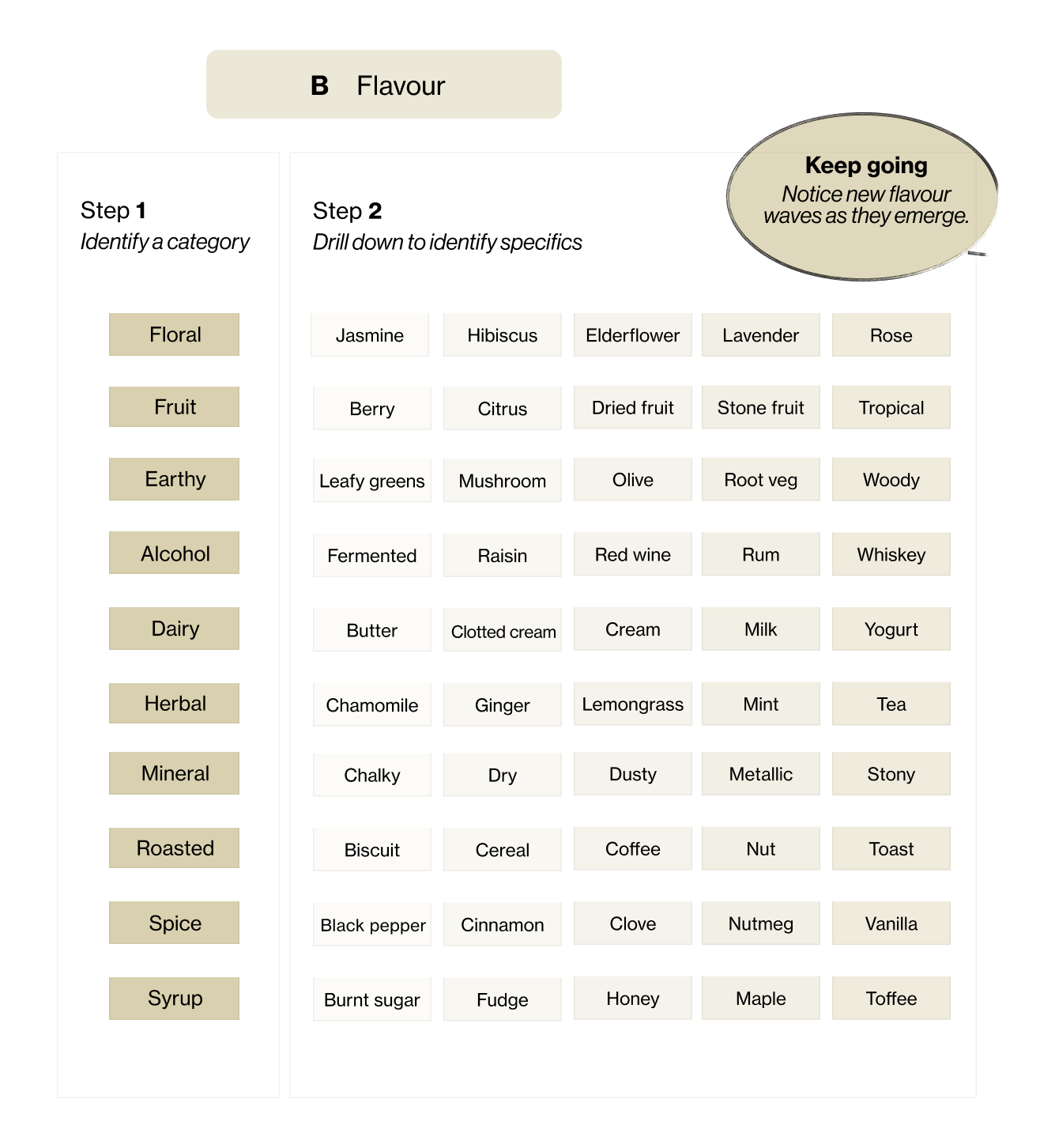
3. Identify, and articulate, waves of different flavours as they come in over the next 5-20 seconds; try to hone in by identifying first if e.g. fruity or floral, or nutty, minerally And then try to work out what sort of fruit – citrus or berry, pineapple or mango. And also be prepared for very different flavours to emerge, and also other tastes and senses (e.g. astringency)
- Floral
- Fruit
- Earthy
- Alcohol
- Herbal
- Spice
- Roasted
- Mineral
… and then try to pin down what sort of fruit (berry, stone, banana, etc), spice (pepper, cinnamon, nutmeg, etc.) and discuss this with a friend – see the image below/
4. Rinse and repeat. Try another piece. See the next set of flavours you can identify
5. Then try with a second bar too. It’s far easier to identify flavours by sensing differences between two different bars than by drilling down into one bar. And that’s another advantage chocolate has; it’s easier to keep a couple of bars “on the go” than to brew two coffees or open a different wine.
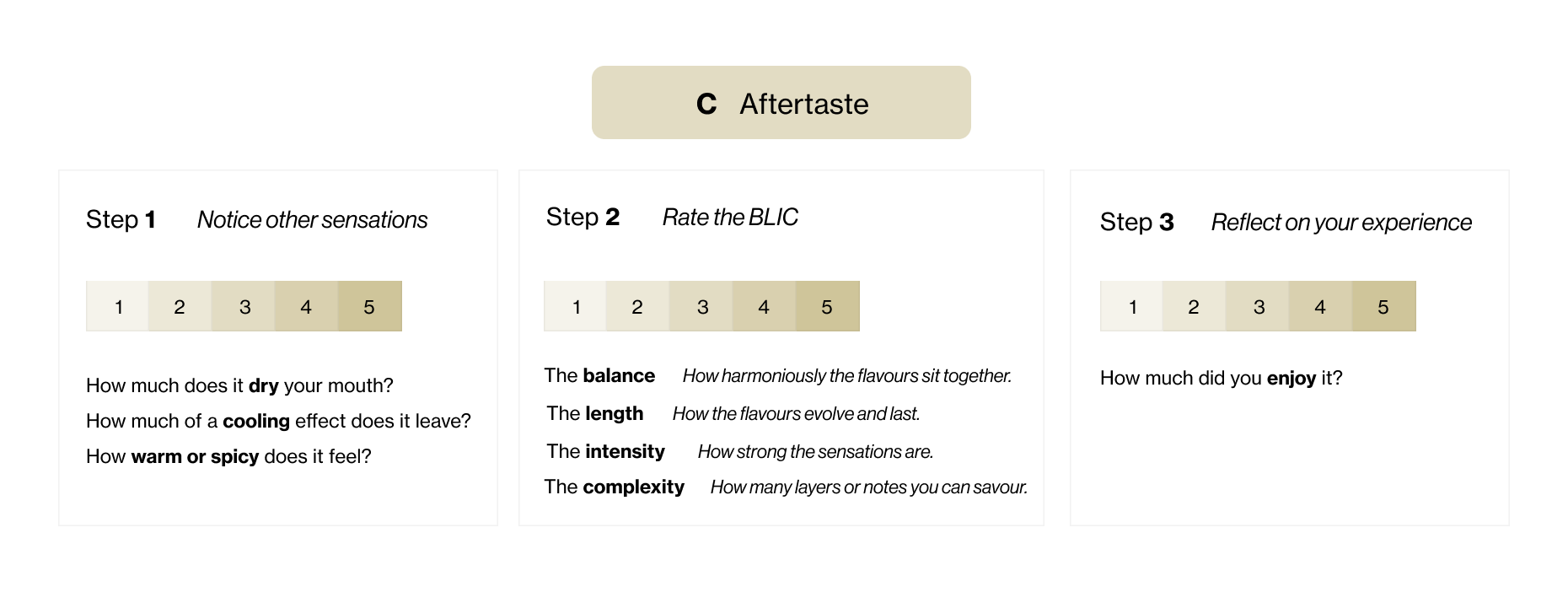
6. Then reflect on the aftertaste. What other sensations – e.g. any astringency? (ie does your mouth pucker and dry out). How was the overall “balance, length, intensity and complexity” (what we call BLIC for short). And above all, did you enjoy the bar!
It’s really easy to do. It just takes a couple of moments. You’ll have fun. And in no time you’ll develop a new language. And it’s even quicker than Duolingo! And as we’ll explain in a later post (and at a tasting) chocolate is BRILLIANT here as it involves so many complex flavours.
To savour, be mindful and to get even more out of your food, it really helps to “learn the lingo”. And so we hope that these flavour practises and languages when used with savouring craft chocolate can be a similar start. What you can articulate you can appreciate. When you can savour the flavours in a food, it’s nature’s way of saying that this food is healthier.
Thanks – next week we’ll explore some of the other benefits from savouring, everything from literally how it’ll change your brain to improve your mood and social life
SOME PAST ARTICLES· https://cocoarunners.com/chocopedia/why-your-second-stomach-always-has-room-for-craft-chocolate/
· https://cocoarunners.com/blog/heavy-metals-in-chocolate-how-worried-should-we-be/
· https://cocoarunners.com/blog/drinking-chocolate-and-heart-health/
· https://cocoarunners.com/chocopedia/savouring-slurping-spitting-saliva/
· https://cocoarunners.com/chocopedia/debunking-raw-chocolate/
Scientific Sources on Polyphenol Degradation in Cocoa Processing
Ioannou, I., & Ghoul, M. (2013). Effect of roasting on polyphenols and antioxidant capacity of cocoa beans. Food Chemistry, 129(2), 401–408. https://doi.org/10.1016/j.foodchem.2011.04.096
Miller, K. B., et al. (2008). Impact of alkalization and roasting on the flavanol content of cacao beans. Journal of Agricultural and Food Chemistry, 56(10), 3111–3117. https://doi.org/10.1021/jf073018u
Kothe, L., Zimmermann, B. F., & Galensa, R. (2013). Temperature influences epimerization and composition of flavan-3-ols in fermented, dried, and roasted cocoa beans. Food Chemistry, 141(4), 3656–3663. https://doi.org/10.1016/j.foodchem.2013.06.049
Othman, A., Ismail, A., Ghani, N. A., & Adenan, I. (2007). Antioxidant capacity and phenolic content of cocoa beans. Food Chemistry, 100(4), 1523–1530. https://doi.org/10.1016/j.foodchem.2005.12.052
Afoakwa, E. O., Paterson, A., Fowler, M., & Ryan, A. (2008). Flavor formation and character in cocoa and chocolate: A critical review. Critical Reviews in Food Science and Nutrition, 48(9), 840–857. https://doi.org/10.1080/10408390701719272
Torres-Moreno, M., Tarrega, A., Torrescasana, E., & Blanch, C. (2015). Changes in chemical composition and sensory properties of dark chocolate during storage. LWT – Food Science and Technology, 62(1), 416–421. https://doi.org/10.1016/j.lwt.2014.06.056
Books
Pollan, Michael. *In Defense of Food: An Eater’s Manifesto*. Penguin, 2008.
Pollan, Michael. *Food Rules: An Eater’s Manual*. Penguin, 2009.
Spector, Tim. *Food for Life: The New Science of Eating Well*. Jonathan Cape, 2022.
Van Tulleken, Chris. *Ultra-Processed People: The Science Behind Food That Isn’t Food*. Cornerstone Press, 2023.
Moss, Michael. *Salt Sugar Fat: How the Food Giants Hooked Us*. Random House, 2013.
Nestle, Marion. *What to Eat*. North Point Press, 2006.
Blythman, Joanna. *Swallow This: Serving Up the Food Industry’s Darkest Secrets*. Fourth Estate, 2015.
Grivetti, Louis E. and Howard-Yana Shapiro. *Chocolate: History, Culture, and Heritage*. Wiley, 2009.
Articles and Regulations
- European Union. Regulation (EU) No 1169/2011 on the provision of food information to consumers.
- European Union. Directive 2000/36/EC relating to cocoa and chocolate products intended for human consumption.
- Forde, C. G. (2018). ‘Oral processing, texture and satiety: The importance of eating behaviours in the control of energy intake and weight management.’ Current Obesity Reports.
- Rolls, B. J., Rowe, E. A., & Rolls, E. T. (1981). ‘Variety in a meal enhances food intake in man.’ Physiology & Behavior.
- Joanna Blythman. ‘Swallow This – Have You Ever Wondered What’s Really in Your Food?’ The Guardian, 2015.
- Chris van Tulleken. Interviews and media based on *Ultra-Processed People* (BBC and podcast appearances, 2023).
Further Reading
Dirt Poor: Have Fruits and Vegetables Become Less Nutritious? – Scientific American
Herb Young: From Bayer to Nutrient-Dense Citrus (Investing in Regenerative Agriculture Podcast)
Are We Born Craving a Balanced Diet? – Discover Magazine
Results of the Self-Selection of Diets by Young Children – Clara Davis (Canadian Medical Association Journal, 1939)