(Another) Rant on Sugar, and a plea for transparency
An ingredient you'll usually find in a chocolate - sugar. This week, we dive into the history and why there's such a lack of transparency.
Print / PDFThis is (another) rant about sugar. And it’s also a rant about the importance of transparency – and the way Big Food, and Big Chocolate and Big Sugar, are incredibly good at avoiding transparency.
Craft chocolate prides itself on transparency. Increasingly on the front of many labels, Craft Chocolate makers will list where they source their beans, backing this up with “transparency reports” on how they pay their farmers, fermentation approach, etc. They know that without the dedication of the farmers to growing great beans, makers can’t craft great bars. And they take great pride in the likes of reforestation initiatives around these direct, transparent relationships. (Side note: as well as tasting all of the 1000+ bars we sell, at Cocoa Runners we also won’t sell a bar unless we know how, and who, has grown the beans in a bar down to the region, farm, cooperative or even individual growers). And when we talk to these same Craft Chocolate makers, they will also happily explain which sugar they use, why they chose it, and where it comes from as they know that the addition of sugar to a bar (often less than the total sugar in an apple), is key to a bar’s flavour.
Big Chocolate (and big food) takes a very different approach. Big Chocolate successfully lobbied against the introduction of “country of origin declarations” for the chocolate in EU (and UK) sold bars and snacks back in the 2010s (see below for the extraordinary logic they used details). And along with the rest of Big Food, Big Chocolate also obfuscates how much sugar it uses, why it uses this sugar (hint it’s not just because we like sweet stuff) and how it sources its sugars. This is despite the fact that sugar often makes up the largest proportion of many mass market bars. For example, for at least 14 of the 20 bars that Tony’s Chocolonely sells in the UK, sugar is listed as the primary ingredient. But because Tony’s sugar is sourced via “mass balance”, and because sugar (like chocolate) is exempt from country of origin disclosure, the source of this sugar is opaque.
Most of the sugar consumed in the UK comes from pre-made drinks and foods – everything from breakfast cereals to barbecue sauces, bread to ready meals, fizzy drinks to protein shakes. Note – in UK survey data collected from 2008 to 2014, ultra-processed foods supplied 64.7% of free sugars. Confusingly, “added” sugar is really just part of a wider category called “free” sugars, which also includes sugars naturally present in honey, fruit juice and syrups, even though nobody’s technically “added” those). By contrast, relatively little sugar is “added” in the home when, for example, we add it to our tea or coffee, or cook with it. Much of this added sugar involves horrific costs to both the environment and to the farmers growing it (especially cane sugar – see below). This extra sugar also has been a major factor in the obesity crisis – a problem still resisted by much of big food. And it’s not one that can be solved by telling people to add less sugar to their tea/breakfast cereal/tomato sauce – it has to be addressed further up the supply chain.
Fortunately, over the last few decades the UK has done a great job – finally – of introducing various measures against foods and drinks high in sugar (and latterly also high in fats and salts too). And the threat of higher taxes, measures to restrict marketing and sales to children along with steps to try and educate consumers, has helped reduce sugar consumption.
But Big Food (and Big Chocolate) hasn’t given up – and the current government has announced it intends to repeal the multibuy and aisle-placement restrictions in favour of ‘smarter regulation’ — even though the multibuy ban itself had only just come into force on 1 October 2025. So it’s important to try and get some transparency on this – starting with an understanding not just of the health issues surrounding sugar, but also why Big Food increasingly so relies on sugar, and also on sugar’s often gruesome supply chain.
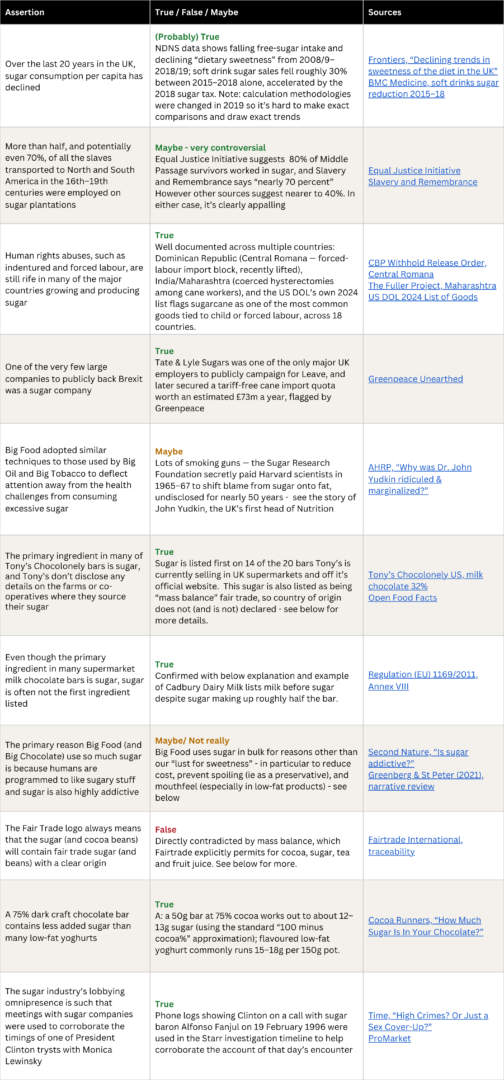
To test your “sugar IQ”, here are a few ‘true or false’ questions – and hopefully they’ll help explain why sugar merits a rant and more transparency.
- Over the last 20 years in the UK, sugar consumption per capita has declined
- More than half, and potentially even 70%, of all the slaves transported to North and South America in the 16th–19th centuries were employed on cane sugar plantations
- Human rights abuses, such as indentured and forced labour, are still rife in many of the major countries growing, and producing, sugar (especially cane sugar)
- One of the very few large companies to publicly back Brexit was a sugar company
- Big Food adopted similar techniques to those used by Big Oil and Big Tobacco to deflect attention away from the health challenges from consuming excessive sugar
- The primary ingredient in many of Tony’s Chocolonely bars is sugar, and Tony’s don’t disclose any details on the farms or co-operatives where they source their sugar
- Even though the primary ingredient in many supermarket milk chocolate bars is sugar, sugar is often not the first ingredient listed
- The primary reason Big Food (and Big Chocolate) use so much sugar is because humans are programmed to like sugary stuff and sugar is also highly addictive
- The Fair Trade logo always means that the sugar (and cocoa beans) will contain fair trade sugar (and beans) with a clear country of origin
- A 75% dark craft chocolate bar contains less added sugar than many low‑fat yoghurts
- The sugar industry’s lobbying omnipresence is such that meetings with sugar companies were used to corroborate the timings of one of President Clinton trysts with Monica Lewinsky.
Not all sugar is “bad”. The majority of the craft chocolate bars we sell contain some sugar. A little sugar can be a good thing, especially in craft chocolate. It helps bring out the flavour of the chocolate – similar to the way a squeeze of lemon or pinch of salt can help “lift” many foods. And flavour encourages savouring and sharing. It’s the antithesis of the approach of Big Food and mass confectionery, where sugar is a key component to encourage scoffing and push down costs. So it’s important to understand why, and how much, sugar is being added. Similarly, given the horrific conditions, and environment costs, under which much sugar (especially cane) is grown, more transparency of supply chains is also critical.
Hopefully you’ll be surprised (and even horrified) by some of the answers below, and it’ll explain why we need more transparency on sugars, history and uses along with far clearer, and “clean” labelling. And it also tries to shed light on how Big Food, along with Big Chocolate and Big Sugar, do their best to avoid this.
A VERY brief history of sugar (early days, slavery, sugar beet, consumption and “transparency”)
History – early days
Sugar cane’s history is normally dated back at least 10,000 years ago in New Guinea, where Papuan farmers domesticated wild cane and chewed the raw stalks for their sweetness. Austronesian voyagers carried cuttings west across the Pacific and into Southeast Asia. Approximately 6-8,000 years later, most likely during the Gupta dynasty (i.e. in the early centuries AD), Indian producers worked out how to boil and crystallise cane juice into a solid, storable product, giving the world both the technique and the word — “sugar” (traced back to the Sanskrit śarkarā). From India, the knowledge spread west via Persia and the Arab expansion, reaching Sicily, Spain and the Eastern Mediterranean by around the 8th to 11th centuries. The Crusades brought sugar to wider European attention, where it arrived as an exotic luxury, sold by the ounce alongside pepper and other spices, and used as often for medicine as for food.
Consumption at this point was miniscule – almost certainly less than a kilo per annum per person even for the wealthiest, with the vast majority of people never adding sugar to any of the foods or drinks they consumed.
History – slave trade
Portuguese and Spanish colonists carried sugar cane cuttings across the Atlantic — first to Madeira, São Tomé and the Canary Islands, then to Hispaniola and Brazil in the middle of the 16th century, and from there into the Caribbean — creating a scale of production, and a scale of labour, Europe had never seen. That labour came from the transatlantic slave trade — and sugar was by far the largest crop underpinning it. Estimates vary, but historians including Sidney Mintz, in Sweetness and Power, put the large majority of enslaved Africans transported across the Atlantic on sugar plantations, concentrated overwhelmingly in Brazil and the Caribbean: over 90% landed there, versus fewer than 5% in what became the United States. Mortality was brutal even by the standards of slavery — cutting cane and running boiling houses in tropical heat killed enslaved workers faster than they could be replaced by birth, part of why the slave trade kept bringing more people across for centuries. And this slave labour was a key part in making sugar cheap enough for ordinary Europeans to put in their tea, coffee and chocolate and a key component powering the industrial revolution.
Consumption grew rapidly. It’s hard to find a single source of data, but pulling together various sources suggests that in Britain, per capita consumption rose from around 1.8kg a year in 1704 to 8kg by 1800 and 41kg by 1901.
History – beyond cane
Sugar beet’s history dates to 1747, when the German chemist Andreas Marggraf found sucrose in beetroot — chemically identical to cane sugar, just hard to extract. His student Franz Achard opened the first beet sugar factory in 1801. When the British blockade in the early 19th century cut Europe off from Caribbean sugar, Napoleon ordered tens of thousands of acres to be planted with beet and subsidised refineries to process it. After the defeat of Napoleon and lifting of the blockade lifted, even though sugar cane was available again beet sugar continued to be grown in the ordinary temperate soils of the UK, France, Germany, the American Midwest, etc. And to this day it remains protected by tariffs supporting European beet over imported cane. Today it supplies around a fifth of the world’s sugar to cane’s four-fifths. Chemically, they’re the same molecule; nothing on a label tells you which one you’re eating (see below for more on this).
Note on Brexit: Tate & Lyle Sugars, which refines imported cane at its London refinery, was one of the few big-name corporate backers of Brexit, betting that leaving the EU’s tariff regime — built to shield Continental beet growers — would let it bring in cane more cheaply. And according to Greenpeace they then seemingly benefited from a post-Brexit tariff-free import quota for raw cane sugar, valued at roughly £73m.
More recently, corn (and in particular US corn) has become a new source of sugar. In the 1950s and 60s, food chemists worked out how to use enzymes to convert corn starch into glucose, then part of that glucose into fructose, producing a syrup (HFCS-55) as sweet, and often far cheaper, than either cane or beet. High-fructose corn syrup reached commercial scale in the US in the 1970s, and by the 1980s the likes of Coca-Cola and Pepsi had switched their American formulas to it outright, and fast food companies also incorporated it into everything from burger buns to sauces. The economics are specific to the US: sugar import tariffs and quotas keep cane and beet sugar artificially expensive there, while corn is domestically subsidised with a price “floor” enacted during the Nixon presidency and the later 1981 farm legislation.
Sugar moves beyond sweetness; how, and why, sugar is now used
By the 20th century, sugar’s job had expanded well beyond sweetening. Food manufacturers were using it as a preservative, a stabiliser and a mouthfeel agent as much as a flavour. High sugar concentrations pull water out of microbial cells by osmosis, which is why jam, marmalade and candied fruit keep for months without refrigeration. In baking it does more than sweeten: it competes with flour proteins for water, which slows gluten formation and keeps cakes tender rather than tough; it’s hygroscopic, so it holds onto moisture and slows staling; and it can give rise to the caramelisation that gives baked goods their colour and depth. In ice cream, it lowers the freezing point of the mix, which is what keeps it scoopable instead of a solid block.
Big Food loves sugar for another reason: it’s stayed cheap. Industrial-scale beet and cane production, ever-improving refining, and — in the US — HFCS undercutting both, kept it that way through most of the 20th century. World prices ran at roughly 10–15 cents a pound for decades, crashed below 5 cents in the mid-1980s glut, then spiked twice — to around 60 cents in 1974, and to around 30 cents in the 2008–11 boom, a thirty-year high. Tariffs and quotas protected producers and forced consumers to pay more. This relative cheapness, combined with its benefits as a preservative etc. meant that sugar moved from a “rationed luxury” to one of the cheapest calories on a supermarket shelf, and one that appeals to most consumers.
The low-fat era starting in the 1980s and 90s gave sugar a further boost. Fat carries flavour and mouthfeel — the body and richness expected from yoghurt, salad dressing, biscuits — and stripping it out for “diet” or “light” versions leaves a thin, chalky product. Manufacturers compensated by adding starches, gums and SUGAR to stand in for the texture fat used to provide. To put this into context: A standard 150g pot of flavoured low-fat yoghurt can carry 15–18g of sugar — the best part of a tablespoon and a half — against 6g of naturally occurring sugar in the same size pot of plain full-fat yoghurt, under a tablespoon. That’s more sugar than in a 50g bar of 75% dark craft chocolate, which carries roughly 11–12g (and hopefully you’ll savour that Craft Chocolate bar over a few occasions with a few friends and family).
Consumption: From around 1.8 KGs in 1704, to 8 KG in 1800 and then 41 KG in 1901 sugar’s consumption per capita continued to rise until wartime rationing, in force from 1940 to 1953, briefly cut that back: by 1950, consumption had fallen to around 20kg It rebounded immediately once rationing lifted, climbing through the postwar decades to a peak of around 54kg by the 1970s — and has been drifting down ever since. By 1990 it had eased back to around 41kg; today it sits at roughly 36kg and now seems to be falling slightly. Note it’s difficult to do “like for like” comparisons as methods of calculation were changed in 2019.
History – forced labour today
(note: this contains some very graphic and unpleasant findings)
In the 20th and 21st centuries, sugar’s exploitative labour patterns continued long after the formal abolition of slavery. The great majority of the most serious and frequently documented abuses concern cane: in many producing regions. But even beet sugar is not exempt (although note that within the UK and EU, sugar beet falls under standard labour, employment and environmental controls).
The US Department of Labor’s current list specifically identifies sugar beet from Türkiye as produced using child labour. Research among Turkish seasonal agricultural workers found children working alongside their parents, often at the expense of their education. Workers also reported long hours, a lack of social-security protection, verbal and psychological abuse, and deductions for transport, accommodation and food—plus labour-intermediary commissions—that substantially reduced their earnings. This research covered seasonal workers moving between several crops, but sugar beet was explicitly among them (note: hazelnuts are another problem)
Xinjiang beet sugar is also now seen to be a forced-labour risk. The US government has recently added Aksu Aodu Sugar Industry and Kashgar Aodu Sugar Industry—both explicitly described as beet-sugar and molasses businesses—to its Uyghur Forced Labor Prevention Act Entity List. Products made by listed entities are subject to a rebuttable presumption that they were produced using forced labour. This does not prove that every beet handled by these companies was grown coercively, but it makes Xinjiang beet sugar a very high-risk supply chain if they are using Uyghurs for forced labour
Nevertheless, cane remains at the centre of most modern sugar-labour scandals. In November 2022, US Customs and Border Protection blocked imports of raw sugar and sugar-based products made by Central Romana, the Dominican Republic’s largest sugar producer. Investigators identified five indicators of forced labour among its predominantly Haitian cane-cutting workforce: abuse of vulnerability, isolation, withheld wages, abusive working and living conditions, and excessive overtime. Central Romana denied the allegations. The Trump administration quietly rescinded the import restriction in March 2025, despite objections from labour-rights organisations and continuing questions about whether conditions had materially improved.
In Maharashtra, India, a New York Times and Fuller Project investigation into sugar supply chains—including sugar bought by Coca-Cola—found workers labouring for twelve to fifteen hours a day within a system of advances, debt and financial penalties for missing work. Women described being pushed towards hysterectomies so that painful periods, pregnancy and visits to the doctor would not interrupt their work or incur further penalties. A 2019 local-government investigation found that 13,861 of approximately 82,000 female sugarcane workers surveyed—nearly 17%—had undergone hysterectomies. A separate, smaller government survey estimated the proportion at roughly one in three. These figures do not establish that the sugar industry caused every operation: medical advice, underlying health problems, poverty and unscrupulous private clinics also played roles. But the combination of extraordinarily high prevalence, punishing working conditions, debt and testimony from the women themselves makes the industry’s contribution impossible to dismiss.
The scale of the difference between cane and beet is visible in the US Department of Labor’s own List of Goods Produced by Child Labor or Forced Labor. Comprising 204 goods from 82 countries and territories in its most recent 2024 edition, it identifies sugarcane as one of the most frequently flagged agricultural goods.
So transparency is important!
Transparency around Sugar as an ingredient
Labelling – why sugar and chocolate’s origins aren’t listed
Over the last few decades, the EU has introduced mandatory country of origin rules for many common foods. Thanks to these, we now know far more about where our olive oil (2012), honey (2001, updated 2014), fish (2013), fresh meat (2013, applied from 2015) and eggs (2008) come from. Fruit and vegetables are covered too, and since 2025 these have been extended to cover cut, dried and pre-packed items as well.
However, sugar and chocolate have managed to avoid being brought into EU country-of-origin regulations. The way Big Chocolate did this is with some pretty extraordinary claims. The first was to claim that listing chocolate origin would confuse consumers. The next was to threaten that having to declare a country of origin would mean that Big Chocolate would have to raise prices. And their third defense was to argue that in many cases chocolate isn’t even the primary ingredient in many of the snacks and chocolate bars they sold (intriguingly this is one place where Big Chocolate is transparent that sugar is the primary ingredient in many of its “chocolate bars”). For more see here and in the sources below.
There’s a further, arguably even more circular, quirk in EU/UK labelling laws that may encourage obfuscation. Since April 2020, Regulation 2018/775 has required that, where a label gives the origin of the finished food and that differs from the origin of its primary ingredient, the label must either give the primary ingredient’s origin or state that it comes from somewhere else. A bar presented as “made in Belgium”, for example, may trigger the rule; simply saying that its cocoa comes from e.g. Ghana (or West Africa) normally identifies the origin of an ingredient, not of the finished chocolate.
It then becomes even more complicated. “Primary ingredient” is also a specific legal term. It means an ingredient representing more than 50% of the food, or one that consumers usually associate with the food’s name and for which a quantitative declaration is generally required. It is not necessarily the first ingredient listed. Sugar might qualify where it genuinely exceeds 50%, but in a product sold as chocolate, cocoa may instead – or additionally – be treated as the primary ingredient. This has to be assessed product by product. And even when the rule is applicable, it does not necessarily lead to meaningful traceability. A business may use broad wording such as “non-EU”, or simply state that the primary ingredient does not originate from the country claimed for the finished product. Either way, the practical result is the same. It’s easier to keep quiet than be transparent.
And unfortunately some of the certifications that could also help – like Fairtrade – also have problems, as the case of Tony’s mass balance Fairtrade sugar epitomises.
More Labelling confusion – Fairtrade and Mass Balance
Since 1988, when coffee became the first certified Fairtrade product, Fairtrade has done a fantastic job persuading consumers and businesses to support better trading terms for farmers. These generally include a Fairtrade Minimum Price, where one exists, and a separate Fairtrade Premium paid to the producer organisation. Bananas became one of Fairtrade’s biggest UK successes: their share reached around a third of the market in the mid-2010s and was still roughly a quarter in 2023 (this is partly explained with the split of Rainforest Alliance). Cane sugar is an important exception to the shorthand “fair price”: Fairtrade sets a Premium for it, but no Minimum Price.
For cocoa, cane sugar, tea and fruit juice, however, Fairtrade allows another form of sourcing known as “mass balance”. Fairtrade formalised this in the early 2010s after many big farms, traders and makers argued that compulsory physical segregation would be too expensive and logistically difficult in these concentrated bulk-processing industries, potentially preventing certified farmers from selling their crops on Fairtrade terms.
Under mass balance, certified and conventional material may be mixed. Enough certified input must nevertheless be purchased to cover the volume sold on Fairtrade terms, allowing for processing yields and losses. That purchase must be made on Fairtrade terms, including payment of the relevant Premium, and the volumes are tracked through an audited documentary trail. For white refined sugar, Fairtrade even permits certified cane sugar to be mixed with or replaced by beet sugar under mass balance.
This means that, where the back of a chocolate bar says “mass balance”, the physical cocoa or sugar in that particular bar did not necessarily come from Fairtrade-certified farms. Documentary traceability does still exist, and some companies choose full physical traceability. But mass balance does break the physical link between the certified producer and the ingredient in the individual bar. Fairtrade does disclose this. The Mark’s little arrow directs consumers to an explanation on the back of the pack, which should identify any mass-balanced ingredients.
Tony’s Chocolonely occupies an “interesting” position here. Its cocoa is not mass-balanced: Tony’s says that all the beans used to make its cocoa mass and cocoa butter are traceable and bought directly from partner cooperatives in Ghana and Côte d’Ivoire, and lists out all sorts of details on its farmer support (although critics still note that even Tony’s admits many of these co-operatives are still using child labour).
Tony’s’ sugar, however, is “mass-balanced” (on Tony’s UK packaging it notes: “Fairtrade cocoa and sugar. Sugar with mass balance.”) This means that the sugar physically present in a Tony’s bar cannot be linked to a particular Fairtrade cooperative or farm (i.e. it’s not “transparent”). Given that Tony’s itself has said that added sugars account for between 27% and 54.5% of its bars — and is the largest ingredient in at least 14 of the 20 bars it is currently selling in the UK – this jars with Tony’s marketing focus on transparency and child labour.
Labelling and sugars position on the ingredients list .. more confusion
Turn over any mass produced milk chocolate bar and there is often an interesting disconnect. Although sugar can be over 40%, 50% or even more or more of ingredients, more often than not the first ingredient on the ingredient list isn’t sugar (in theory ingredients lists are laid out in order).
The first reason for this is that some of the ingredients – such as milk – already include sugars like lactose, and these aren’t “separated out” (see last weeks’ blog for an attempt to explain the difference between “free” and “added” sugars, and for overall labelling complexities around sugar).
The second is less straightforward. Big Food will often use a number of different sugars “side by side” — sugar, glucose syrup, invert sugar syrup, dextrose, etc. These are then each listed separately, none individually outweighing cocoa butter or milk solids, even though added together “sugars” are the primary ingredient.
The third reason, at least in the UK, comes down to how some famous milk chocolate bars are actually made. Swiss maker Daniel Peter, working with Henri Nestlé, developed the technique behind milk chocolate in the 1870s; mix milk and sugar together, condense it down into sweetened, dried condensed milk, then blend that with cocoa mass and dry the whole lot into a solid “crumb” which then became the base for the finished chocolate. Cadbury, chasing the success of Swiss milk chocolate, adopted and refined its own version of the crumb process in the early 1900s. And this is still the basis to every bar of Cadbury Dairy Milk today, with sugar being added to both the milk crumb and then chocolate bars (Note: the US didn’t adopt (or adapt) this crumb process and condensed milk, and are still believed to add “butyric” acid to some of their milk chocolates, giving rise to what some in Europe associate with baby vomit see here).
UK and EU labelling rules allow milk used in concentrated or dehydrated form, then reconstituted during manufacture, to be declared by its weight before concentration — its original liquid weight, not the weight of milk solids that actually end up in the bar. That helps explain why “milk” can still outrank “sugar” on the ingredients list of a bar where sugar is, by weight, the biggest ingredient.
Bottom line: ingredient lists by law are ordered by weight. But to find out how much sugar is actually in your bar, check the nutritional breakdown, not just the first item on the ingredients list.
History – Consumption, lobbying and regulation
Recap of sugar’s rise
Sugar consumption’s rise in the 18th, 19th and 20th centuries was spectacular. To recap the earlier statistics, pulling together various sources suggests that in Britain, per capita consumption rose from around 1.8kg a year in 1704 to 8kg by 1800 and 41kg by 1901 — a roughly twenty-two-fold increase in two centuries, enough to make Britain the highest sugar consumer in Europe by the turn of the 20th century. Wartime rationing, in force from 1940 to 1953, briefly cut that back: by 1950, consumption had fallen to around 20kg, roughly half its 1901 level. It rebounded immediately once rationing lifted, climbing through the postwar decades to a peak of around 54kg by the 1970s — and has been drifting down ever since. By 1990 it had eased back to around 41kg; today it sits at roughly 36kg and now seems to be falling slightly. Note it’s difficult to do “like for like” comparisons as methods of calculation were changed in 2019.
Beyond transparency: regulating the food environment
Transparency is critical. But transparency is a “necessary but not sufficient” condition. Given the amount of money Big Food brings to bear on deciding what people see, where, how often, etc they see amazing ads and powerful brands simply adding country of origin it and ingredients lists aren’t enough. Other forms of marketing, and even some regulation on how sugar laden food is sold and promoted, are also needed.
With the arrival of commercial television in 1955 and the subsequent growth of supermarkets and mass-market food brands, large manufacturers built incredibly strong, and appealing brands. And they also were innovative in making their products widely, and constantly available, extending beyond conventional shops especially, and controversially, into schools (note: Big Chocolate in the 1920s and 1930s was also a pioneer of selling chocolate bars in vending railway stations too).
Industry influence was not confined to TV advertising, brand building and retail strength. As British sugar consumption ballooned following the ending wartime rationing, nutritionist John Yudkin argued that sugar deserved far more attention as a possible contributor to coronary heart disease. In 1957 he warned against blaming any single dietary factor, but by the 1960s and in his 1972 book Pure, White and Deadly, he was making a much stronger case against sugar. His American contemporary Ancel Keys placed greater emphasis on saturated fat, serum cholesterol and heart disease. The debate hardened into an unhelpful choice between fat and sugar; Keys’s position became dominant and Yudkin’s was marginalised. Big Sugar, like Big Oil and Big Tobacco, worked actively to steer that debate. For example In 1965 the US Sugar Research Foundation commissioned Harvard researchers D. Mark Hegsted and Robert McGandy, overseen by department head Frederick Stare, to review the evidence on sugar, fat and coronary disease. It ultimately paid $6,500 – about $49,000 in 2016 money – and did not disclose its involvement. Internal documents show that the foundation set the review’s objective, supplied material and received drafts. The resulting two-part review, published in the New England Journal of Medicine in 1967, emphasised saturated fat and cholesterol while discounting evidence implicating sucrose, including work by Yudkin.
Arguably it was a television chef, Jamie Oliver, with his 2005 series Jamie’s School Dinners, that finally catalysed public awareness and anger against poor food, fizzy drinks, etc. in school. Jamie Oliver’s “Feed Me Better petition” rapidly secured 271,677 signatures and was one of the factors encouraging the UK government to announce £220 million of additional funding, a new School Food Trust and tougher standards. The legal changes took longer: food-based lunch standards became mandatory in England in September 2006 and were extended in September 2007 to vending machines, tuck shops, breakfast clubs and other food provided during the school day. (Note: vending machines per se were not prohibited; confectionery, crisps and most sugary drinks were.)
In parallel from 2007 to 2009, Ofcom phased in restrictions preventing HFSS advertising during children’s programmes and programmes with a disproportionately large child audience. These reduced children’s TV exposure but didn’t cover online and social-media advertising. Oliver later helped return sugar to the political agenda in his 2015 campaign that fed directly into the Soft Drinks Industry Levy. He joined more than 60 health organisations calling for action, presented evidence to Parliament and attracted more than 150,000 signatures. The government announced the levy in the 2016 Budget and implemented it in April 2018. It was not a general “sugar tax”, but a levy on manufacturers and importers of qualifying prepacked soft drinks containing added sugar, designed principally to drive reformulation.
At the same time, the UK has seen attempts to regulate the wider retail environment. Big Food again has extensively lobbied to contest, curtail and repeatedly narrow these regulations. Nonetheless in England, restrictions on placing qualifying less-healthy products at store entrances, aisle ends and checkouts – and in equivalent prominent positions online – came into force on 1 October 2022. However these only cover prepacked products within 13 specified categories that also fail the government’s Nutrient Profiling Model – in which sugar is only one part, and whose negative points can be offset by fibre, protein and fruit, vegetable or nut content (and yes, to be cynical this may partly explain why e.g. so many sugary breakfast cereals are now have added fibre, protein, etc.).
The multibuy restrictions – including “three for two” and buy-one-get-one-free offers – were supposed to arrive alongside the location rules in 2022. Following industry pressure and government concern about the cost of living, they were postponed until 1 October 2025. The wider UK advertising restrictions were delayed even more: from January 2023 to January 2024, then October 2025 and finally 5 January 2026. Big Food’s influence here was remarkably candid: IAB UK called the first postponement a “major win” and said securing it had been central to its lobbying.
Another “Big Food” win is in advertising where company and product-range advertising remains permitted where no specific less-healthy product is identified. In addition, the government’s 2025 ten-year health plan suggested that mandatory reporting of healthy-food sales might eventually allow it to repeal the multibuy and aisle-placement restrictions under the banner of “smarter regulation”. No repeal has yet occurred. In July 2026, the House of Commons Health and Social Care Committee instead called the advertising rules unambitious and recommended bringing brand and product-range advertising within their scope.
Transparency tells us what is in a product and – sometimes – how it’s been sourced. Regulation determines where it can be placed, how aggressively it can be promoted and how relentlessly it can be advertised. Both matter while sugar remains central to so many mass-market foods. And Big food is remarkably effective in preserving its reliance on sugar – and in keeping this anything but “transparent”.
Smarter regulation – more transparency
We’d like “smarter regulation” – but of a different kind. Enhanced transparency on sugar origin (including clarification around the use of terms like “mass balance” when used by Fair Trade et al). More taxes. More regulations – and more transparency – on how, and where, products that are high in sugar (and/or salt and fat) are advertised, marketed and sold. Tighter regulations on “health claims” (see earlier blogs).
Craft chocolate places huge importance on being transparent about how, and from whom, they source their beans (and often also the purchase price they pay), and then how they craft these beans into bars (as opposed to the way that many “artisan” makers merely purchase, and then remelt, blocks of pre-made chocolate). They also fastidious about the sugar they use, and how they source it, as it’s a critical tool for bringing out the flavour and mouthfeel in their bars.
It’d be great if Big Chocolate would start to be as transparent – in both their cocoa and sugar sourcing. And much as we’re loath to request more regulations and paperwork, if Big Chocolate isn’t forthcoming, regulation that forces the issue would be a welcome outcome.
Sources
History, slavery and consumption
Sugar Association, History of Sugar: https://www.sugar.org/sugar/history/
Earth@Home, History of sugarcane: https://evolution.earthathome.org/grasses/andropogoneae/sugarcane-history/
World History Encyclopedia, Sugar & the Rise of the Plantation System: https://www.worldhistory.org/article/1784/sugar–the-rise-of-the-plantation-system/
Equal Justice Initiative, “The Transatlantic Slave Trade” (2022): https://eji.org/report/transatlantic-slave-trade
Slavery and Remembrance, “Transatlantic Slave Trade”: https://slaveryandremembrance.org/articles/article/?id=A0002
UC Davis Migration blog, “Sugar, Slavery, and Sweeteners” (citing Sidney Mintz, Sweetness and Power, 1985): https://migration.ucdavis.edu/rmn/blog/post/?id=3104
The Conversation, “How England became the ‘sweetshop of Europe'”: https://theconversation.com/how-england-became-the-sweetshop-of-europe-137010
Era Journal, “Bittersweet: Britain’s Sticky History with Sugar”: https://erajournal.co.uk/rose-gabbertas/bittersweet-britains-sticky-history-with-sugar/
Hu, “Perspective: A Historical and Scientific Perspective of Sugar and Its Relation with Obesity and Diabetes,” PMC: https://pmc.ncbi.nlm.nih.gov/articles/PMC5421126/
AHRP, “Why was Dr. John Yudkin ridiculed & marginalized?”: https://ahrp.org/why-was-dr-john-yudkin-ridiculed-marginalized/
Wikipedia, Pure, White and Deadly: https://en.wikipedia.org/wiki/Pure,_White_and_Deadly
arXiv, “Prenatal Sugar Consumption and Late-Life Human Capital and Health”: https://arxiv.org/pdf/2301.09982
Chocolate Class (Tufts), “Sugar Sugar Sugar! The Rise in British Sugar Consumption”: https://chocolateclass.wordpress.com/2020/03/25/sugar-sugar-sugar-the-rise-in-british-sugar-consumption/
Cambridge Core / British Nutrition Foundation, “History of sugar” (per-capita consumption data): https://www.cambridge.org/core/product/429FDAB2ED8D53F8A7702484AA0A52A4/core-reader
Science.org, “Britain’s postwar sugar craze confirms harms of sweet diets in early life”: https://www.science.org/content/article/britain-s-postwar-sugar-craze-confirms-harms-sweet-diets-early-life
Cane, beet and molasses
USDA FoodData Central, Sugars, turbinado (FDC ID 170674): https://fdc.nal.usda.gov/food-details/170674/nutrients
NHS, Sugar: the facts: https://www.nhs.uk/live-well/eat-well/food-types/how-does-sugar-in-our-diet-affect-our-health/
WHO, Guideline: Sugars intake for adults and children (2015): https://www.who.int/publications/i/item/9789241549028
The Sugar Association, GMO Statement: https://www.sugar.org/about/positions-principles/gmo-statement/
ResearchGate, “Sugarcane in Prehistory”: https://www.researchgate.net/publication/285269923_Sugarcane_in_Prehistory
Sugar.org, “A Brief History of Real Sugar: The Story of Sugar Beets”: https://www.sugar.org/blog/a-brief-history-of-real-sugar-the-story-of-sugar-beets
Südzucker Group, “History of Sugar”: https://www.suedzuckergroup.com/en/company/history/history-of-sugar
Greenpeace Unearthed, Tate & Lyle/Brexit investigation: https://unearthed.greenpeace.org/2020/08/08/brexit-sugar-cane-tate-lyle-sweetheart-conservative
The Guardian, “Brexit backers Tate & Lyle set to gain £73m from end of EU trade tariffs”: https://www.theguardian.com/business/2020/aug/08/brexit-backers-tate-lyle-set-to-gain-73m-from-end-of-eu-trade-tariffs
The Hustle, “How Corn Syrup Took Over America”: https://thehustle.co/originals/how-corn-syrup-took-over-america
Winton, “The Sweet and Sour History of Sugar Prices”: https://www.winton.com/news/the-sweet-and-sour-history-of-sugar-prices
US Customs and Border Protection, Withhold Release Order release: https://www.cbp.gov/newsroom/national-media-release/cbp-issues-withhold-release-order-central-romana-corporation
Business & Human Rights Resource Centre, on the 2025 lifting of the ban: https://www.business-humanrights.org/en/latest-news/dominican-republic-us-govt-lifts-ban-on-sugar-co-central-romana-over-forced-labour-despite-alleged-failure-to-improve-conditions-incl-co-comment
Portside, “Trump Administration Quietly Lifted Ban on Dominican Sugar Company Over Forced Labor”: https://portside.org/2025-03-21/trump-administration-quietly-lifted-ban-dominican-sugar-company-over-forced-labor
Fuller Project, Maharashtra investigation: https://fullerproject.org/impact-stories/global-repercussions-of-exploitation-in-sugar-farms
BehanBox, “Why Women Sugarcane Cutters Of Maharashtra Seek Needless Hysterectomies” (Beed district 17%/36% figures): https://behanbox.com/2022/07/19/why-women-sugarcane-cutters-of-maharashtra-seek-needless-hysterectomies/
US Department of Labor, TVPRA List of Goods: https://www.dol.gov/agencies/ilab/reports/child-labor/list-of-goods
Sugar Research Foundation/Harvard funding, corroborating detail: Scientific American, https://www.scientificamerican.com/article/sugar-industry-secretly-paid-for-favorable-harvard-research/ ; STAT News, https://www.statnews.com/2016/09/12/sugar-industry-harvard-research/
Labelling
Confectionery News, “Country-of-origin labeling for cocoa ‘meaningless'”: https://www.confectionerynews.com/Article/2014/11/17/Country-of-origin-labeling-for-cocoa-meaningless/
European Commission, Origin labelling (Regulation (EU) 2018/775, in force 1 April 2020): https://food.ec.europa.eu/food-safety/labelling-and-nutrition/food-information-consumers-legislation/origin-labelling_en
Tony’s Chocolonely UK, Milk Chocolate 32% product page (ingredients/mass balance confirmation): https://uk.tonyschocolonely.com/products/milk-chocolate-32-180g
Cadbury UK, Dairy Milk Chocolate Bar product page (ingredients order confirmation): https://www.cadbury.co.uk/products/cadbury-dairy-milk-chocolate-bar-180g/
The Irish Times, “What’s really inside your bar of Cadbury Dairy Milk?”: https://www.irishtimes.com/life-and-style/food-and-drink/what-s-really-inside-your-bar-of-cadbury-dairy-milk-1.3535947
UK regulation timeline
UK Parliament, Health and Social Care Committee, “‘Stand up to food industry’ after decades of failure to tackle obesity epidemic” (July 2026): https://committees.parliament.uk/committee/81/health-and-social-care-committee/news/214888/stand-up-to-food-industry-after-decades-of-failure-to-tackle-obesity-epidemic-mps-tell-government/
House of Commons Library, “Advertising of HFSS food and drink to children” (briefing CBP-10061): https://commonslibrary.parliament.uk/research-briefings/cbp-10061/
The Grocer, “HFSS bogof ban to be scrapped under new NHS 10-year plan”: https://www.thegrocer.co.uk/news/hfss-promotions-ban-to-be-scrapped-under-new-nhs-10-year-plan/706608.article
Food Manufacture, “Labour to ditch HFSS multibuy ban”: https://www.foodmanufacture.co.uk/Article/2025/07/08/labour-to-ditch-hfss-multibuy-ban/
Clinton–Fanjul
Time, “High Crimes? Or Just a Sex Cover-Up?” https://time.com/archive/6733522/just-a-sex-cover-up-high-crimes-or-just-a-sex-cover-up/
Bond Buyer, “Lewinsky in the Room, Fanjul on the Phone”: https://www.bondbuyer.com/news/lewinsky-in-the-room-fanjul-on-the-phone
Jamie Oliver campaign figures
Wikipedia, Jamie’s School Dinners: https://en.wikipedia.org/wiki/Jamie’s_School_Dinners
The Caterer, “School dinners and the Jamie Oliver effect”: https://www.thecaterer.com/news/school-dinners-and-the-jamie-oliver-effect