Cocoa Prices – an update from Spencer
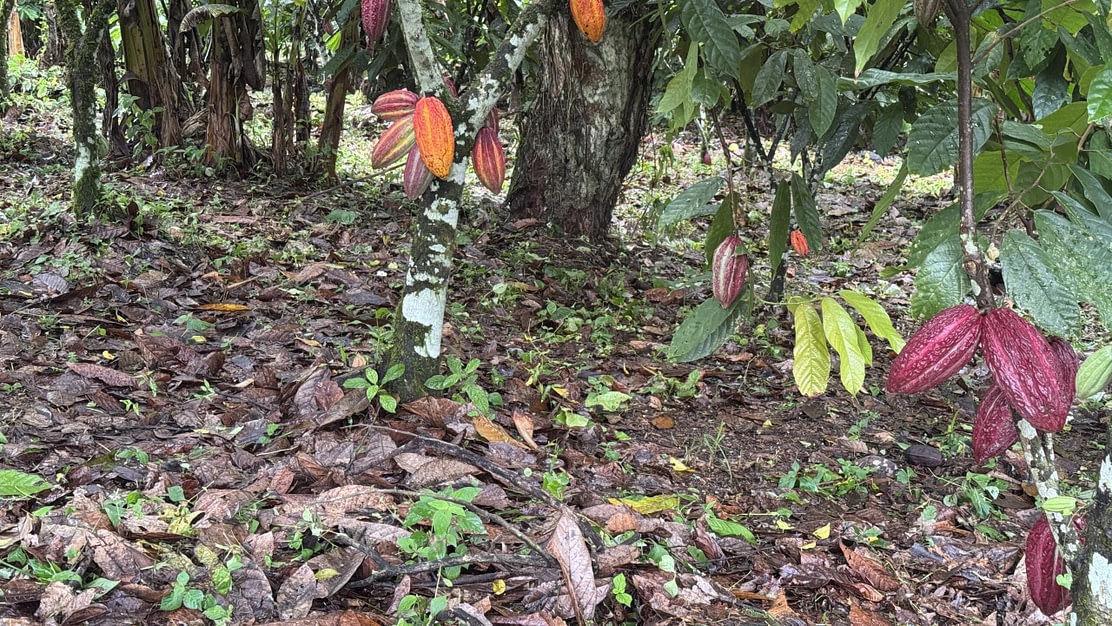
An update from Cocoa Runners on the skyrocketing cocoa prices which are still hitting the newscycle.
Print / PDFYou know that Cocoa Prices are still going up when even the BBC is starting to write headlines like:
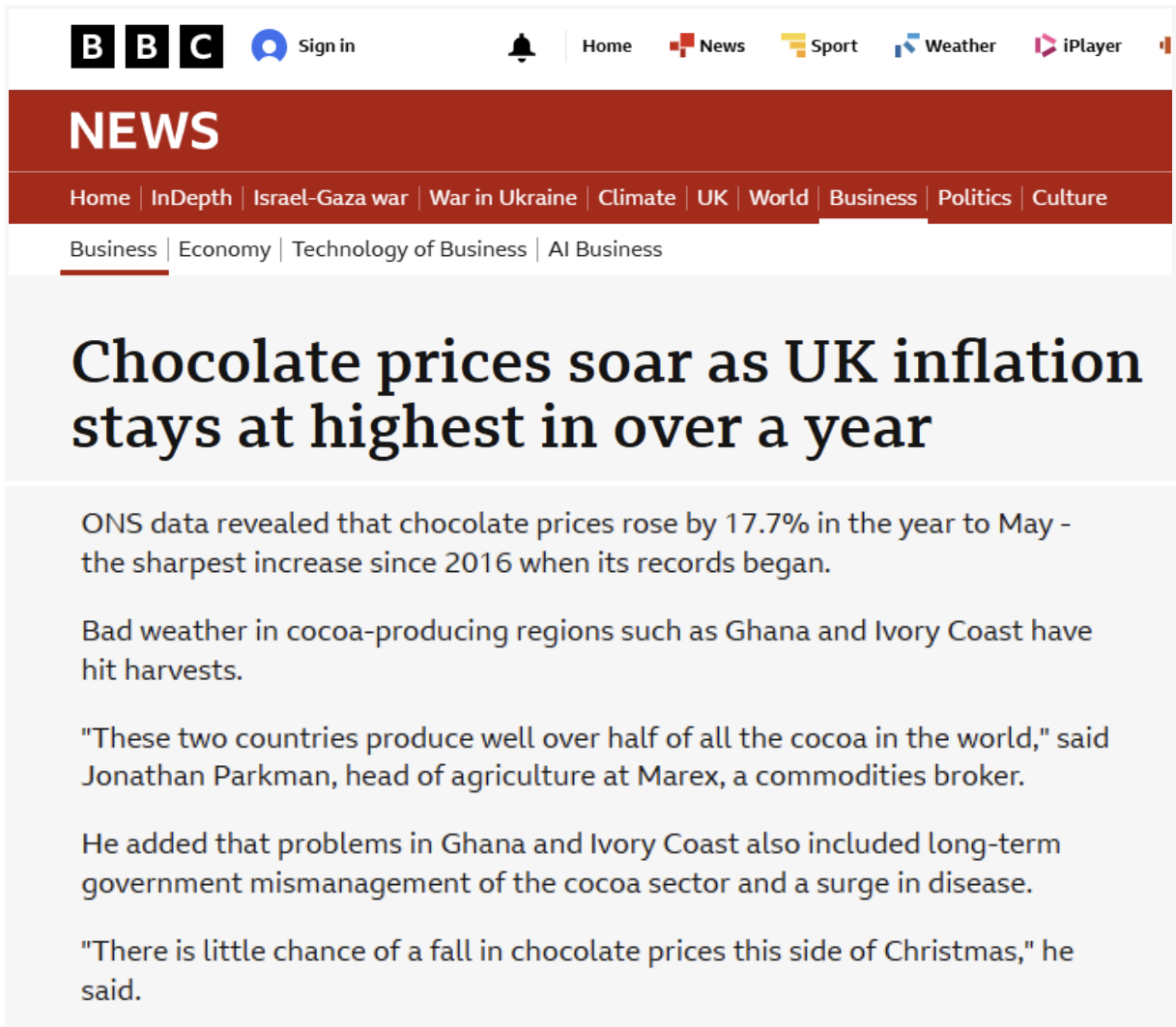
We’ve written about Cocoa Prices before (see here and here). And we agree. The price of chocolate is going to keep going up (and beyond Christmas).
But the reasons for this price rise are more complicated than the factors cited above of “bad weather”, “a surge in disease” and “government mismanagement”. There is a fundamental problem of chronic underinvestment in all the key components for a healthy cocoa sector – farmer education, replanting trees, irrigation systems, disease control, canopy management, infrastructure (like roads, warehouses, farming centres, etc) and farming best practices. And this is particularly acute in West Africa which accounts for over 60% of world cocoa production (with Cote D’Ivoire and Ghana in turn accounting for most of this volume).
Until relatively recently, consumers have been incredibly fortunate to enjoy artificially low prices for their mass produced chocolate bars and confectionery. The cheap price of these bars is effectively paid for by West Africa Cocoa Farmers who work for incredibly low take-home pay. The World Bank’s poverty threshold is about $2.15/day, but fewer than 10 % of West African cocoa farmers earned this pre‑COVID. Fair Trade international estimated that salaries for male cocoa farmers in West Africa was below 80c and for women even lower, less than 30c.
So unsurprisingly, young people don’t want to become cocoa farmers – the average cocoa farmer in West Africa is aged 50-55 in a population with median ages of 18-20. And to try and raise more cash by growing cocoa, farmers have destroyed much of the rainforest through “slash and burn” techniques. Mighty Earth estimates that in the early 1990s, primary rainforest canopy in Ghana and the Cote D’Ivoire was nearly 30% before falling to below 15% in the 2010s and now below 2% – and much of this came from cocoa farmers’ desperate attempts to grow more cocoa to feed their families and earn more income. Today however there is no money to replant the cocoa trees. So, many cocoa trees are now over 30 years old, and some even over 50 years old, and they therefore yield far less cocoa.
These low prices and incomes also partially explain the continued blight of child, and indentured, labour on all too many cocoa farms in West Africa. Many small cocoa farmers (the average size of a farm is under 3 hectares) can’t afford to drill wells nor put in irrigation pipes, let alone fresh water plumbing. And so their children have to skip school to walk for hours to collect water. Or take schooling; even though schooling is free in Ghana, many cocoa families can’t afford the uniforms and books kids need to go to school. But child labour is far more complicated and nuanced. For example, some cocoa child labour came from parents desperate for their kids to escape war and disease in neighbouring countries by working on cocoa farms (and this is also true for illegal gold mining, another huge challenge). Note: while we applaud the highlighting of the issue of child labour by Tony’s Chocolonely here, Tony’s is far from the “silver bullet” they claim to be. Tony’s still acknowledges that over 10% of the farms it sources from have child labour “issues”. It’s still not clear what prices Tony’s is effectively paying to farmers of either cocoa or sugar (which is the primary ingredient in most of their bars, and has equally appalling labour issues) – for more see here. Fundamentally their approach doesn’t address the structural problems of commoditised cocoa and chocolate.
The structural conundrum in cocoa (and big food)
There is a fundamental issue that is often overlooked in cocoa and the world’s food supply- and it’s become a structural conundrum and problem. Over the last 50 years, the world has done an amazing job of feeding a massive population explosion. Despite the world’s population more than doubling, for the first time in modern history we are growing more calories that we can (or should) consume. This has been done through massive structural changes; we’ve increasingly focused down on a small number of key crops, commoditised these crops and then dramatically concentrated supply to a small number of players. To put this in context:
- Today, just three crops—rice, wheat, and maize—provide over 50% of global calories, while 15 staples cover about 90%.
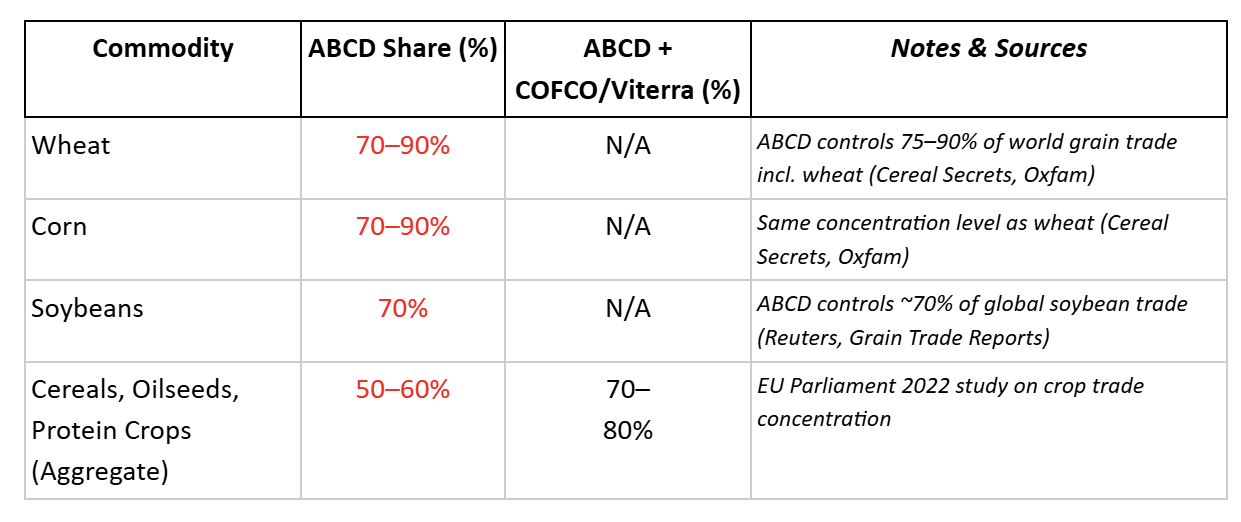
- At the same time a relatively unknown, but incredibly powerful, handful of firms known as ABCD (ADM, Bunge, Cargill, Louis Dreyfus, plus COFCO/Viterra) now control eye watering market shares of these commoditized crops
Cocoa has followed a similar trajectory. Three companies now dominate the sourcing of cocoa from West Africa (where over 60% of the world’s cocoa is grown). For example, according to Ghana’s Cocobod, Olam, Barry Callebaut and Cargill (the latter is one of the ABCDs above) purchase 60-70% of Ghana’s Cocoa Production. And these cocoa trading companies don’t just control the “trading” of cocoa beans, they also take up a huge share of the processing of these beans into chocolate couverture, powder and liquid which is then “remoulded” by all the well known chocolate brands. Cargill is estimated to sell over a third of all the beans it trades/purchases and this rises to nearer two thirds for Callebaut. Up against these players are over 5 million small cocoa farmers. It’s OPEC in reverse (The Organization of the Petroleum Exporting Countries enables leading oil-producing and oil-dependent countries to cooperate and influence the global oil market). Lots of suppliers, with very, very few buyers.
There is a limit for how long this sort of structure and system can work. Trees and farmers are mortal. If there isn’t enough investment and renewal, and if prices remain incessantly under pressure via labour costs, in the end demand will exceed supply and there will be a shortage. And when there is a shortage, prices will spike.
And this is what has happened in cocoa. Yes, part of the cocoa shortage that has caused the recent spike in prices comes from bad weather and El Nino. And yes diseases like Swollen Shoot Virus are a challenge. And yes the wars in the Middle East and Ukraine have increased shipping costs. And yes global warming is a massive challenge for cocoa farming. And yes Hedge Funds have piled in.
But fundamentally the current cocoa shortage is because there isn’t enough cocoa being grown. It’s a deep structural problem: suppressed prices over decades disincentivised replanting and investment, cocoa farming isn’t a popular career – and consequently cocoa yields are heading south.
So what next?
Mass market prices for cocoa – and especially cocoa butter – are going to keep going up. The prices of mass market chocolate bars will rise, bar sizes will shrink even more, ever more additives (especially more sugar) will “stretch” out bars. And we may even see some new alternative cocoas and chocolates.
In the world of craft chocolate it’s more complicated. Back when commodity prices from cocoa were $2,000-$2,5000 per tonne, craft chocolate makers were already paying $6,000-10,000+ per tonne for their high quality beans. Commodity prices for cocoa skyrocketed to over $12,000 dollars, the highest in over 60 years. Even though they are now down to around $10,000 they may well spike up again. Craft chocolate bean prices have also increased – often by 60% or more, and almost invariably to over $10,000 per tonne, and often over $13,000. And because cocoa is the primary ingredient in craft chocolate (usually at a much higher percentage) these cost increases are dramatic not just on the bottom lines of makers but also their cashflow (beans are generally bought 6-18 months before bars are sold). Other key costs, in particular salary costs, electricity, transport and packaging are dramatically increasing, and the situation over proposed trade tariffs is causing even more uncertainties. So craft chocolate makers are having to raise prices. We used to have multiple makers who sold bars at under £5; we now have only three. Most craft bars used to be under £8. Now many are pushing double digit prices.
However, even though prices are rising, craft chocolate makers will continue to make long term commitments to farmers. They want to ensure cocoa farmers will grow great cocoa not just for today but also the future. And they’ll continue to craft amazing bars. So even though we in craft chocolate are a small part of the chocolate world, and even though we face the challenges of global warming, cocoa diseases and socio-political challenges, the future still holds clear promise. Craft chocolate is all about the co-operation between makers, farmers and consumers. Everyone has the same objectives: craft great bars that not just taste great, but are great for your health, the planet and the farmers.
Conclusion
It’s not that Big Food / Chocolate deliberately set out to screw West African Cocoa farmers and consciously underinvest in cacao’s future. Big Chocolate loves to point out the warehouses and processing plants they’ve built in West Africa. And Big Chocolate certainly isn’t happy about cocoa prices going up. But the combination of the commodisation of cocoa and concentration of buying power into a handful of companies, along with an incessant drive to lower prices, has created the fundamentals of today’s cocoa shortage in West Africa. And so prices – finally – are now rising. Hopefully some of these price rises will be passed onto the farmers. And hopefully some of this will translate into more cocoa trees being planted, more investment in farm infrastructure, farmer education, etc. But this isn’t inevitable. It’s a hope rather than a certainty. Incentives aren’t aligned.
I’m not an economist. And this isn’t some anti-capitalism rant. Capitalism, and “Big Food” have done an amazing job of ensuring that the world has enough food. But many economists have demonstrated how too much commodisation and too much concentration of sourcing power distorts pricing and incentives to invest. NumberAnalytics, a specialised research firm that analyzes agri-market structure and economics, has just published a paper describing how
“A small number of large firms can… lead to lower prices for farmers due to the bargaining power of large firms… Reduced innovation and investment in the agricultural sector due to the lack of competition”
Other economists like the Nobel Laureate Jean Tirole, Alfred S. Eichner, or János Kornai have also explained how oligopolies can lead to underinvestment and price distortions. And the current spike in cocoa / chocolate prices fits this analysis. Cocoa farming is a long term commitment. Farmers need encouragement and incentives, not commodisation and buying oligopolies.
So now more than ever, please tell your friends and family to try craft chocolate. Unfortunately craft chocolate bars are going to be even more expensive. So craft chocolate makers and farmers really need your support. They are committed to making great tasting bars that reward the farmers. It’s the antithesis of the mess that commodisation, buyer concentration and a focus on lowering prices has created for Big Chocolate. To be grandiose, it’s a far more positive vision for the future. And it also tastes better, and is far better for you and your families, farmers, makers and the planet.
Thanks as ever for your support
Sources
https://www.bbc.co.uk/news/articles/c5ygdqp922vo
https://papers.ssrn.com/sol3/papers.cfm?abstract_id=3325432
https://www.opendemocracy.net/en/oureconomy/abcd-grain-giants-profit-world-hunger/
https://www.europarl.europa.eu/RegData/etudes/STUD/2024/747276/IPOL_STU%282024%29747276_EN.pdf
https://www.jpmorgan.com/insights/global-research/commodities/cocoa-prices
https://www.farmaid.org/issues/corporate-power/fair-competitive-markets-for-family-farmers-our-food/
https://www.numberanalytics.com/blog/impact-oligopoly-agricultural-market