Celebrating Women in Craft Chocolate
A tribute to the many amazing women working in craft chocolate.
Print / PDFA tribute to the many amazing women working in craft chocolate.
Print / PDFMaking and crafting: the role of women in craft chocolate
There are many amazing women working in craft chocolate, and we’d like to highlight them – to step back and look at the incredible contribution made by women at all levels of the craft chocolate industry, from makers to growers, from authors to competition judges, and from scientists to everyday enthusiasts. At all these levels women are clearly leading craft chocolate. It’s not easy to do exact comparisons to other industries or to ‘big chocolate’. But it’s worth making some anecdotal comparisons as it may offer another perspective, and help explain why the craft chocolate world is so passionate about converting people to delight in chocolate that tastes better, is better for you, and better for the farmers and planet.
We’ve crunched some numbers, looking at the number of women who’ve firstly founded and secondly who lead the crafting of their companies’ bars. And the results are extraordinary. In over 50% of the craft chocolate makers we work with, the founding teams either were all women, or with both men and women. And for almost the same proportion, the actual chocolate ‘crafting’ is also done by women, or shared between men and women. Unsurprisingly there are some geographic differences; in the UK, almost 80% of the founding teams were all women, or men and women together, and in the US it’s almost two thirds. It’s lower in mainland Europe (just below 50%), and around 40% in Asia, Africa, Australia, Latin America and the Caribbean. But it’s moving in the right direction.
And it’s not just ‘a numbers game’. Just sticking with the ‘women only’ founding and making teams, we are spoiled with an amazing choice of bars. Lisi, founder and chief chocolate maker of Shatell, won chocolate maker of the year in 2017. In the Americas, Jenny from Conexión, Luisa Abram, DeAnn of Solstice, Christine of Palette Des Bine and Ana of Mucho all craft awarding winning bars. In Europe, Agur and Siv of Fjåk (Norway) won “rising new star”. Tomoko-san and Sue of Feitoria do Cacao (Portugal) have also won medals galore. And here in the UK, Isobel of Dormouse, Ama of Lucocoa, Luisa of Luisa’s Vegan Chocolate and Deana from Tosier have similarly won multiple awards and accolades.
Apologies for any oversights; we’ll try to update this list regularly.
Comparisons to mass-produced chocolate
Unfortunately we haven’t found a database that offers an easy comparison or benchmarking to women’s position in mainstream chocolate.
But there are some useful tools if you want to do more research; for example for the UK you can use https://gender-pay-gap.service.gov.uk/ and see that for e.g., Cadbury, women comprise less than 10% of all the “highest earning jobs”.
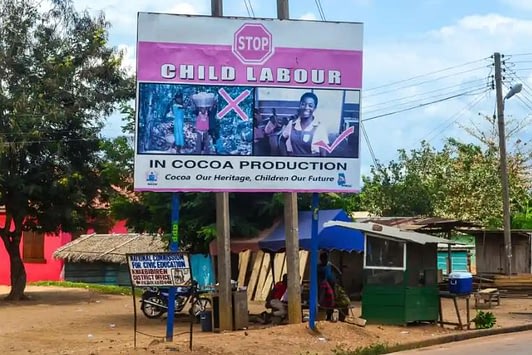
And, revealingly, there are, yet again, a number of great ‘promises’ and ‘pledges’ being made by ‘big chocolate’. Just as Callebaut is promising to end child labour in all its chocolate by 2025 (promised almost two decades after the BBC aired it’s first documentary on child slave labour), it’s also pledging to make “more progress in gender balance at senior level … 40% women at director level … 30% women at director level in sales”. Mars, Hershey’s, Olam and Nestlé all have similar pledges … but tellingly they don’t benchmark where they are coming from TODAY in their organisations.
Women in cocoa farms
The inequities and inequalities of women versus men in big chocolate are even more extreme ‘on the ground’. Over 90% of West African cocoa farmers earn less than the living income benchmark. Or in dollars and cents, the average income for a cocoa farmer in West Africa approximates to US$0.84 per day. And for women working in cocoa farming, it’s even worse; US$0.23. Fixing this inequity is also the the key to fixing everything from deforestation to child slave labour. And fixing this means paying more for cocoa, and paying more for cocoa means seeing it as more than just a commodity.
Craft chocolate is at the vanguard here; to make great craft chocolate you need great beans. And to secure great beans, you have to pay the farmers appropriately (craft chocolate pays a premium of 3-10 times more than commodity cocoa prices and signs long term commitments). Trying to clean up supply chains by “inspecting them”, ”checking that kids are in school”, “highlighting the issue” etc. may make you feel better (and it can make great advertising copy, as Tony’s shows). But to fix the problem, we need to stop treating cocoa as ‘just another commodity’; we need to pay farmers (men and women) for growing great beans.
And yet again, women in craft chocolate are leading many of these initiatives. Kate and Justine are spearheading this at Cacao Latitudes. As is Emily from Uncommon Cacao. And Katrin, Alix and Jeannette from Silva.
In addition there are a number of initiatives like ‘Femme Du Virunga‘, where women cocoa growers have created women cocoa co-operatives, especially welcome in the Eastern Congo given the dire combination of wars, destitution and violence against women. Luisa (of Luisa’s Vegan Chocolate) is building a similar initiative in Colombia. Please see below for a range of bars crafted from beans grown these initiatives.
Research on chocolate
Much of the research into what is happening on the ground is also being done by women. Kristy Leissle continues to do great research here (her book ‘Cocoa’ is a must-read on this), . Similarly, Amanda Berlan does extraordinary work on child labour and unpacking the claims of big chocolate for its initiatives (see her critique and expose of Nestlé, and please read her insights on how divorce is linked to so many of the income inequalities in West Africa). And Stephanie Barrientos continues to do pioneering work on many gender and cocoa issues in West Africa and India.
Ayn Riggs is leading the charge for slave free chocolate, and huge kudos to her for taking a stand against Tony’s without fear of the blowback.
And in the area of cocoa plant genetics, great work is being done by scientists including Frances Bekele and Sarah Bharath, and for fermentation and farming best practises Zoi Papalexandratou shows what can be done.
Reference books on chocolate
Many of these researchers have produced insightful books. If you want to read just one recently published book, please try Kristy Leissle’s ‘Cocoa’. And if you want a deep dive into the horrors that Ayn Riggs is fighting against in ‘Slave Free Chocolate’, please try Orla Ryan’s ‘Chocolate Nations: Living and Dying for Cocoa in West Africa’. Or if you want the definitive history, try Sophie Coe’s unbeatable ‘The True History of Chocolate’. All great books. All authored by women.
A number of other women authors use chocolate to describe other aspects of their interest in food and cooking, such as Jenny Linford and Vanessa Kimble.
And another hat tip to two women involved in the book industry, Kathryn Laverack and Cat Black, for their work in pairing craft chocolate to book clubs.
Bloggers and journalists writing about chocolate
Outside of formal books and long publications on chocolate, there are a number of journalists and bloggers in the world of chocolate. And again, a huge number of these are written by women; and at the risk of offending many, here are a number to follow:
Annalisa Barbieri – The Guardian and Observer’s chocolate journalist,
Sharon Terenzi – The Chocolate Journalist,
Megan Giller – Chocolate Noise,
Lauren Heineck – Chocolate in Conversation,
Pam Williams – Ecole Chocolat (also great for chocolate making courses and more).
Judges, fairs and tasters
Women also played (and continue to play) a crucial role in the judging, and awards, of craft chocolate. The Academy of Chocolate (AoC) was established by the much missed Sarah Jayne Staynes, and her work is being brilliantly continued by Silvija Davidson, Marie-Pierre Moine, Chantal Cody and Sara Jane Evans. Similarly Martin at the International Chocolate Awards (ICA) works with a host of women from the US (George Gensler and Maricel Presilla), Italy (Monica Meschini) and Germany (Michaela Schupp).
And then moving outside the UK, Caroline Lubbers in Amsterdam has done amazing work with the Chocoa Festival (and in promoting the Rokbar with Lisi from Shatell).
And these bodies are also hugely assisted by the amazing palates, and judging support, of numerous women, again from all over the world, again, apologies for those I may be missing, but huge hat tips to Terese Fenger Weiss, Jen Earle, Judith Lewis, Hazel Lee, Cat Black, Lauren Adler, Harmony Marsh and Lizzie Jackson.
Scientific research on chocolate
Much of the ‘delight’ from chocolate is all about the wonderful complexities, length and varieties of ‘flavour’ that we can enjoy in craft chocolate. And again, much our understanding of flavour can be tracked back to the pioneering work of Linda Buck who won the Nobel prize in 2004 for her work on the mechanics of our olfactory system and receptors. Much still remains to be done, and chocolate is a great tool for flavour experiments. And if you want to read more about this, please try Ann-Sophie Barwich’s ‘Smellosophy’.
So from our understanding of chocolate’s flavour down to who crafts, makes, writes about, judges and promotes craft chocolate, a huge thanks to all the women leading the ‘Craft Chocolate Revolution’. If you’ve attended any of our tastings you’ll know that craft chocolate tastes better, is better for you, is better for the farmers, and better for the planet; and we’ve another reason to add to this; the pioneering work by women in craft chocolate is an amazing opportunity to celebrate RIGHT NOW (as opposed to big chocolate’s future promises and pledges).