Valentine’s Day: More than a Box of Chocolates?

The history of Valentine’s Day hasn’t always been boxes of chocolates and cutesy cards.
Print / PDFThe history of Valentine’s Day hasn’t always been boxes of chocolates and cutesy cards.
Print / PDFLupercalia: The Dark History of Valentine's Day
The history of Valentine’s Day is darker than you might expect. It hasn’t always been boxes of chocolates and cutesy cards.
The Roman festival, Lupercalia, which took place annually on February 15th, was bloody and sexually charged – with animal sacrifices and violent spankings standing in for the dinner dates and lingerie we now know today.
The pagan festival was dedicated to Faunus, the Roman God of agriculture. It was believed that running around spanking women would ward off evil spirits of infertility. Lupercalia actually had less to do with love (as we know it) and more to do with reproductive health. Romantic, right?
Although Lupercalia survived the initial rise of Christianity, it was later outlawed at the end of the 5th century by Pope Gelasius. Instead, he declared the 14th of February to be “Valentine’s Day”. However, whipping continues to play an important role during festivals around fertility in countries such as Hungary, the Czech Republic, and Slovakia!
Who was St. Valentine?
The patron saint of Valentine’s Day is shrouded in mystery, it is even thought to be three separate people. The Catholic Church recognises three different saints called Valentine, all of whom were martyred.
One legend suggests that Valentine was a Roman Priest who, when Claudius III outlawed marriage for young men on the basis that single men make better soldiers, defied this rule by continuing to marry young men anyway. He was subsequently executed – so died in the name of love, quite literally.
Another – similarly tragic – Valentine was said to have sent the first ever Valentine’s Day card. After falling in love with his jailor’s daughter, he wrote her a letter signed ‘from your Valentine’. A sign-off which later became the cliched mantra for the ultimate cliché holiday. Who knew that its origins lay behind the bars of a Roman prison?
Although the truth of these stories is murky, the popularity of these figures endured in medieval France and England.
Ye Olde Valentine’s Day: Chaucer’s Parliament of Foules
Geoffrey Chaucer was the first to record Valentine’s Day in English. He refers to the occasion in his dream-vision poem, The Parlement of Foules, written in the 1370s. He wrote: ‘For this was Seynt Valentyne’s day / When every foul cometh ther to choose his mate.’
So, even by the 14th century, Valentine’s Day had more to do with fertility and animals than with love.
The Victorian Era: Cadbury’s Box of Chocolates
The prudish Victorians certainly wouldn’t have dedicated a holiday to spanking – nor would they have necessarily entertained the idea of dying in the name of love (a notion far too impractical for the industrial age). Instead, with Richard Cadbury’s revolutionary way of making solid bars, boxes of chocolate and greetings cards became the new way to celebrate Valentine’s Day.
The boxes Cadbury designed were so beautiful that they were often kept as places to store other love mementoes, once the chocolate had been consumed.
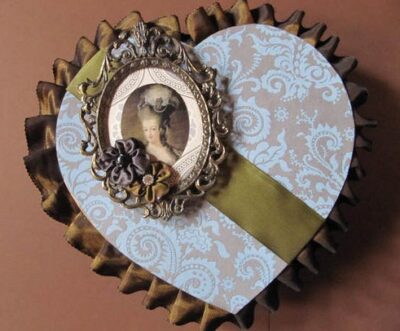
Victorian-era Valentine’s box
Be our Valentine!
For Valentine’s Day, whether you’re looking to treat a partner or yourself, be sure to check out our range of Valentine’s Day gifts! Nothing says “I love you” (or “I love me”) more than a chocolatey sweet treat in pretty packaging.