How Chocolate Is Made, the Willy Wonka Way
Who better to glean industry secrets from than Mr. Willy Wonka himself!
Print / PDFWho better to glean industry secrets from than Mr. Willy Wonka himself!
Print / PDFHow chocolate is made, Willy Wonka style
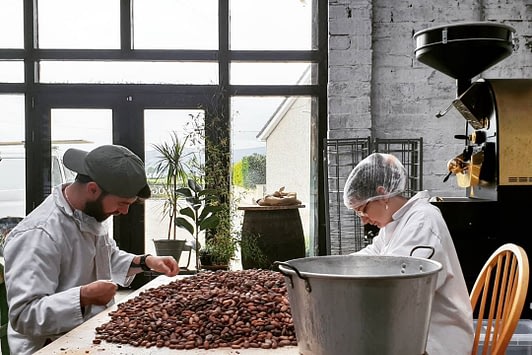
It’s hard to imagine how a knobbly, shiny, multicoloured pod becomes a beautiful, smooth, easy-to-eat bar. Who better to glean the industry secrets from than the man who makes bars, ‘far sweeter and creamier and more delicious than anything the other chocolate factories can make!’. Mr Willy Wonka himself!
“The cacao bean,’ Mr Wonka continued, ‘which grows on the cacao tree, happens to be the thing from which all chocolate is made. You cannot make chocolate without the cacao bean. The cacao bean is chocolate. I myself use billions of cacao beans every week in this factory.”
Wonka knows a thing or two about cocoa beans. In Loompaland he came across the Oompa-Loompas, who go mad for cocoa beans but can sadly only find three or four a year. He strikes a deal with them. They come and live in his factory. In a manner slightly reminiscent of the Atzecs using cocoa beans as currency, Wonka gives them an endless supply of beans.
To us now, this setup may feel rather uncomfortable. Stuck within the factory walls and kept happy with an addictive substance – no matter how much Wonka sugar coats it, the reality is that this is a form of slave labour.
Unfortunately, the chocolate industry has a difficult history with slavery. Forced labour was used on cocoa plantations to maintain a low price, fight the lack of workers, and supply the increase in demand over the 17th and 18th centuries.
And sadly it hasn’t stopped. Even today chocolate prices are kept low with child slave labour on plantations. That is why we believe that it is really important to pay a little more per bar, ensuring traceability of the raw materials.
“…it’s the only way to do it properly! The only way!”
Wonka’s chocolate is definitely the cheap supermarket type. Incredibly sweet and creamy and packaged in shiny wrappers, it seems similar to some of the most popular contemporary confectionary brands.
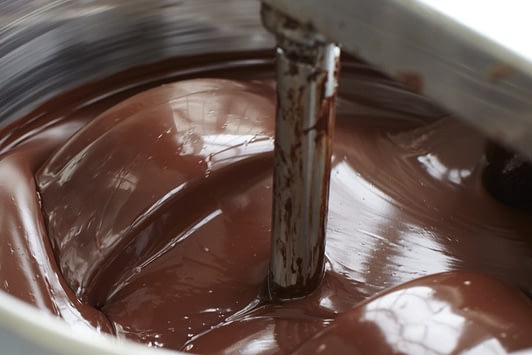
So what does Wonka do to give himself the advantage? Well, if you have ever thought of making chocolate yourself at home, there’s bad news. It’s not very replicable. Firstly, it’s on a massive-scale; there is a chocolate river running through his factory;
“It’s all chocolate! Every drop of that river is hot melted chocolate of the finest quality. The very finest quality. There’s enough chocolate in there to fill every bathtub in the entire country! And all the swimming pools as well! Isn’t it terrific?”
Terrific it may be, but maybe also terrifying. A leak would be a very messy business! The various production rooms are supplied with chocolate via a series of pipes;
“And just look at my pipes! They suck up the chocolate and carry it away to all the other rooms in the factory where it is needed! Thousands of gallons an hour, my dear children! Thousands and thousands of gallons!”
Unsurprisingly, everyone is completely dumbfounded at the scale of the operation. But the most wonderful (and most important) part is, of course, the waterfall;
“The waterfall is most important !’ Mr Wonka went on. ‘It mixes the chocolate! It churns it up! It pounds it and beats it! It makes it light and frothy! No other factory in the world mixes its chocolate by waterfall! But it’s the only way to do it properly! The only way!”
Here Wonka departs from standard practice. Click here for the facts. Mixing, churning, pounding, and beating sound like grinding and conching, but we’re struggling to imagine how this might work. So we can only presume that the waterfall doesn’t replace any of the basic chocolate-making steps but instead happens after tempering and before moulding.
Tempering is the process in which chocolate is heated and cooled to the desired temperature in order to get the right texture and ‘snap’. Wonka’s waterfall must therefore already be at the perfect point, around 29°C for milk chocolate, ready to be transported around the factory and into rooms full of moulds.
A lesson to be learnt?
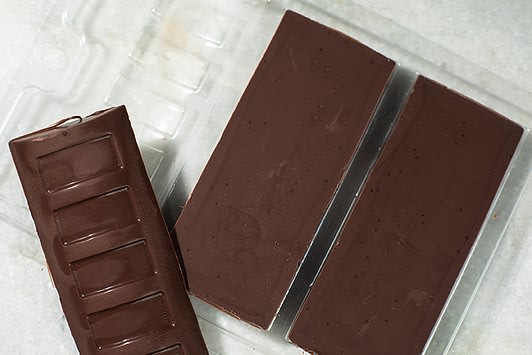
Probably not! Moulds filled with molten chocolate should be tapped to remove air bubbles but Mr Wonka wants his chocolate ‘light and frothy’. But that’s not to say that we don’t like the sound of a chocolate room…