How Flavour Works

What happens when you put a square of chocolate in your mouth? Read on to discover.
Print / PDFWhat happens when you put a square of chocolate in your mouth? Read on to discover.
Print / PDFSummary
- Chocolate is a unique solid which melts in your mouth.
- As it melts, the heat, saliva and unique biochemistries of your mouths work their magic to release the flavour volatiles.
- While heat melts the chocolate and releases the flavour volatiles, saliva takes a bit longer to release the ‘bound volatiles’ created by fermenting, roasting and processing the cocoa beans.
Chocolate – the unique solid which melts in your mouth
Chocolate has a unique quality that we take almost completely for granted – it’s a solid at room temperature which melts in your mouth.
What happens when you put a square of chocolate in your mouth? The chocolate starts to melt, and a whole new world unfolds in your mouth as the flavours emerge from the melting, masticated chocolate.
What alchemy is at work here?
Tastes are detected by receptors all over your tongue (plus your throat and gut, and possibly even further). Flavours are detected by a process called retronasal olfaction (flavours and aromas are detected by your olfactory bulb via the back of your mouth).
And that’s not all – chemical reactions in your mouth cause other nerves to register various other sensations (textures and mouthfeels like dryness, astringency).
Heat, saliva and the unique biochemistry of your mouth all come together in a complex interplay that releases the flavour volatiles for you to experience once you snap off and bite into a square of chocolate.
But it doesn’t happen all at once. Heat and saliva require some time to work their magic, which is why we experience flavour as a wave that unfolds over time.
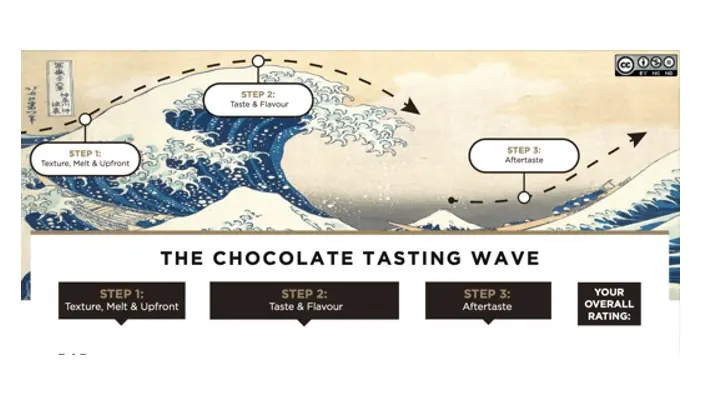
Heat melts chocolate and releases a wave of flavours
Heat plays an important role in revealing chocolate’s flavours. To understand this better, try holding your nose and popping a chocolate morsel in your mouth. Wait for 10 seconds, release your nose and breathe in through your mouth.
As you release your nose, you allow your sense of smell to start working again. The chocolate should have melted by now, and a wave of flavours will bombard you.
This ‘melting’ is thanks to cocoa butter’s crystal structure (although much of the cocoa butter is replaced with industrial fats in mass-produced chocolate).
If the chocolate has a good snap (i.e., it’s properly tempered), it will melt. If you’ve stored your chocolate in the fridge or left it out in the sun, for instance, it may well have ‘badly tempered’ to crystal structure 6, which won’t melt in your mouth (but will be fine to cook with).
Our taste receptors register sweetness, saltiness, and fattiness quite quickly, but flavours and aromas are released far more slowly. Heat and saliva work to release them as a wave of flavour in our mouths.
Saliva releases the bound volatiles in chocolate
Saliva performs its own wonderful magic in terms of releasing flavours. Over the last couple of decades, we have come closer to understanding how cooking ‘binds in’ flavours and aromas which are later released through the microbes in our saliva.
The wine chemist Emile Peynaud paved the way in the 1980s for us to understand the role of saliva in savouring. He noted how wines ““smell more of the flavour of the fruit than the grapes themselves”.
He went on to describe how saliva amplifies and catalyses flavours: “saliva reacts with and releases the (herbaceous…bruised leaves) in Sauvignon which is present in the grapes in a relatively odourless form”.
Which is why savouring is the best way to enjoy your chocolate. The flavours just keep evolving. While heat melts the chocolate and releases the flavour volatiles, the saliva takes a little longer to break down the ‘bound volatiles’ (created by fermenting, roasting and grinding cocoa), and ‘liberate’ them for your olfactory bulb.
There is a simple trick to illustrate the power of saliva’s microbes: chew some chocolate in your mouth for ten to twenty seconds. Then spit it all out. Wait for another ten to twenty seconds and you should be able to detect a whole load of new flavours.
Even though you’ve spat out the chocolate, the microbes in your mouth will continue to release aromas and flavour volatiles from the chocolate you’ve spat out.
If you’re loath to spit out your delicious craft chocolate, you can experience the same by swallowing the chocolate, but it’s not quite so graphic an example of ‘saliva in action’.
Our taste receptors register sweetness, saltiness, and fattiness quite quickly, but flavours and aromas are released far more slowly. Heat and saliva work to release them as a wave of flavour in our mouths.