Treats for Halloween (With No Tricks)
What links medieval religious festivals, Celtic pagan rituals, pumpkins and costumes for pets?
Print / PDFWhat links medieval religious festivals, Celtic pagan rituals, pumpkins and costumes for pets?
Print / PDFHalloween & Craft Chocolate: A Match Made in Hell?
What links medieval religious festivals, Celtic pagan rituals, pumpkins and costumes for pets? The answer is, perhaps surprisingly, that they’re all related to Halloween! Read on to find out more about Halloween’s history, and how it relates to craft chocolate.
Halloween is second only to Christmas as a commercial holiday: in the US alone 6 billion dollars are spent each year. Over 20% of millennials now dress their pets up in themed costumes. But the history of Halloween reveals a deeper and darker side to the yearly rite of dressing up in silly costumes and eating armfuls of sweets.
Read on for a story full of tricks and treats!
Halloween might seem like the antithesis of our aims here at Cocoa Runners. We’re all about what you might call slow chocolate. Craft chocolate, with its delicious complexity, doesn’t lend itself to the over-consumption associated with the holiday. But craft chocolate does provide an alternative treat, much tastier and far less sickening than most mass-produced sugar-laden confectionery marketed at Halloween!
At Cocoa Runners, we take pride in developing our knowledge about chocolate. That includes understanding the processes our artisan makers use to craft the chocolate products we sell, but it also includes exploring the historical origins and cultural relevance of chocolate itself. So we took it upon ourselves to investigate the history of Halloween, which is almost synonymous in modern culture with our most serious passion: chocolate!
Halloween's Spooky Pagan Origins
We know that looking deeper into topics often turns our expectations on their heads, and reveals exciting surprises. Our research into the history of Halloween has proved no exception!
The festival we know as Halloween has its origins in ancient Celtic traditions. The start of winter festival was known under many different names in Celtic countries. In Gaelic (the Celtic language spoken in Ireland, Scotland and the Isle of Man), the festival is called Samhain, meaning ‘the end of summer’. In the Brittonic languages of Wales, Cornwall and Brittany it has a different name: Calan Gaeaf (Welsh), Kalan Gwav (Cornish) or Kalan Goañv (Breton). All these similar names mean the same thing: ‘the first day of winter’.
The Celtic festival fell halfway between the Summer and Winter equinoxes. People used the feast to ask the gods, fairies and spirits for support during the hard winter months. The feast was also thought to be a time when the souls of the dead came close, and should be fed and cared for.
Offerings of food and drink were left outside the house for wandering souls, or extra places at the table might be set for dead relatives who might visit for the night. You might say that modern Halloween carries the legacy of this history, continuing the practice of inviting in the ghosts and ghouls to share food through the phenomenon of trick-or-treating!
Halloween Gets Converted!
In the 9th century, Christianity entered the history of Halloween. The new religion came to the British Isles and absorbed the Celtic festival into the feast of All Hallows, or All Saints Day. All Saints Day has been a festival in the Christian church since the 4th century, but it was a moveable feast. In the 7th century the date was set on the 13th of May. So why do we celebrate Halloween on the 31st of October?
In the 9th century, the British church began celebrating the All Hallows feast on the 1st of November, turning the pagan Celtic celebrations into a legitimate Christian festival. From the 8th century, the feast had involved more than just All Saints’ Day: it was a three-day affair, including All Hallows’ Eve the day before, and All Souls’ Day on the day after. (All Souls Day was dedicated to praying for the souls of the dead.)
With its connection to the holy and the damned, the spirit world and the realm of the dead, All Hallows Day was similar to the Pagan winter festivals. Similar enough to replace them. Today, we might call this ‘cultural appropriation’, but the Church was trying to convert the Celtic tribes to Christianity, and it was easier to do that if the old cultural traditions were absorbed into the new religion, rather than set apart from it.
So Where Does The Word Halloween Come From?
The word ‘Halloween’ comes from the Old English name for the day before All Saint’s Day, ‘All Hallow’s Eve’. The English name of the feast, ‘All Hallows’ comes from the Old English ‘ealla halgan’, combining the word for ‘all’ with the word ‘halgan’ which means ‘saints’ or ‘holy ones’ (‘halga’ means holy, saint, or blessed).
References to All Hallows’ Eve date back to Wulfstan, the 9th century Bishop of Worcester, who writes about ‘ealra halgena mæsseæfen’ (all hallows’ mass-eve). All Hallow’s eve even features in Shakespeare’s Measure for Measure, with the slightly strange spelling of ‘Allhallond-Eue’! (The u in ‘Eue’ should be pronounced as a v, making this word ‘Eve’.)
However, ‘Halloween’, which blends ‘Hallows’ and ‘Eve’ into one word, is actually not an English word at all: it comes from 18th-century Scots! The word first appears in Scots poetry by Robert Fergusson, published in 1773. The publication of Robert Burns’ poem ‘Halloween’ in 1785 catapulted the term into general usage.
“Some merry, friendly, country-folks,
Together did convene,
To burn their nits, and pou their stocks,
And haud their Halloween
Fu’ blithe that night.”
– Robert Burns, From Halloween, 1785
Customs and Traditions
Samhain, Calan Gaea, Kalan Gwav and Kalan Goañv all involved food offerings and prayers. And it’s not hard to see how these traditions morphed into the medieval and early modern customs of ‘souling’, ‘guising’ and ‘mumming’. (And how these gave rise to the modern tradition of‘trick or treating’!)
As early as the 15th century we find records of poor folk promising to pray and sing for the souls of their richer neighbours in return for ‘soul cakes’ on All Hallows’ Eve. Indeed, the custom still exists in parts of the world where Catholic traditions remain strong. In the Philippines there is a custom called Pangangaluwa, where kids drape themselves in white cloth on All Hallows’ Eve and visit neighbours, where they sing and ask for prayers and sweets.
In northern Europe in the 15th and 16th centuries, All Hallow’s Eve was a time for mumming: dressing up in elaborate costumes and going door-to-door to sing and pray. (In Britain, mumming happened round Christmas, and has morphed into the modern tradition of Christmas carolling.)
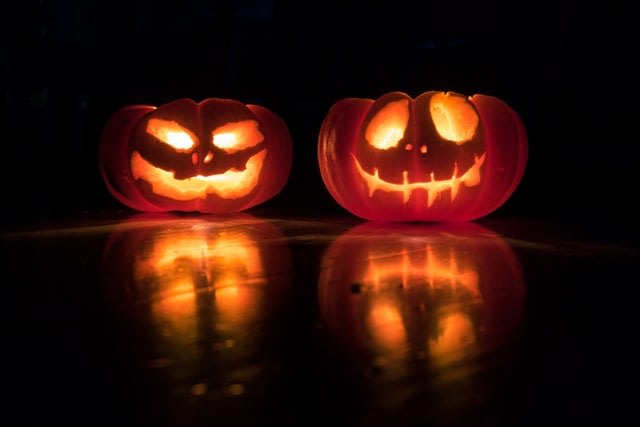
In Scotland, a similar practice called “guising” happened at Halloween – and it’s the Scots we have to thank for the iconic symbol of the festival: carved pumpkins. In the 19th century, Scottish guisers carried lanterns carved out of turnips! These lanterns may have referenced the lighting of candles to pray for the souls of the dead in the old Christian traditions.
Halloween in the Modern Day
There are references to guising happening in America as far back as 1911, and the name-change to ‘trick or treating’ happened in the 1930s. Instead of turnips, Americans carved out pumpkins to use as their festive ‘Jack O’ Lanterns’. This term references another Celtic story that immigrated to the states: the Irish legend of Jack who tricked the devil out of a lump of hot coal, to help him survive the cold of purgatory. (In Catholic tradition, praying for the dead at All Hallows’ helped speed their way out of purgatory and into heaven.)
All sorts of other customs and traditions have also been added, many borrowed from other winter festivals. For example, caramel and toffee apples from the UK’s bonfire night have become staples of American Halloween!
Increasingly, Halloween has been commercialised and evolved in some peculiar directions. The US has ‘trunk-or-treat’ parties where kids beg for candy from cars in a parking lot, like a sweet-toothed car boot sale. This custom emerged from the need to keep kids safe and handle the logistics of American suburbs where houses can be miles apart. Halloween has become a huge card giving market, and even pets now get dressed up for the season (though they shouldn’t get involved in eating festive candy, as theobromine – an important compound in chocolate – can be toxic to pets).