Pairing Beer and Chocolate
The Cocoa Runners handy guide to pairing craft chocolate and craft beer.
Print / PDFThe Cocoa Runners handy guide to pairing craft chocolate and craft beer.
Print / PDFSummary
- Select 3-4 craft chocolate bars from different regions and intensities, paired with a variety of beer styles. Utilize texture, mouthfeel, and flavour sheets to articulate tasting experiences, encouraging sharing with friends.
- Don’t worry about the tasting order; experiment with trying chocolate first, then beer, and vice versa. Consider how pairings change based on tasting order, aiming for synergistic combinations rather than clashes.
- Astringency can affect pairing in beer & chocolate. Explore the nuances of flavour pairing, aiming for matches, contrasts, or complexity in combinations. Understand how astringency in both beer and chocolate affects pairing success.
Craft Beer and Craft Chocolate Have a Lot in Common
Do beer and chocolate go together? It might surprise you to learn: yes! Craft beer and craft chocolate have a lot in common.
Here’s our guide on what works when pairing chocolate and beer: how to try different flavour combinations and flavour partnerships, how to taste chocolate and how to taste beer. Towards the end of this article, we recommend a bunch of beer & chocolate combinations for you to try.
Does tasting order matter? Does bitter chocolate pair well with the more bitter beers? We’ve got all your questions covered.
The Dos and Don’ts of Pairing Beer & Craft Chocolate
Dos
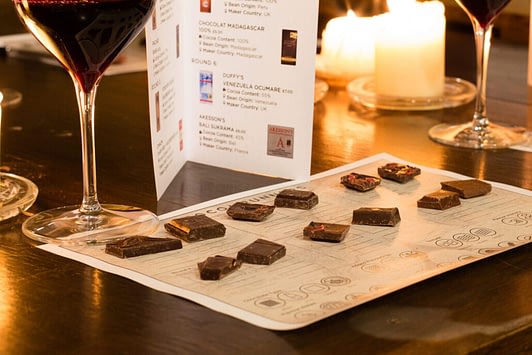
- Assemble 3-4 bars; ideally from different cacao regions and of different intensities. This is a great opportunity to introduce different makers from different countries!
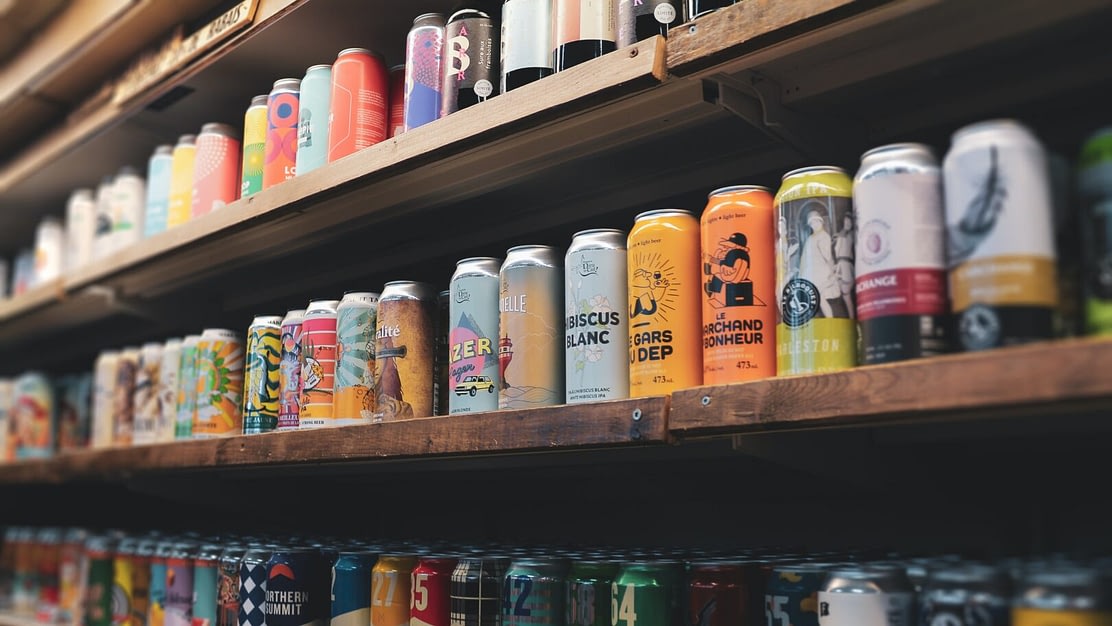
- Do the same with beer. Why not introduce different styles – from IPA to Gose to Porter. We’ve also found lagers to be hugely underrated in food pairings!
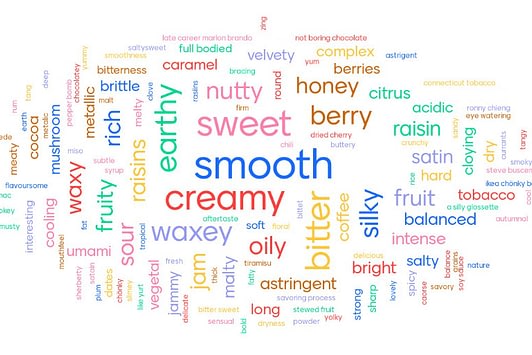
- Use our texture, mouthfeel and flavour sheets below to help you articulate what you are tasting with the chocolate (with particular focus on flavours and mouthfeel).
- Invite a few friends. We strongly encourage sharing the pairing experience with more people because no two palates are the same; but equally, because it is a really fun experience!
- Have some water on hand and any neutral palate cleansers, such as bread.
Don’ts
- Do not worry about the order you taste, whether that’s having the beer or chocolate first.
- You may begin to notice that pairings will change depending on the order that you’re tasting in. For example, we like to take the chocolate first, then the beer, then go back to the chocolate. Then it’s probably worth going back to the beer again!
How to Taste the Chocolate
- Snap, smell, and let it melt on the tongue.
- Whilst chewing or sucking chocolate is perfectly acceptable, when ‘tasting’ chocolate we strongly encourage people to smell it first and let it melt on the tongue.
- As flavour is detected via your sense of smell (both via your nose; orthonasal; and via swallowing; retronasal), with the chocolate’s pure cocoa butter melting at just below human body temperature, we are treated to a wealth of flavours.
How to Taste the Beer
- Pour, swirl, smell, drink; don’t chug!
- At this stage, you should begin thinking about what particular flavours, tastes, textures and sensations you are experiencing. Hint; there is no wrong or right answer here…
Is the Pairing a Good Match?
When choosing the bars and beers, look for flavours and textures that not only match (e.g. smoked chocolate with smoked beer) but pairings that also contrast (e.g. stone-ground chocolate with a smooth beer). Some pairings work together by layering or fulfilling complexity, for example, a fruity, complex Belgian beer with a rich, indulgent bar akin to chocolate pudding.
In short, does the pairing match, contrast, or fulfil complexity? Likewise, does it produce a natural harmony – as if the pairing was always meant to be?
Understanding Astringency
In our chocolate tastings and elsewhere in chocopedia, you can find our thoughts and experiments to do with mouthfeel: astringency and the trigeminal nerve.
Astringency, often confused with bitterness, creates a drying sensation in the mouth, common in tannin-rich foods like red wine and chocolate. We often confuse the two.
The cool thing about both chocolate and beer is that they both have flavour and mouthfeel, and both stimulate the trigeminal nerve, i.e., they both have astringency. Whilst bitterness in beer is acceptable, astringency, on the other hand, is thought to be an ‘off-flavour’ by brewers and experts. Some balanced astringency can be pleasant in certain beer styles. However, if it becomes too noticeable it generally ‘ruins’ the beer experience. The same thing can be said for chocolate. Astringency and bitterness are always welcome and acceptable, but these tastes and mouthfeel sensations must be balanced.
You may begin to notice that pairings will change depending on the order that you’re tasting in. Does the pairing match, contrast, or fulfil complexity? When choosing the bars and beers, look for flavours and textures that not only match (e.g. smoked chocolate with smoked beer) but pairings that also contrast (e.g. stone-ground chocolate with a smooth beer).
When a Pairing Fails
When testing your craft beer and craft chocolate pairings, you may come across something we refer to as a “car crash” pairing. Hat tip to Steve Taylor, beer expert and a good friend of Cocoa Runners, for lending us this epic term. It’s true, a good pairing should work as a synergy, as both the beer and chocolate, in their own right, should taste amazing. If being paired together is a “taste sensation”; we call out a pairing for being a “car crash pairing” not only if it fails to enhance the pairing, but actually if it sabotages both the beer and chocolate.
One way to test this hypothesis is to find a chocolate bar that you find works particularly well with a beer, and then take the same beer style (e.g. an IPA) and see if that still works with the chocolate.
Our Recommendations for Craft Beer & Craft Chocolate Pairings
Fruity Sour with a Fudgy Dark Milk Chocolate
Sour beers are very much seasonal beers; falling into fashion in spring/summer and out by autumn/winter. Sour beers are, as the name suggests, very sour. Often too sour for the average palate. They do have a fairly strong following; but not quite to the levels of IPAs, nor even stouts nor pilsners.
Fruity, Malty Noted Lager with a Dark Milk Chocolate
Lagers, whilst hugely popular on a mass scale (think Heineken, Corona, San Miguel) are often underrated at craft scale. Although typically easy drinking, not all lagers are the same. One pairing we like to opt for is to find a nice, fruity, malt-noted lager and pair it with a dark milk chocolate.
American-Style Barley Wine with a Rich, Not Too Sweet White Chocolate
The ‘barley’ wine style of strong ale typically ranges between 6-11% alcohol by volume. The suggestion of an American-style barley wine, as opposed to its founding English counterpart, is that the American style tends to be more hop-forward.
Find a barley wine that has caramel, malty, and fruity aromas and flavours, nothing too carbonated.
Imperial Stout with Textured and Salted and Textured Chocolate
If you’ve googled chocolate and beer pairing, you’ve probably come across this pairing already. Dark beers and chocolate are typically the ‘go-to’ pairing due to the richness and dark flavours they both behold. On reflection, this actually isn’t the easiest pairing to achieve.
Stouts are a dark beer, and yet within this style there are a number of variations, including milk, oyster, imperial and porters. With an imperial stout, also known as Russian imperial stout, aim to find one with chocolate and roasted flavours, with a soft but distinct hoppy bite to it and a touch of bitterness.
A chocolate that contains a touch of salt will reduce the bitterness of the beer and increase the overall perceived sweetness, sourness, and umami flavours – thus making it a very dynamic pairing. Adding a contrasting texture of the chocolate to the pairing also helps balance with the often thicker texture of dark beers.
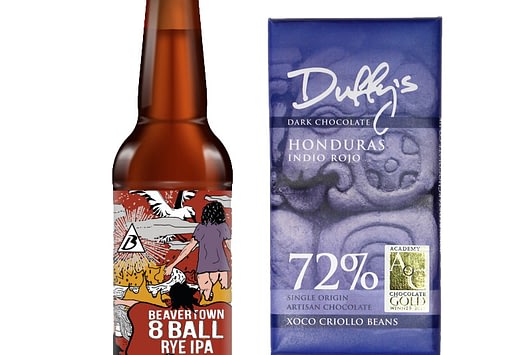
IPA with a Mellow Dark Chocolate
IPAs take no prisoners in taking the throne of craft beer. And yet, despite their huge popularity, this style probably has the most variability compared to any other style of beer.
Choose an IPA that’s not too hoppy or bitter, but more relishes in fruity-led flavours and has a crispy bite. An IPA that is essentially easy drinking.
We opt for a mellow dark chocolate here so as to not overpower the beer, but rather ground the bright and juicy flavoured beer.