Time To Savour The Craft (And Read The Small Print)
What is the craft chocolate process, and why does it matter? Read on to find out.
Print / PDFWhat is the craft chocolate process, and why does it matter? Read on to find out.
Print / PDFThe Craft Chocolate Process
What exactly is the craft chocolate process? Anyone who has been to one of our virtual tastings will have been subjected to an explanation using the analogous difference between roast chicken and chicken nuggets.
We use the comparison to try and highlight the difference between mass-produced chocolate and craft chocolate. It’s all about time. And ‘who’ does ‘what’ and ‘when’. And ‘what’ is added (and taken away).
Roasting a chicken takes time. You are the cook. The end result directly reflects the unique combination of ingredient quality, level of care, and time that is taken.
Making chicken nuggets requires the end-user to use a microwave or oven for a short time. But on the other hand, making a chicken nugget requires a LOT of processing, and capital equipment, at the factory. An awful lot is added. And much is taken away. It’s an efficiency game which is all about consistency, cost, and getting people hooked.
Time and Craft Chocolate
To craft chocolate, time and care are key. You first have to sort the beans, think a few hours per 50kg sack. Then you have to roast (and sometimes pre-roast), think 20-30 mins in most cases, but realise that the time at different heats is key here to account for different bean sizes and types. Then the roasted beans have to be cracked and winnowed (removing the shells from the roasted beans), think 1-2 hours per batch, and depending on the winnower (which could even be a hair dryer…) lots of broken nails. Then grinding and conching, which can be anywhere from 10 to 200 hours. Then, many chocolate makers will let their chocolate ‘rest’ before tempering and moulding into bars (some will rest for weeks if not months). All this requires time. It’s all about coaxing flavour from the beans. And that takes time.
Efficiency and Mass Produced Chocolate
By contrast, mass-produced chocolate can see a bean turned into a bar in a few hours. It uses a completely different approach. Time is (literally) money: The faster, and more efficient, the better. Flavour, taste, and texture are all added later. The machines have to be kept running and utilised. Hence, the problem with “mass balance Fair Trade” bars: the beans in these Fair Trade bars may not be themselves “Fair Trade” as this would require the machines to be stopped, cleaned, changed over, etc. So there is an exemption allowed and beans are “balanced out”.
Indeed, the very roasting approach of mass-produced bars is completely different to craft makers’ roasting. Instead of first roasting the beans, and then removing the shells, most mass-produced chocolate bars reverse the process. Beans are steamed, shells removed, and the nibs are roasted. This is more efficient (yields go up by 3-5%). But it doesn’t optimise flavour. Think freeze-dried coffee versus freshly roasted, and then ground, coffee beans. Faster and more efficient. But not the same flavour.
Next, mass-produced chocolate uses high pressures and massive grinders to turn the roasted nibs into chocolate liquor. And then they temper and mould. It’s fast, it’s efficient, it’s MASSIVE. Craft chocolate is in batches of between 10-500kgs. Mass-produced chocolate starts with batches of 2,500kgs and goes to hundreds of thousand kilos/tonnes per batch. However, to put it mildly, this is not great for flavour. But that’s what additives are for!
Also, very often mass-produced chocolate will remove the cocoa butter and replace it with other ingredients. Why? These other ingredients are far cheaper. Palm oil, vegetable fat and PGPR are a lot cheaper than cocoa butter. Sugar is even cheaper than cocoa powder (cocoa butter’s desiccated by-product). And sugar is VERY addictive.
Read the Label
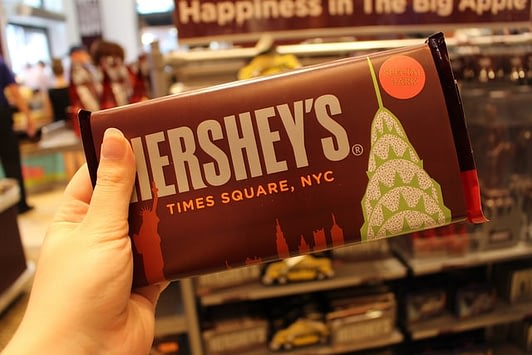
It’s so important to turn the bar over and look at the ingredients. Sugar should NEVER be the first ingredient. And follow Michael Pollan’s advice: “Only eat ingredients your grandmother would recognise”.
But it’s not always that easy. Labels can be confusing. Different countries have different requirements (e.g. in the UK and US you can list cocoa beans as an ingredient, but in Germany, you have to say cocoa liquor). And we can debate the merits of vanilla as an ingredient for a long time (quick answer: vanilla is great for milk chocolate, whereas in dark chocolate it’s generally not a great sign of bean quality. And vanillin should always be a flashing red warning light).
And there is an interesting additional ‘tell’. Mass-produced chocolate will hardly ever detail location: who makes their chocolate? Where are their beans grown? Indeed, ‘big chocolate’ is even exempt from normal EU regulations here; they argue that they can’t answer these questions as their chocolate derives from a huge variety of places. Couverture (a type of semi-finished chocolate) is roasted and initially ground in one place, before being sold to a ‘chocolate maker’ to temper and mould on a completely different continent.
What is 'Belgian Chocolate'?
Couverture shows how complex (and ironic) terms like ‘Belgian’ can be. One of the reasons we associate Belgium with chocolate is that in the 1920s Oskar Callebaut created couverture in his Belgian factory, thereby alleviating the need for other chocolate makers to make their own chocolate. And then a generation later (in the 1960s) Callebaut started to export this couverture, putting Belgium firmly on the chocolate map.
Today, Belgium no longer processes much of this ‘Belgian’ couverture. After merging with the French company, Cocoa Barry in 1996 and listing its shares in Switzerland, Callebaut isn’t technically Belgian anyway. But under EU (and UK) regulations, this couverture can still be labelled “Belgian” as the term is not protected.
Bottom line: read the back of a bar carefully. Check the ingredients. Check where the beans are from. And check where, how, and by whom the bar has been crafted (as opposed to ‘processed‘).