Which Came First – The Chocolate Or The Egg?
With Easter, which came first: the chocolate or the egg? Read on to find out.
Print / PDFWith Easter, which came first: the chocolate or the egg? Read on to find out.
Print / PDFThe Egg Came First
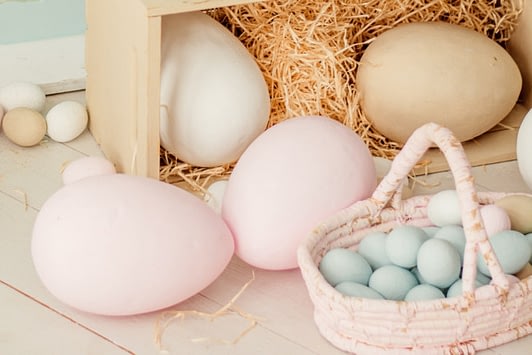
So, unlike the conundrum of which came first in “the chicken or the egg”, with chocolate Easter eggs, the answer seems clear; it was the egg.
Humans have been decorating eggs for millennia (apparently over sixty of them, with evidence of ostrich egg carvings found over 60,000 years ago in South Africa).
By comparison, we can track the drinking of chocolate back to around 3,500BC. And wide scale gifting of chocolate eggs at Easter only really started in the 19th century and then took off in the later 20th century thanks to some smart packaging innovations.
Today, Easter is second only to Christmas as a time for gifting chocolate (and please can we encourage you to check out our range of Easter eggs, bunnies, chicks and more). And at the same time factors that made chocolate Easter eggs ‘hatch’ offer a great history of chocolate, lent, fasting and packaging innovations.
The History of Lent and Eggs
Eggs featured in many religions’ celebrations of Spring, some of which still continue. For example, the Zoroastrians have been painting and gifting eggs at their spring holiday of Nowruz for over 7,000 years. And the ancient Egyptian spring festival of Sham el Nessi, which is still held today as a non-religious holiday, involved hard boiled coloured eggs being eaten at picnics. Eggs also play a key role in the Chinese creation myth of Pangu, and this theme of eggs involved in the world’s creation stretches from Finland (see the Kalevala, the Finnish national epic) to Fiji, Hawaii and indeed pretty much everywhere.
The early church took a different tack; celebrating eggs but also abstaining from them in the run up to Easter. One upshot of this is Shrove Tuesday (aka pancake day) where as many eggs as possible can be turned into pancakes before the 40 days of Lent. France has a slightly different tradition; Mardi Gras, which occurs on the same day as Shrove Tuesday, i.e. the Tuesday before Ash Wednesday. Mardi Gras translates literally as “Fat Tuesday”; and is so named as an encouragement to eat as many as eggs, cheese, dairy, etc. as you can before Lent starts. Easter egg rolling, egg races, etc. may well be another result (after all chickens don’t stop laying eggs during Lent, so something has to be done with them).
And these traditions were then combined with other customs around the Easter hare, which then became the Easter bunny (we’ve written about this before) to end up with breaking the fast with chocolate Easter eggs.
The History of Chocolate and Fasting
Fasting, and not just at Easter, also played a key role in the spread of chocolate over Europe in the 16th and 17th centuries. During the 16th and 17th centuries, Catholics didn’t just fast at Lent, they also fasted on many Saints’ Days and also on Fridays and Wednesdays (hence ‘fish on Fridays’). And this meant that they had to abstain from all animal products (milk, cheese, meat, etc.), and only have a meal 1-2 times a day (note: Henry VIII in the UK as part of the English Reformation pared back the demands of fasting to allow consumption of chicken, and this was seen as a major concession; but eggs remained off the Lenten menu).
The Jesuits saw this as a great opportunity to promote nutritious, and very filling, drinking chocolate that they were importing from the “New World”. They positioned their drinking chocolate as a delicious means to stave off pangs of hunger on any fast day. This campaign met with significant push back from other religious orders, especially the Dominicans, who argued that anything that tasted as good as chocolate, and was so filling, was missing the point of abstaining and fasting. However the Jesuits persevered, and eventually succeeded in persuading various Popes, starting with Gregory XIII and culminating in Alexander VII, to back their argument that “Liquidum non frangit jejunum (i.e. liquids do not break the fast)”. And the rest is history: Europe started to drink chocolate.
Chocolate Eggs
There are various claims floating around for the first chocolate Easter egg, ranging from the court of Louis XIV to an Italian, known as “the widow Giambone”, who had the idea of filling empty eggshells with melted chocolate and selling them in her shop in 1725.
However, the effort involved in hand crafting these eggs, pouring them into hollowed out egg shells, etc. was too great for these initiatives to be anything more than a court occasional treat.
It took another century for makers, starting with Joseph Fry, to work out how to make chocolate Easter eggs ‘at scale’. Fry’s back in 1847 had already worked out how to make the world’s first commercial chocolate bars by “folding back” the cocoa butter produced by the Van Houten’s cocoa press into their cocoa grinders and making stable, solid bars. And they used this insight to mould chocolate Easter eggs, launching them in 1873 (Cadbury followed a couple of years later).
These eggs were filled with all sorts of other confectionery and they sold well. However they suffered from the perennial problem of eggs as a whole. They are fragile. They broke all too easily.
A Lightbulb Moment for Packaging
Chicken (and other non chocolate) eggs until the twentieth century were wrapped in straw and transported by basket, boxes, etc. But they often broke in transit. However in 1911, a Canadian newspaper editor Joseph Coyle, seeking to end a bust up over eggs breaking in transport, invented the first egg carton (note: Liverpudlians sometimes argue that a citizen of theirs; Thomas Peter Bethell; had invented something similar in 1906, but this design was more a series of dividers so Coyle is generally credited as the father of the modern egg box).
Chocolate Easter egg packaging had to wait another few decades for its ‘eureka moment’. In the early 1950s, William T. Horry, a packaging designer, realised that he could adapt a carton he was using to transport electric light bulbs to package Easter eggs. Cadbury seized upon this idea, using it first on their Roses Easter Eggs as it offered greater protection and also windows that could show the egg inside the box.
Links for Further Reading
If you want to read more about any of these topics, we’d highly recommend the follow articles:
https://www.archives.gov/publications/prologue/2000/spring/white-house-egg-roll-1.html
https://www.historytoday.com/archive/history-matters/theology-chocolate
https://aratta.wordpress.com/2015/06/02/the-world-egg/
https://pmc.ncbi.nlm.nih.gov/articles/PMC6362887/