Who REALLY first brought chocolate to Europe?
The history of chocolate is complex, complicated and varied.
Print / PDFThe history of chocolate is complex, complicated and varied.
Print / PDFSummary
- The history of chocolate is intricate and often obscure, from its consumption in early civilizations to its introduction to Europe. Misconceptions, such as Columbus’ role in bringing chocolate to Europe, highlight the complexity of its origins.
- Chocolate’s journey involves dark chapters including colonization, slavery, and environmental destruction in the New World. These issues shaped cocoa cultivation and consumption dynamics, leaving lasting impacts on indigenous cultures.
- Despite adversity, indigenous groups like the Q’eqchi’ Maya have preserved cocoa cultivation traditions. Initiatives by modern craft chocolate pioneers aim to support sustainable practices and cultural heritage, creating a hopeful narrative amidst historical challenges.
The history of chocolate is appropriately rich, complex, and obscure in parts. Everything from how chocolate was consumed and celebrated, to how it first made it to Europe, is shrouded in confusion. For example; although Columbus certainly came across cocoa beans, he doesn’t appear to have realised it could be made into chocolate, and it’s a myth that he was the first to bring it back to Europe.
Much of chocolate’s history with cocoa is also dark and depressing: The conquest of the “New World” and eventual ‘take off’ of chocolate in the “Old World” involves everything from plagues to slavery, and deforestation to desertification.
However, there are some brighter spots. For example, we can now enjoy craft chocolate bars from Lachua, Guatemala, which can trace a lineage back to the first people who brought chocolate to Europe; some Kechi tribal leaders way back in 1544. For more on this history and some of these award winning Lachua bars, please see below.
New Foods from the New World
The discovery of the “New World” revolutionised food in the “Old World”. Before Columbus, Europe didn’t know about potatoes, tomatoes, chillies, turkeys, corn, maize, vanilla, tobacco, peanuts or, of course, chocolate.
Columbus brought back many of these new foods with him to impress Ferdinand and Isabella, the sponsors of his expeditions. In particular, he was proud of what he called “chili peppers”, as he used these chilis to argue that he had discovered a lucrative new route to the Indies for black pepper. This confusion still persists even though peppers and chilis are very different plants, and the ‘heat’ from piperine (peppers) is very different to the heat from chilis (capsaicin).
While European (and Asian) desire for chilis took off quickly, it took far longer for many of these new foods to percolate through into “Old World” diets. For example potatoes didn’t really take off for over two centuries. And even chocolate took a few generations.
Indeed, in the case of cacao and chocolate, it took some time before anyone brought them back to Europe. We know that Columbus and his son came across cocoa beans on his fourth voyage and were amazed at the importance that the Mayans treated these “almond like beans”. But there is no evidence that he witnessed how the Mayans drank chocolate, nor is there any evidence that he brought any cocoa beans, or chocolate, back with him to Europe.
There is also no evidence that Hernán Cortés sent any chocolate back to Europe, although he did describe it in various letters he sent back. This is even more surprising given the fact that his chronicler Bernal Díaz del Castillo was enamoured with chocolate, gushing over Montezuma consumption of “the froth of fifty cups of chocolate” before visiting his wives. (Indeed, this tale of superhuman stamina may well have been the start of chocolate’s association with aphrodisiacs).
When did chocolate first reach “The Old World”?
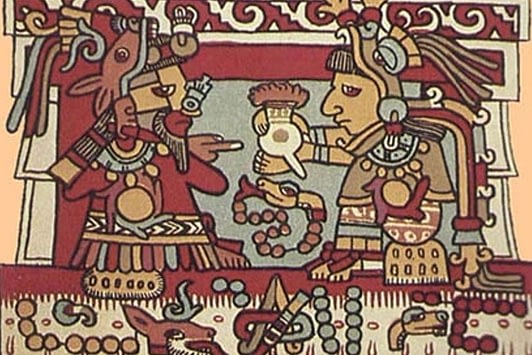
The first clearly documented evidence we have of cocoa beans and chocolate being presented to a European court is 1544. Dominican friar Bartolomé de las Casas brought a delegation of Kekchi (or Q’eqchi) leaders to the court of the future Philip II of Spain, who gave the future monarch a series of gifts including 2000 quetzal feathers, chillies, sarsaparilla and both cocoa beans and chocolate for drinking. Perhaps because the drinking chocolate was served cold (and therefore associated with all sorts of health issues), perhaps because it wasn’t mixed with spices and sweeteners, or perhaps because Philip just didn’t like chocolate, this event was not a ‘eureka moment’ for chocolate in Europe.
It took another generation for Europeans to import cocoa beans in any volume from the New World. And chocolate’s success in the late 1500s appears largely down to its promotion as a great, and tasty, source of nutrition on fast days in Catholic Europe. In medieval and early modern Catholic Europe, over 100 days of the year were ‘fasting days’: All Wednesdays, all Fridays and most saints’ days, plus Lent. On these fasting days, any animal based product, meat, cheese, butter, etc. was to be avoided. Hot chocolate was therefore promoted as a nutritious and delicious option, especially by the Jesuits, and they even secured papal endorsement for this practice (along with fish on Fridays).
How did cocoa and chocolate fare in the post-conquest “New World”?
Whilst drinking chocolate started a rapid ascent in Europe (and later in the USA and Caribbean), the history of chocolate consumption and cultivation in the conquered “New World” was not nearly as rosy.
One disastrous consequence of the “discovery” of the “New World” was the introduction of various diseases, in particular smallpox, which devastated the populations of the Aztec and Inca Empires, wiping out over 70% of the population in modern day Guatemala and Belize. For more on this tragedy, please see HERE.
Indeed, this is why in the 17th and 18th Centuries cocoa cultivation moved to Ecuador and Venezuela, and away from its traditional heartlands of Mexico, Guatemala and Belize. The combination of smallpox and brutal conquest meant that there weren’t enough people to farm cocoa in areas once famed for their cocoa production.
The first clearly documented evidence we have of cocoa beans and chocolate being presented to a European court is 1544. Dominican friar Bartolomé de las Casas brought a delegation of Kekchi (or Q’eqchi) leaders to the court of the future Philip II of Spain, who gave the future monarch a series of gifts including 2000 quetzal feathers, chillies, sarsaparilla and both cocoa beans and chocolate for drinking.
Ceremonies, Festivals, and Chocolate
These social and political upheavals radically changed not just the way chocolate was farmed, but also how it was consumed and used in celebrations. The Aztec ruling classes, who had consumed cocoa as a core part of their aristocratic lifestyles, were destroyed and many of their chocolate rituals were also abandoned. Given that some of these ceremonies involved human sacrifice, with victims’ hearts cut out with knives dipped in ‘ceremonial cocoa’, some of these ceremonies may not have been sorely missed. But as the indigenous peoples and tribes were brutalised and enslaved, many of their rituals and ceremonies celebrating cacao, the rainforest and their traditional ways of life were destroyed and lost.
In a few cases, some celebrations involving chocolate seem to have survived, and indeed some new rituals have emerged. For example the Ch’orti’ Maya people, based in Eastern Guatemala and Western Honduras, were able to continue to farm cacao despite extensive hardships. And it appears that they managed to preserve some uses of cocoa in religious ceremonies. In pre-Columbian Mayan society, chocolate was a key part of everyday life, woven into the fabric of society. It is still an everyday drink in indigenous Maya culture, and is used in ceremonies to mark milestones in life. The Yucatec Maya use chocolate in coming-of-age rituals to usher girls into adulthood, while the Kekchi Maya in Belize scatter cocoa beans during ceremonies to bless new houses. In the Ch’orti’ culture, where agriculture is still extremely important, chocolate is used in various rain ceremonies, where ritual meals of turkeys and chilate (a gruel made out of cocoa and maize) are consumed.
Amongst the neighbouring Ladino peoples, whose culture combines aspects of their Spanish and indigenous heritage, the Catholic Church co-opted traditional native practices of using chocolate. Hot and cold chocolate drinks made with roasted cocoa beans, cinnamon and sugar are used to celebrate Christmas, the New Year and Easter. (Note: In traditional religious practice, chocolate drinking varied depending on the time of year, according to the Mayan calendar. This switching between hot and cold chocolate drinks caused all sorts of confusion with the European ideas of ‘humours’ and health). Numerous rituals involving cocoa beans and communally sharing chocolate were (and are) also used to celebrate everything from moving house to getting married and even to help mothers recuperate after giving birth.
A Hopeful Story: Lachua Cocoa from the Q’eqchi’ and Mopan Maya
Las Casas had brought the Q’eqchi’ to the court of Philip of Spain in 1544 to counter the idea of forcefully conquering the indigenous peoples, and to show the benefits of “peaceful” cooperation. Sadly, Las Casas’ approach was soon abandoned, and the Q’eqchi’ were enslaved to the Spanish colonists, along with many other indigenous peoples. Their lives became fuel for the colonial machine.
Nevertheless, some of the Q’eqchi’ peoples survived. They were displaced from their homelands, and are now one of the most widely distributed of all the Maya peoples. In spite of this, and of the continued blights of poverty, enslavement persecution, environmental destruction and land loss, they managed to preserve elements of their traditional culture. And for their own personal consumption they continued to grow, and celebrate, cocoa.