Wake up and smell the cocoa
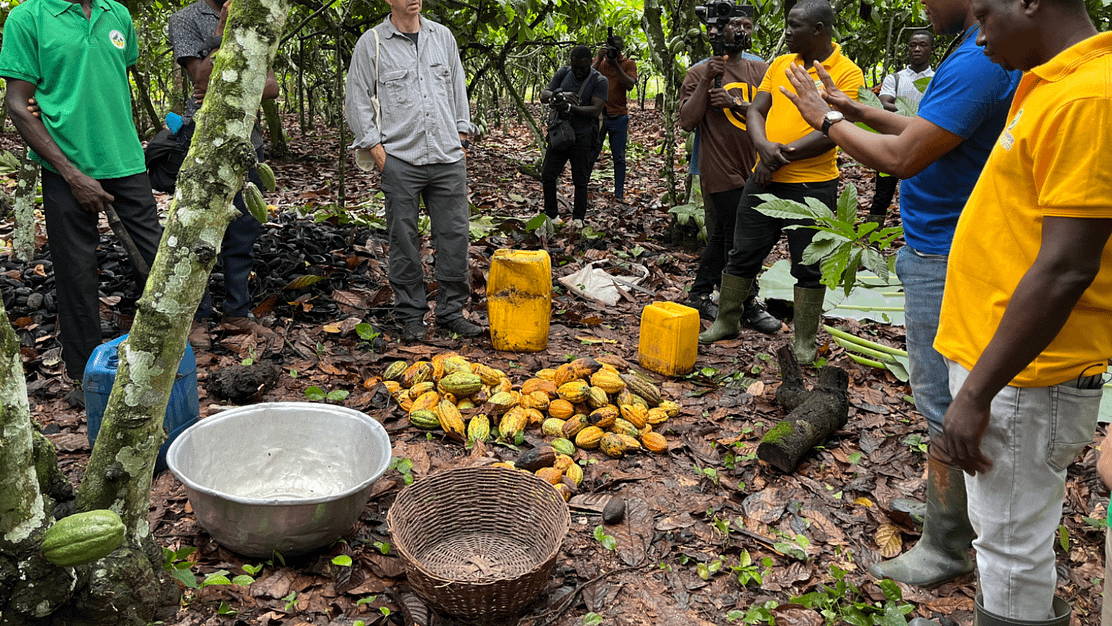
After returning from a trip to the cocoa farms of Ghana, Spencer shares the cocoa journey from flower to pod to bean through the sense of smell.
Print / PDFWe are all intimately aware of the deliciousness, and appeal, of the aroma of a freshly brewed coffee. Hot chocolate, and the smell of roasting cocoa beans, are similarly enticing and delicious. And the flavour of chocolate as it melts in our mouth is another example of the power of craft chocolates’s aromas – after all, we are effectively “smelling” the chocolate here with our mouths (see here for more).
But as one perspicacious participant at a recent in person tasting asked, what about all the other smells of cocoa and chocolate – what are they like? and what can they tell us?
It’s a great question; and fortunately on my recent trip to Ghana with the AMAZING BOTANIST and cocoa guru Sarah Bharath, we were able to explore some of these aromas “in the field and farm”. And they really were very, very different to what I’d expected.
Even if you can’t make it in the near future to a cocoa farm, hopefully you’ll be near a craft chocolate maker .. so why not visit them to enjoy the wonderful smells of winnowing, roasting, conching and tempering? See here for a map of some makers. And if that doesn’t work, why not make some hot chocolate – try a couple of different beans and makers so that you can not only savour the flavour, but also delight in the aroma waves.
So please crack open a couple of bars and/or make a hot chocolate, and do smell their aromas – and then read on for more about the complex world of aromas, and why even though with humans the idea of chocolate as an aphrodisiac may be a bit far fetched, cross pollination by midges shows the power of smell!
On the farm – flowers and pods
Try as I might, I really couldn’t detect any aromas from the small flowers that bud and then pollinate into cocoa pods. However there does appear to be something about the cocoa flower that delights the midges and other insects that help pollinate cocoa. Given the importance of this pollination, as Sarah notes it’s surprising that more hasn’t been done here in exploring what odours, or even pheromones, may be stimulating the midges — especially given the challenges of alternatives like hand pollination (see the sources below for some interesting work in Australia and Trinidad).
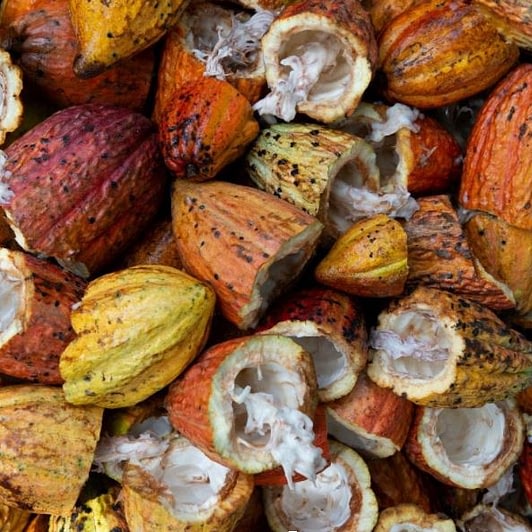
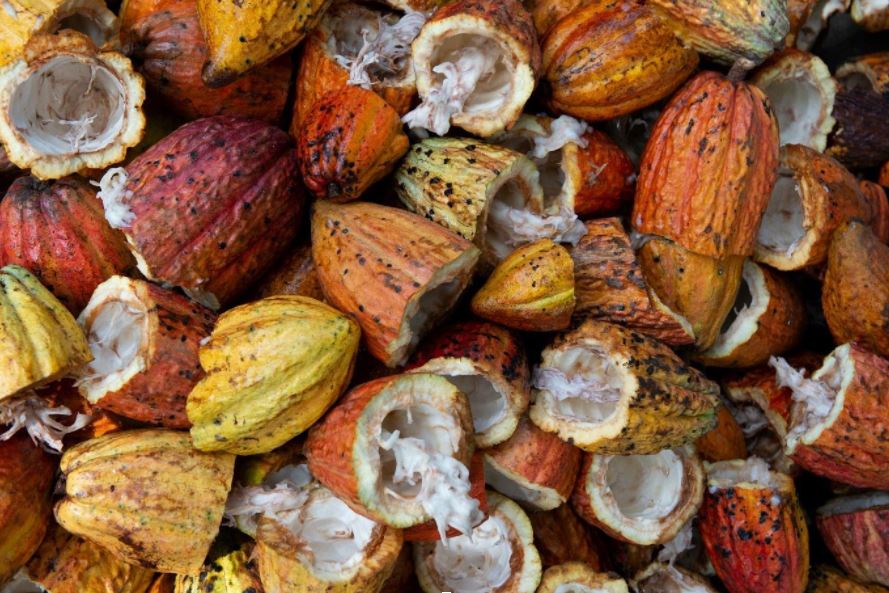
Unripe cocoa pods emit hardly any odour, and even though ripe cocoa pods have a very subtle smell, these are nowhere near as distinctive as in most other fruits. As Sarah explained, visual cues are far more revealing than smell for determining ripeness. Ripe pods typically change colour from green to yellow, and red ones to orange-yellow, depending on the variety. Sound can be used to assess ripeness with a ripe pod making a hollow sound when tapped (or shaken) as the beans inside have loosened from the inner side walls of the pod. Textural changes can also indicate ripeness, with the pod’s surface becoming marginally softer when pressed as it over-ripens.
As you open a (ripe) pod, a completely wonderful set of aromas emerge. These aromas bear no similarity to the smells of hot chocolate, roasted cocoa beans or a chocolate bar. For the pods we opened in Ghana, the white pulp that surrounded the cocoa beans had a very distinctive, sweet-tart fruity smell that reminded me of lychee, mangosteen and various other tropical fruits – and sucking the fruit reinforced these flavours too. Sarah explained that different cocoa varietals have different aromas too .. confirmed by Juliana of Baiani when comparing the different pods on her Brazilian Finca. If you want to try this in the UK, we’ve some pulp sachets sachets which you can get here, or try Knoops drink Cocoa-fruit frappé.
If you open an overripe, or rotten cocoa pod, it’s a very different experience. Indeed the smell of a pod left for a few days in the field reinforces the importance of rapidly transferring the pulpy seeds from pods to either trays, boxes or heaps so that the pulp can start fermenting the seeds to become beans. We brought back a couple of pods with us from the farm and Three Mountains to Accra, and when we opened them the smell was very different – almost boozey, and with some very powerful almost off notes.
Similarly, smell might be a warning of diseases. Just as there is increasing interest in using smell to detect all sorts of diseases from Parkinsons to Covid in humans, there is clearly scope for using smells and odours to check for specific cocoa diseases; for example the notorious black pod disease is associated with a distinctive smell of seaweed.
On the farm – fermentation
Cocoa fermentation is not only amazing and miraculous, turning bitter and astringent cocoa seeds into nutty, wildly flacour and nutritious cocoa beans. But it’s also INCREDIBLY complex. There are LOTS of different fermentation approaches – varying from heap, box or tray fermenetation, and then also “lavado” (a sort of half fermentation, liked washed fermentation with coffee – see here for a rare example from Mucho). And fermentation involves all sorts of aromas that differ hugely between cocoa varietals, fermentation approaches, stages, microbes, yeasts and more. Just to give a “flavour” of this complexity, here are some aromas to look out for:
- Early fermentation (anaerobic, usually lasts for 24-48 hours):
- The pulp’s fruity aroma intensifies as yeasts begin to ferment the sugars (and this will differ by cocoa varietal)
- Alcoholic notes start to develop due to yeast activity.
- Mid-fermentation – Late Fermentation (aerobic, lasts for 48-72, hours or even longer in many cases)
- Acetic acid bacteria become active, producing acetic acid. This leads to a more pungent acidic, vinegar-like aroma.
- The fruity notes begin to diminish as the pulp breaks down.
- In box fermentation, one intriguing recent study (on Criollo) beans have been done that suggest that beans “turned” every 24 hours may develop fermented, bready, and fruity aromas whereas those turned with a start time of 48 hours aromas of floral, woody, sweet, fruity and chocolate aromas emerged
- Over-fermentation – and all its associated problems – are also clearly manifested in all sorts of “off” smells (and attendant mouth flavours)
- Over-fermentation can lead to the growth of undesirable microorganisms, such as bacilli bacteria and mould, which produce off-flavours and smells uncannily reminiscent of fresh and stale urine outside a pub, rotten meat or putrid smells with strong ammonia.
- … in addition, over-fermentation can result in mould growth, leading to musty or mouldy odours. This is particularly likely if the beans are not turned properly or if the fermentation environment is too humid, or in some cases too dry.
- Over-fermentation can lead to an excessive buildup of acetic acid and other organic acids, resulting in overly sharp or vinegary aromas (and this can also happen if there is too much pulp)
As anyone who has “smelt” and/or savoured the likes of Solomon’s Gold bars will know, drying also makes a huge difference to the mouth flavour and nose smell of a bar. These bars are crafted with beans from the Solomon Isles that are only partially “solar dried”; because of the rains they are also dried near fires and/or in special artificial driers. So if you are fan of e.g., peaty whisky or smokey flavours in general, these bars are for you.
Ghana, as part of its drive for “the world’s best cocoa”, has seen Cocobod develop clear protocols and best practices for consistently drying beans on raised beds of reeds. As well as allowing the beans to dry evenly, when it rains (and it does – see below), these reeds can provide a means to stop the fermented beans getting soaked and prevent any mould. And it was intriguing to hear from Stephen Opoku of the way that drying on concrete floors (as in e.g., Madagascar) can help amplify some of the citrus, berry and bright (acid) notes often associated with Madagascar.
And again, flavour can help identify some less than ideal drying approaches. For example, in some West African cocoa growing countries, beans are frequently left to dry on the convenient, hot surfaces of the nearest dirt (or tarmac) road. The problems here are obvious – and if you ever detect a diesel note in any chocolate, be wary that this may be from the exhaust of trucks passing by as the cocoa beans dry.
Even at this stage, dried beans – until they are roasted – still aren’t going to set hearts aflutter with delicious chocolatey smells. If you place your nose into a bag of dried beans, you may well get some fruity, floral, nutty and/or some chocolatey notes but there will also be a pretty acidic and pungent smell too, sometimes that is almost “sweaty”. It’s still a long way to go for the beans to develop the rich, complex aromas typical of craft chocolate!
Conclusion
I’m incredibly grateful to Sarah Bharath, Kate Cavallin, Leslie Agyare, Greg D’Allesandre, Kristy Liessle, Juliana Aquino plus Stephen Opoku (of CRIG) for providing me with this “101” introduction, and I hope it gives a “taster” of the incredible complexity of flavours, aromas and smells involved in growing, harvesting, fermenting and drying cocoa.
Sadly at our in person tastings and “Taste and Flavour” masterclasses we very rarely have pods for participants to try. But we’ve a tonne of bars that showcase these aromas – so hope to see you at one of these soon. At the Taste and Flavour masterclasses we are planning to try bars showcasing different fermentations (box and heap), drying (solar and fire) and even some “off fermentations”.
And again, trust your sense of smell .. it’s also what provides balance, length, intensity and complexity of flavour as chocolate melts in your mouth. And it’s not only an amazing skill to practise which literally opens up a new sense, but it’s also a great way to avoid junk foods/ confectionery with their reliance on artificial flavours, sugar, salt and added fats.
FURTHER READING
PODS AND RIPENESS
Aroma Properties of Cocoa Fruit Pulp from Different Origins – PMC (nih.gov)
Natural Resources Institute – Midges guide the scent of success for better cocoa pollination (nri.org)
Floral Odors and the Interaction between Pollinating Ceratopogonid Midges and Cacao – PubMed (nih.gov)
FERMENTATION ARTICLES
Chemical and flavor profile changes of cocoa beans (Theobroma cacao L.) during primary fermentation – PMC (nih.gov)
Fermentation of Cocoa Beans | IntechOpen
Cocoa bean turning as a method for redirecting the aroma compound profile in artisanal cocoa fermentation – ScienceDirect
DRYING
A Review of Cocoa Drying Technologies and the Effect on Bean Quality Parameters – Dzelagha – 2020 – International Journal of Food Science – Wiley Online Library
286.pdf (aidic.it)