Chocolate in a Place Where Chocolate Melts: Vietnam

Vietnam: the place where chocolate melts – like the morsel just snaffled into your mouth.
Print / PDFVietnam: the place where chocolate melts – like the morsel just snaffled into your mouth.
Print / PDFWhat chocolate in Vietnam used to be like
Before the craft chocolate movement, kickstarted by Marou’s founding in 2011, chocolate in Vietnam was a small little novelty. Something to coat the Snickers’ bar, or to fill an M&M.

We were talking to Jonathan, an importer of Marou’s chocolate bars, who lived in Vietnam in the 1990s and 2000s, and this is what we learned.
Chocolate was never that popular until recently, usually found melted or bloomed in the shops. The energy supply was unreliable (to say the least) and didn’t quite help to keep the bars from retempering.
The Vietnamese always had a taste for coffee; there are coffee shops everywhere in the cities; but they never quite latched onto cocoa, despite both being products of French colonialism.
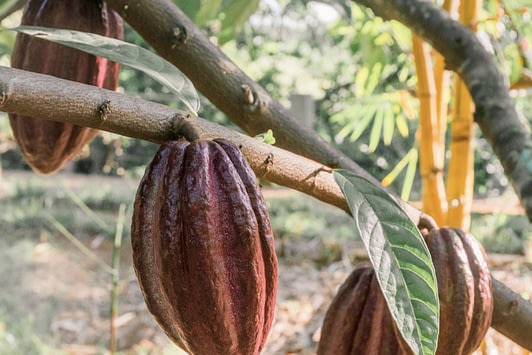
Cocoa was this weird commodity crop, grown alongside the big bumper crops like pomelo, durian, and rubber. Many farmers had never even heard of cacao then!
There were attempts to make cacao a standard crop in Vietnam. Farmers were trained to grow cacao trees through various programmes, run with help from both inside and outside Vietnam. But by the late noughties, this all died down.
A Craft Chocolate Renaissance
Marou single-handedly brought about the cacao renaissance. Alongside the economic growth of Vietnam, since 2011, Marou has put Vietnamese cocoa on the world stage.
The decision to make craft chocolate, to bring it right down to the bean, meant that the founders; Samuel Maruta and Vincent Mourou, met the cacao farmers themselves.
Jonathan tells us how the farmers used to put bricks in the bottom of their bags of cocoa beans, to make the yield seem greater:
How did Marou find out? Well, they tipped out the bags to check. Quality over quantity. So long as the farmers produce and maintain fine beans, Marou will be happy to pay the higher prices.
Marou’s worldwide success put Vietnam on the chocolate map. Now over 10 Vietnam-based chocolate companies have been founded, opting for quality craft chocolate, made from their own Trinitario beans.
What is Chocolate Like Now in Vietnam?
Now, the Vietnamese people are getting a taste for craft chocolate.
Thang Minh Truong, one of the founders of TBros, tells us that craft chocolate is catching on among the younger professionals. All it needed was some teaching around how to appreciate high-end chocolate.
Before; sweeter confections were preferred over dark chocolate bars. Now; those with disposable income have learnt from tourists how good Vietnamese chocolate really is.
The Vietnamese have taken on Western customs as they’ve done before; think of French baguettes and Vietnamese bánh mì. Chocolates are bought as gifts every Valentine’s Day and Lunar New Year. Dark chocolate is fashionable due to its healthy nature and low-sugar content. Chocolate is now freely eaten as a snack and enjoyed on its own, not just on candy.
The Vietnamese are now seeing how wonderful their own product is, and they’re proud of it. Thang tells us how the Vietnamese market for TBros’ bars is growing, partly due to the COVID-19 pandemic, but it’s a sign of growing taste in their own chocolate.
What Are The Vietnamese Makers Doing Then?
True to their food ethic, they are using the whole pod. Thang tells us how farmers are planting cacao trees alongside other crops which require a certain soil type like coffee and durian, and how he is starting to make his own kombucha out of the cacao pods.
In fact, TBros are constantly experimenting with flavours, ranging from adding coffee and coconut milk – Marou’s coconut milk bar is excellent – to fermented shrimp paste!
Though, it’s really the beans themselves that make Vietnamese chocolate stand out. Trinitario beans only account for around 15% of the worldwide cocoa bean production, and Vietnam only produces Trinitario beans.
The beans ferment for 4-6 days, unlike the 3 days for Criollo beans. The makers taught, and are teaching, themselves how to make chocolate. The experiments they do and the experience they gain all add up when they make their chocolate.
Vietnam may be a country in transition, but chocolate makers are looking to maintain quality chocolate and sustainability in their businesses. TBros’ nipa palm packaging and Marou’s diligent testing of cacao beans even now tell you everything.
Chocolate culture in Vietnam may have started from foreign roots, from cultivation to appreciation, but it’s the Vietnamese people themselves who deserve praise and pride for their fine produce.