India’s Chocolate History and Future
Deep dive into the history of cocoa farming in India, and its relevance to craft chocolate.
Print / PDFDeep dive into the history of cocoa farming in India, and its relevance to craft chocolate.
Print / PDFCocoa's Colonial Beginnings
India is gifted with an extraordinarily diverse food culture and, luckily, chocolate is showing up on its horizon.
Admittedly, chocolate might not be the first thing that comes to your mind when you think of India. You might instead think of fragrant curries, spicy achars, chewy chappatis, or a soothing cup of spiced sweet tea. But the history of cocoa farming in India, and its relevance to our craft chocolate world, is well worth a dive.
The history of cocoa in India starts with the British occupation, at the end of the eighteenth century when the country was part of the British Empire. In order to satisfy their craving for chocolate, the British used their colonies across the world as agricultural bases for cocoa. While cocoa took very well to West African soils, imports of the fragile criollo varieties to Southern India never really adapted to local conditions, though it can now be found in Sri Lanka.
Cocoa agriculture in India only really took up as recently as the 1960s when Cadbury, with the support of the World Bank and Kerala Agricultural University, launched cocoa agriculture initiatives. Recognising that the warm forested regions of Southern India held great potential, the corporations and institutions went and educated local farmers about cocoa while conducting research and holding trials so as to identify viable and high-yielding varietals of cocoa. Due to cocoa’s preference for an all-year-round hot but shaded weather, cocoa is only suited to the Southern states of Kerala, Andhra Pradesh and Karnataka. Most cocoa plants grown in India today are from the forastero variety, which is productive and widespread across the globe.
Cocoa Production in India Today
To this day, Indian cocoa only represents about 1% of global production. For the most part, Indian grown cocoa goes directly to satisfy local demand which, in the second most populous country in the world, far exceeds the supply. Indeed, in 2015/16, India was still importing 57% of its chocolate. What’s more, the chocolate market is dominated by two big names: Cadbury and Nestlé, neither of which are after the high-quality chocolate we promote here at Cocoa Runners. Why is that? See our article on ‘big chocolate’ and its impact for starters.
At present, India’s cocoa production is relatively steady and healthy though it has plenty of room for improvement, especially at the level of trade. By interacting directly with craft chocolate makers, and by developing the necessary knowledge to learn how to process cocoa into chocolate, India will add value to the sector.
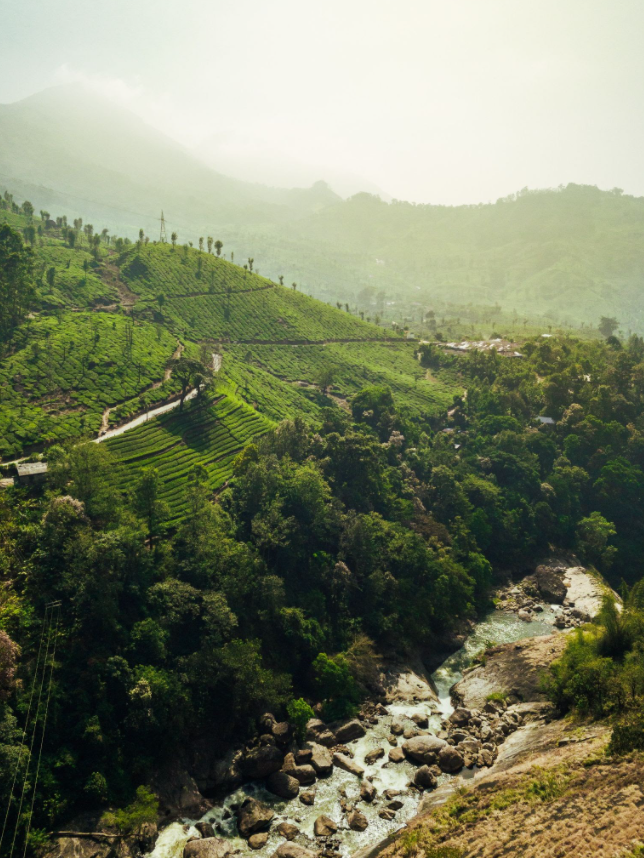
The landscape of Kerala, in India’s South, has the conditions for growing cacao successfully.
Fortunately, the past twenty years in India have seen a slow rise of the craft chocolate movement, though it still very much remains somewhat of a niche. One of India’s most notable craft chocolate makers is Soklet, whom we are happy to stock here at Cocoa Runners.
Craft Chocolate on the Rise
Soklet (“chocolate” in Tamil) is a family-run business at the head of which are brothers-in-law Harish Manoj Kumar and Karthikeyan Palansiwamy and their wives Rahti and Sajini. Previously involved in the textile industry, the pairs combine agricultural and chocolate making know-how to craft India’s first and only tree-to-bar chocolate. Their chocolate is a celebration of the terroir of their plantations where their cocoa trees grow in harmony with all other kinds of crops. Their richness and complexity of flavours has garnered Soklet recognition at the International Chocolate Awards.
Indian cacao is also at the heart of another maker’s work: Karuna (“compassion” in Sanskrit). The couple behind Karuna, Armin Untersteiner and Katya Waldboth, started their chocolate journey in Southern India, where the couple lived for some time. An encounter with cocoa farmers inspired Armin to take chocolate making as a hobby. Initially using small-scale traditional lentil grinders to create chocolate, the hobby gradually scaled up to become what we know today. Karuna’s chocolates are not only a sight to behold (the bars are carefully moulded and wrapped to evoke traditional South Indian dresses) but they will also certainly please your taste buds. We currently have one bar of Indian origin from Karuna who also sources cocoa from other countries. This 70% bar was created from cocoa beans of the Idukki region in Kerala, the cradle of Indian chocolate making.
We also have in stock bars made from cocoa sourced in India from other makers such as Mirzam and Fjåk to only name a couple.
In the future, we hope to see Indian cocoa farming to gravitate towards smaller and fairer (for the people and the planet) practices as demand for craft chocolate expands in unison with the general demand for the bittersweet treat. With its deeply rooted culinary culture, we are excited to see how creative Indian cocoa making is going to be.