The Sustainability of Our Packaging
As specialists in ethically and sustainably produced chocolate, using environmentally-friendly packaging is a priority both...
Print / PDFAs specialists in ethically and sustainably produced chocolate, using environmentally-friendly packaging is a priority both...
Print / PDFAs specialists in ethically and sustainably produced chocolate, using environmentally-friendly packaging is a priority both for us and for our customers.
We have recently decided to upgrade our packaging for wine, whisky and all our other glass bottles from wooden boxes to inflatable plastic airpacks. These airpacks, specifically called ‘Green-Paqs’, are by Airpack Systems, one of the UK’s leading specialists in biodegradable inflatable packaging. Green-Paqs cushion each bottle while surrounded by an appropriately-sized cardboard box.
We understand that the words ‘plastic’ and ‘packaging’ together can sound alarm bells, so we want to give you as much detail behind this choice as possible.
Why have we made this upgrade to inflatable airpacks?
We have switched to Green-Paqs for two main (linked) reasons:
- They are an environmentally-friendly choice.
- This is an extremely durable packaging which offers a high level of protection (the breakage rate for shipments using Green-Paqs is a miniscule 0.04%) for our products, resulting in less waste.
Airpacks and the environment
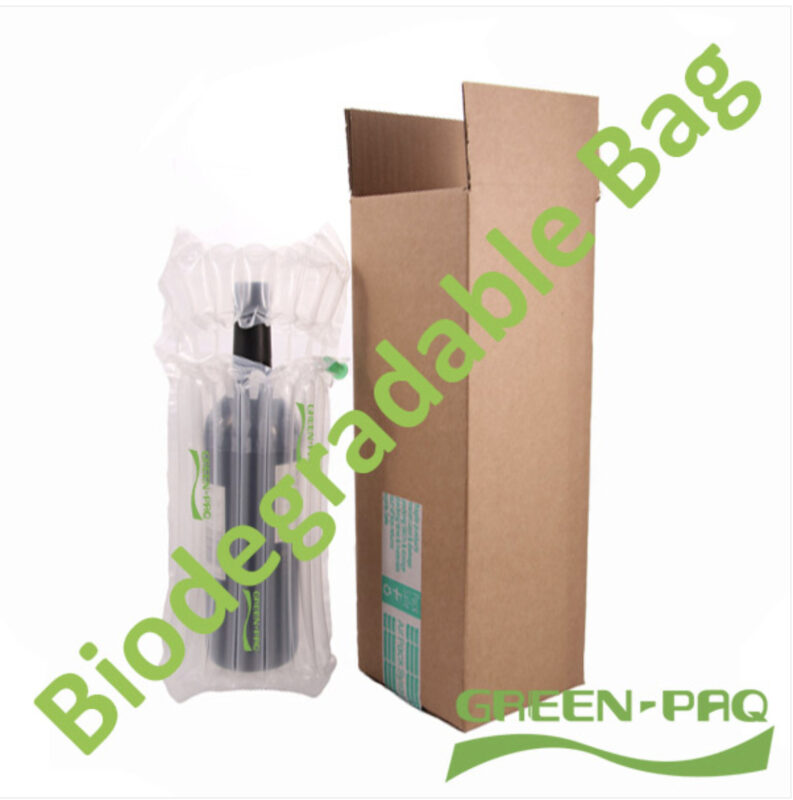
Airpack Systems make their Green-Paqs from 98% recyclable, reusable, biodegradable plastic. This means that they can either be re-used or disposed of in home recycling bins and local recycling facilities.
The type of plastic used is called OXO biodegradable plastic. In landfill, this plastic breaks down over time and gets converted into CO2, H2O and biomass. It should be noted that a small proportion of the bag is made from nylon to improve performance, which is not biodegradable.
The biodegradability of the Green-Paq plastic has been tested by the SP Technical Research Institute of Sweden (“SP”). The institute performed SP Method SPCR 141 Appendix 4: “Polymeric Waste degradable by abiotic and subsequent biological degradation requirements and test Methods”. This may sound convoluted, but it essentially means that an external regulating body has assessed the biodegradability of the material.
Green-Paqs are also only 2% plastic and 98% air, making them extremely light. They are also transported from AirPack Systems to us before they are inflated, meaning that they take up very little space. As a result, fewer vehicles are required to transport them compared to traditional paper and board-based packaging, for instance. This keeps the CO2 emissions and carbon footprint from Green-Paqs to a minimum.
In further defence of plastics
As we mentioned, ‘plastic packaging’ tends to conjure images of colossal landfill sites and polluted oceans. Often this is for good reason: if plastic is not disposed of carefully, it can have horrific consequences for our natural environment. However this is a complex issue, and it is important to be wary of viewing plastic alternatives as better for the planet.
Plastics have a huge role to play in reducing food waste. Food stored and transported in plastic lasts longer and is less at risk of becoming spoiled or damaged during transportation. Food waste is not usually the first culprit that springs to mind when it comes to greenhouse gas emissions, but it contributes a whopping 3.3 billion tonnes each year. To put that in perspective, if we were to imagine ‘food waste’ as a country, it would rank only below the US and China in terms of its contribution to greenhouse gas emissions.
Moreover, the production processes for plastic alternatives such as paper can sometimes cause more harm. For example, it requires somewhere between 4-5 times as much energy to produce a paper bag as it does a plastic one, and 15 times more water. Paper bag manufacturing also generates 80% more greenhouse gas emissions than plastic bag manufacture.
At the moment, no effective packaging solution is flawless. By choosing packaging which uses recyclable, reusable plastic in minimal quantities, reduces damage risk to our bottles (and therefore waste) and the amount of energy required to make and transport it we are taking a step in the right direction.