Untangling Taste, Flavour, Texture and Mouthfeel
Taste, flavour, texture, and mouthfeel are all part of the experience of craft chocolate. But the way we use these terms can be confusing.
Print / PDFTaste, flavour, texture, and mouthfeel are all part of the experience of craft chocolate. But the way we use these terms can be confusing.
Print / PDFSummary
- Experiencing craft chocolate is one thing, articulating it is another entirely. Understanding taste, flavour, texture and mouthfeel better can help you articulate those frustrating “on the tip of your tongue” sensations.
- To understand the difference between taste and flavour, hold your nose while sucking a piece of chocolate. You’ll realise that there are many flavours unfolding gradually, because flavour is experienced through our sense of smell.
- Craft chocolate is all about the nuances, for example, the difference between astringency (fun) and bitterness (not so much).
Learn how to articulate your experience with craft chocolate
How is texture different from mouthfeel? Where do taste and flavour begin and end? We go through several sensations when experiencing craft chocolate, but don’t always have the ability to articulate them. Here’s a primer to help you identify and articulate those sensations that are “literally on the tip of your tongue”.
At the end of this post, we also suggest a bunch of trials and experiments of different pairings of craft chocolate with wine, beer, coffee, rum, whisky and much more that you can try at home and in the company of friends. In particular, we hope that highlighting the difference between the mouthfeel of astringency and the taste of bitterness will help open up the world of 100% cacao bars to even more customers. It gives us another excuse to try and persuade people to travel to the truly dark side of 100% cacao and explore a bunch of exquisite bars.
The many sensorial dimensions of craft chocolate
We experience craft chocolate through multiple sensations. At Cocoa Runners, when we taste chocolate, we break down these sensations into five very different experiences: taste, flavour, texture, mouthfeel and melt. We know that these aren’t the only aspects to appreciating craft chocolate (for example, occasion, colleagues, temperature to name but a few other important aspects).
Taste versus Flavour – Hold your nose!
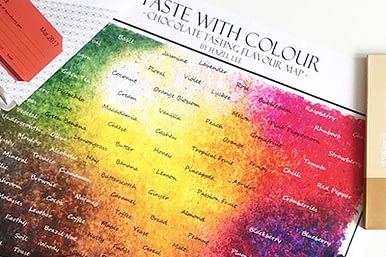
One of the most fun parts of any Craft Chocolate “Tasting” we do is when we try to explain the difference between “taste” and “flavour” by having customers hold their nose whilst sucking a piece of chocolate. At best, our guests can taste a little bit of sweetness – but only after they open their nose can they start to identify all the flavours of that chocolate. Full disclosure – this test we “borrowed” from Professor Barry C Smith – Director, Institute of Philosophy and Centre for the Study of the Senses at the University of London. To paraphrase the Professor, there are five basic tastes you detect on your tongue (sweet, bitter, sour, salty and “umami”) but “flavour” is detected via your sense of smell (both via your nose – orthonasal and via swallowing – retronasal). So with chocolate, in particular high quality craft chocolate that only uses cocoa butter (which melts at just below human body temperature), we are treated to a wealth of flavours. We’ve assembled the most common here – and we hope that these help you hone in on that flavour that is on the tip of your tongue.

Texture and Mouthfeel in Craft Chocolate
Above and beyond “taste” and “flavour”, craft chocolate has some other sensations that we love to explore – in particular texture and mouthfeel. And again, we are heavily indebted to the expertise and guidance of Professor Smith here.
Texture is relatively straightforward – it’s all about the smoothness or graininess of the chocolate (compare stoneground bars like Taza which are almost biscuit-like in texture to smoothly conched bars from Akesson’s, Bonnat and most other craft chocolate makers). We use four basic descriptors here which are fairly self explanatory –
TEXTURE
Smooth Chewy
Coarse Unrefined
Mouthfeel is more complicated and confusing. Unlike flavour, taste and texture we know that there is a lot more to be done on mouthfeel. Here is where we’ve got to so far in developing a framework to articulate the different sensations.
MOUTHFEEL
Intense Mellow
Buttery Clean
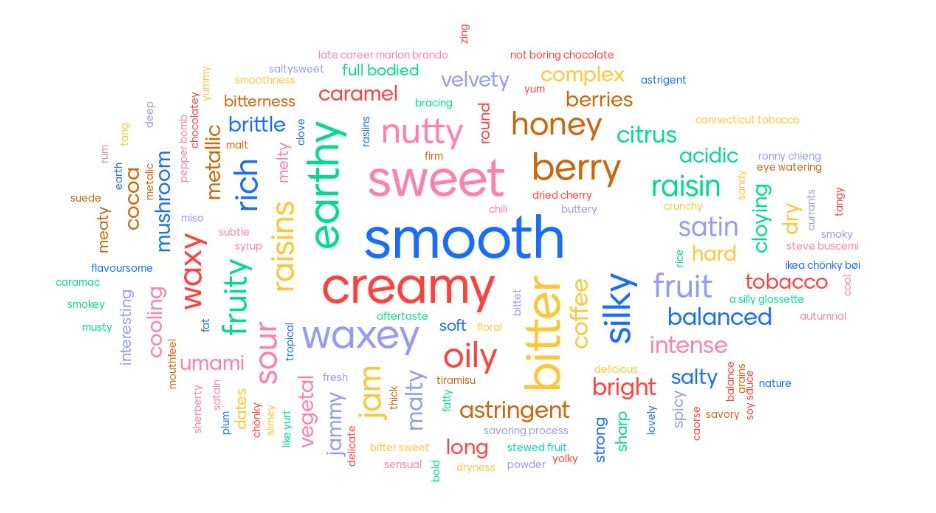
And to be honest, I’m not sure we’ve (yet) completely cracked these descriptors. Nonetheless it’s very clear that we all know the difference between butteriness and intensity – or creaminess and astringency. Neither creaminess or butteriness, nor intensity or astringency are tastes, textures or flavour. But all too often we confuse creaminess with sweetness and astringency with bitterness. For chocolate, especially 100% and higher percentage chocolate, the difference between astringency and bitterness is really important – astringency is part of the fun; bitterness not great.
Astringency is classically defined as when the saliva in your mouth is “pulled” away so you have the sensation of “drying”, “roughing” and/or “puckering”. You desperately want something else to drink and get your saliva going (hint: milk is better than water, and goat’s milk better than cow’s milk because of the way goats milk binds with the proteins causing the dryness). Classic cases of astringency are when we eat or drink a product with lots of tannins (red wine, whisky, roasted coffee beans, many teas and of course chocolate). Although astringency – this puckering – is very different from bitterness, all too often we confuse the two.
It may be that part of the problem for us in the West is that many astringent items are also quite bitter (or at least that’s when we notice the astringency …). In Japan the difference between what they call bitter (nigai 苦い) and astringent / puckering (suppai 酸っぱい ) and (渋い shibui) is very clear. The classic Japanese persimmon (kaki) is astringent and causes your mouth to pucker. But it’s also quite sweet. And this perhaps helps explain why in Japanese there is less confusion between the two sensations. It’s hard to think of a common fruit or drink we have in the west that is astringent (mouth puckering) but also sweet – maybe some heavy but mellow red wines, and possibly chewing the skins of red grapes if that’s your fancy.
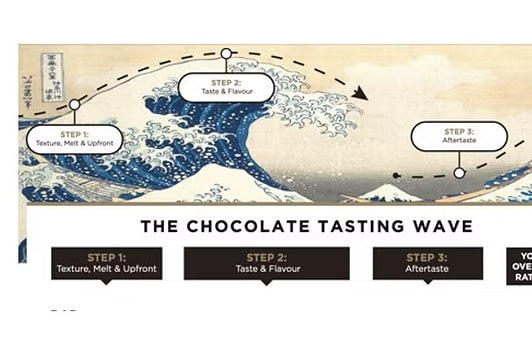
At Cocoa Runners, when we taste chocolate, we break down these sensations into five very different experiences: taste, flavour, texture, mouthfeel and melt.
A Technical Digression On Astringency
Technically what happens when we eat something astringent is pretty amazing. Astringency, the sensation of dryness or puckering, is caused by tannins in chocolate (and coffee, red wines, etc.) binding with the proteins in your saliva and “drying” out.
Interestingly if you don’t “chew” something astringent you won’t detect the astringency (try this with some 100% cacao bars or some nibs; put them on your tongue, don’t suck or chew and you’ll be fine. The moment you start to masticate or suck, about 10-15 seconds later you should start getting astringent sensations as the saliva starts to gum up and dry out.
Here’s how to overcome the sense of astringency when you try 100% chocolate:
Take a small piece of 100% cacao and “enjoy” it (try a buttery bar like Akesson’s 100% or Original Beans Cusco Chuncho if you are nervous). Then chew a roasted coffee bean and go back to the chocolate. Most people we’ve tried this with are amazed by how much “easier” (ie less astringent) the 100% cacao bar is after the coffee bean. You can try the same with a rich red wine or rum; again, the astringency of the 100% is muted and its flavour easier to appreciate.
You don’t need to “distract” with coffee, red wine, etc.
The range of flavours, textures, astringency and intensity different makers can coax from different beans is quite extraordinary. In tastings we try to encourage our customers to try nibs (the ground up part of a roasted cocoa bean, less it’s shell) and then a couple of different 100% bars – and invariably, we’re asked why there is such a range of intensity and astringency.
There is no single answer here … but we’ve a few hypotheses that are worth experimenting and trying at home or at a tasting.
The first point is the amount of cocoa butter – basically the more butter, the more “smooth” and “creamy” so the less astringent. And then the size of grind can accentuate this further (the smaller the particle, the more cocoa butter to particle … simple physics). The type of bean also plays a role – as does the roast and fermentation. Confusingly roast and fermentation when done “badly” also create bitterness … And then the time the bar is in the mouth (ie the melt) also makes a difference – astringency is a slow build (it takes 5-15 secs) and then it depends on how long it’s in your mouth … so a thin bar is less astringent.