Ginger
Two of the fun insights that (almost) everyone leaves with following a Craft Chocolate Tasting are firstly, yes, you really do have a pudding / second stomach and secondly, that it’s far better to satisfy this “pudding stomach” with a few squares of craft chocolate than almost anything else. For the full details, you’ll have to join us at a tasting (and spoiler alert, this is one of the questions in the quiz, and one that almost everyone answers correctly). If you can’t make it to a tasting (or need your memory jogged), you can read the blog I wrote here.
For more on how the gut detects sugar and sweeteners, and why artificial sweeteners may be counterproductive, see the work of the wonderfully named Charles Zuker of Columbia University on gut–brain sugar sensing and vagal pathways below.
Another great example of how our gut impacts our urges, reactions and thinking is ginger. For centuries ginger has been known as a great way to calm unsettled stomachs – and hence it’s also great for travel and motion sickness, not just in the west but also Chinese and Ayurvedic medicine.
Scientists suggest that ginger dampens nausea because various compounds it contains, especially gingerols and shogaols, can interfere with 5-HT3 serotonin signalling involved in nausea and vomiting, including signalling on vagal afferent pathways between gut and brain. In addition there is some evidence that because ginger can help what is scientifically described as gastric motility (ie emptying your stomach) it may also help you feel less nauseous. Plus ginger has also been shown to reduce nausea‑linked gastric ‘dysrhythmias’ and dampen surges of vasopressin, another hormone closely tied to feeling queasy in motion sickness studies.
Since then, psychologists and biologists have also explored whether ginger can psychologically impact other “gut reactions”, and in particular whether ginger can help people overcome feelings of disgust. In one intriguing paper in 2019, researchers Jessica L. Tracy, Conor M. Steckler and Gordon Heltzel l gave participants either ginger or a sugar placebo to see if this impacted feelings of disgust from a variety of scenarios. The good news is that for “moderately disgusting” scenarios (e.g. sneezing without a handkerchief, rotten meat) ginger did reduce “gut wrenching” feelings of disgust. However even ginger wasn’t enough to overcome the sight of vomit and other bodily excretions.
More recently scientists have extended their research to see if ginger can move beyond the gut and impact sexual appetite by reducing disgust towards “sexual body fluids”. The response was not what they were expecting – and not straightforward. Their hypothesis was that ginger could reduce feelings of disgust created by sexual body fluids and thereby increase sexual arousal (who or how this study was funded, we’re not sure…). What their research discovered was very different. Ginger did impact sexual arousal toward erotic stimuli in certain conditions, but the disgust result itself was weak or absent. The authors float a few possibilities: either ginger affects bodily nausea/disgust in ways that do not show up clearly in conscious self-reports, or any effect may have been indirect and/or via another mechanism (my “gut” response is that ginger is great .. so makes you feel happier, relaxed etc.? But the paper doesn’t discuss this).
The history of ginger
Few spices have travelled as far, healed as much, or flavoured as many civilisations as ginger. From the forests of Maritime Southeast Asia to medieval European courts, from Ayurvedic medicine to the Victorian confectioner’s counter, ginger’s journey is one of the great stories in culinary history.
Unfortunately unlike e.g. mint and chocolate, there is no clear “eureka” like that with Fry’s Peppermint Cream where chocolate and ginger can be first placed together.
Origins: Maritime Southeast Asia
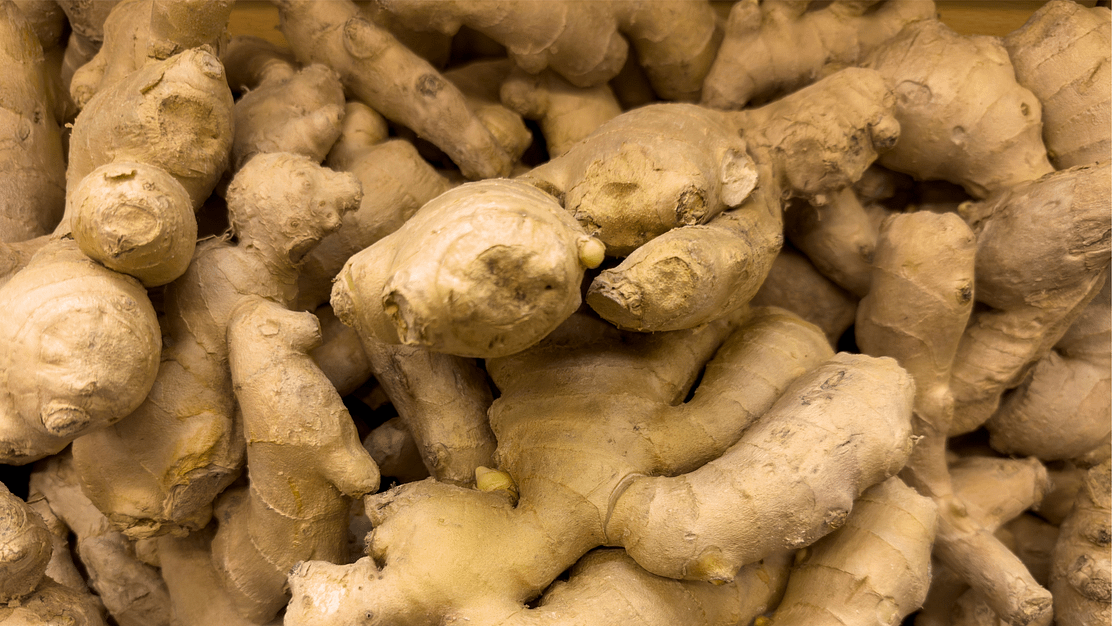
Ginger (Zingiber officinale) originated in Maritime Southeast Asia and was likely first domesticated by the Austronesian peoples. It is a rhizome — an underground stem, not a root — whose fleshy, knobbly form gives it the Sanskrit name śṛṅgavera, meaning “horn-shaped” or “horn body,” a word that evolved through Greek and Latin into the English “ginger”. Because it has never been found growing in the wild and cannot be propagated from seed, ginger has always been a cultivated plant, dependent on human hands to spread.
During the Austronesian expansion (c. 5,000 BCE), ginger was transported throughout the Indo-Pacific, reaching as far as Hawaii. From its island origins it spread west into India and China.
China’s relationship with ginger stretches back at least 4,000 years, possibly much longer. The first written record of ginger comes from the Analects of Confucius, written during the Warring States period (475–221 BCE), in which the philosopher is said to have eaten ginger with every meal as a digestive aid. Ginger was later enshrined in Li Shi-zhen’s monumental pharmacopoeia Ben Cao Gang Mu in 1578. In Traditional Chinese Medicine it is considered a “yang” herb — warm, vital, life-affirming — used historically to treat arthritis, digestive complaints, and seasickness.
In India, ginger was called srngaveram in Sanskrit, and its documented use in Ayurvedic medicine stretches back some 3,000 years. Known as vishwabheshaja — “the universal medicine” — it is prescribed in the Ayurvedic tradition for digestive, respiratory, and circulatory disorders. Indian and Chinese practitioners are believed to have cultivated ginger as a tonic root for over 5,000 years. Archaeological evidence from Indian Ocean trade sites confirms ginger’s presence in 1500 BCE spice routes.
The Spice Trade: Ginger Goes West
Ginger seems to be one of the first spices ever exported from Asia. Arab traders brought it to the shores of Alexandria, and from there it spread into the Mediterranean world. Greek physician Dioscorides described it in his 1st-century CE encyclopaedia De Materia Medica, noting its value as a digestive aid — the Greeks reportedly wrapped ginger in bread and ate it after meals. Pliny the Elder (24–79 CE) also wrote of it, and the geographer Ptolemy noted in 150 CE that ginger was produced in Ceylon (Sri Lanka).
For the Romans, ginger was both a prized culinary spice and a luxury medicine, so expensive it was reserved for the wealthy. It travelled overland via the Silk Road and by sea via the Spice Route — through the Indian Ocean, up the Red Sea to Berenike, overland to the Nile, and into Mediterranean ports. After the fall of Rome, ginger nearly vanished from European tables. However it gradually reappeared, and in Marco Polo’s accounts of the Far East in the late 13th century he wrote about, and reignited European enthusiasm, for ginger. By the Middle Ages, ginger had become one of the most sought-after spices on earth. In 13th- and 14th-century England, a single pound of ginger was reportedly worth as much as a live sheep. By the middle of the 16th century, Europe was importing more than 2,000 tonnes of dried ginger a year from the East Indies. Germany established a gingerbread guild to maintain quality control, and Sweden was prescribing gingerbread to ease gastrointestinal distress as early as 1444.
Ginger was used in medieval Europe to flavour beer, ward off the plague, and season roasted meats in pungent sauces alongside saffron, cloves, and cardamom. It was placed on dining tables like salt and pepper — both a condiment and a status symbol. The 15th century saw the first recognisable gingerbread recipes appear, and by the early 1800s the tradition of gingerbread houses had taken root in Germany.
Ginger in the Modern World
Ginger’s global reach expanded dramatically in the colonial era as European powers — first Portugal, then the Dutch and British — gained control of the spice routes. Today, India is the world’s largest producer of ginger, accounting for 45% of global output, with world production reaching 4.9 million tonnes in 2023. Ginger ale emerged from 19th-century British pubs, where ginger was stirred into beer; ginger tea, ginger biscuits, crystallised ginger, and stem ginger in syrup all became popular confectionary forms during the Victorian era.
… and Ginger and Chocolate — The Pairing
For most of their histories, ginger and chocolate (or cacao) existed on opposite sides of the world. Cacao originated in Mesoamerica, where the Olmec, Maya, and Aztec civilisations cultivated it as a sacred, bitter beverage — xocoatl — flavoured with chilli, vanilla, cinnamon, annatto, and allspice (see here).
When Spanish conquistadors brought cacao to Europe in the 16th century, they sweetened it with sugar and spiced with Old World flavourings to make it palatable to European tastes, often using these same spices. At some point, ginger seems to have been added to these traditional spices. An 18th-century recipe for colonial spiced hot chocolate lists ginger among its spices, alongside cinnamon, nutmeg, star anise, and allspice. This is arguably the first documented context in which ginger and chocolate shared the same cup.
The transition from ginger-in-chocolate-drink to ginger-in-chocolate-confection required the invention of the solid chocolate bar itself. That milestone came in 1847, when Joseph Fry & Sons in Bristol produced what is widely considered the first modern eating chocolate bar by mixing cocoa butter, cocoa powder, and sugar into a mouldable paste (see here). Over the following decades, Fry’s introduced more than 220 products, and other British makers — Cadbury, Rowntree — followed rapidly. But unlike mint, violet or orange we have no records of any chocolate ginger inclusion or flavoured bars in the 19th Century.
In some ways this seems like a strange oversight as the 19th century, alongside the development of chocolate bars, saw the emergence, and increasing popularity, of crystallised ginger (ginger cooked in sugar syrup and rolled in granulated sugar). This was enjoyed on its own, used in cakes and biscuits, and increasingly incorporated into chocolate treats. And it’s likely that some local chocolate makers combined the two. But there doesn’t appear to be any single inventor, date, or product that can be definitively credited with first combining ginger and solid chocolate. Arguably the first bar was actually a “spin off” from Bentick’s 1930 “Bittermints” with their dark chocolate gingers.
Today, we’re fortunate to have some amazing craft chocolate bars with ginger to enjoy.
Further reading
Research on sweeteners, sugar and “second stomach”
https://pmc.ncbi.nlm.nih.gov/articles/PMC7185044/
https://www.nature.com/articles/s41586-022-05266-z
https://pmc.ncbi.nlm.nih.gov/articles/PMC9605869/
Other studies
https://www.nature.com/articles/s41593-021-00982-7
https://pmc.ncbi.nlm.nih.gov/articles/PMC8825280/
Research on ginger
https://pubmed.ncbi.nlm.nih.gov/30596444/
https://research.abo.fi/ws/files/59117046/Wen_et_al_ginger.pdf