Magnesium in chocolate
What is magnesium?
Magnesium is a silvery metal that was first isolated in 1808 by Humphry Davy at the Royal Institution in London. He initially called it magnium, later adopting the name magnesium from the Greek region of Magnesia in Thessaly. Its first major use arose from one of its most striking properties: when burned, magnesium produces an intense white light. This brilliance made it invaluable for military flares, fireworks, signal devices, and early flash photography. By the twentieth century, engineers had begun exploiting another of its remarkable traits — lightness combined with strength — developing magnesium alloys that transformed the design of car engines, aircraft, cameras, and electronics.
During the 19th century agronomists and chemists also realised the importance of magnesium as a plant nutrient. In particular Justus von Liebig, the German chemist, identified magnesium as essential for chlorophyll and therefore healthy plant growth in the 1840s. And this led to the promulgation of magnesium carbonate and sulfate as common fertilizers to correct soil deficiencies.
Before magnesium was isolated as an element, its compounds—especially magnesium sulfate, commonly known as Epsom salts—were already prized for their medicinal properties. In 1618, a farmer in Epsom, Surrey, noticed that the bitter-tasting water from a local spring healed his cows’ skin sores, even though they refused to drink it. Later chemical analysis revealed the water contained magnesium sulfate. Over the next century and a half, Epsom salts became a staple of European apothecaries, used as a laxative, bath additive, and wound treatment.
Another well-known remedy was “magnesia alba,” a fine white powder of magnesium carbonate sold as an antacid. This paved the way for “milk of magnesia” (magnesium hydroxide), patented in 1873 by Charles Henry Phillips and soon a common household remedy.
During World War II, magnesium sulfate was widely used as a topical antiseptic and to treat eclampsia—a practice that continues today. By the mid-20th century, nutritionists began recognizing magnesium deficiency as a public health concern, linking it to stress, heart disease, and muscle function.
Note: Nutritionists and food scientists classify magnesium as a “micronutrient” as we only need small amounts of it compared to macronutrients like proteins, carbohydrates, fats and fibre. And it’s a mineral, not a vitamin or plant compound – so it’s not a phytonutrient (see HERE for more on polyphenols, and the technical difference between macro, micro and phytonutrients).
Why is magnesium important for health?
Medical scientists believe that magnesium is directly involved in over 300 enzymatic reactions in the body, influencing almost every system. Its key roles include:
- Energy production (ATP synthesis) – it helps convert food into energy.
- Muscle and nerve function – it helps regulate muscle contraction, nerve impulses, and heart rhythm.
- Bone health – Works with calcium and vitamin D to build and maintain bone.
- Protein synthesis – it’s critical for building DNA, RNA, and proteins.
- Blood pressure regulation – it supports healthy vascular tone and reduces hypertension risk.
- Mood and sleep: Low magnesium is linked to anxiety, irritability, and poor sleep quality.
- Glucose metabolism: Multiple studies have suggested that it improves insulin sensitivity and blood sugar control.
To put it another way, a deficiency in magnesium can be a cause of
- Sugar cravings
- Constipation
- Irregular heartbeat or palpitations
- Poor sleep quality
- Anxiety or irritability
- Fatigue or low energy
We don’t need that much of it; the typical daily requirement for men is ~400–420 mg/day and women is ~310–320 mg/day.
According to data from the EFSA and NIH, as many as half of all adults in Europe and the United States may fail to meet the recommended magnesium intake. Precise figures are difficult to establish, however. In the UK, for example, some studies suggest that the proportion of people not getting enough magnesium is closer to 10–20%.
One cause of this is down to changes in the foods we eat and the way these are grown and processed. The rise of ultraprocessed foods and application of excessive fertilizers and pesticides, many of us are getting less and less of magnesium. For example, processed white flour in many supermarket breads will have 80% less magnesium than those of a whole wheat flour loaf. Similarly, white rice has 75% less magnesium than brown rice. Intensive agriculture and fertiliser use have also depleted magnesium in soils – with various studies indicating that fruit and vegetable magnesium content has fallen by 20–30% in the last 50 years.
In addition, various medicines and supplements are now recognised as inhibiting magnesium absorption. For example medications such as proton pump inhibitors (for reflux), diuretics, and some antibiotics reduce magnesium uptake. And calcium supplements, if taken to excess, can compete with magnesium for absorption.
Why aren’t we more aware of magnesium deficiencies?
Even though magnesium is clearly critical for human health and specific diseases our awareness is far lower than, for example iron or calcium deficiencies. This may be because magnesium deficiency develops slowly and causes vague, diffuse symptoms — fatigue, poor sleep, anxiety, muscle twitches, headaches, irregular heartbeat — which can easily be misattributed to stress, ageing, or lifestyle. In addition it’s far harder to test for magnesium deficiency. In comparison anaemia can be checked via a simple blood test (haemoglobin or ferritin), and calcium deficiency clearly shows up in bone density scans given to check concerns like osteoporosis. And magnesium deficiency often remains “subclinical”: levels in blood may look “normal” even when tissues are depleted, since only ~1% of body magnesium circulates in blood.
Public awareness of iron and calcium deficiency is far greater — both have long benefited from major health and industry campaigns. Anaemia prevention initiatives, especially those targeting women and children, are well established. Likewise, calcium’s link to bone health has been a cornerstone of dairy industry marketing for decades — think “milk builds strong bones.”
By contrast, magnesium, despite its involvement in over 300 enzymatic reactions (from muscle contraction to insulin signalling), lacks both a “headline disease” to anchor public concern and a strong commercial champion. As a result, while governments routinely fortify flours and cereals with iron and folic acid, and many foods are enriched with calcium (such as dairy alternatives), magnesium fortification remains rare — even though deficiency is widespread.
The bottom line: Magnesium deficiency is difficult to test for and hard to communicate. So whilst it’s essential to every cell in the body, its effects don’t lend themselves to simple messaging — it doesn’t colour your blood, build your bones, or shine in a milk advert.
Where does dark craft chocolate (bars and hot chocolate) come into play?
Magnesium isn’t just crucial for humans — plants need it too. This mineral sits at the heart of the chlorophyll molecule, enabling photosynthesis by helping plants capture and convert sunlight into energy. Magnesium also activates hundreds of enzymes that drive plant growth, sugar transport, and protein formation. When soils are deficient in magnesium, plants commonly display yellowing leaves (“chlorosis”), stunted growth, and reduced yields — all of which can compromise both crop productivity and nutritional quality. This is why magnesium-rich fertilisers are often used to correct deficiencies.
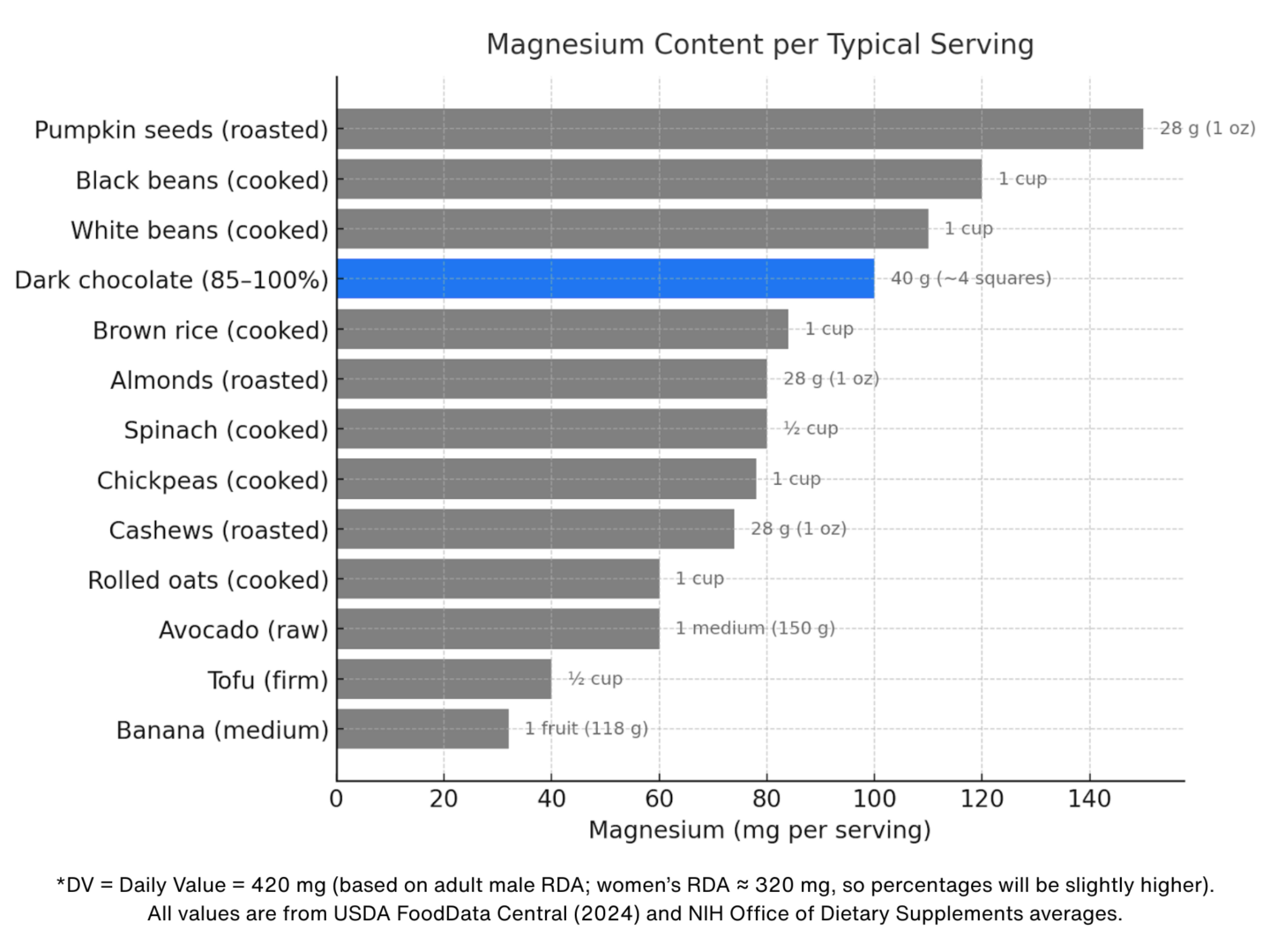
Not surprisingly, foods rich in chlorophyll, such as dark leafy greens (spinach, kale), nuts and seeds (especially pumpkin, almonds, and cashews), whole grains (brown rice, oats, quinoa), legumes (lentils, beans), avocados, and bananas, tend to be particularly good sources of magnesium
And dark, craft chocolate – either in bars or hot chocolate – is right up there – see below
What determines how much magnesium is in my chocolate?
Magnesium is taken up by the cacao tree through its roots as it grows, making soil composition and fertility crucial. In this sense — at the risk of starting a long diversion — it’s a bit like cadmium, a heavy metal contaminant that cacao trees can also absorb from the soil (note for more on this, and why cadmium is very different to lead, please see HERE).
As with polyphenols / phytonutrients, alkalisation destroys the magnesium in the cocoa powder by 85% or more. So if you are looking for your hot chocolate to give you some magnesium (and polyphenols, etc.) go craft.
However, unlike the damage caused by heat to polyphenols, magnesium levels in chocolate don’t appear to be degraded by e.g. commercially high roasts over drying etc. Note: there are a few studies that challenge this, but the consensus seems to be that magnesium levels aren’t damaged by heat – although it’d be great to have more analysis here.
Fermentation is far more complex. There is some evidence that fermenting the cocoa beans causes some of the magnesium to “leach” away. However, and more importantly, fermentation reduces phytic acids – and by reducing these acids, the actual bioavailability of the magnesium in chocolate is increased. Again, more studies would be great here.
But what does make a HUGE difference is firstly the percentage of chocolate in your bar. White, milk and supermarket dark chocolates like Bournville, where cocoa solids are lower than 40% of the bar’s ingredients, will mathematically have less than 50% of the magnesium than an 80% plus craft chocolate bar. And the amount of magnesium in a supermarket dark or milk bar is also lower than even this basic maths because the second factor driving magnesium in a chocolate bar is the nature of the soil. Magnesium enters the cocoa tree, and then pods and beans, via the soil. And if you have a soil that is low magnesium, the cocoa beans grown there will have less magnesium take up. See below for some ranges:
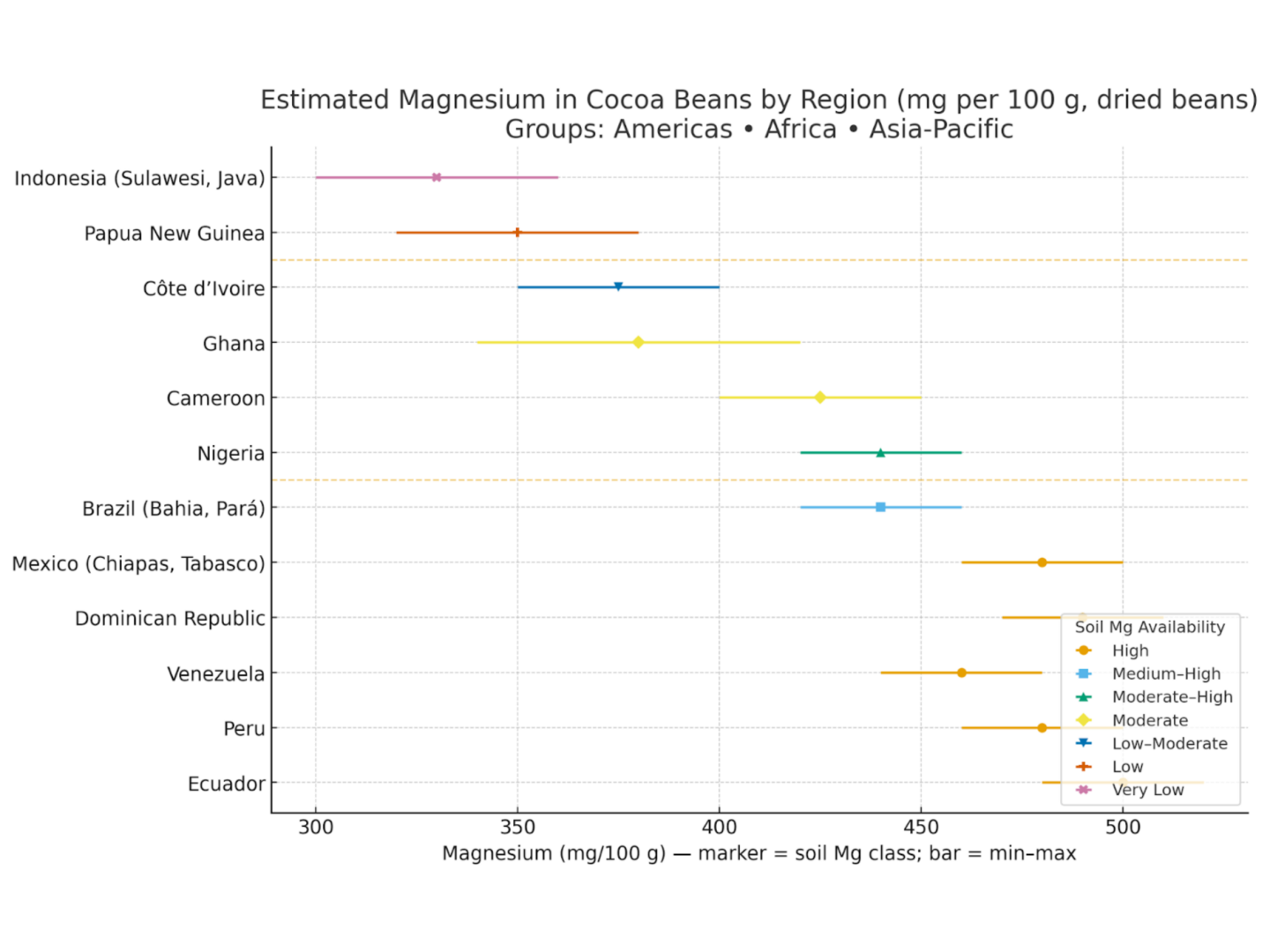
It’s important to note that these are broad generalisations, and that within any given country — and even between provinces or individual farms — there can be significant variation. For instance, in the DRC, cocoa from the Virunga region grows in soils that are exceptionally rich in minerals and often “fertilised” by volcanic ash. By contrast, a few thousand kilometres away in the northern Équateur province (Ituri region), soil magnesium levels are much lower.
The soil degradation issue is well understood at both an academic and governmental level. The key chocolate research institutes in West Africa like CRIG in Ghana and CNRA in Côte d’Ivoire have long recognised this challenge. They’ve led campaigns that offer “short term” solutions (e.g., foliar sprays of Epsom salts for short-term corrections, and are promoting longer term approaches like, adding dolomitic limestone to raise pH and promoted increased organic mulching and composting to improve cation exchange capacity plus various fertilisers. But most small holder farmers can’t afford or access these initiatives, so the problem persists.
To be cynical, this may offer one lens to understand why Big Chocolate is so “quiet” about the magnesium content of chocolate. Olam, Cargill, and Barry Callebaut — the industry’s “Big Three” — together handle upwards of 60% of global industrial cocoa purchasing and processing. Most of their supply originates in West Africa, particularly Côte d’Ivoire and Ghana, which in turn produce about 60% of the world’s cocoa. This cocoa forms the backbone of mass-market chocolate bars, snacks, and much of the cocoa powder and mass used by ice cream producers and bakeries. If major chocolate companies aggressively promoted magnesium in chocolate, as US Dairy does for calcium with milk and bone health, their messaging could raise some “challenging” questions about sourcing, cocoa percentages, etc.
To end on a more positive note:
- Magnesium is important for our health and wellbeing
- Many (most?) of us don’t get our recommended daily dose, and unfortunately this is hard to test and check
- … so why not have a few squares of a dark chocolate bar to supplement your daily magnesium ingestion?
Sources:
https://lpi.oregonstate.edu/mic/micronutrient-inadequacies/overview
https://futureyouhealth.com/blogs/knowledge-centre/magnesium-definitive-guide
https://ods.od.nih.gov/factsheets/Magnesium-Consumer/
https://www.nmi.health/magnesium-a-review-of-clinical-use-and-efficacy/
Sources
Wood, G.A.R. & Lass, R.A. (2001). Cocoa, 4th ed. Blackwell Science.
Afoakwa, E.O. (2014). Chocolate Science and Technology. Wiley-Blackwell.
Villeneuve, J-P., et al. (1993). “Mineral composition of cocoa beans from various origins.” Journal of Food Composition and Analysis, 6(3): 216–230.
Oracz, J. & Nebesny, E. (2019). “Effect of processing on minerals and bioactive compounds in cocoa.” European Food Research and Technology, 245: 511–522.
FAO (2020). Soil Atlas of the World (Updated Edition). Food and Agriculture Organization of the United Nations.
CRIG (Cocoa Research Institute of Ghana). Agronomy and Soil Fertility Bulletins, 2018–2023.
CNRA (Centre National de Recherche Agronomique, Côte d’Ivoire). Soil Fertility and Cocoa Productivity Reports, 2017–2022.
EMBRAPA (2016). Soil Fertility and Cacao Production in Bahia. Brazilian Agricultural Research Corporation.
USDA NRCS (2022). Soil Survey and FAO Harmonized World Soil Database.
ICCO (2023). International Cocoa Organization Yearbook.
Ruf, F. & Bisseleua, H. (2019). Sustainable Cocoa Production Systems in Africa.
Davis, D.R., et al. (2004). “Changes in USDA food composition data for 43 garden crops, 1950–1999.” Journal of the American College of Nutrition, 23(6): 669–682.