Transparency in chocolate – and seeing things differently
Around 100 years ago (give or take), Cadbury’s had a fantastic idea — add the price they wanted their products to be sold at onto the packaging. The earliest confirmed example I’ve found is a box of Cadbury’s Dairy Milk Chocolate Neapolitans, manufactured between 1930–1934, with the price of sixpence (6d) printed in gold lettering on its distinctive purple sleeve (it was discovered in near-pristine condition in 2023 by Emma Young, a Plymouth homeowner renovating her 1930s house — under the original bathroom floorboards).
This price transparency gave customers confidence that they weren’t being tricked into paying more — and that retailers weren’t price gouging. It seems rooted in a 19th century Quaker movement towards fixed prices, driven by the belief that it was morally and ethically wrong to charge different customers different amounts for the exact same product — depending on, for example, your negotiating skill, your relationship with the shopkeeper, or simply how you looked. The Quakers rejected this as a form of dishonesty: one God, one price. This ethic spread widely. In the US, John Wanamaker — a devout Presbyterian who shared the Quakers’ conviction about equal pricing — opened his Grand Depot department store in Philadelphia in 1876 with a fixed-price policy, reportedly stating: “If everyone was equal before God, then everyone should be equal before price.” Macy’s founder Rowland Hussey Macy was also a Quaker, and Macy’s began affixing physical price tags in the 1870s. Cadbury’s further turbocharged this transparency by printing their prices on their packaging in the 1930s.
Sadly the chocolate world has moved away from such transparency. Instead we are faced with all sorts of shenanigans ranging from shrinkflation and reformulation to “deals of the century” and “buy one get one free” offers that yoyo every week.
Craft chocolate is all about transparency – for more see the heartening and educational reports from organisations like Askinosie and Uncommon Cacao. The hope is that this transparency will help consumers see things differently, and – like Cadbury’s price stickering – generate behavioural change.
But sadly these transparency reports aren’t as impactful as Cadbury’s 1930s packaging price transparency. In an era of greenwashing these transparency reports sadly don’t cut through as much as we’d like (last time we linked to them, only a handful of people downloaded them). Instead all too many consumers gravitate towards messages they want to hear that give them an excuse to purchase “healthy chocolate” (hats off to the marketing of “raw” chocolate, ceremonial cacao, etc.) or “guilt free” chocolate (again, Tony’s Chocolonely is great at this even if the reality is a LOT less clear – see here).
So to spark some more thinking jiu-jitsu, here are a few examples of reframing a problem differently, with more transparency and dramatic potential impact (and full disclosure, all of these are sourced and championed by marketing guru Rory Sutherland with the term “psycho-logic”, see below for links).
- The London tube map. TFL (transport for London) wanted more Londoners to use its Overground services. Rather than running adverts advocating these “British Rail” lines (which could have been an uphill challenge), an easier and cheaper strategy was employed – adding the lines to the tube map. The impact was extraordinary. Passenger numbers on the Overground soared from 29 million journeys in 2007/08 to 140 million by 2014/15 — nearly a fivefold increase in just eight years. Of course, TfL also improved frequencies, refurbished stations and added new lines (esp. In East London), but the map inclusion was a pivotal moment that made Londoners aware the overland service existed as a viable option. No advertising campaign. Just a TRANSPARENT reframe.
- The gym-pool premium. Hotels have long charged more for rooms with a view. But what about a room next to the gym or pool? For the right guest, proximity to the thing they actually came to use is worth far more than a nice outlook. A small reframe of “what counts as desirable” helped Ogilvy, and their hotel partners unlock a pricing opportunity hiding in plain sight.
- The Paceometer. A standard speedometer makes every 10 mph jump look identical. But the real-world maths tells a very different story. Accelerating from 20 to 30 mph saves 10 minutes over 10 miles, with almost no added risk. Accelerating from 70 to 80 mph saves barely a minute over the same distance — while dramatically increasing the chance of a fatal crash. So researchers Eyal Peer and Eyal Gamliel propose replacing the speedometer with a Paceometer: a dial that shows not your speed, but the time you’re actually saving. Sadly this one hasn’t (yet?) been introduced.
Craft Chocolate and Transparency
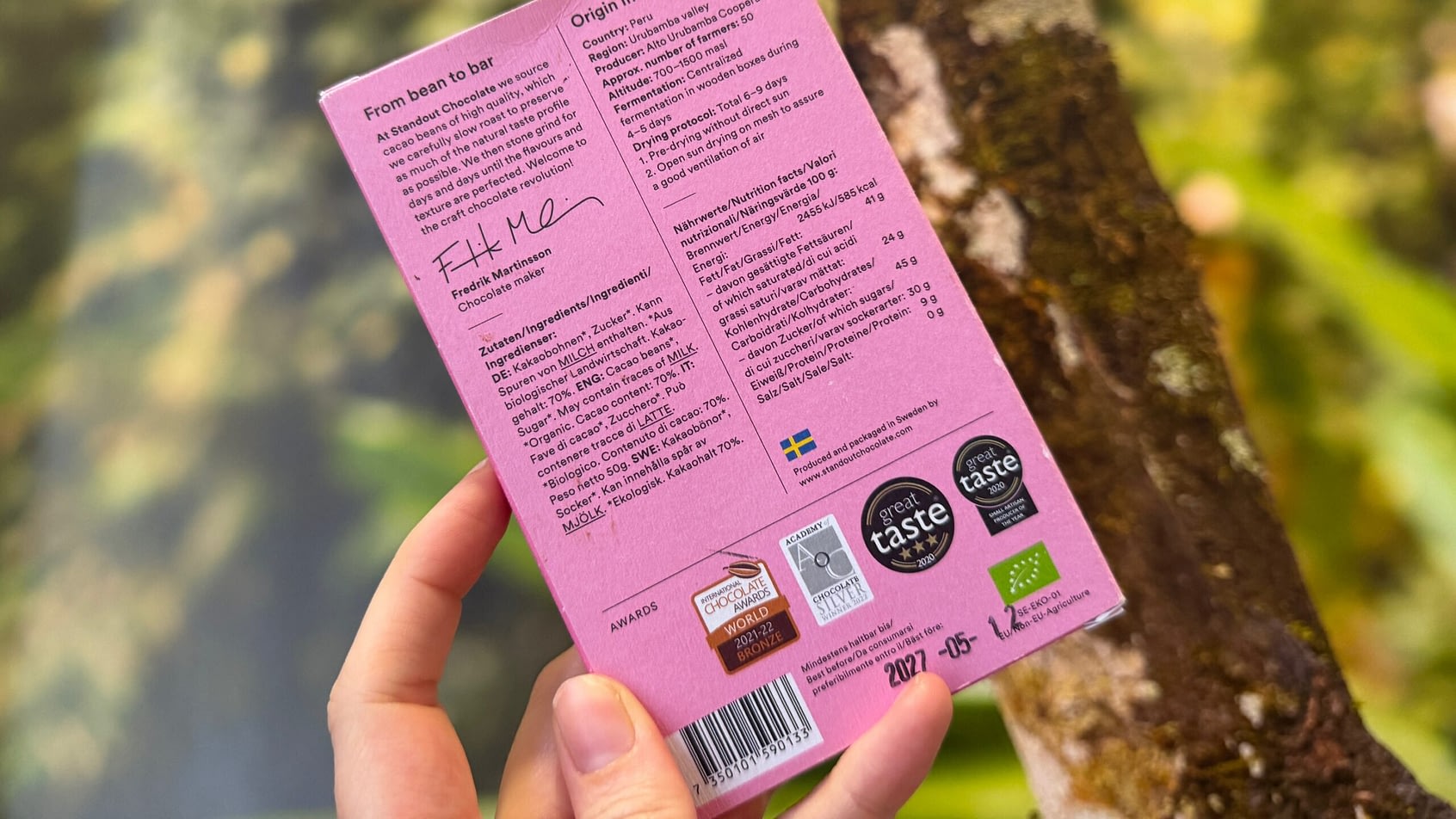
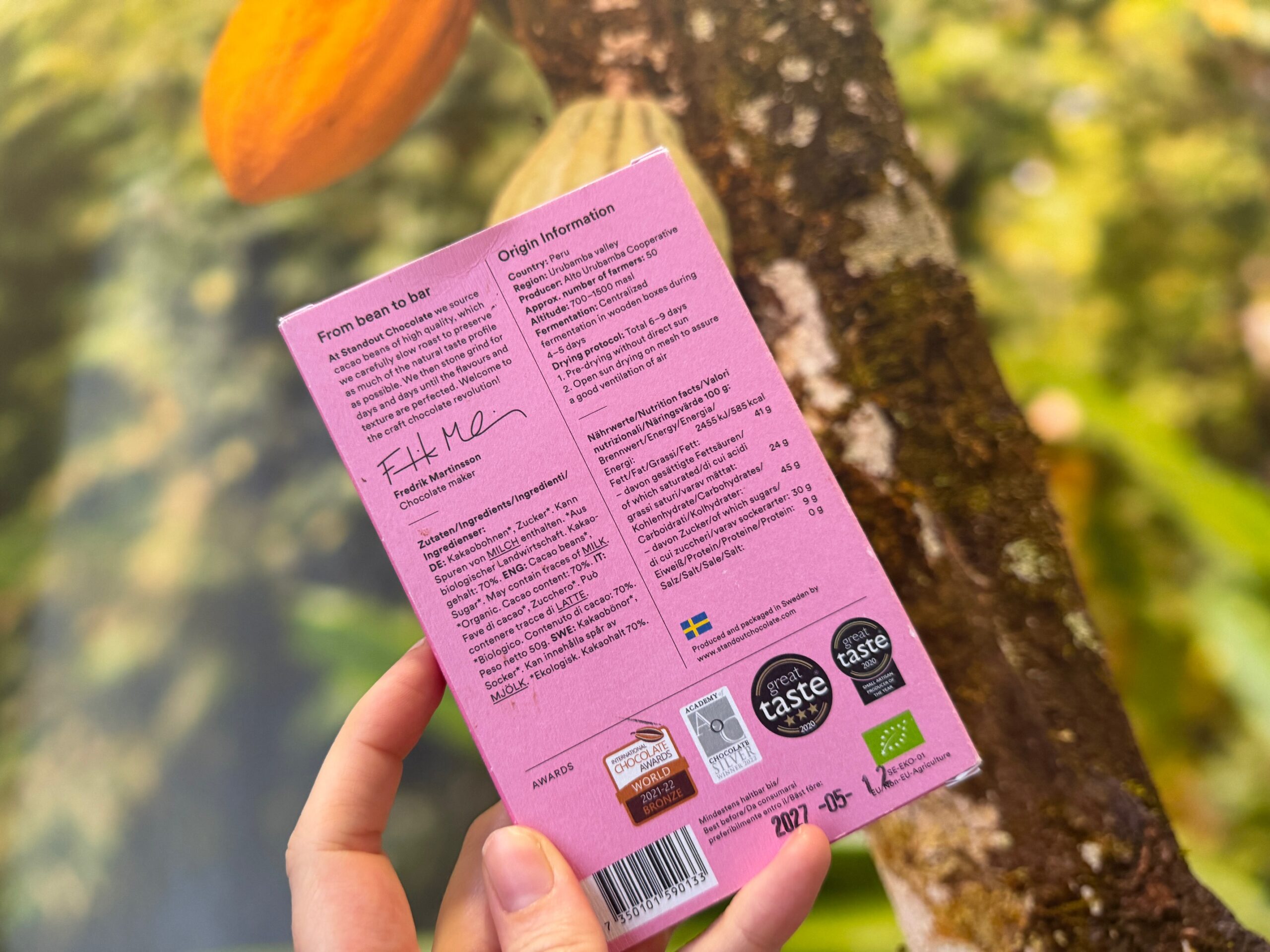
Craft chocolate makers pride themselves on their packaging to explain their environmental objectives, farmer connections, crafting skills and flavour. For example, many have taken a leaf from specialty coffee to explain roasting profile, fermentation lengths, farm and harvest details plus their flavour notes (see below for an example from Standout). This assumes a considerable amount of knowledge – which many craft chocolate aficionados delight in exploring.
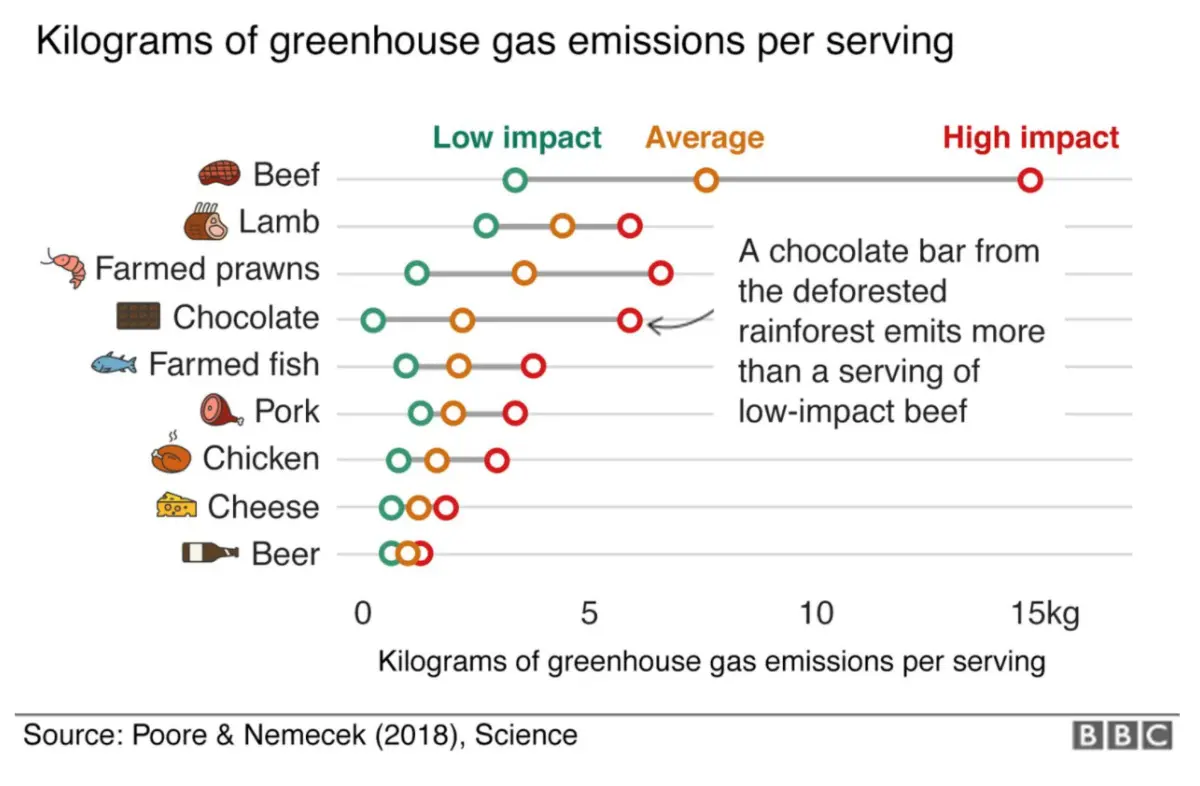
What’s interesting is the way that only rarely do we numerically, and transparently, compare ourselves to mass market confectionery; and I wonder if this is where we can replicate the impact of Rory Sutherland’s “psychologic”? For example, we know that this chart about water from Poore and Nemeck is wonderfully powerful – as is the fact that a chocolate bar requires 1500 + litres of water to grow the cocoa; so why not link this more to deforestation and desertification?
Or how about we think about a Sugar Speedometer — reframing cocoa %s
- Since the pioneering work of Martin Christy and his “Seventy% website” (founded way back in 2001) there has been an increasing recognition of the importance of percentages in cocoa. And many bars now list their “cocoa percentage” on their packaging (although many more don’t).
- However, percentage is just part of the story – transparency on where the beans come from, and how they’ve been crafted is equally critical (and for more on how Big Chocolate has avoided the 2012 regulations on country of origin for chocolate see here)
- Why not be more transparent about what else is in a chocolate bar — starting with being transparent sugar? A 50g bar of 70% dark chocolate will often contain around 12–16g of sugar — roughly 3 to 3.5 teaspoons. And for most of us, we’ll share and savour this over a few days with partners and friends. By contrast, 50g of Dairy Milk contains about 28g of sugar, and 50g of Bournville about 29g — just over 7 teaspoons in each case that, all too often, are scoffed as a solitary treat, reward and/or guilty pleasure. For reference, a standard 330ml can of Coca-Cola Original Taste has 35g of sugar, which is about 8.75 teaspoons.
And also how about being more transparent, and caring, about TIME TAKEN?
- Industrial chocolate prides itself on processing speeds, volumes and efficiency. And the costs, and consistency, they achieve is impressive (as are their margins!).
- Craft chocolate is very different. A well-made craft bar prides itself on time, and care, taken. It takes at least 12–18 months from harvest to fermentation to sorting to roasting to winnowing to conching to tempering. The result is amazing flavours that are far healthier for the consumer, farmer and planet. Other “crafts” also value time – for example, wine, cheese and whisky have each done a great job in explaining the importance of TIME and vintages. It’d be great if we could shift more focus on the way taking time with craft chocolate is also key for flavour.
Other suggestions are welcome too!
Sources
Rory Sutherland / Nudge Podcast
https://podcasts.apple.com/in/podcast/rory-sutherland-on-drink-driving-five-guys-and-the-tube-map/id1457621005?i=1000662254947
https://podcasts.apple.com/ro/podcast/63-rory-sutherland-why-counter-intuitive-thinking-wins/id1457621005?i=1000533520430
https://podcasts.apple.com/au/podcast/006-rory-sutherland-on-alchemy-psycho-logic-the-power/id1575240086?i=1000533173355
https://www.youtube.com/watch?v=at4NkyZ69Tg
Quaker Fixed Pricing / Wanamaker / Macy’s
https://historyfacts.com/science-industry/fact/before-price-tags-no-fixed-prices/
https://wanamakerorgan.com/lore/
https://iblp.org/john-wanamaker-fixed-prices-and-customer-satisfaction/
https://religionnews.com/2018/12/04/evangelical-retailer-john-wanamaker-built-fortune-by-blending-faith-with-business/
London Overground Passenger Numbers
https://en.wikipedia.org/wiki/London_Overground
https://tfl.gov.uk/info-for/media/press-releases/2015/june/-tfl-annual-report-published
Paceometer (Peer & Gamliel)
https://www.cambridge.org/core/journals/judgment-and-decision-making/article/pace-yourself-improving-timesaving-judgments-when-increasing-activity-speed/73B5AE666D64F1B4DCA7ED4A0A960F81
Poore & Nemecek — Water / Environmental Data
https://www.oxfordmartin.ox.ac.uk/publications/reducing-foods-environmental-impacts-through-producers-and-consumers
https://cocoarunners.com/chocopedia/water-and-chocolate/
Craft Chocolate / Sugar / Time
https://cocoarunners.com/chocopedia/how-much-sugar-is-in-your-chocolate/
https://cocoarunners.com/chocopedia/time-is-everything/
Seventy%
https://www.seventypercent.com/about/
Big Chocolate / EU Origin Labelling Exemption
https://cocoarunners.com/blog/from-cacao-to-cocoa-to-chocolate-whats-in-a-name/
https://cocoarunners.com/blog/big-food-vs-craft-chocolate-the-fight-against-ultra-processed-foods/