The importance of breathing
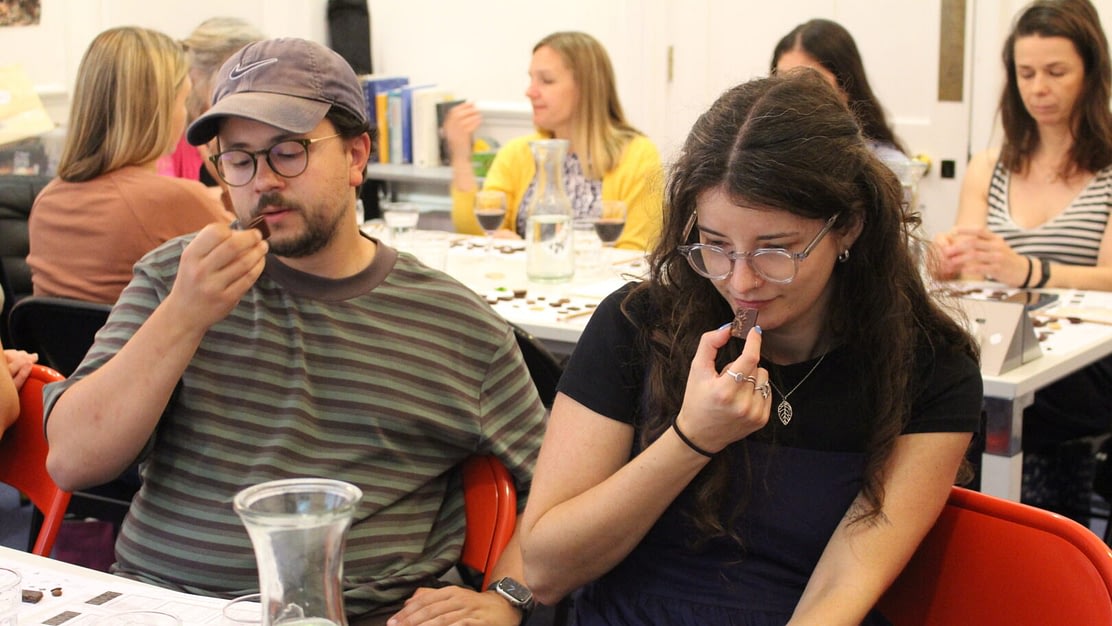
It's time to think about the importance of breathing, in particular breathing via our noses, as we savour Craft Chocolate.
Print / PDFIf you’ve joined one of our Craft Chocolate tastings — in person or virtual — you’ll remember the fresh mint moment. We hand you a sprig, ask you to pinch your nose shut, and then chew. Something strange happens: the mint barely tastes like mint. You might pick up a faint bitterness, perhaps a hint of something spicy. It’s only when you release your nose that the mint flavour hits you showing the way that flavour is really our sense of smell in our mouths, activated by breathing and our brains.
Over the past couple of decades, breathing has become a much studied subject, and the topic of endless podcasts. Yoga devotees — and pranayama practitioners — will have long known this. But conscious, deliberate breathing is now being applied in a remarkable range of contexts: special forces and elite athletes use box breathing to sharpen focus and manage pre-competition nerves; slow rhythmic breathing is prescribed for anxiety and stress, directly dampening the body’s fight-or-flight response; techniques like 4-7-8 breathing (inhale for 4 seconds, hold for 7, exhale for 8) are widely used as natural sleep aids; and diaphragmatic breathing has even been shown to support digestion via increasing blood flow to the gut. See the blog for a list of books, YouTube videos and articles on the subject — the book I’ve most recently enjoyed on this topic was Giulia Enders’ Organ Speak: What It Really Means to Listen to Our Bodies (2025).
The late Gordon Shepherd — who passed away in June 2022 — radically changed how we think about flavour. Working across four decades at Yale School of Medicine, he coined the term “neurogastronomy” to describe the brain’s extraordinary role in constructing what we experience as “flavour” (as opposed to taste …). Central to his work was something most of us completely overlook: the role of breathing. Below is an attempt to explain some of his ideas — and then turn them into practical advice for tasting chocolate.
If you just want to “skip to the answer”, here are a couple of very practical insights from his work that aren’t intuitively obvious:
- Savour with a closed mouth, breathing in and out via your nose, as the chocolate melts in your mouth (try it also by breathing in and out via your mouth to appreciate the massive difference it can make; you can also try this with tea, coffee and wine .. but it can be a bit messier)
- Try to breathe out for slightly longer than you breathe in (see below for why)
- Try to compare a couple of different bars .. and ideally also use our flavour wave to help you articulate some of the flavours you are detecting, and to help you savour the journey
- Compare notes with anyone with you who is also tasting the bars .. and don’t worry, and don’t be surprised, if you radically diverge in your descriptions!
In praise of gordon shepherd, breathing and flavour
For much of Western intellectual history, smell was treated as the lowest and most primitive of the senses. Aristotle regarded it as less intellectually refined than sight or hearing because it lacked clarity and distance. Immanuel Kant was even harsher, calling smell the “most dispensable” sense and associating it with animal appetite rather than reason. Vision became the noble sense of philosophy and science; smell was messy, bodily and difficult to describe.
Part of the problem was, and remains, language. Very few of us learn the language to describe smells and flavours. As the philosopher Barry C. Smith has often pointed out, we possess rich vocabularies for colour, shape and sound, but describe smells mostly by analogy or source: “smoky”, “floral”, “strawberry-like”, “woody”. That was one of the motivations behind the famous wine aroma wheel developed by Ann C. Noble in the 1980s: an attempt to give flavour and aroma a more structured vocabulary, learning from systems such as the Pantone system for colour (see here for more on this), so that wine makers could hold meaningful conversations about what they were enjoying in their wines.
Into this stepped Gordon M. Shepherd (1933-2022). Shepherd was not formally a philosopher, though his work ended up reshaping philosophical questions about flavour and perception. He was a neuroscientist — formally trained as both a medical doctor and a DPhil from Oxford — who spent most of his career as Professor of Neurobiology at Yale School of Medicine. His early research focused on the olfactory bulb — the first major processing station for smell in the brain — and helped pioneer modern computational neuroscience. Long before “brain imaging” became fashionable, Shepherd was modelling how populations of neurons create spatial “maps” of smells inside the brain (and an area that still foxes AI research).
Over time Shepherd became increasingly convinced that smell had been radically underestimated — not just by philosophers, but by chefs, wine experts and even neuroscientists themselves. His key insight was that much of what we casually call taste is actually smell — specifically retronasal smell: aroma molecules travelling from the mouth, up the back of the throat and into the nasal cavity during eating and, crucially, during breathing and exhalation.
This breathing component was absolutely central to Shepherd’s work. He distinguished between orthonasal smell — sniffing through the nostrils from the outside world — and retronasal smell, where aromas released in the mouth are carried internally toward the olfactory receptors as we exhale. The second process is largely hidden from conscious awareness, which is why most people mistakenly think flavour is happening on the tongue and in our mouths.
The anatomy here is surprisingly strange. The olfactory receptors responsible for smell sit high inside the nasal cavity in a small specialised region called the olfactory epithelium, tucked above the main airway behind the bridge of the nose (that is to say, they are NOT in our mouths). When we sniff externally, aromas swirl upward through the nostrils toward this region. But during eating, aroma molecules can also travel internally from the back of the mouth through the nasopharynx and into exactly the same sensory space.The brain receives signals from the same receptors — but because the airflow originates inside the mouth, the resulting flavour feels as though it is located inside the food itself. Crucially, this only works on the exhale: studies using 3D-printed airway models showed that during inhalation, the cavity behind the palate has almost zero airflow — aroma molecules simply stagnate — but during exhalation, airflow velocity spikes, actively drawing volatiles upward toward the olfactory epithelium. Our airways, in other words, according to Shepherd, appear to have been shaped by evolution specifically to enhance retronasal smell on the out-breath.
This fascinated Shepherd, particularly in relation to wine. In the 2000s he increasingly focused on retronasal olfaction and began using the term “neurogastronomy” to describe the brain’s role in constructing flavour. His landmark 2012 book Neurogastronomy brought these ideas together for a broader non academic audience, arguing that flavour is one of the brain’s most sophisticated multisensory constructions (it’s a fun, and easyish read). He later extended many of the same ideas specifically to wine in Neuroenology, exploring how smell, airflow, memory and expectation shape wine tasting.
Wine fascinated Shepherd (and Barry Smith at London University’s Centre for the Study of the Senses continues this tradition) because it exposed something particularly strange about retronasal smell: flavour seems to occupy an ambiguous internal “space”. When we smell wine orthonasally, through sniffing, the aroma appears external, located somewhere in the glass. But when we drink and exhale, the flavour suddenly feels as though it is occurring inside the mouth and throat — even though the olfactory receptors detecting those aromas remain physically located high inside the nasal cavity. Shepherd argued that the brain effectively creates a kind of virtual sensory object, projecting flavour into the mouth.
In wine tasting, Shepherd noted that subtle changes in breathing patterns and mouth movements could alter aroma delivery dramatically.The same is true in chocolate. Research has shown just how dramatic the difference is: in a 2010 study by Masaoka and colleagues at Showa University School of Medicine in Tokyo, 71% of participants correctly identified a chocolate flavour when breathing through the nose, compared to only 31% when breathing through the mouth — with successful identification specifically linked to the onset of expiration rather than inhalation. Slowly savouring “extends retronasal airflow and allows volatile compounds to emerge sequentially”. By contrast eating fast (aka scoffing) limits the complexities of flavour we can identify, especially if we eat – and breath – with open mouths.
Some practical advice on savouring and breathing
Flavour, as Shepherd saw it, is one of the most extraordinary things the human brain does — and how you breathe while tasting can materially change what you perceive. A few simple techniques to bring this to life:
- Savour with a closed mouth, breathing gently in and out through your nose as the chocolate melts. Then try the same chocolate breathing mainly through your mouth — the difference can be remarkable. (This works beautifully with tea, coffee and wine too, though it can get a bit messier.)
- Don’t scoff! Eat more slowly than you normally would. Fast eating suppresses a lot of flavour complexity because there is less time for volatile aroma compounds to be released. Big Food engineers food to be hyperpalatable, with lots of sensory specific satiety boosted by the bliss point – so it’s not surprising that we scoff crisps, snacks and confectionery. They abuse our instinctive love of sweet, fatty, salty stuff that is gooey, and add textural differences to create “sensory specific satiety” – and we end up scoffing more than we planned
- Try breathing out slightly longer than you breathe in. This long breath out reflects something remarkable about human anatomy. A 2015 study from Shepherd’s own lab, published in PNAS, showed experimentally that the human airway is specifically shaped to enhance volatile transport during exhalation and to limit it during inhalation, with the asymmetry most pronounced at quiet, relaxed breathing rates. In other words, our airways appear to have evolved to help us savour food. A separate peer-reviewed study found that subjects were significantly more accurate at identifying chocolate flavour when breathing through the nose rather than the mouth — and that successful identification was specifically correlated with the onset of expiration rather than inhalation. So when you breathe out gently through your nose as the chocolate melts, you are working with your airway geometry and savouring more complexity and flavours.
- Compare two or three bars in parallel. Again, as Barry Smith notes: the brain is exceptionally good at perceiving differences and contrasts. Flavours that seem subtle in isolation often become obvious when compared directly.
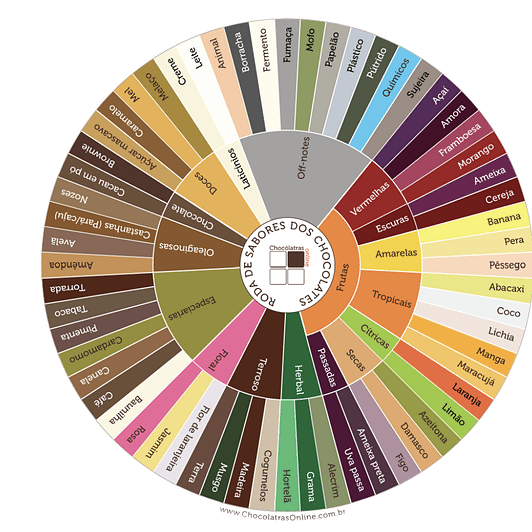
- Use our “flavour wave” approach: pay attention to what happens at the start, middle and finish of the tasting experience. Many fine chocolates evolve significantly over time as different aroma compounds emerge. See HERE (get link)
- Compare notes with other people tasting alongside you. People can perceive the same chocolate very differently — and that divergence is normal, interesting and often revealing (for more on the “whys” of this, see here – and next week’s blog)
- Finally: experiment. And enjoy! One of Shepherd’s broader insights was that flavour is not static. Airflow, temperature, saliva, timing and attention all change perception. Tiny changes in tasting technique can completely alter the flavour experience – and add to the fun
Taking a big sigh of relief now that there is some respite from the heat … and enjoying how this takes me on a great craft chocolate flavour wave.
SOURCES:
Gordon Shepherd & Neurogastronomy
Neurogastronomy: How the Brain Creates Flavor and Why It Matters (2011)
https://cup.columbia.edu/book/neurogastronomy/9780231159114
Neuroenology: How the Brain Creates the Taste of Wine (2016)
https://cup.columbia.edu/book/neuroenology/9780231193385
“In Memoriam: Gordon Murray Shepherd” — Yale School of Medicine
https://medicine.yale.edu/news-article/in-memoriam-gordon-murray-shepherd-md-dphil/
“In Memoriam: Gordon M. Shepherd (1933–2022)” — INCF
https://www.incf.org/blog/memoriam-gordon-m-shepherd-1933-2022
Gordon Shepherd interview on Neurogastronomy — Columbia University Press
https://cupblog.org/2011/12/06/neurogastronomy-gordon-shepherd-discusses-neurogastronomy-how-the-brain-creates-flavor-and-why-it-matters/
Nature obituary for Gordon Shepherd
https://www.nature.com/articles/d41586-022-04403-z
The Science of Retronasal Olfaction & Exhalation
“Expiration: the moment we experience retronasal olfaction in flavor” — Neuroscience Letters (2010)
https://pubmed.ncbi.nlm.nih.gov/20171264/
“Optimal directional volatile transport in retronasal olfaction” — PNAS (2015)
https://www.pnas.org/doi/10.1073/pnas.1511495112
“The Flow of Flavor: How Exhaling While Eating Affects Smell and Taste” — Yale Scientific
https://www.yalescientific.org/2016/04/the-flow-of-flavor-how-exhaling-while-eating-affects-smell-and-taste/
“Smell images and the flavour system in the human brain” — Nature
https://www.nature.com/articles/nature05405
Barry Smith, Flavour & the Language of Smell
Professor Barry C. Smith — University of London profile
https://research.london.ac.uk/institute-ip/staff/26/professor-barry-c-smith/
Barry Smith — Centre for the Study of the Senses
https://sensorystudies.org/sensory-matters/barry-c-smith/
Barry Smith — “Tasting Flavours”
https://philpapers.org/rec/SMITFY-2
Barry Smith — “The Complexity of Flavour” (Aeon)
https://aeon.co/essays/wine-tasting-is-about-more-than-just-the-liquid-in-the-glass
Barry Smith interview — Prospect Magazine https://www.prospectmagazine.co.uk/ideas/philosophy/42088/barry-c-smith-the-philosopher-of-flavour
Barry Smith TEDx Talk — Taste, Flavour and Why Wine Tasting is Not Bullshit
https://www.youtube.com/watch?v=I3eX8k7Qj9Y
Article on AI – featuring Barry Smith: https://www.noemamag.com/why-ai-needs-a-sense-of-smell
Breathing, the Body & Wellness
“Breathing Practices for Stress and Anxiety Reduction” — PMC / NIH review (2023)
https://pmc.ncbi.nlm.nih.gov/articles/PMC10741869/
“4-7-8 Breathing: How it Works, Benefits and Uses” — Medical News Today
https://www.medicalnewstoday.com/articles/324417
“The Science is Clear: Deep Breathing Can Be a Game Changer” — The Athletic / New York Times (2025)
https://www.nytimes.com/athletic/6321893/2025/05/01/the-science-is-clear-deep-breathing-can-be-a-game-changer-for-anyone-elite-a
Giulia Enders — Organ Speak: What It Really Means to Listen to Our Bodies (2025)
https://www.hachette.co.uk/titles/giulia-enders/organ-speak/9781915780751
Ann Noble, Flavour Language & Aroma Wheels
Ann C. Noble — Wine Aroma Wheel official site
https://www.winearomawheel.com/about.html
CocoaRunners — “What Colour Teaches Us About Flavour”
https://cocoarunners.com/blog/colour-teaches-us-about-flavour/
The book I’m reading:
Organ Speak: What It Really Means to Listen to Our Bodies (2025) — Hachette
https://www.hachette.co.uk/titles/giulia-enders/organ-speak/9781915780751/