The chocolate under your Christmas tree
Christmas is when all chocolate, including craft chocolate, goes into overdrive. Chocolate boxes under the tree. Chocolate baubles on the tree. Chocolate Advent calendars. Chocolate coins. Chocolate selection boxes of all shapes and sizes. Chocolate-covered fruits, nuts, and assorted oddities. Chocolate spreads. Chocolate stocking-stuffers. Drinking chocolate with more variations than many wine lists.
This week’s blog is partly an attempt to entice you toward some brilliant craft-chocolate gifts for the season – from Cinnamon Twirls to Peppermint Treats, hot chocolates to kids’ activity kits, stocking fillers to curated gift boxes. Even some giftable experiences and that wonderfully smug present: a monthly subscription.
It’s also an attempt to unwrap how chocolate became entwined with Christmas trees. In the process, we’ll explain why 75–85% of households in the UK and US now put up a Christmas tree, a tradition whose roots lie in German/Baltic midwinter customs and which was turbo-charged by the Victorian media machine and the German wing of the British Royal Family.
You’ll also learn why Christmas colours are red, white and green, plus discover some staggering statistics about real vs artificial trees – and how they differ as much as bûche de Noël differs from Lebkuchen (and yes: one is French, one is German).
First, the practical bit. Here are some craft-chocolate treats that work beautifully under the tree, in the run-up, on the day, and well after Christmas.
- If you want to celebrate the fruits on the Christmas Tree’s predecessor (the Paradisebaum), we’ve got you covered with a range of chocolate-coated nuts and fruits
- Or you can make your own, and keep the kids entertained
- If you are more disposed to truffles, we’ve everything from handmade Cornish to Stockholm truffles to extraordinary filled creations from Austria.
- And if you’re after great seasonal bars – gingerbread, cinnamon, myrrh and more – head here. The blog explains why cinnamon has such a long and spicy history with cacao (hint: like cacao and vanilla, cinnamon became globally traded through the Columbian Exchange)
- If, following the lead of Queen Victoria, you’d like to gift some boxes of chocolates, please see here – or make your own (and please do read the blog to find how Victoria strong armed the pacifist Quaker Frys and Cadburys to help her gift chocolate boxes to soldiers fighting the Boer War)
- Even though you’ve missed Advent (we’ve sold out), you can still enjoy the Twelve Days of Christmas with this box – buy two and you’ve improvised an Advent calendar.
- If drinking chocolate is your thing – especially the monastic-meets-Mesoamerican traditions of hot chocolate during fasting seasons – see the blog for the strange but true tale of why drinking chocolate became tangled with the theology of fasting (and the link to “fish on Fridays”).
- Mint and chocolate? A stone-cold classic. For trivia fans: the world’s oldest continuously produced branded chocolate bar is Fry’s Chocolate Cream (1866), and Fry’s Peppermint Cream followed in 1912.
- Chocolate oranges? Terry’s launched the Chocolate Orange in 1932, after its earlier Chocolate Apple (1924) and Chocolate Lemon – both of which fizzled. Oranges won decisively. Try these bars to see why.
Finally, if you want to understand why 80% of British and US households purchase Christmas trees, and why we place so much chocolate “under” and “on” our christmas trees; please read on!
Chocolate before Christmas and Columbus
In Mesoamerica, cacao was a ceremonial drink long before Europe encountered it. The Olmecs, Maya and Aztecs used cacao in diplomatic exchanges, ritual gifting, weddings, courtly feasts – and yes, sometimes in rites surrounding sacrifice (see here). Cacao beans also served as currency; Columbus’s son Ferdinand famously described the confusion at seeing “almonds” (cacao beans) treated as money.
Palaeobotanists and archaeologists now agree cacao was first used as a fermented fruit beverage – a light, mildly alcoholic pulp beer. Only later does the shift to roasted-seed, frothed drinking chocolate appear. By the medieval period in Mesoamerica, cacao drinks were sweetened in some contexts (Howard-Yana Shapiro has written well on this), and were often mixed with vanilla and Mexican cinnamon (canella). Note this is different to the Ceylon/Saigon cinnamons later imported to Europe, and often used at Christmas in bars and drinks
Drinking chocolate was a social experience: shared, status-laden, tied to generosity, ritual and hospitality.
Chocolate and the church
When cacao arrived in Europe in the 16th century, it was rapidly medicalised, theologised, sweetened and heated. By the 17th century, it had slipped neatly into Christian seasonal rhythms for a somewhat counterintuitive reason: it helped people fast.
Pre-Reformation Catholic fasting rules forbade animal-based foods and drinks on Fridays, Saints’ Days and during Advent (and that partially explains “Fish on Fridays”.) Jesuits and other canny operators realised that water-based drinking chocolate – sweetened and spiced – marketed drinking chocolate as nourishing yet technically “not breaking the fast”.
Seventeenth-century theologians debated the matter at length, and many theologians, confessors and members of the clergy came to permit drinking chocolate during fasts, treating it as not breaking the fast.
Bottom line: fasting partially explains why drinking chocolate, including in cold winter months, spreads over Catholic Europe
Christmas trees and chocolate – and why red, white and green are christmas colours
To understand why chocolate ends up hanging from, and under, Christmas trees, we first need to unfurl the history of Christmas Trees.
Paradise Trees (Paradisebaum)
In medieval German-speaking Europe, 24 December was the Feast of Adam and Eve. Towns staged “Paradise Plays” using an evergreen tree to represent the Tree of Knowledge and eternal life. The fir tree carried red apples (the Fall) and white communion wafers (redemption). The evergreen symbolised eternal life. (Note: the red colour associated with Father Christmas is far later and very different, stemming from some CocaCola adverts in the 1920s)
Municipal records from cities such as Freiburg and Basel (15th–16th centuries) describe public trees hung with apples, nuts and wafers during winter festivities. These weren’t Christmas trees yet, but food-decorated winter trees – civic displays rather than household ones.
Lutheran reformers objected to Catholic-style public spectacle, and the celebration shifted into private homes. By the 18th century, the decorated Weihnachtsbaum was well established in German domestic life – still studded with edible symbolism.
An Alternative Tradition (that’s also become edible) – The Yuletide Log
Long before the Paradisebaum, northern Europeans burned massive Yule Logs to carry the household through the darkest nights and celebrate various gods, lengthening of days, etc.. Ashes were frequently saved for protection; log fragments kept to light next year’s flame.
In France, this tradition continued before in the 19th century spawning the edible practise of “la Buche Noel” (See here)
German-speaking Europe kept this yuletride long tradition alongside their Paradisebaum. And historians have suggested that some of the symbolisms migrated – e.g., candles moving from log to tree, apples supplemented with sugar-coated nuts and gingerbread
What about St Boniface?
There is also a Victorian story that links Christmas trees to St Boniface. Henry van Dyke wrote an 1897 short story “The First Christmas Tree” about how St Boniface as a missionary ventured into a pagan rite to chop down a sacred oak dedicated to Thor, and then pointed to a nearby fir tree, proclaiming: “See how it points upward to heaven. Let this be called the tree of the Christ-child; gather about it in your homes.”
There is an early medieval core to this: Boniface really is said to have felled a sacred oak (usually called Donar’s Oak or “Jove’s oak”) near Geismar in Hesse, in the 8th-century Latin Life of Boniface by Willibald. But Willibald says nothing about a fir tree, nothing about a “tree of the Christ-child,” and nothing about people taking it into their homes.
However we do have other reasons to thank the Victorians, and in particular Queen Victoria’s Hanoverian antecedents, as to why 75% plus households contain Christmas Trees today.
Queen Victoria, The Hanoverians and British Christmas trees
With the Hanoverian “takeover” of the British Crown, Queen Charlotte, consort of George III (from Mecklenburg-Strelitz) brought over this tradition, introducing a decorated yew tree at Windsor for a children’s Christmas gathering in 1800. On it was hung fruit, sugared almonds and small gifts – and it became an annual tradition that started to be copied by aristocratic families close to the royal family.
What really made this tradition take hold was the adoption of a Christmas Tree by Victoria and Albert in the 1840s, and in particular an article in the winter edition of the 1848 Illustrated London News with an engraving that showed the royal family gathered around a decorated tree.
The image was reprinted in the US in 1850 in Godey’s Lady’s Book, sparking a parallel American craze. Claims about the first White House tree vary, but the earliest widely attested example was displayed for President Benjamin Harrison in 1889.
The association with chocolate
The 19th century industrialised chocolate. Cocoa pressing (van Houten, 1828), conching (Lindt, 1879), milk chocolate (Daniel Peter & Henri Nestlé, 1875), moulds, tempering and foil wrapping opened the way for chocolate to become far cheaper, more shelf stable and easy to become a foiled ornament for the tree.
Woolworths claim to have been first to sell chocolate Xmas tree ornaments in 1880. However historians have noted that by the late 19th century, German makers such as Stollwerck were making chocolate figures, ornaments and novelties that doubled as Christmas Tree decorations. Plus British makers including Fry’s and Cadbury were selling foil-wrapped chocolate ornaments designed to hang on trees. And In Hungary, the Christmas candy known as Szaloncukor developed in the 19th century from French‑style fondant, was typically coated in chocolate, wrapped in shiny foil, and deliberately hung on the tree – meant to be picked off and eaten over the festive days.
Above and beyond chocolate tree decorations, Queen Victoria added another promotional tailwind in the late 1890s / early 1900s. Despite the Quaker inspired pacifism of Fry’s and Cadbury’s, Victoria “persuaded” (aka ordered) them to send chocolate gift tins to British soldiers in the Boer War (1899–1902) further promoting the idea of Christmas Boxes of Chocolate. (Note: initially both Fry’s and Cadbury’s “donated” the boxes of chocolates commissioned by Queen Victoria, but omitted their branding. Queen Victoria then insisted that the soldiers should know it was BRITISH made chocolate, and they then applied their branding)
Chocolate coins appear in the US by the early 20th century, partly through the blending of St Nicholas Day traditions with mass-manufactured confectionery (and some Hanukkah gelt / coins too)
Smart marketing… but what sort of tree?
Chocolate makers have sensibly linked their Christmas offers to Christmas Trees.
In the UK, about 85% of adults put up a Christmas tree; in the US, surveys range from 75–80% of households.
Quite what sort of tree is being used is controversial. Firstly, it’s hard to figure out what sort of trees are being “put up”; artificial versus real. Surveys suggest ~80% of US and UK households use artificial trees. Yet real-tree sales remain high: with over 6–8 million real trees sold annually in the UK (against 28-29m households) and 25–30 million real trees sold annually in the US (against 130-135m households). Statisticians suggest that many households could have multiple trees .. but even then, many artificial trees are used for a multiple years too ….
And then there is the debate as to which is environmentally “greener”. Essentially this breaks down into tree lifespan and disposal mechanics. According to skoot.eco and multiple lifecycle analyses:
- Real trees have the lower carbon footprint per year if they are chipped, mulched, composted, or burned cleanly.
- Artificial trees only break even after 8–12 years of reuse, depending on materials, transport distance and storage.
Whichever you have, craft chocolate under the tree is the far more environmental (and healthier, and more flavoursome) choice
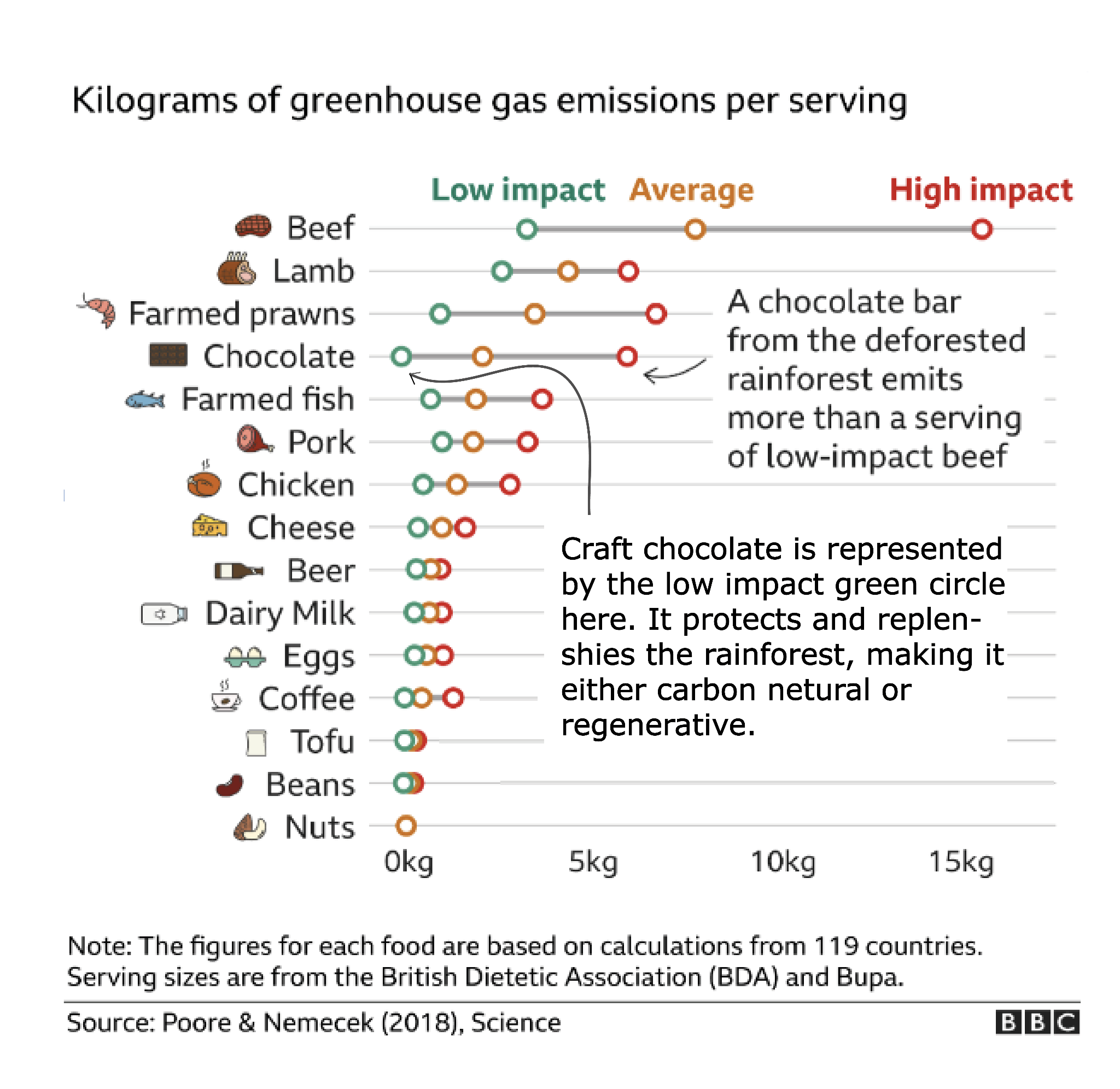
One thing isn’t in dispute: craft chocolate has a dramatically lower environmental footprint than industrial confectionery.
Studies by Poore & Nemecek (2018, Oxford University) show that industrial cacao supply chains – especially West African bulk cocoa – carry the highest land-use change and carbon burdens, while small-batch agroforestry cacao systems have orders-of-magnitude lower emissions.
Come to tasting to find out more – and how many baths it takes to grow the cocoa in one chocolate bar (hint: A LOT!)
Sources:
Mesoamerican cacao history
• Smithsonian National Museum of Natural History – Cacao origins and archaeology
https://naturalhistory.si.edu/education/teaching-resources/food/cacao
• Coe & Coe, The True History of Chocolate (summary via Harvard link)
https://chs.harvard.edu/chocolate/
• Early cacao fermentation evidence (Science Advances 2018)
https://www.science.org/doi/10.1126/sciadv.aas9875
Ferdinand Columbus describing cacao-as-money
• The History of the Life and Actions of Admiral Don Christopher Columbus (Ferdinand Columbus) – digitised excerpt
https://archive.org/details/lifeactionsofad00colurich/page/60/mode/2up
Cacao sweetening and flavourings (Howard-Yana Shapiro)
• Chocolate: History, Culture and Heritage (Google Books excerpt)
https://books.google.com/books?id=LWxi0DLpQ2oC
Cacao, fasting & the Church
• Marcy Norton, “Sacred Gifts and Profane Pleasures” – chocolate and Catholic fasting debates (UPenn)
https://www.upenn.edu/pennpress/book/13965.html
• Catholic fasting rules (scholarly overview)
https://www.cambridge.org/core/journals/church-history/article/abs/fasting-in-western-christianity/
Paradise Trees / Weihnachtsbaum origins
• Encyclopaedia Britannica – Christmas tree
https://www.britannica.com/topic/Christmas-tree
• German Adam & Eve feast-day trees (“Paradeisbäume”) – Österreichisches Volkskundemuseum
https://www.volkskundemuseum.at/de/paradeisbaum
• Freiburg/Basel municipal records (summary via German Historical Museum)
https://www.dhm.de/lemo/kapitel/weihnachten/
Queen Charlotte’s 1800 tree at Windsor
• Royal Collection Trust – Queen Charlotte’s Christmas tree
https://www.rct.uk/collection/themes/exhibitions/windsor-castle-royal-gifts/windsor-castle/queen-charlottes-christmas-tree
Victoria & Albert and the 1848 Illustrated London News image
• Illustrated London News archive – 1848 engraving
https://illustratedlondonnews.com/christmas-tree-1848/
• Historic UK summary
https://www.historic-uk.com/CultureUK/The-Victorian-Christmas-Tree/
Adoption in the United States
• Godey’s Lady’s Book reprint of the ILN image (1850)
https://www.godeysladysbook.com/christmas-tree/
• First White House Christmas Tree – White House Historical Association
https://www.whitehousehistory.org/photos/first-christmas-tree
Chocolate industrialisation
• Van Houten cocoa press (1828) – Utrecht Archives
https://www.hetutrechtsarchief.nl/onderzoek/resultaten/archieven/archief/1239
• Lindt conche (1879) – Lindt historical record
https://www.lindtusa.com/history
• Daniel Peter & Nestlé milk chocolate (1875) – Nestlé archives
https://www.nestle.com/aboutus/history/nestle-company-timeline
Earliest foil-wrapped chocolate ornaments
• Stollwerck (Germany) – early foil-wrapped tree decorations (German Museum of Chocolate)
https://www.schokoladenmuseum.de/en/chocolate-history/
• Fry’s & Cadbury’s Victorian innovations (Cadbury archive)
https://www.cadbury.co.uk/our-story
Fry’s chocolate bars
• Fry’s Chocolate Cream (1866) – Bristol Archives / Museum of Bristol
https://www.bristolmuseums.org.uk/stories/frys-chocolate/
• Fry’s Peppermint Cream (1912)
https://www.cadbury.co.uk/products/frys-peppermint-cream
Terry’s Chocolate Orange
• Terry’s historical timeline
https://www.terryschocolateorange.co.uk/heritage/
Christmas tree ownership statistics
United Kingdom
• YouGov: “85% of Brits display a Christmas Tree”
https://yougov.co.uk/topics/society/articles-reports/2023/12/12/how-brits-celebrate-christmas
United States
• American Christmas Tree Association (ACTA): 77% of households display a tree
https://www.christmastreeassociation.org/press-releases/2023-survey-results/
Real vs artificial tree sales
UK
• British Christmas Tree Growers Association – 6–8 million sold annually
https://www.bctga.co.uk/faqs
US
• National Christmas Tree Association – 25–30 million real trees sold annually
Carbon footprint: real vs artificial
• skoot.eco carbon comparison
https://skoot.eco/blogs/knowledge/christmas-tree-carbon-footprint
• Carbon Trust report
https://carbontrust.com/news-and-events/insights/carbon-footprint-of-christmas-trees
Environmental impact of chocolate
• Poore & Nemecek (2018), Science – lifecycle analysis of food systems
https://science.org/doi/10.1126/science.aaq0216
• Accessible summary via Oxford University
https://www.ox.ac.uk/news/2018-06-01-study-reveals-environmental-impact-widest-range-foods