The environmental impact of chocolate – what will EUDR mean?
Craft chocolate rests on three pillars: Flavour, Fairness to farmers and Forests.
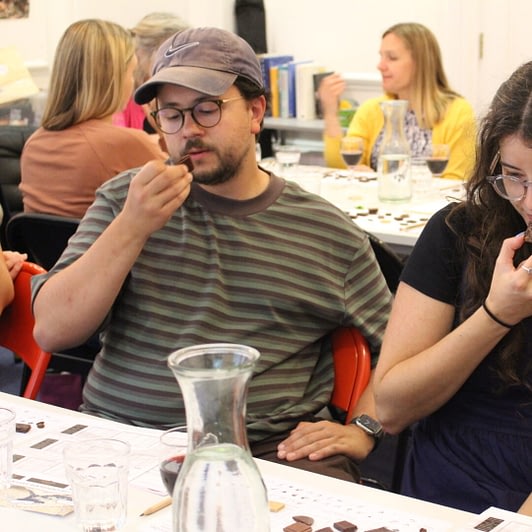
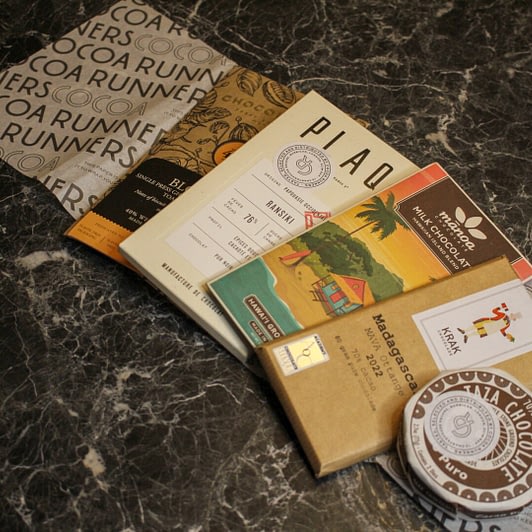
Flavour is pretty simple to demonstrate; just try a bar!
Fairness to farmers is also relatively straightforward to tell as a human story.
The harder part to explain is the third pillar: craft chocolate as a way to save rainforests and cut chocolate’s planetary footprint. Cocoa/chocolate is extraordinarily complex. It can be one of the best ways to save rainforests and desertification. But it’s also one of the most destructive – and water consuming – crops out there.
The big news in the cocoa and chocolate world is that the long awaited EU Deforestation Regulation (EUDR) is finally coming into play, which should signal a major change for the future of cocoa growing and its impact on the environment. That’s what I’ll be exploring in this week’s blog.
Bottom line: next time you savour a craft chocolate bar remember that it requires an astonishing 1,500+ liters of water to grow and make (ie the equivalent to over 30 baths, or 50 showers). The good news is that, unlike the chocolate in mass market confectionery, the chocolate in your craft chocolate bar is all about recycling this water and preserving / replanting the rainforest.
The science – Poore and Nemeck
In a landmark 2018 Science paper by Poore and Nemecek, modern food systems were shown to be responsible for around a quarter of global greenhouse-gas emissions. The study also showed how different farming and processing techniques can radically impact a crop’s environmental footprint.
Their database covers an enormous range of foods, and cocoa stands out for its variability. That is to say a chocolate bar can be relatively benign or catastrophically damaging depending on how, and where, the cocoa was grown. Because so much cocoa is grown on recently deforested land (especially in West Africa), and because cocoa is water‑intensive – one 60 g bar of 70% dark chocolate can require around 1,500–2,000 litres of water (roughly 30 bathtubs) – its footprint can be among the worst of any crop when treated as an agro‑industrial commodity (sometimes even rivalling beef).
By contrast, cocoa grown “traditionally” under rainforest canopy, with cocoa trees part of a diverse environment, has a radically different profile. Water is recycled and recycled, land‑use change emissions drop sharply, and carbon is stored rather than released.
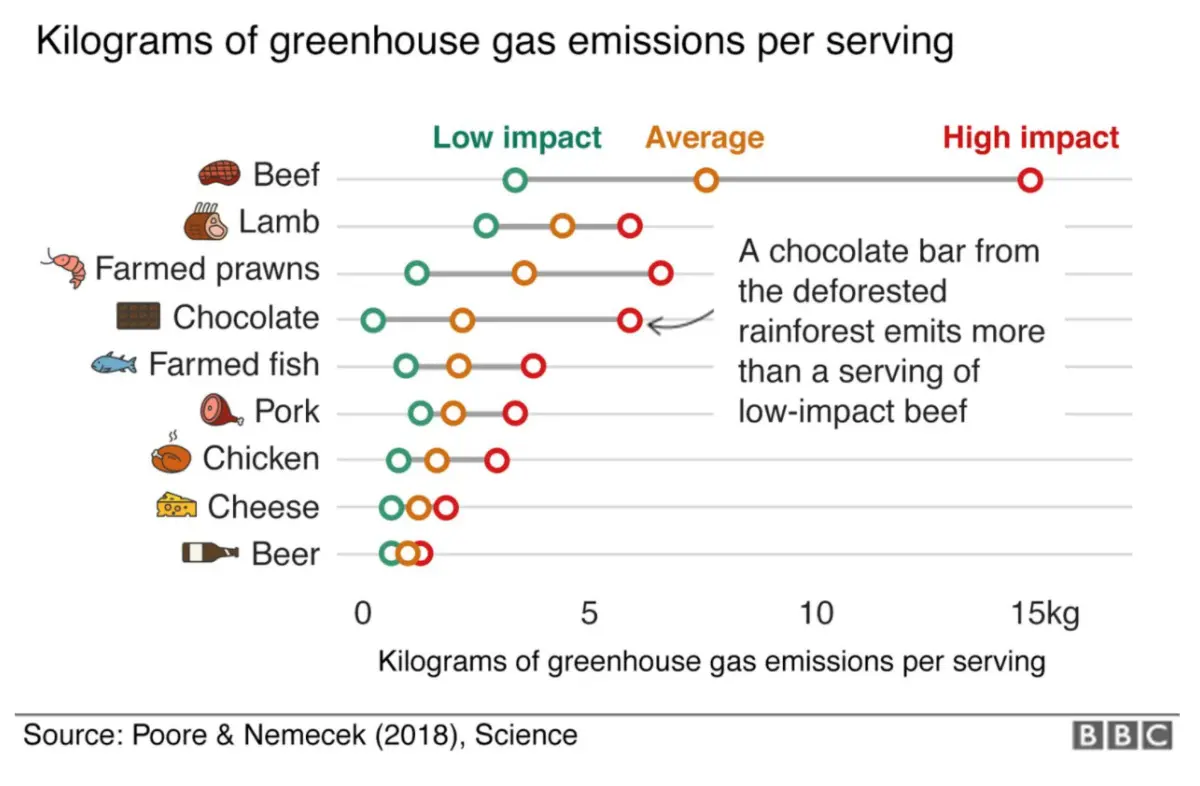
To put it another way:
- A typical 1kg of milk chocolate made from commodity West African cocoa generates around 19 kgCO₂e total impact (land use + processing + dairy) – equivalent to 1.9 kgCO₂e per 100g supermarket chocolate bar. In worst-case scenarios with recent deforestation, cocoa’s land-use emissions can exceed even beef on a per-kg basis.
- By contrast, rainforest / shade-grown craft chocolate can achieve around 2.9 kgCO₂e per kg (or 0.29 kgCO₂e per 100g craft chocolate bar) – slashed by agroforestry systems that boost carbon storage 2-3x over monocultures and cut fertiliser/pesticide inputs by 50-70%.
Cocoa as a forest crop and force for good
Cocoa is native to the Amazon basin, dating back to at least 5,000 BC. It evolved under dense, diverse rainforest canopies, thriving in shade alongside taller trees that recycle nutrients through leaf litter, stabilise fragile tropical soils, regulate water by intercepting rainfall and reducing runoff, and buffer extreme heat. In properly designed agroforestry systems, these trees are not natural wonders – they perform essential agronomic functions.
This is why, in Bahia, Brazil, farmers like Júliana at Baianí and Rogério at Mestiço are reviving the time‑tested cabruca system – mixed cocoa forestry under native canopy – as part of their recovery from Witches’ Broom, a disease that almost wiped out Brazilian cocoa (see here for images from my trip last year).
Where cocoa is grown within such systems – like Brazil and much of Latin America, Madagascar, and Southeast Asia – cocoa trees remain productive for 30–50 years or more. Yields stabilise rather than collapse. Soils improve rather than degrade. Water is recycled and stays in the landscape. Rainforests are treasured (and can even be reclaimed) because cocoa performs better under a mixed rainforest canopy.
In the 1990s, this ecological logic helped drive a series of amazing political and environmental initiatives. For example, US and UN programmes linked to the war on drugs promoted cocoa as an alternative to coca in regions such as Colombia and Peru’s VRAE (Valley of the Rivers Apurímac, Ene and Mantaro). The reasoning was pragmatic: cocoa is one of the few crops that rivals even the coca leaf in its love of rainforest canopy. And unlike the coca plant, cocoa provides a legal crop.
This is a wonderful virtuous circle. Rainforests are protected and even reestablished (see here for examples in Colombia). Farmers grow a legitimate crop that offers long term, predictable incomes. And consumers benefit from amazing beans that are turned into wonderful craft chocolate bars.
Why the industrial/commodity model is such a bad fit for cocoa
Unfortunately much of the world’s cocoa production has been shoehorned into the agro-industrial model that emerged from the Green Revolution of the mid-20th century. This system was designed to maximise output from crops like wheat, maize, rice, soybeans – and even fast-growing pulpwood plantations. These crops were selectively bred and genetically reengineered to mature faster, grow bigger, and deliver higher yields per hectare. They were also optimised to thrive under heavy applications of synthetic pesticides, herbicides, and chemical fertilisers. The model explicitly favoured massive, mechanised plantations over traditional smallholder farming, enabling uniform planting, industrial-scale harvesting, and rapid turnover cycles.
A handful of multinational giants came to dominate these supply chains, consolidating processing, trading, and distribution into highly efficient – but opaque – commodity pipelines. Today, just three crops (wheat, rice, maize) supply around 50% of humanity’s calories, while ten crops account for over 85%. At the top of this pyramid sit the undeservedly unknown “ABCD” companies – Archer Daniels Midland (ADM), Bunge, Cargill, and Louis Dreyfus – the “Big Four” that collectively control an estimated 70–80% of global grain trade, 50–60% of oilseed processing, etc. These are not household names like Nestlé or Mars; they are the invisible powerhouses that set prices, manage logistics, and dictate prices terms to millions of farmers worldwide.
The results have been staggering: yields skyrocketed (e.g. global wheat production tripled from 1960–1990), prices were driven relentlessly downward through economies of scale, and this system underpinned an extraordinary population boom, helping feed humanity’s growth from 3 billion in 1960 to over 8 billion today.
But cocoa – a slow-growing, shade-loving perennial tree crop – is a profoundly poor fit for this industrial template. The vast majority of it is still grown by small holder farmers in West Africa (and Latin America) whose farms are only 3-5 hectares, and this cocoa is planted alongside other tropical crops like plantain and bananas. There are a few examples, most famously CCN51 in Ecuador, where some attempts have been made to grow cocoa as a mono culture and the traditional rainforest cleared. But this remains the exception not the rule. And yields haven’t increased at anything like the rate of these other green revolution crops.
The tragedy of cocoa in west africa
West Africa grows roughly 60-70% of the world’s cocoa, primarily in Ghana and Côte d’Ivoire. Over 60% of the cocoa grown here is bought, and often processed, by three big cocoa / commodity trading companies (Olam, Cargill and Callebault). These companies have, until recently, done an amazing job of ensuring that in the west we can enjoy £/$1 commodity cocoa confectionery bars.
But this has come at a massive cost to farmers and to the environment, with massive deforestation and even desertification. Between 2001 and 2015, Ghana lost around one-third of its rainforest cover and Côte d’Ivoire around a quarter. To put this into context: over the past two decades, Côte d’Ivoire alone has lost approximately 2.4 million hectares of forest – nearly the size of Rwanda. And commodity cocoa has been the single largest driver. Since 2000, cocoa has accounted for more than 37% of forest loss in Côte d’Ivoire’s protected areas and roughly 13% in Ghana.
The reasons are both ecological and economic.
Much of West Africa lies on ancient tropical soils (technically known as highly weathered ferralsols and acrisols) that are naturally low in nitrogen and often deficient in magnesium. This limits photosynthesis and impacts tree vigour. All too rapidly, organic matter is lost and these soils struggle to retain nutrients, making fertiliser both expensive and inefficient (note: for more on magnesium and human health, please see here).
At the same time, cocoa remains a key cash crop for millions of smallholder farmers. Yet until very recently, decades of commoditisation and consolidation have kept prices under sustained downward pressure. Combined with falling yields, this has meant that in Ghana, for example, the average cocoa farmer is estimated to earn around $0.40 per person per day for women and $0.80 for men – well below widely cited living-income benchmarks of $3+ PP per day, and far short of what is needed to support a family or keep children in school.
When you are earning less than a dollar a day, and the fastest way to increase income is to increase volume, a national response is to try and grow more cocoa. With prices too low to afford investing in fertilisers, irrigation systems, pruning, soil health etc, many farmers expand “horizontally” instead. That is to say: they cut down the nearby rainforests to plant more trees. This creates a double win. Firstly it means more cocoa trees. And secondly slash‑and‑burn methods create a short‑term nutrient “reset,” as ash releases nitrogen, potassium, and phosphorus, and organic matter temporarily rises for both the new, and older neighbouring trees.
In effect, deforestation has become a substitute for farm investment – a hidden subsidy paid for by forests and our environment. This is not about a few rogue and malicious “bad actors” deliberately ruining the rainforest. Rather it is the systemic outcome of commoditisation and consolidation: farm-gate prices pushed ever lower, soils degraded, disease pressure rising, and a cocoa supply chain that has long externalised the true costs of forest fertility, water, labour, and risk.
The EUDR: closing the door too late?
The EU Deforestation Regulation aims to end this dynamic not just in cocoa but a host of other crops that have also involved deforestation. From late 2026 for large operators (and mid‑2027 for smaller ones), any cocoa entering the EU must be provably deforestation‑free, with geolocation and due‑diligence data tracing it to the farm.
The regulation tackles the right problem – land‑use change – but arrives after most deforestation has already occurred. It is designed to halt new clearing but doesn’t try to restore lost rainforest. The horse had already bolted before the stable door was closed.
Moreover, implementation is brutal for small farmers; their plots are often unsurveyed (boundaries defined by trees, paths, or streams), intercropped under canopy (hard for satellites to parse), fragmented from inheritance, and in areas where sharing coordinates risks land disputes, taxation, or distrust of outsiders. Mapping requires trust‑building, field visits, neighbour negotiations, and ongoing data maintenance – all costly and time‑intensive. If mishandled, the EUDR could exclude these vulnerable smallholder cocoa farmers from all over the world precisely when they need support.
To be optimistic, by removing deforestation as the system’s “pressure valve” to grow more cheap commodity cocoa, the EUDR may force some change.
To be pessimistic, there isn’t much rainforest left in which to grow cocoa (at least in West Africa). And the US and Asian markets don’t have stringent EUDR-like initiatives.
Your bar as a forest / environmental decision
Which brings us back to where we started: flavour, fairness, and forests.
Flavour is a great hook and entry into craft chocolate. Fair pay and transparency is a human story to which we can all relate (note: hats off to Tony’s for marketing this brilliantly, but see here for why this really isn’t enough to improve cocoa farmers lifes and reduce child labour).
Forests are the deeper, slower reality underneath both flavour and farmers. When you choose a craft bar from a maker working closely with farmers growing cocoa in shaded, diverse rainforests – rather than a mass‑produced bar built on anonymous bulk cocoa from deforested lands – you are not just choosing how your chocolate will taste. You are also choosing which farming model, how farmers are rewarded, what water use and what forestry practices you are funding.
Upgrading to craft chocolate won’t, on its own, solve deforestation, stop desertification or reverse climate change. But it’s a great, and easy, first step. This simple choice really can directly support the farmers, makers, and systems that treat chocolate as what it should be: one of the best crops to keep rainforests standing.
Sources
Poore & Nemecek (2018) – Reducing food’s environmental impacts
Landmark Science paper: 26% global GHG from food; cocoa GHG variability (19 kgCO2e/kg milk chocolate).
https://www.science.org/doi/10.1126/science.aaq0216[pubmed.ncbi.nlm.nih]
PDF: https://josephpoore.com/Science%20360%206392%20987%20-%20Accepted%20Manuscript.pdf[josephpoore]
Cocoa Barometer 2025 (Public Eye / SÜDWIND / Solidaridad)
Farmer incomes, deforestation, EUDR, production crises.
Exec Summary PDF: https://www.suedwind-institut.de/fileadmin/Suedwind/Publikationen/2025/2025-Cocoa-Barometer-Executive-Summary.pdf[suedwind-institut]
Full PDF: https://www.publiceye.ch/fileadmin/doc/Schokolade/2025-Cocoa-Barometer-The-Way-Forward.pdf[publiceye]
Living Income Report: Ghana Cocoa (Anker et al., 2018)
Avg income ~$0.45/day; living benchmark $329/month family of 5.
PDF: https://www.living-income.com/fileadmin/living_income/Publications/Studies/Living_Income_Report_Ghana_Cocoa_Final_version_210918.pdf[living-income]
Cocoa & Forests Initiative (CFI) 2024 Progress Reports (World Cocoa Foundation)
Ghana/Côte d’Ivoire deforestation-free efforts, tree planting.
MDLZ/Cocoa Life: https://www.cocoalife.org/en/progress/mdlz-cocoa-life-2024-cocoa-forests-initiative-progress-report/[cocoalife]
Cocoa Plantations & Deforestation in Côte d’Ivoire/Ghana (Nature Food, 2023)
37% protected area loss to cocoa since 2000.
https://www.nature.com/articles/s43016-023-00751-8[pmc.ncbi.nlm.nih]
World Cocoa Conference 2024 Report (ICCO)
Global production, sustainability initiatives.
PDF: https://www.icco.org/wp-content/uploads/REPORT-WORLD-COCOA-CONFERENCE-2024_low.pdf[icco]
Barry Callebaut Sustainability Update 2024-25
EUDR mapping, poverty reduction.
https://cocoaradar.com/barry-callebaut-puts-a-price-tag-on-cocoa-sustainability/
Olam Cocoa Supply Chain Monitoring (Fair Labor Assoc., 2018—ongoing)
Côte d’Ivoire traceability, child labour.
https://www.fairlabor.org/reports/2018-independent-external-monitoring-reports-olam-cocoa-supply-chain/
Cocoa Life Progress Report (Mondelēz, 2017-2024 baseline)
Farmer training, yields.
PDF: https://www.cocoainitiative.org/sites/default/files/Cocoa-Life-2017-Progress-Report-compressed.pdf
Cocoa deforestation stats (Côte d’Ivoire 37% protected areas since 2000, Ghana 13%; 2.4M ha loss; 60-70% global production)
Nature Food (2023): https://www.nature.com/articles/s43016-023-00751-8
PMC: https://pmc.ncbi.nlm.nih.gov/articles/PMC10208960/
West Africa review: https://www.tandfonline.com/doi/full/10.1016/j.njas.2015.09.001
Ghana cocoa farmer incomes (~$0.40-0.80/day; living income $3+/day)
Freedom United / Cocoa Barometer (2024):
https://www.freedomunited.org/news/ghana-cocoa-farmers-living-income/
(Avg $0.40-0.45/day; living wage ~$13.50 PPP/day benchmark)
Cocoa origins (Amazon, 5,000+ years domesticated)
Mongabay DNA study (2024): https://news.mongabay.com/2024/07/dna-testing-proves-that-cocoa-originated-in-the-amazon-and-reveals-robust-pre-columbian-trade/
US/UN war on drugs promoting cocoa vs. coca (Colombia, Peru VRAE)
Cabruca system, Bahia Brazil, Witches’ Broom recovery
Dutch gov’t agroforestry report (2023):
https://magazines.rijksoverheid.nl/lnv/agrospecials/2023/01/brazil
ABCD companies control (70-80% grains, 50-60% oilseeds)
UK Agroconsult (2024):
https://ukragroconsult.com/en/news/four-companies-control-half-of-the-worlds-agricultural-trade-but-competition-is-intensifying/
Green Revolution (wheat yields tripled 1960-90, population boom, 3 crops 50% calories, 10 crops 85%)
Environmath summary of Poore/Nemecek:
http://environmath.org/2018/06/17/paper-of-the-day-poore-nemecek-2018-reducing-foods-environmental-impacts/
Craft/shade-grown benefits (2-3x carbon storage, 50-70% input cuts)
Derived from Poore/Nemecek variability + agroforestry:
https://www.nature.com/articles/s43016-023-00751-8