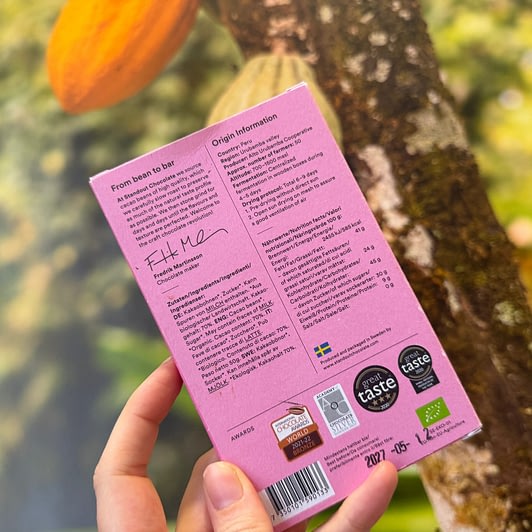
When Chocolate Becomes Art (Literally!)
How chocolate has been inspiring artists for millenia, from Mayan pottery to Picasso’s Cubist still lifes and some UNIQUE bars from Friis Holm with David Shrigley and Peter Carlsen.
Print / PDFPre-Columbus conquest art
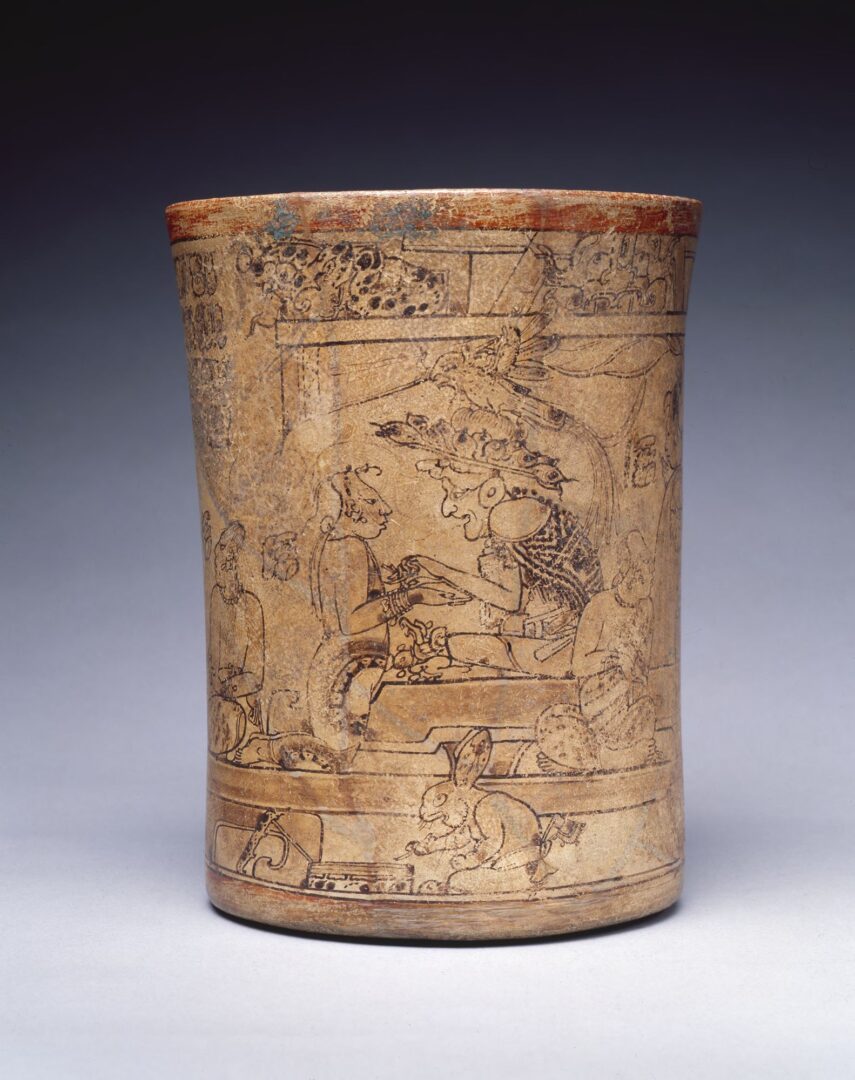
The Princeton Vase, 670–750 AD (Ceramic with red, cream, and black slip, with remnants of painted stucco). Image courtesy of the Princeton University Art Museum.
Much of the early evidence we have of how chocolate was consumed before the Spanish invasion comes from Mayan pottery. Perhaps the most famous example is the “Princeton Vase” (see above), demonstrating how Mayans frothed, shared and venerated their cocoa. Even earlier pottery from Ecuador and Honduras provides some of the evidence that it was the pulp of the cocoa that was first consumed, fermented into an alcoholic beer. It may well have been making this “chicha” beer by fermenting cocoa’s pulp that led the ChinChipe to discover that the bitter astringent cocoa seeds could be fermented into tasty, nutritious and filling cocoa beans that also could be turned into a drink (for more see here).
Post-Columbus – and chocolate in europe
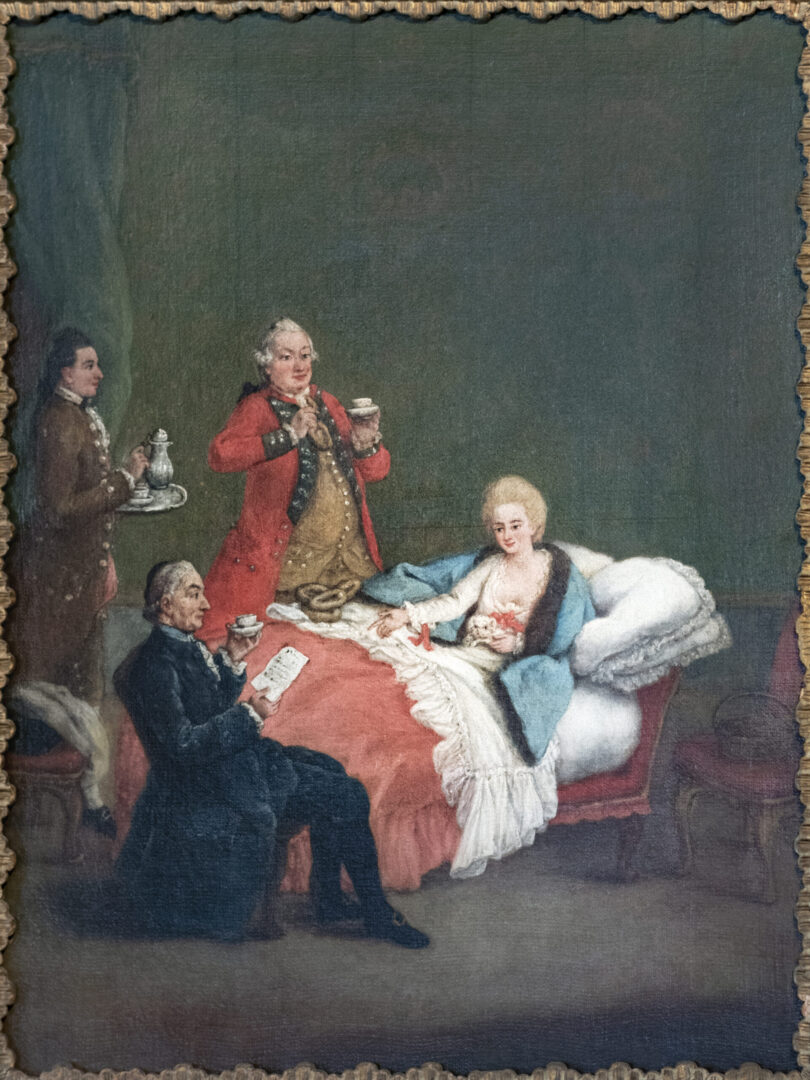
Pietro Longhi “La cioccolata del mattino” (The Morning Chocolate, c. 1775–1780) Ca’ Rezzonico – Museum of 18th-Century Venice
See also: Luis Egidio Meléndez Still Life with a Chocolate Service (1770), Museo del Prado in Madrid
The first record we have of chocolate being prepared, and consumed, in Europe dates back to 1544 when Bartolomeo De Las Casas brought over tribal leaders from the Kechi, who came bearing gifts of a rare, ceremonial feather headdress or quetzal plumes, spices and some drinking chocolate. Apparently the feathers went down a storm .. but judging by the lack of mention, the chocolate wasn’t a massive success.
Nonetheless over the next 50 years, chocolate drinking gradually caught on in Europe. One notable context was its consumption on Fridays and saints’ days in Catholic churches, when many believed that drinking chocolate did not break the fast. (For more on the theological debates this sparked – including papal bulls permitting chocolate on fast days and its parallels with the tradition of eating fish on Fridays – see here.)
Unfortunately, we have little artistic evidence of this custom. Perhaps that’s because drinking chocolate in church was so controversial, or simply because very few paintings were set in church interiors – especially ones depicting such everyday or contentious practices.
By the late 1600s and 1700s, chocolate appeared in more and more paintings – with both still lives of kit used to make chocolate and paintings showing people drinking chocolate. French and Spanish artists such as Pietro Longhi, Jean-Baptiste-Siméon Chardin, Antonio de Pereda or Luis Egidio Meléndez captured chocolate’s evolution, from a church-time ritual to something enjoyed in bedrooms, dance halls, and dedicated drinking houses. These paintings, along with surviving porcelain cups and saucers, also illustrate how drinking chocolate helped pioneer the classic cup-and-saucer format. (For more, see here.)
Chocolate posters as art
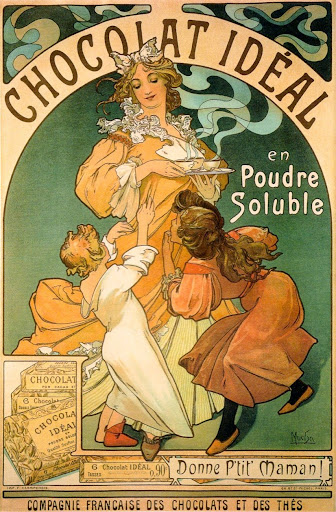
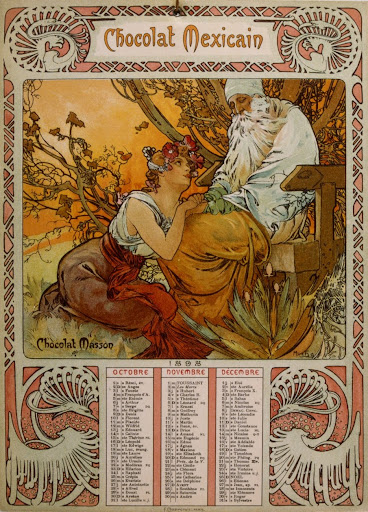
Alphonse Mucha, Chocolat Idéal (1897), lithographic poster.
During the second half of the 19th century, chocolate as a drink continued to enjoy success, but consumption shifted more towards eating solid chocolate (especially bars – thanks to Frys). The innovation of the (hydraulic) cocoa press made it far easier to process cocoa powder and in parallel chocolate bars were one of the first examples of “mass factory production”. To introduce and promote these mass produced chocolate drinks and snacks, makers turned to a new art form – that of the printed poster. One of the great artists of Art Nouveau, the Czech Alphone Mucha, developed his well known style promoting a variety of champagnes, wines and alcoholic drinks – and also chocolate. See attached for his famous calendar for Chocolat Masson (sold under the brand Chocolat Mexican) – and also some of his works for Chocolat Ideal, Nestlé chocolate, and also his posters and packaging for the Chocolate Amattler. Not quite TikTok .. but they’ve survived the test of time.
Modern Art
More recently modern artists, arguably starting with Picasso and Matisse, used chocolate to “tell” new stories, and launch new styles. For example, art historians suggest that the wedding gift of a silver chocolate pot to Matisse was a critical prop and feature in the development of his Fauvism style. Similarly for Picasso, chocolate pots appear in many of his early cubist works (e.g., his Still Life with Chocolate Pot, 1909–1910, with its disassembled and geometric reinterpretation).
More recently chocolate has moved from being the “subject” to being a “medium” used in art works. Artists from Dieter Roth to Ed Ruscha have incorporated chocolate into their works in the forms of chocolate sculptures, chocolate paints and even chocolate sauces to blur what we think of as “art” with what we smell, see and experience as chocolate.
Copyright laws means we can’t show these directly here – but if you want to see them, here are some links:
- Picasso The Chocolate Pot … Date: Paris, early 1909 https://www.metmuseum.org/art/collection/search/4906l
- Henri Matisse, Still Life with a Chocolate Pot (ca. 1900–02) https://www.artsy.net/article/artsy-editorial-story-one-matisses-most-painted-objects
- Dieter Roth, Chocolate Gnome (1968–70). https://www.slam.org/collection/objects/42330/
- Ed Ruscha Chocolate Room for the 1970 Venice Biennale—https://www.moma.org/audio/playlist/334/4458
- Hannah Wilke’s Venus Pareve (1982) https://worleygig.com/2018/08/06/modern-art-monday-presents-hannah-wilke-venus-pareve/
- Janine Antoni, Gnaw (1992). –http://www.janineantoni.net/gnaw
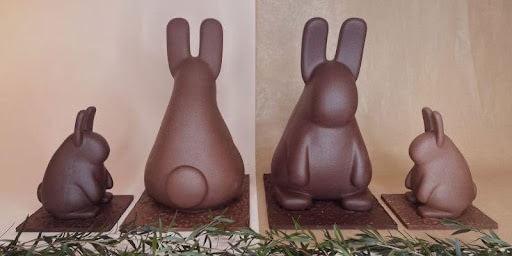
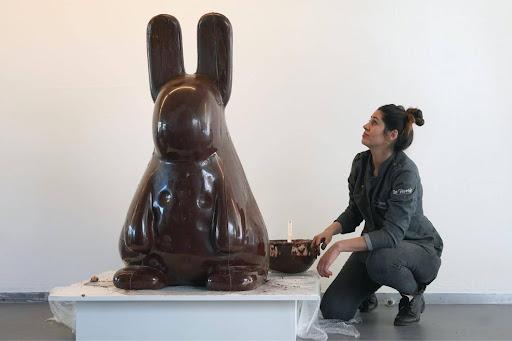
One Chocolate artwork that we can show you is one commissioned by Hasna and Vincent Ferriera by Tom Claassen – a huge Chocolate Easter Bunny that we hope next year to have some smaller versions available to sell!
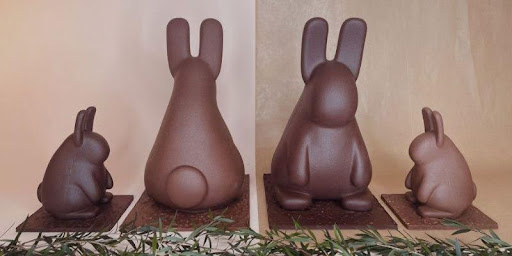
Over the millenia, chocolate has evolved from an object of reverence and ritual – captured in Mayan pottery and Baroque still lifes – to a medium in its own right, used by modern and contemporary artists to question, provoke, and delight. Today, that creative spirit lives on in the world of craft chocolate. Makers don’t just source and craft like an artist – they collaborate with designers, illustrators, and artists to turn each bar’s packaging into a miniature canvas. From tesselated animals to packaging designed by award winning artists like David Shrigley, a craft chocolate bar invites us to savour not just the flavours, but the stories and aesthetics behind them. Craft chocolate, in every sense, remains a feast for the senses. Savour on!