Craft Chocolate vs. AI: The Health Test it Can’t Pass
From step counters to glucose monitors, we’ve tracked our health with gadgets. Next up? AI-powered food selfies. Here’s why chocolate lovers are already ahead.
Print / PDF“It’s tough to make predictions, especially about the future.” attributed variously to Niels Bohr (physicist) or Yogi Berra (baseball legend).
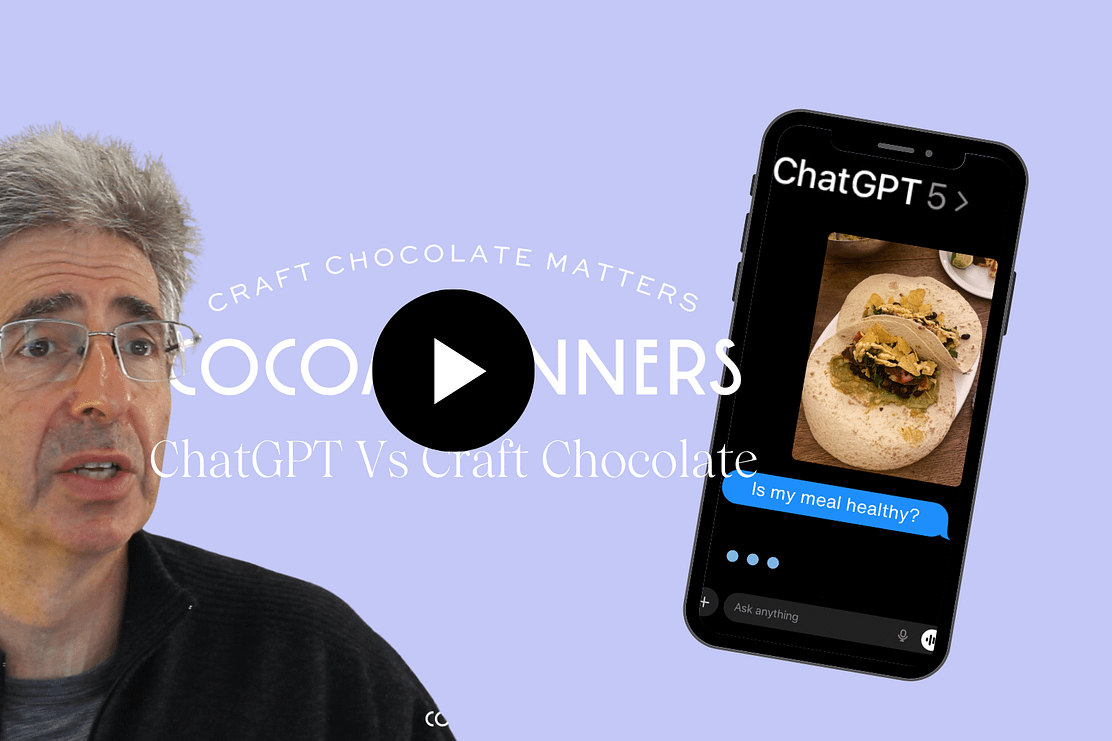
Despite this sage advice, I’m still going to make a prediction. Within a year (and probably faster), even more people will be taking photos of their food (and drinks). And this time it won’t be just for instagram. It’ll be to assess the “healthiness” of the foods you are about to eat via the magic of AI and a camera phone. And indeed various apps already exist – e.g. Calorie Mama, SnapCalorie, Foodvisor, and Levels (by Dr Casey Means, nonetheless than the US’ next Surgeon General).
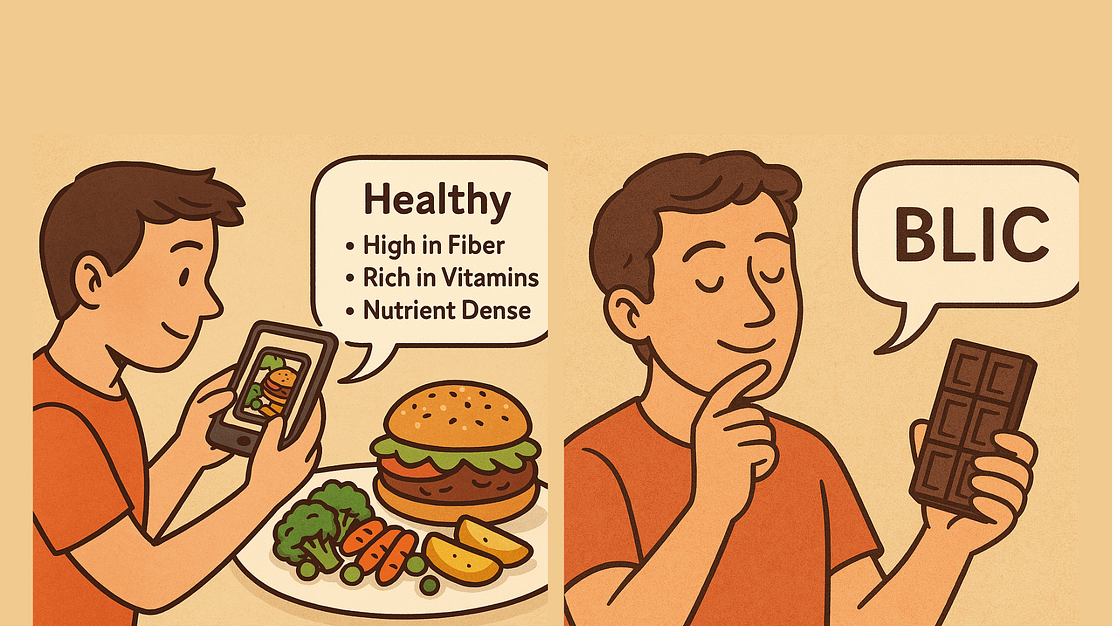
This is going to be potentially BEAUTIFUL for Craft Chocolate. Camera phones, even with AI, can’t tell you if a bar is full of flavour, “BLIC” (Balance, Length, Intensity and Complexity), and are “healthier” for you. To do this, you need to learn to savour – and once you can do this with craft chocolate, it can also help you assess the flavour, and healthiness, of everything from berries to olive oils, tea to coffee, broccoli to tomatoes, etc.
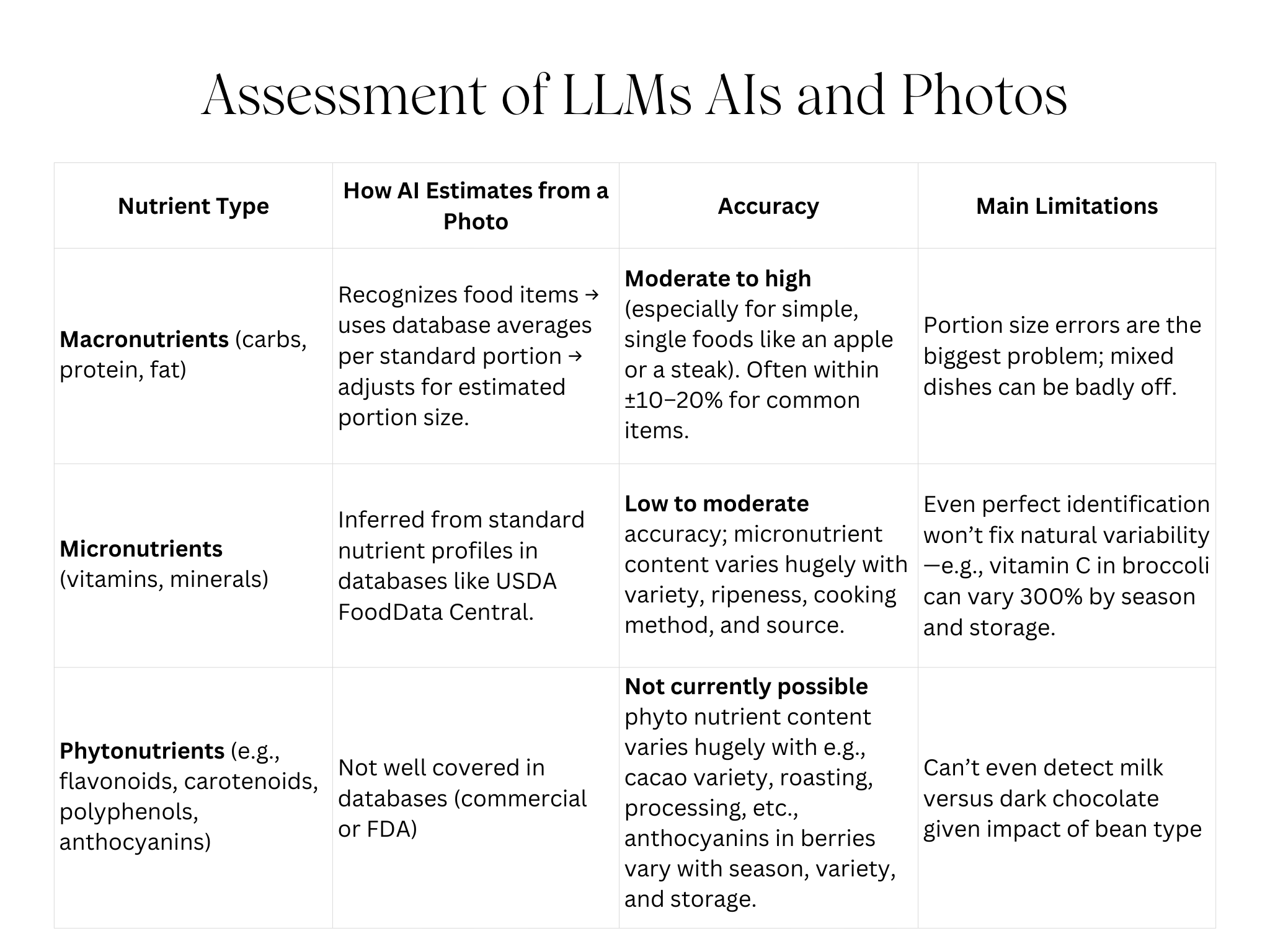
Here’s why: AI, with a camera, can help assess the “macro” nutrients in your food (ie carbs, fats, proteins). And it can help assess micro nutrients (vitamins, minerals, etc.) especially f you can take a picture of the label and ingredients. But it’s going to really struggle with the phytonutrients (polyphenols, resveratrol, anthocyanins, etc.) that are so key for your gut and general wellbeing.
So just as you are ahead of the curve in your appreciation of Craft Chocolate, here is a suggestion on how to get ahead of the pack: Explain to your friends, families and partners that savouring Craft Chocolate beats their camera phone and AI when it comes to assessing the healthiness of their chocolate (and much else).
Tracking devices… what you can monitor and measure, you can take action on
The fitness world is awash with tracking watches and devices that help you count your steps, sleep and speed. Used wisely, these can really help you become fitter.
Similarly CGMs (Continuous Glucose Monitors) have revolutionised the lives of diabetics, and helped many others identify what foods cause their blood sugar to “spike” (in my case, I found that coffee and grapes go through the roof – and that eggs are far better as a breakfast for me than porridge).
Instagram, TikTok, etc. has changed the way people eat out – with every other person in a restaurant posting their images. Be prepared for another wave of photography coming soon. AI and LLMs have opened up the possibility for anyone to take a picture of their food and get feedback on the “macronutrients”, and some of the micro nutrients in that food (note: this is very different from bar code scanning).
But just as you can “fool” a continuous glucose monitor with junk foods, photos can only tell you so much about a food. Macronutrients are relatively predictable (see sources for various studies). Micronutrients are far harder (the databases aren’t as developed). And phytonutrients are even further off – and indeed images (even using non visible spectrum) aren’t going to help. But your sense of flavour – see above with polyphenols in chocolate – can help.
What do you mean by macro, micro and phytonutrients
At this point, you may be reaching for your dictionaries (or ChatGPT) to figure out what’s the difference between these different terms
Here are some parallels
The car analogy:
- Macros – ie carbs, fats, proteins are like the petrol (or diesel) that “fuel” the energy
- Micros – ie vitamins, minerals, etc. are like the oil and water in a car. Run out of them, and it all seizes up
- Phytonutrients – ie polyphenols, anthocyanins, etc are the tuning and protective additives in the fuel, oil, ball bearing joints, etc. that optimise performance and so there is less “wear and tear”
Or if that doesn’t work, here is the computer analogy:
- Macros = electricity (power supply) → raw energy to run the computer
- Micros = motherboard, chips, software drivers → small but absolutely essential for the compute to work
- Phytos = software, antivirus, etc → help you do what you need to get done; protect against damage, reduce wear, and improve performance
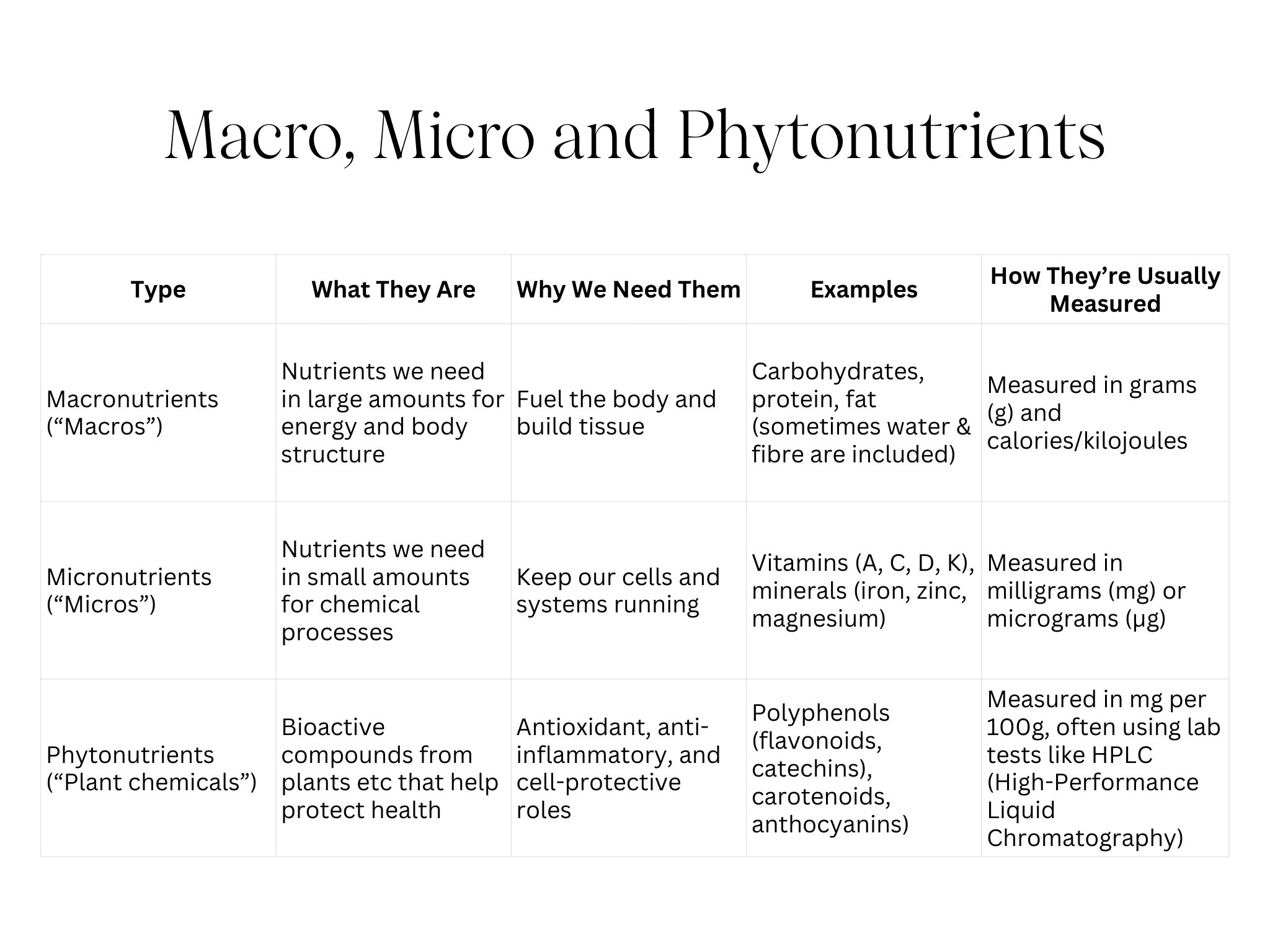
Or if you want a more technical overview, please see below:
And if you want to know more about how these relate to calories please see here. Note: one important observation is that different people respond very differently to different sorts of “macro-nutrients”. Or to put it in car terms, some cars are designed for diesel, other’s for petrol .. and we can be similar in how we respond to the same absolute calories but from different sources (ie protein or carbs or fats). So “merely” taking photos isn’t really enough – you need to have this personalised, according to your microbiome (and that’s a key part of the basis to the likes of projects / companies like Zoe).
That in turn brings us onto the role of phytonutrients in protecting and tuning your microbiome – and another reason as to why (dark) craft chocolate in moderation can be so good for you.
What’s a phytonutrient?
Phytonutrients are the protective compounds that plants create for survival — natural defences against pests, sunlight, and disease. For us, they are flavour and health intertwined: the bitterness of kale, the peppery tickle of olive oil, the long lasting evolution and flavour complexities of dark craft chocolate. They don’t provide bulk energy like macronutrients or essential building blocks like vitamins and minerals. However they are critical for a healthy gut, they shield our bodies from oxidative stress and inflammation. And they make our food that much more delicious.
The science of polyphenols, the largest and best-studied group of phytonutrients, has roots in the 19th century. French chemist Michel Eugène Chevreul and his contemporaries first isolated tannins from oak galls, tea, and wine, coining the word “polyphenol” to describe their shared chemical structure of multiple phenol rings. At first these compounds were prized mainly for tanning leather and dyeing fabrics, but gradually their role in flavour and astringency became clear. By the late 19th century, researchers like Emil Fischer had mapped the structures of flavonoids, paving the way for modern nutrition science. In the 1930s, Nobel laureate Albert Szent-Györgyi, discoverer of vitamin C, proposed that certain citrus and paprika extracts represented a new nutrient he called “Vitamin P” (for “permeability”), because they strengthened fragile blood vessels. However Vitamin P as a term was later dropped as its absence doesn’t cause a specific “deficiency disease” (unlike e.g. Vitamin C – scurvy, Vitamin D – rickets, Vitamin B3 (Niacin) – Pellagra, etc.)
Nonetheless physicians and nutritionists are increasingly convinced that these phytonutrients are key for health, resilience and protection. Unfortunately unlike Macro and Micro nutrients there is far less testing, and far less information, about the phytonutrients in our foods and drinks. Unlike sugar, salt, fat, and protein, they aren’t listed on the label. And the “look” of a food can only tell you so much. So whereas we know that just in straight mathematical terms a 40% milk chocolate will have less polyphenols than a 70% dark chocolate, you can’t tell this by “just” taking a picture. Often, milk and dark bars look remarkably similar. Sometimes their colour tells you more about which beans the maker has used than whether they’ve added milk or not – for example, Brazilian Catango beans or Colombian B9 beans are white, and when made into a dark bar look lighter than many milk bars.
And this is before all the other key factors impacting polyphenols in chocolate are taken into account. For a deep dive into this, we’ve written a long blog post (see here) that looks at the differences between commodity / mass produced chocolate and craft chocolate. Knowing that heat is key, we researched Big Chocolate’s patents to understand more about how they pre-roast and roast their beans. This, combined with the way that (many) commodity beans can be overfermented, overdried, etc. raises doubts about what polyphenols are left after they’ve been overheated on the farm and in the factory (and yes, this is why you can get burnt and overroasted notes, without much flavour length or complexity.
If you are “just” taking a picture, given that this information isn’t on the packaging or in any databases (yet?), you need another approach. Fortunately, there is an elegant twist and solution: savouring and searching for flavour. For a bean, and therefore a bar, to have complexity, intensity and length of flavour, it first needs to have been grown in healthy soil with minimal pesticides, without excessive fertilisers and then carefully fermented and dried (and not overheated in this process). And then it needs to be crafted carefully – if it is heated above 150 °C (or alkalised) almost all the polyphenols can be reduced by 60-70% – see here.
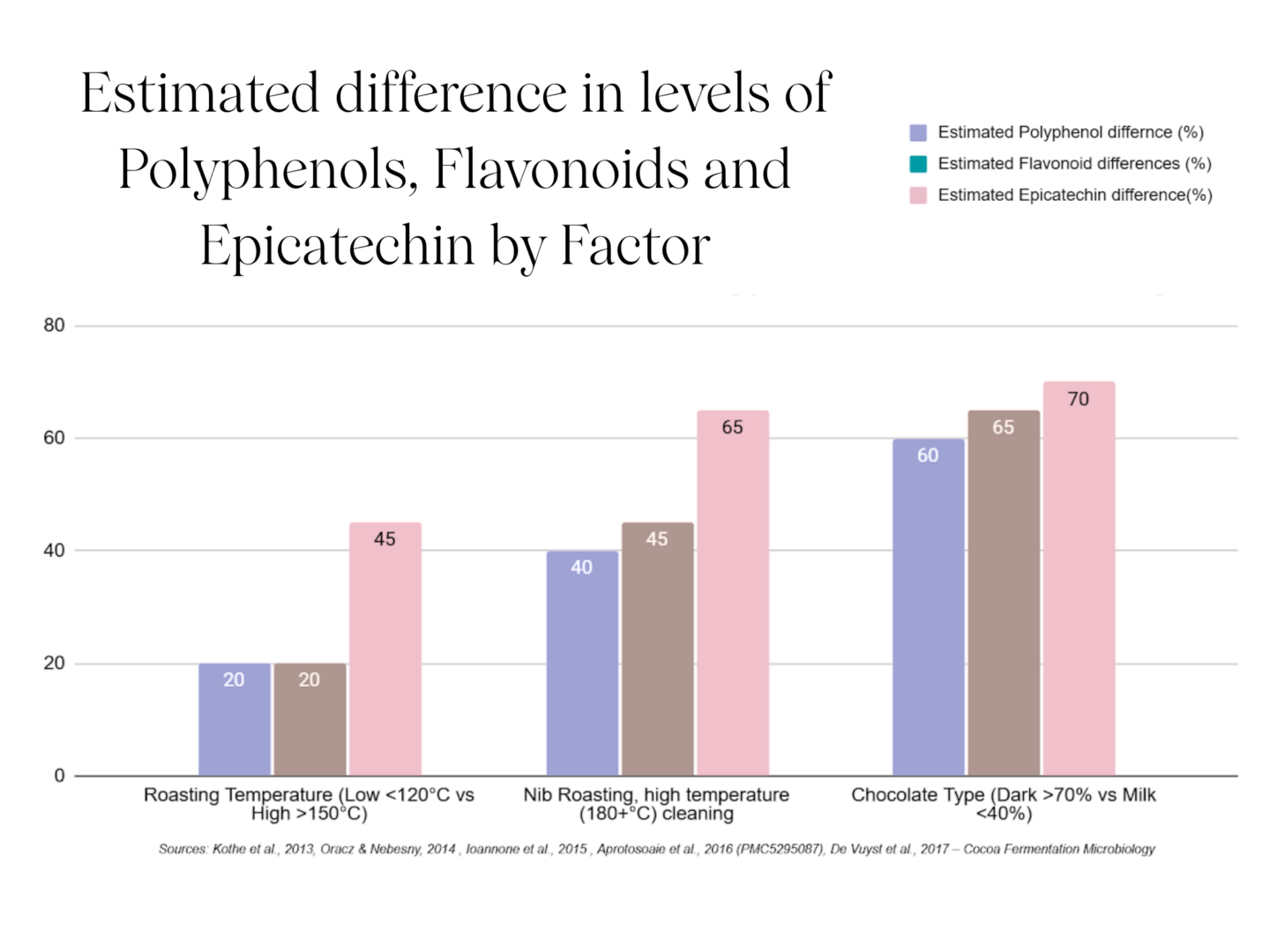
Note: this isn’t just for chocolate. The peppery burn in Tuscan olive oil is oleocanthal, another phytonutrient. A strawberry from your allotment will have far more length of flavour than a budget supermarket one – and that’s a sign of not just its variety, but how it’s been grown, stored etc. and its phytonutrients. By savouring slowly, attending to balance, length, intensity, and complexity, you are not just enjoying flavour — you are literally sensing the plant’s protective chemistry, and taking some of that protection into yourself. And even a camera phone linked to AI can’t help here.
If you want to dive a bit deeper, here is a summary table
It’s good practice when filling up your car with petrol, to also check on the oil, tyres, etc. Similarly, as you boot up your computer, most of us have an anti-virus and firewall.
Taking pictures, along with learning to savour, could well become the equivalent for our diets.
Next week we’ll be outlining some thoughts on how Craft Chocolate can help you learn about flavour – and how it can be a route to “savouring” rather than “scoffing”, and a key part of the anti ultraprocessed food movement that doesn’t “throw the baby out with the bathwater”.
As ever thanks for your support.
PS The sources / research here was fairly extensive (see below), but two books that I STRONGLY recommend if this topic interests you are:
David Montgomery and Anne Biklé – “What your Food Ate”
Fred Provenza – “Nourishment”
Sources/ Further Reading
On AI food photo & nutrition apps
Meyers A, et al. (2019). “Image-based dietary assessment: Review of the state of the science and future directions.” Journal of Nutrition.
SnapCalorie whitepaper: https://snapcalorie.com
Foodvisor overview: https://foodvisor.io
On CGMs & personalised nutrition
Zeevi D, et al. (2015). “Personalized nutrition by prediction of glycemic responses.” Cell.
Casey Means & Levels blog: https://www.levelshealth.com/blog
On macros, micros, and phytonutrients
US NIH, Office of Dietary Supplements: https://ods.od.nih.gov
Slavin JL. (2012). “Dietary fiber and body weight.” Nutrition.
Liu RH. (2004). “Potential synergy of phytochemicals in cancer prevention.” J Nutrition.
On chocolate polyphenols
Oracz J, Nebesny E. (2019). “The content of polyphenols in cocoa beans and cocoa products depending on variety, origin, fermentation, and roasting.” Critical Reviews in Food Science & Nutrition.
Ioannone F, et al. (2015). “Polyphenol content of different cocoa and chocolate products.” Food Chemistry.
On olive oil & oleocanthal
Beauchamp GK, et al. (2005). “Phytochemistry: Ibuprofen-like activity in extra-virgin olive oil.” Nature.
On phytonutrients generally
Neveu V, et al. (2010). “Phenol-Explorer: an online comprehensive database on polyphenol content in foods.” Database (Oxford).
Montgomery, D.R. & Biklé, A. (2022). What Your Food Ate.
Provenza, F. (2018). Nourishment.