Fibre in Chocolate
Given that some high percentage dark chocolates, per 100g, have more fibre than the likes of lentils, oats or chickpeas (see below), it’s unsurprising that more and more health claims are being made about chocolate. You’d almost believe all you need to do is have a dark craft chocolate bar with the magical numbers of 70% (or even better 80%+) to get your daily recommended dose of fibre.
With the caveat that I’m definitely not a nutritionist, what follows is my attempt to understand these claims. I’ve tried to unpack what’s getting everyone moving on fibre and then assess how chocolate, and theobroma cacao more broadly, fits into this and then give some cautionary optimism along with a few more “out there” predictions and ruminations on new potential cocoa teas, flour, and more.
My layman’s understanding of fibre
To start with a terrible pun, fibre has literally “moved” our understanding of gut health. Go back a couple of decades and fibre was something that helped get our bowels “moving” – via, for example, having bran for breakfast. Today, more and more large population studies consistently show that higher fibre intake is associated with the likes of:
- Lower rates of heart disease
- Lower rates of type 2 diabetes
- Lower body weight over time
- Lower overall mortality
(see sources for some of these studies).
These are associations rather than simple cause-and-effect proofs, but the consistency across different populations – and the plausible biological mechanisms – make the case compelling. Doctors, food scientists and nutritionists suggest that there are three main mechanisms at work:
- Fibre Slows Down Digestion: When fibre is present in food – especially in intact plant structures – it slows stomach emptying, slows carbohydrate absorption and reduces sharp blood sugar spikes (thereby improving insulin regulation). In particular, viscous soluble fibres can form gel-like structures in the gut that blunt post-meal glucose rises, while intact cell walls physically “trap” starch, making it harder for digestive enzymes to access.
- Fibre Improves Satiety: At the same time, fibre makes you feel full faster and for longer. High-fibre diets “increase volume without adding many calories”. Fermentation products from fibre may also influence satiety hormones, reinforcing that feeling of fullness. Regularly, “health” companies come up with new plays on this – for example, about a decade ago there was a famous Japanese preparation from the konjac root (rich in glucomannan fibre) that proudly advertised zero calories along with feeling full. It was all the rage… before people wised up and realised that there are better – and safer – ways to eat healthily than chasing single-ingredient hacks.
- Fibre Feeds Your Gut Microbes: Over the last few decades, the importance of the gut and gut microbiome has come to the fore. We have trillions of bacteria living in the large intestine. Most of these bacteria are helpful – for example, helping digest compounds that we otherwise can’t break down, modulating our immune system, and influencing inflammation. These bacteria “eat” (more accurately, ferment) certain types of fibre, producing small molecules called short-chain fatty acids. These molecules are used for energy and signalling. They help maintain the gut lining, support metabolic balance and regulate inflammation. If our fibre intake is too low, microbial diversity tends to drop, and diets low in fibre are associated with higher rates of metabolic disease.
To try to summarise: fibre has moved on from being about “bowel regularity” to being celebrated for its key role in our “metabolic infrastructure”. Fibre has moved from simply keeping things moving, and is now more about sustaining the complex biological systems that keep the whole organism functioning properly.
Let’s look at the stats
As we’ve moved to eating more and more ultra-processed foods (and drinks), fewer and fewer of us are consuming anything close to the recommended daily allowance of fibre. In the UK, adults are advised to eat about 30g of dietary fibre a day, but average intake is only around 18-19g – roughly two-thirds of what’s recommended. Only a small minority of adults actually meet the 30g target.
Across the Atlantic, US recommendations generally sit at 25–38g a day for adults, depending on age and sex, yet most Americans average closer to 15–16g per day. In other words, the majority of adults in both countries are running a chronic fibre deficit.
But here’s the part that matters even more: fibre isn’t one single thing.
Broadly speaking, there are different “sorts” of fibre, and they behave very differently in the body.
Insoluble fibre – found in whole grains, wheat bran and many vegetable skins – doesn’t dissolve in water. It adds bulk to stool and speeds up transit through the gut. This is the traditional “keeps you regular” fibre.
Soluble fibre – found in oats, pulses, fruit and some vegetables – dissolves in water and can form viscous, gel-like structures. This is the fibre that slows gastric emptying, blunts blood sugar spikes and can help lower LDL cholesterol.
Then there’s fermentable fibre – overlapping with soluble fibre but not identical to it – which gut bacteria can metabolise into short-chain fatty acids. These are the fibres that most directly feed the microbiome and influence inflammation, gut barrier integrity and metabolic signalling.
And finally, there’s the concept of intact plant structure. Fibre embedded within real food matrices – whole beans, intact grains, minimally processed vegetables – behaves differently from isolated or powdered fibre added back into a processed product. When you mill, extrude, refine and reconstruct foods, you often destroy the physical architecture that slows digestion and modulates absorption.
This is why simply adding “fibre” to a cereal bar or drink doesn’t fully recreate what’s lost in ultra-processed diets. It’s not just about the gram count. It’s about diversity – different fibres feeding different microbial populations – and about structure. A diet dominated by refined starches and emulsified fats may technically contain some added fibre, but it rarely delivers the spectrum or the structural complexity that human physiology evolved to expect.
So, bottom line: most of us aren’t getting “enough”. But the deeper issue is that we’re not getting enough variety, enough fermentable material, and enough intact plant structure.
A simple review of fibre per 100g in different foods explains why it’s so tempting for marketing folks to argue that you can (and perhaps should?) eat dark chocolate for fibre.
Per 100 grams:
Lentils (cooked): ~7–8g fibre
Chickpeas (cooked): ~7–8g
Oats (dry): ~10–11g
Almonds: ~12–13g
Wholemeal bread: ~6–9g
Dark chocolate (70–85%): ~10–12g
Milk chocolate: ~2–3g
White chocolate: 0g
Natural cocoa powder (unsweetened / non-alkalised): ~30–37g
Bottom line: on a simple weight basis, high-percentage dark chocolate is comparable to oats or wholemeal bread. And non-Dutched cocoa powder is genuinely extremely fibre-dense.
It’s also worth noting that the fibre in cocoa is not nutritionally inert. Cocoa contains largely insoluble structural fibres (cellulose, hemicellulose, lignin), along with some soluble and partially fermentable components. A proportion of cocoa fibre can be fermented by gut bacteria into short-chain fatty acids, meaning it may contribute to microbiome activity rather than simply acting as “roughage”. So yes – cocoa fibre is biologically active.
To be a spoilsport
Sadly, the devil is in the detail. Even though calories have all sorts of conceptual problems, you can’t just look at fibre per 100g; you need to think about fibre per calorie.
Calories per 100g:
100g cooked lentils: ~110–120 kcal
100g dark chocolate: ~550–600 kcal
To get ~8 g fibre:
100g lentils (~115 kcal) — a modest serving
~70–80 g dark chocolate (~400–450 kcal) — most of a bar
To hit the 25g per day fibre guideline:
~300–350 g lentils (~330–400 kcal); the basis to a hearty salad
~220–250g dark chocolate (~1,300–1,500 kcal) – that’s pushing half a carton of bars!
There’s another subtle issue: structure. Fibre in lentils or chickpeas is embedded within largely intact plant cells. In industrial chocolate, the cocoa mass – roasted beans ground, refined and/or hydraulically pressed to miniscule particle sizes – has had much of that original cellular structure broken apart. That disruption affects digestion dynamics, the technical term being “bioaccessibility”: how much of a nutrient is actually released from the food matrix and made available for absorption. The clearest comparison is almonds. When you eat whole almonds, some fat remains trapped inside intact cell walls and passes through unabsorbed; grind them into almond flour or butter and more of that fat becomes accessible. Same plant, different metabolic outcome. So while the fibre gram number in dark chocolate may look comparable to oats on paper, the physiological context is not. Look beyond the label.
And on top of this, many supermarket chocolate bars – even those labelled “dark” – contain not just the substantial cocoa butter naturally present in the bean (a cocoa bean is over 50% cocoa butter), but often added cocoa butter for flow and smoothness, plus significant sugar designed to hit the “bliss point.” Milk versions add milk fat; emulsifiers are routinely used to optimise texture and rapid melt. The result is a finely milled, highly palatable product engineered to be eaten quickly. In that context, any natural satiety effect of fibre can be all too easily overridden.
Craft chocolate is different – especially high-percentage dark bars designed to be savoured rather than scoffed. You are far less likely to feel compelled to wolf them down. They are not made with alkalised or hydraulically pressed cocoa mass, and they are not bulked out with vegetable fats or palm oils. The structure, the ingredients and the intent all shift. And that changes the experience as much as the numbers on the label.
… but it’s not all bad news! back to polyphenols and magnesium
As we’ve repeatedly stressed, craft chocolate is unusually rich in phytonutrients known as polyphenols – particularly flavanols such as epicatechin and catechin, along with larger compounds called procyanidins. Many of the smaller flavanols can be absorbed in the small intestine (after metabolism in the liver). But many are not. A substantial proportion are either bound to fibre, retained within the plant matrix, or present as larger procyanidins that are simply too large to absorb directly.
To get a bit more graphic: when you eat dark craft chocolate, some of its polyphenols – especially these larger, fibre-associated compounds – travel down into the colon. There, microbes break them down into smaller metabolites (including phenolic acids and related compounds) which can then be absorbed. These metabolites, along with absorbed flavanols such as epicatechin, have been associated in human studies with improved vascular function and reductions in certain inflammatory markers.
Craft chocolate is also full of key minerals – including magnesium, iron, copper and zinc. Cocoa solids are among the more concentrated dietary sources of magnesium per gram, though levels vary depending on origin, soil health and processing. How – and where – the cocoa beans are grown, fermented and processed materially affects what ultimately remains in the bar.
The bottom line: Dark Chocolate vs Lentils: Honest Comparison
If you want to boost your daily fibre, may we recommend lentils (or chickpeas, butter beans, etc.)? Don’t rely on – even craft – dark chocolate. You would need to eat far too much.
But craft chocolate does contribute fibre in a distinctive way. A 20–35 g serving of 70–80% dark chocolate typically provides around 2–4 g of fibre, plus a meaningful dose of minerals and polyphenols. That is not trivial – it can account for around a tenth of daily fibre intake in a modest portion – and those compounds work together within the cocoa matrix.
Still, it complements vegetables. It doesn’t replace them.
Some speculation
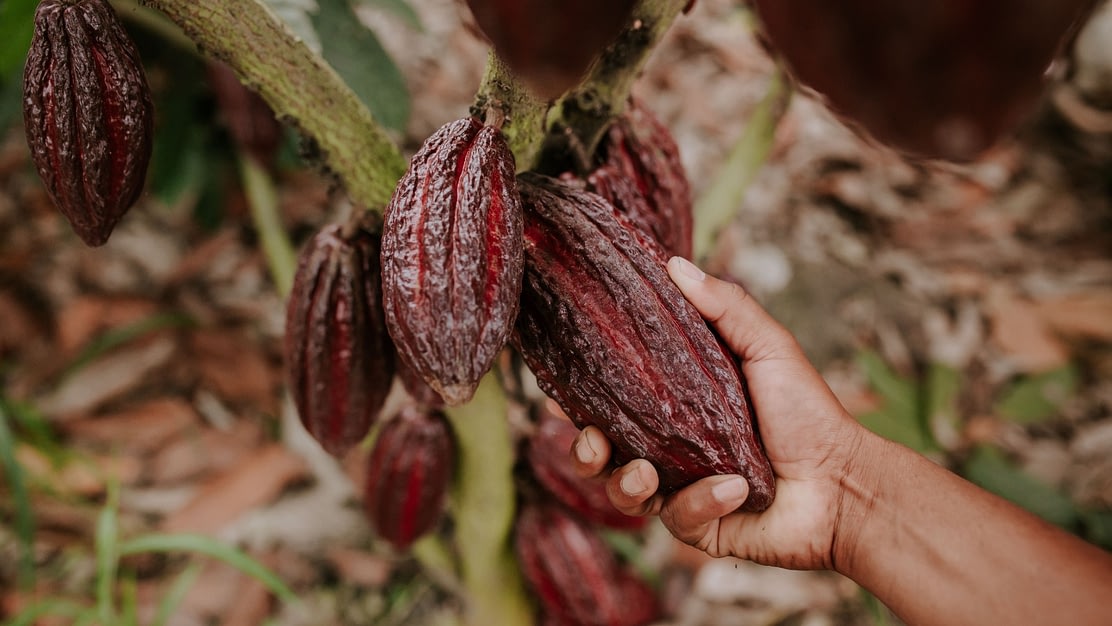
It’s not just the cocoa seed – the bean or nib – that contains fibre. Other parts of Theobroma cacao are fibre-rich too, though in very different proportions and ways.
To dig a bit deeper:
- Winnowed cocoa nibs (cotyledons) contain roughly 10–15g fibre per 100g (dry weight).
- The cocoa bean shell (testa) – removed during winnowing – is extremely fibre-dense, typically 50–60g fibre per 100g, largely insoluble cellulose and lignin.
- The cocoa pod husk – the thick outer wall of the fruit – also contains substantial structural fibre, often 30–40g per 100g (dry weight).
- The fresh cocoa pulp (mucilage) surrounding the beans is mostly water and sugars, with only modest amounts of soluble fibre (such as pectins).
As a reminder, 70–85% dark chocolate contains around 10–11g fibre per 100g – broadly similar to oats on paper. But the shell is in a different league entirely. It is predominantly insoluble structural fibre: cellulose, hemicellulose and lignin.
There are not yet many human nutrition studies on fibre from these non-nib fractions, but compositional analyses suggest clear potential – particularly in the shell.
This could (and I stress could) open up some interesting opportunities.
- Cocoa shell tea. A number of makers are experimenting with infusions made from cleaned cocoa shells. Plaq serves one in France; Duffy previously produced one in the UK. These are not drinking chocolates – they contain virtually no cocoa butter – but rather light, aromatic infusions with toasted and fruity notes, closer to a fruit or herbal tea. Shell hygiene is critical. The testa is the most exposed part of the bean during drying and transport, and contamination risk must be managed carefully.
- Cocoa shell flour. Properly cleaned and milled shells can be blended with conventional flours for baking. They are intensely fibrous and cocoa-aromatic. My daughter has baked some of the best brownies and chocolate cakes I’ve ever had using carefully cleaned shells she ground down and mixed with other flours – proof that this is not just theoretical. Again, sourcing and testing matter, particularly given documented risks of environmental contamination during open-air drying in some producing regions.
- Cocoa pulp applications. Cocoa pulp is increasingly being used in juices, sorbets and ferments – more for its bright acidity and sugars than its fibre. Plaq has incorporated cocoa fruit into frozen formats; NearyNógs has explored cocoa fruit products; and Knoops has featured cocoa fruit sorbet-style offerings. The fibre contribution from pulp is modest, but it represents a broader shift toward using more of the fruit rather than discarding it.
In short, the cocoa bean is only part of the story. Watch this space as fibre keeps moving.
And in the meantime, don’t forget to add some cocoa nibs to your porridge, smoothie, salads etc. Just don’t be fooled by the nonsense marketing around “raw” nibs (see here) and here are some great bars made with, and covered in, nibs.