The new Flavour Wave
“You can’t talk about what you can’t name – and you can’t measure what you can’t describe”
– Ann Noble, Author of the first flavour wheel (for wine)
“The elephant was in the dark; some men touched it to learn what it was.
One took the trunk and said, ‘It is a water pipe.’
Another touched the ear and said, ‘It is a fan.’
Another, the leg: ‘It is a pillar.’
Had each held a candle, their difference would have gone.”
– Jalal al-Din Rumi, Masnavi, Book III (13th century) in the “Elephant in the Dark” parable
Flavour wheels and waves are trying to solve this problem of perspective and language. We first developed our Flavour Wave back in 2020, and we’ve used it for hundreds of tastings with thousands of people ever since. After five years with our original Wave, we have updated it with what we hope are a bunch of improvements.
Read on to find out what a flavour wave is, why it’s so important, and what we’ve changed as we’ve learnt more about the way people discover flavour.
But first, here’s some important information you need to know to understand why we developed the Flavour Wave.
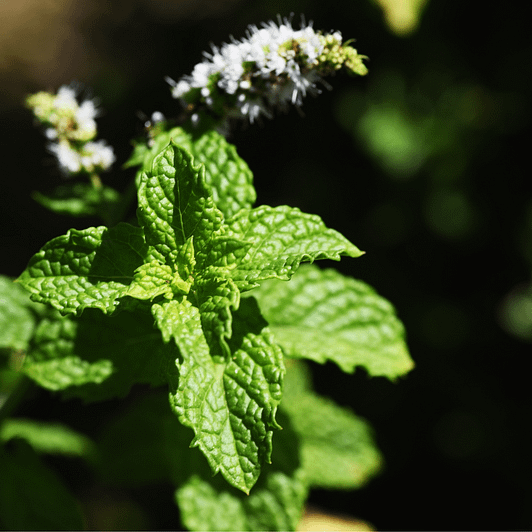
- Flavours (or the aromas you “sense” in your mouth) are very different to your sense of taste. And if you don’t want to have your instinctual love of sweet, salty and fatty tastes (ab)used by Big Food, savouring is a key way to eat healthier. If you want to understand the difference between flavour and taste, try the mint (or jelly bean) test. Smell the mint, then pinch your nose so no air can get it and then start to chew the mint (or jelly bean). Keep chewing for 5 seconds, then release your nose. You should suddenly find you can detect the mintiness which was unavailable to you with your nose held – you need your nose to “get” mintiness in your mouth.
- Describing flavours is not as instinctive as describing tastes. Describing flavour is like learning a language, or even to learn to swim or read. To paraphrase Ann Noble – once you can name some flavours, you can start to talk about them, and have even more fun. Unlike colours, we don’t have a shared lexicon and language for flavours (and read on if you want to know why traffic lights in Japan don’t go “red, yellow, green” but “red, yellow, blue”)
- Flavours are more like watching a movie rather than looking at a static image. If you “just” see one image in a movie, it’s a bit like just feeling the trunk of an elephant – you can only describe what’s in front of you in that moment. But when you watch a movie, there are different images and stories which reveal themselves.You may well be missing a lot more if you don’t explore the different flavours, ride the wave and explore all the flavour journey.
The history of our Flavour Wheel
…and thanks once again to the “founding team” of James, Barry, Rebecca and Peter
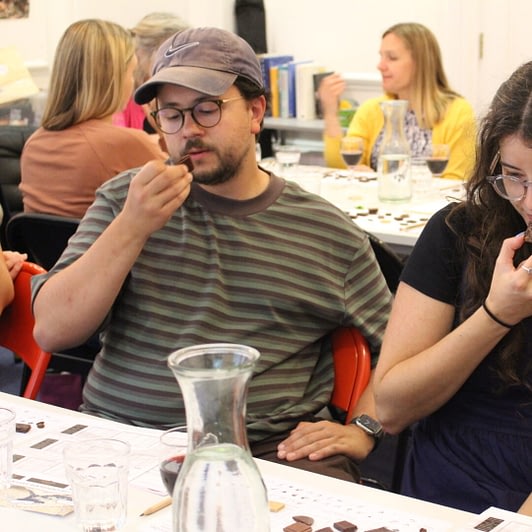
Just before Covid, James Hoffmann, Professor Barry Smith, Rebecca Palmer and I held a tasting and workshop for a big, multinational chocolate company. These marketers and scientists wanted to understand, and see what lessons they could learn, from the fascination with flavours, their complexities and magic, that underpinned specialty coffee, fine wines and craft chocolate – and compare this to their focus on consistency, branding and “cost efficiencies”.
One of the key outcomes was James’ insight that tasting craft chocolate (along with coffee, wine and many of our other favourite drinks and treats) was like going on a river trip down the Amazon. You knew you were on a long trip, but were never quite sure what was going on to emerge round the next corner. Out of this came what we called the “flavour wave” where we likened a craft chocolate, fine wine, speciality coffee, etc. to James’ Amazon adventure. The tasting/ river might start with a smooth surface and texture, but at the next bend you could be facing all sorts of flavour rapids before eventually ending with a completely unexpected aftertaste.
Over time, we found it really helped craft chocolate fans – and people exploring other foods and drinks too – to reflect, and savour the “waves” and flavour journeys they experienced. It helped them describe to one another what they were enjoying (and occasionally, what they weren’t!), and open up all sorts of flavour insights for one another. Most people can readily identify the basic tastes – sweet, salty, bitter, sour, umami, and so on – and describe and discuss this. But many of us struggle to describe the flavours and aromas that are literally on “the tip of their tongues” (or rather noses). As Ann Noble noted, (see the intro) having shared words and phrases can unlock those moments and make discoveries easier to communicate. Hence why Ann Noble developed the wine flavour wheel at UC Davis in California in the 1980s; she wanted to give winemakers, growers, and drinkers a shared language for exploring and appreciating wine. Try describing a painting without mentioning colour or shape (And to return briefly to Japanese traffic lights: they go “red,” “yellow,” and “blue” because, until the early 1900s, there wasn’t a common word that clearly separated green from blue – the term ao 青 covered both, and the newer word midori 緑 only gradually came into everyday use.)
At the same time, thinking of flavour as a wave or journey really helps us appreciate its complexities and admire the magic of what’s really going on. It addresses the above elephant perspective problem. We perceive flavour very differently from most of our other senses. Our olfactory system – the network responsible for smell and flavour – connects directly to the brain’s limbic centres, bypassing the thalamus pathways that process sight and sound. That’s why aromas and flavours can feel so immediate and emotionally charged – and also why they’re often so hard to put into words.
Most of us can consciously identify only two or three aromas at once, whereas with music or colour we can process many variations simultaneously. And as a drink or piece of food interacts with your saliva and oral microbiome, and as it warms and cools in the mouth, different aromatic compounds are released — unfolding new layers of flavour as they rise retronasally to your nose.
Flavour, in other words, is a journey: it evolves, develops, and lingers — unlike taste, which is far more immediate and instinctive, often liked or disliked in an instant.
What’s new?
Now that we’ve been using the flavour wave 1.0 for almost five years, following feedback from thousands of tastings, we’ve realised that there are few easy improvements. In particular at our Masterclass tastings, held with Peter McCombie MW, and in the tastings we’ve hosted at our Craft Chocolate Fair with Barry, Rebecca and James, we’ve explored this new wave. I’ve tried to list the changes below. And we’d love to hear your feedback, and if you have further refinements and suggestions (for example, would you like it as an app?). And please do try it out with some craft chocolate!
Step 1 – Taste and Texture
We’ve tried to help you focus on specific tastes by listing them — and then inviting you to identify and rate them, a bit like a spider diagram. You might find a chocolate that’s a touch sweet, gently bitter, richly fatty, with a hint of umami and even a flicker of sourness.
Our tongues – and indeed our whole mouths – are astonishingly tactile. We can detect textural differences as fine as 15–20 microns (for comparison, a human hair is roughly 70–100 microns thick). Part of the delight of chocolate lies in how roasted cocoa nibs are ground and suspended in their own cocoa butter to create that silky texture that titillates the tongue. Some makers deliberately leave it a little rougher for character and contrast. So in Step 1, we’ve added a few questions to help you notice this – and to savour it.
There’s another benefit to spending just three to five seconds identifying and articulating these tastes and textures: by the time you’ve done so, the chocolate will already be melting, releasing its first wave of aromas and flavour compounds – and your journey of discovery has begun.
Step 2 – Flavours
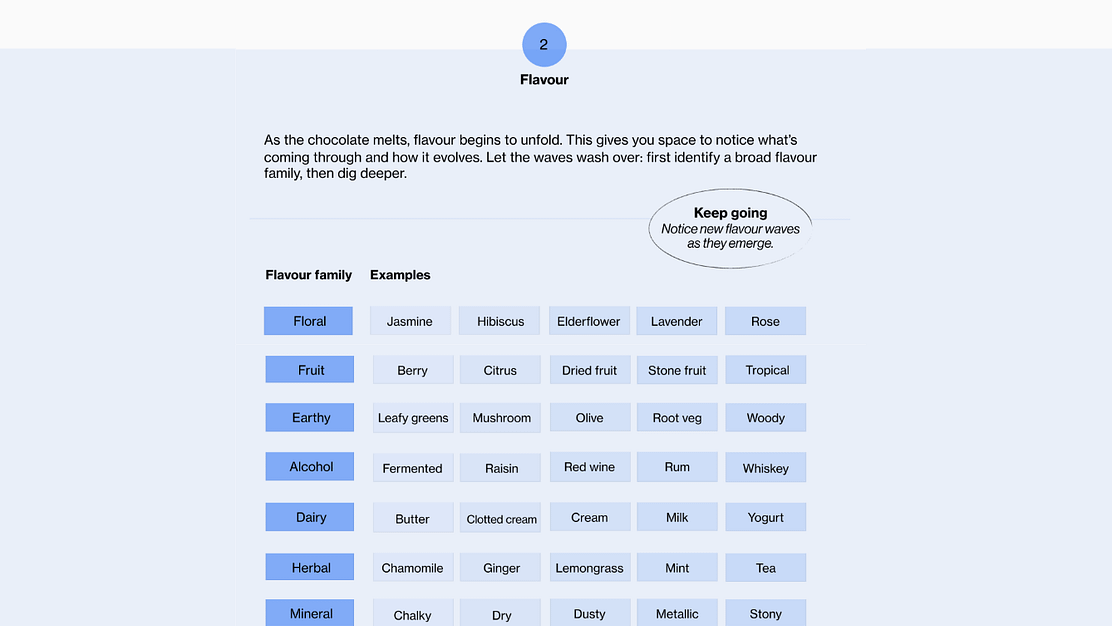
This is where we’ve made one of the biggest changes. Previously, we simply listed lots of different aromas and flavours – much like the descriptors on a flavour wave. Now, we’re asking you to go a step further and complete the whole puzzle systematically:
Identify the broad category of the first flavours you sense – is it fruity, floral, nutty, spicy, vegetal, or minerally?
Drill down: within that category, what kind of fruit, flower, or spice are you tasting?
Iterate: as the chocolate melts, notice what changes – what new categories or notes emerge next?
We’ve deliberately avoided the traditional “wheel” approach. While flavour wheels can be helpful for narrowing down from, say, fruit to stone fruit to plum, we found they don’t always encourage people to notice how aromas unfold and evolve over time, nor how they all fit together. Flavour wheels can be a bit static, asking you to match a couple of individual pieces of a jigsaw puzzle rather than stepping back, imagining the whole puzzle (or elephant).
If you find wheels useful, by all means use them – and if colour helps you articulate flavour (hat tip to Hazel Lee, as ever), go for it. But remember the elephant! And ride those flavour waves as they rise, change, and recede.
One other pro tip. Just as with those Japanese blue/green traffic lights, having the right words and descriptors is key to recognising country-specific flavours. To help South Africans appreciate their local wines, for example, flavour wheels from Europe or the US – filled with fruits that aren’t readily available in South Africa – have been replaced with local equivalents.
And the next time you travel, before diving into the local craft chocolates, head to a market and taste the local fruits and vegetables. I did this in Brazil – and it made me appreciate even more the bars from Juliana (Baiani), Rogério (Mestiço), and Luisa (Abram) when I understood their flavour references and vocabulary.
Step 3 – After Taste and Impressions
We’ve also made some significant changes to Step 3. From the outset, we wanted people to stay open about how much they enjoyed a bar – so we’ve kept a simple scoring system here as the final (and perhaps most important) assessment.
At the same time, we wanted to tease apart sensations such as spiciness, cooling, and astringency, which are neither tastes nor flavours. Instead, they’re examples of chemesthesis, sensations transmitted by the trigeminal nerve (the fifth cranial nerve connecting your mouth, nose, and eyes). We’ve focused in particular on astringency – that drying feeling when the tannins in chocolate bind to your saliva. In moderation, it’s not just enjoyable but also a sign that the chocolate is rich in polyphenols. It’s important to distinguish astringency from bitterness: over-roasting can destroy astringency, create harsh bitterness, and dramatically reduce polyphenol levels (see our deep dive on polyphenols here).
We also wanted to emphasise the importance of BLIC — Balance, Length, Intensity, and Complexity – a brilliant concept borrowed from wine by Rebecca and Peter. When a wine (or coffee, tea, tomato, strawberry, beer, or chocolate) has BLIC, the odds are it’s been well grown, well farmed, and well crafted – and it will usually be healthier too.
BLIC is especially useful in areas where flavour descriptors fall short. Some foods are hard to describe precisely: for example, try putting into words the difference between an “industrial” strawberry or tomato and one grown in a local allotment. Texture and basic taste are easy enough to name, but flavour is subtler – and that’s where BLIC helps. When you sense balance, length, intensity, and complexity, you’re detecting quality and care.
As Tim Spector noted in the recent Zoe podcast episode I took part in, craft chocolate made from great beans is one of the most delicious and healthy plant-based foods – especially when paired with fruits and nuts. Chocolate can be full of fibre, polyphenols, magnesium, and vasodilating theobromine when it’s grown, farmed, and crafted with care (see blog link here). Detecting length, intensity, and complexity in flavour is one of the few reliable ways to ensure those benefits are really present.
Sadly, these micro- and phytonutrients aren’t listed on ingredients labels – and even AI image recognition can’t spot them. As we discuss in the podcast, when you can taste complexity, intensity, and length, it’s a powerful signal that the food is healthy. Flavour is nature’s way of showing that a fruit, vegetable, spice, or bean has been grown in healthy soil, not blitzed with fertilisers or pesticides, given time to ripen, and gently processed to bring out its best.
You don’t get flavour from commoditised ingredients that have been deodorised, hydrogenated, alkalised, or bleached – and then bulked out with preservatives, flavourings, and artificial fats. Big Food, instead, exploits your instinctive attraction to sugar, salt, and fat (and a few textural tricks) to get you to scoff. But Big Food can’t do BLIC.
When I started to write this blog, I decided to do a bit of research on the history of flavour descriptors, and in particular the now ubiquitous flavour wave. It’s truly fun and fascinating. Even though Plato and Aristotle were dismissive of flavour, a few of their insights are now being proven out by recent science. Similarly, I didn’t realise that Linnaeus, father of modern taxonomy including his binomial nomenclature under which he classified chocolate / cocoa as Theobroma Cacao – or food of the goods, was also one of the earliest to make systematic attempts to categorise tastes and odours. Plus James Hoffmann’s insight about the flavour wave and journey is now the subject of all sorts of research by perfumers and AI researchers. So if you’d like to go on this journey, head over to the blog for an even deeper dive into how flavour works and the history behind the science of flavour, and flavour wheels.
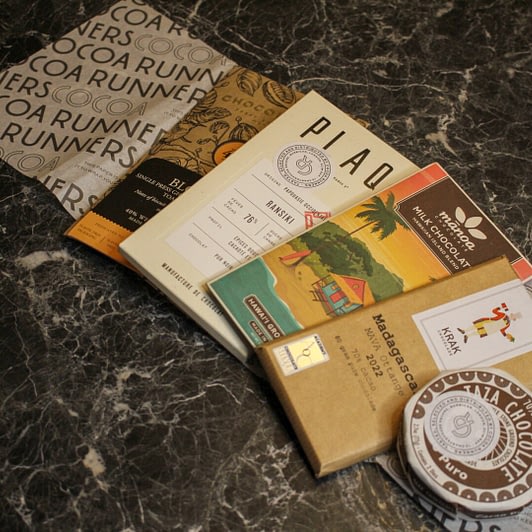
And please do so as you savour a couple of craft chocolate bars .. and then do share your discoveries with some fellow enthusiasts
The history of flavour lexicons, wheels, waves – AKA our attempt at some order and understanding of what is on the tip of our tongues!
Philosophers, scientists and food obsessives have long recognised that, just as we have structured vocabularies for colour, we also need them for smell and flavour. The idea goes back much further than most assume. Greek philosophers may have relegated taste and smell to the “lower senses,” yet they knew these sensations varied widely and resisted simple language. Plato admitted that smell was “fugitive and difficult to name.” Lucretius, in De Rerum Natura, went further in materialist fashion, claiming that taste differences arise from atomic shapes themselves: “Sweetness is smooth, bitterness hooked or jagged” – predating Kiki and Bouba (See HERE) by a few millenia.
Aristotle’s student Theophrastus took a more empirical approach. In his Enquiry into Plants (c. 300 BCE) he catalogued the smells and flavours of plants, spices and resins – frankincense, cinnamon, myrrh – and reflected on how roasting, drying or boiling transformed their character. It is now seen by historians as one of the earliest attempts at what eventually emerged as “flavour” chemistry and biochemistry.
Medical writers took an even more bold approach. The Hippocratic corpus and later Galenic medicine (2nd c. CE) made smell and flavour a diagnostic instrument. Physicians literally tasted and smelled bodily fluids to detect humoral imbalance. We may dismiss Galen’s humours now. But it’s intriguing that smell is again being used as a diagnostic tool to e.g. identify Parkinsons and, with considerable irony, the way specially trained dogs could identify Covid before its worst symptoms manifested.
After a long lull, the idea to classify and understand smell revived in early modern science. Carl Linnaeus – whose botanical classification still underpins biology – attempted what can be seen as the first modern taxonomy of odours in Odores Medicamentorum (1756). He posited seven broad categories (Aromaticus, Fragrantissimus, Ambrosiacus, Alliaceus, Hircinus, Teter, Nauseosus). His system never gained the traction of his plant system, and doesn’t link to any modern lexicon. But it seeded the idea that odours could be organised scientifically. And that seed resurfaced in the 19th century, when Zwaardemaker – inventor of the “Olfactometer” (1890) – tried to measure both smell intensity and character, grouping odours into families like ethereal, aromatic, ambrosial and empyreumatic in a far more instrument-driven attempt at classification.
At the same time, 19th-century perfumers pursued their own analogies. Piesse’s The Art of Perfumery (1857) famously proposed a “musical scale of odours,” aligning scents with notes and chords – language that later seeped into wine writing via terms like “top notes” and “base notes.” By the 20th century, professional perfume houses such as Givaudan, Firmenich and IFF had developed vast proprietary dictionaries linking specific molecules to descriptors (“ethyl-2-methylbutyrate = fruity, apple, juicy”). These were essentially giant internal lexicons, the first real encyclopaedic databases of odour chemistry. Arctander’s Perfume and Flavor Chemicals (1969) offered the first public glimpse – a vast index of aroma molecules with standardised descriptors – but the flavour houses kept most of their sensory IP locked behind closed doors. Flavour science never had an “open-source” moment: training schools remain private, data proprietary.
Food science took a somewhat more open and formal route. From the 1950s onward, sensory panels in USDA labs, UC Davis and Nestlé required standardised descriptors to train tasters. Rose Marie Pangborn and colleagues at UC Davis developed Descriptive Analysis – teaching assessors to use agreed vocabularies with precision. Structured lexicons emerged from this movement. Wine researchers such as Émile Peynaud, and Amerine & Roessler at UC Davis (Wines: Their Sensory Evaluation, 1959), began grouping wine aromas into stable families (fruity, floral, spicy, vegetal). Perfume analysts developed “odor circles” and fragrance pyramids based on volatility.
The breakthrough came at UC Davis in the 1970s and early 1980s, when Ann Noble and colleagues began organising wine aroma terms into a hierarchical map based on chemical and sensory kinship. In 1984 Noble published the first Wine Aroma Wheel – a three-tier system moving from broad categories to specific descriptors. It was a training tool, a scientific diagram and a bridge to consumers all at once, and it rapidly became one of the most influential taxonomies of flavour ever created. It also set the template for every wheel that followed.
For example, Coffee followed in the 1990s, with early SCA wheels drawing on lexicons built by Michael Sivetz and Ted Lingle. The 2016 World Coffee Research – SCA redesign, using new sensory data from Texas A&M’s Sensory Lab, became the first wheel grounded in modern statistical analysis rather than accumulated expert intuition.
Chocolate entered the arena in the 1990s. Cacao Barry, CIRAD and the ICCO produced early wheels. UC Davis and Guittard collaborated on a robust, research-led Chocolate Flavor Wheel between 2014–2017 under sensory scientist Darlene Dubinett; the Fine Cacao and Chocolate Institute refined the approach again in 2017. These chocolate wheels mirror wine’s logic but incorporate the distinctive production variables – fermentation, roasting, conching, origin – just as wine distinguishes vineyard, cellar and bottle stages of flavour.
Digitalisation pushed classification into new territory. Contemporary wheels can link descriptors to underlying chemistry at the click of a button, and cross-category research is accelerating: shared aldehydes producing “nutty” in chocolate and “malty” in beer; similar esters explaining overlaps between tropical notes in wine and coffee. And inevitably artificial intelligence has entered the field, with data scientists training large language models to cluster descriptors, predict sensory similarities and claim (with varying levels of bombast) that they will soon “decode aroma space.” We are not so confident – see here as to why humans will (probably/hopefully?) keep judging for some time.
Alongside this taxonomic drive, writers in wine and whisky were mapping flavour not as a circle but as a journey, borrowing from perfumers. In the 1980s and 1990s Michael Broadbent, Hugh Johnson and Oz Clarke described wine’s “attack, mid-palate and finish.” Whisky writers like Dave Broom, Charlie MacLean and Richard Paterson adopted similar chronologies — the “first hit,” the rising “crest,” the lingering “fade.”
Sensory scientists eventually quantified these intuitions. From the late 1990s onwards, “Temporal Dominance of Sensations” (TDS), developed by Pineau, Schlich and colleagues, tracked which sensory attribute dominated second by second as a product was tasted. Later refinements in the 2010s allowed multiple sensations to be recorded simultaneously. These temporal maps confirmed what tasters already suspected: flavour unfolds in peaks, transitions and sequences, not a single static impression. Flavour is like a movie, not a series of static images.
Across this whole history – from Plato’s exasperation with smell’s elusiveness to AI’s attempts to tame it – one thread runs straight. We like to make sense of our experiences and surroundings, so we keep trying to pin down the most evasive of senses. Ann Noble phrased it with characteristic clarity:
“You can’t talk about what you can’t name — and you can’t measure what you can’t describe.”
Enjoy your flavour journeys and waves!
To download the new flavour wave, please click here.