Why does chocolate taste different on different days?
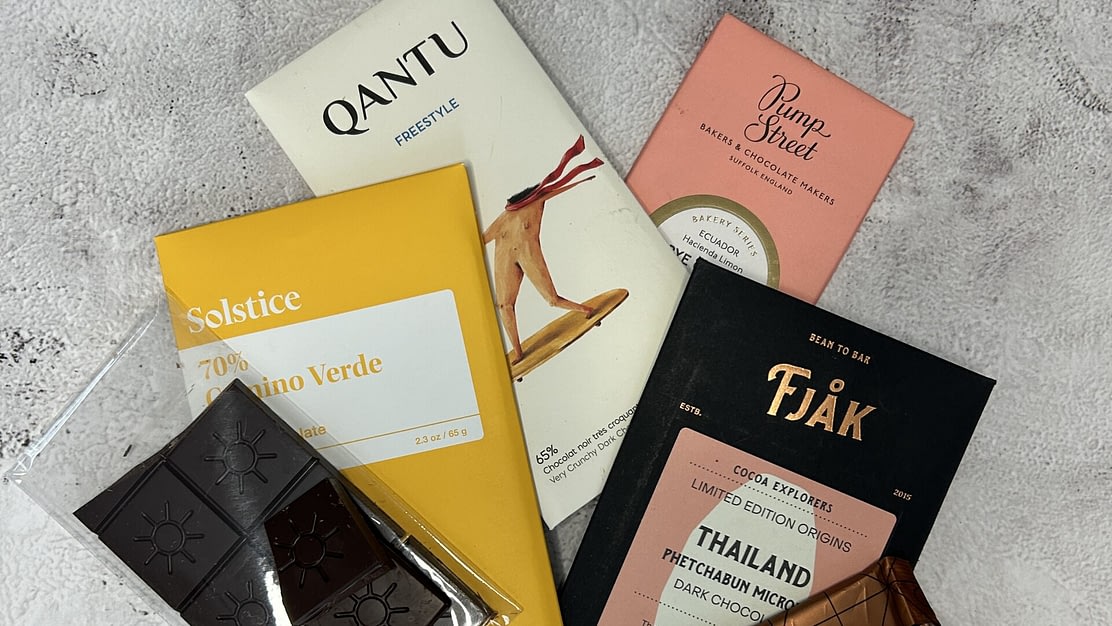
Have you ever wondered why one day you really love a bar, and yet a few days - or even a week later - you crack open the same bar (and from the same batch) but it just doesn’t taste as great? Or vice versa? Suddenly you start loving a bar that before you weren’t that enamoured with. It’s a great question (and thanks to Franziska, a subscriber, for asking it). It raises some intriguing questions about how flavour, aroma and our preferences interact and change. And to be candid, we’re not really sure of the answer here – it could be your mood, what else you’ve been eating, the time of day, phase of the moons and much more. We’ve explored these, and also a few experiments for you to try, ideally with a bunch of bars and a group of friends, to explore this more.
Print / PDFHave you ever wondered why one day you really love a bar, and yet when you try it a few days – or even a week later – you crack open the same bar (and from the same batch) but it just doesn’t taste as great? Or vice versa? Suddenly you start loving a bar that before you weren’t that enamoured with.
It’s a great question (and thanks to Francisca, a subscriber, for asking it). It raises some intriguing questions about how flavour, aroma and our preferences interact and change. And to be candid, we’re not really sure of the answer here. But we’ve a few thoughts and suggested experiments for you to try, ideally with a bunch of bars and a group of friends.
We’ve outlined these experiments and thoughts in more detail on the blog, but here are a few suggestions:
- What else is happening around you as you try the chocolates? We all know that different ambiences and moods impact us greatly .. so for example, what music are you listening to or what are you touching. Try the experiments in the blog and be surprised at their impact (and yes, this is linked to an interesting use of beards, stubble, etc.)
- What else have you been eating and drinking recently? The aromas and flavour volatiles in chocolate are released by firstly the heat of your mouth, and secondly by enzymes and bacteria in your “oral microbiome” and your saliva. And both your oral microbiome and saliva can dramatically change from day to day. This is harder to experiment on, but we still have a couple of ideas including a miracle fruit that (temporarily) makes everything sour taste sweet …
- What’s your general state of mind and health? Your sense of taste and smell can be affected by factors like medications, hormonal changes, and, for example, the common cold (or even more notoriously covid). Similarly, your level of hunger or thirst can impact your perceptions .. so if you are sated, you may well enjoy a chocolate bar differently from when you are pleasantly peckish
- What time of day? For almost all of us, our sense of taste (i.e. sweetness, sourness, saltiness, bitterness, umami and – arguably fattiness) has a distinct daily rhythm, with taste buds being most sensitive for the vast majority of us in the morning. Scientists now believe that this is be driven by circadian clocks present in our taste bud cells, and are now investigating similar circadian rhythms for flavour too. For the experiments here, we’re naturally recommending you try chocolate for breakfast, lunch and dinner .. on a couple of daysAnd it may well be that our sense of flavour also has a daily rhythm
- What’s the phase of the moon? A whole industry has emerged with bio-dynamic wines not just suggesting which days are best to plant, prune, harvest etc. the vines but also to DRINK wines. For example, advocates for the biodynamic calendar believe that on “fruit days” (when the moon is in a fire sign like Aries, Leo, or Sagittarius), wines will exhibit more vibrant fruit flavors and aromas. Conversely, on “root days” (earth signs like Capricorn, Taurus, Virgo), wines are thought to taste more subdued or earthy. And perhaps this might be true for chocolate too? One of our maker’s Mark Gerritz of Oblo, perhaps not coincidentally with a background in wine, certainly thinks so. And on the blog we’ve more details, and a link to a bio-dynamic calendar to explore.
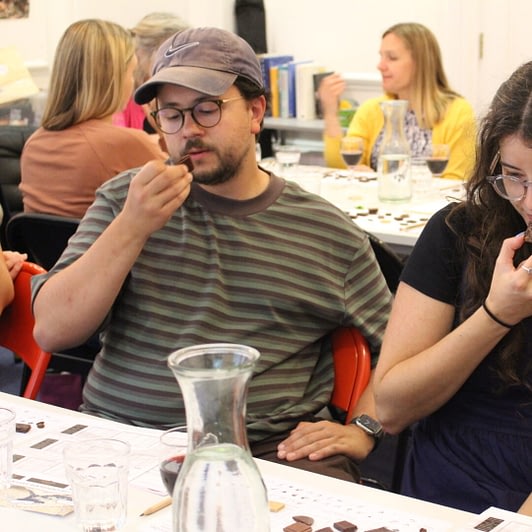
- Who are you tasting with … and what are you discussing and doing? Craft chocolate is a wonderful solitary treat. But it’s also fantastic to share. And sharing one, or even better two or three craft chocolate bars offers a fantastic way to compare notes. And with flavour, two heads really are better than one – and try the experiments with the flavour wave we’ve suggested.
Ambience and cross modal perception
The theory: If you’ve ever been stuck in a telephone customer support queue, you’ll be aware of how music can (hopefully) calm but more likely irritate. And you may also be aware of the way that supermarkets use music to e.g., drive sales of different wines. Back in 1999 Professor Adrian North demonstrated that consumers’ choice of French or German wines was strongly affected by stereotypic French and German background music.
In addition, music impacts our senses of taste and flavour via what’s known as “cross modal associations”. That is to say, musical elements like pitch, tempo, and timbre can correspond with, and enhance, perception of specific tastes and flavour. For example, higher-pitched sounds tend to accentuate sweetness, while lower-pitched sounds can enhance bitterness. Professor Barry Smith and Mika Hyman dramatically demonstrated this at our Fidelio Fair when Mika played different cello chords and tunes as people tried 100% and grainy chocolate, with very different responses. Similarly, another study by North in 2012 found that playing music with “powerful and heavy” connotations led participants to rate wines as having more intense and robust flavours, while “light and fresh” music resulted in perceiving the wines as more refreshing.
And it’s not just music. Touch plays a similarly HUGE role. People vary in their sensitivity to touch, with some being more “autotelic” (deriving pleasure from touch) than others. High autotelics tend to be more consciously aware of the potential effect of haptic cues on their their sense of flavour. So for example, they can “ignore” the importance of the cup they are drinking from. By contrast low autotelics are more influenced by tactile cues from e.g., from what they use to drink tea, coffee or chocolate – and have had a hard time enjoying any hot drink from “flimsy or insubstantial receptacles”.
Experiments:
- Explore the same range of 2-3 craft chocolates with different music playlists (ideally including some high percentage ones, and some milk chocolates)
- Stroke some sandpaper, and then some smooth materials, as you try 2-3 craft chocolates, ideally with some texture (so e.g. Taza, Pump Street’s Bakery Bars, Menakao’s Salt and Nibs). And/or try using beards or stubble here too
- Try drinking chocolate out of different cups too – fine china versus paper cups?
The state of your mouth; temperatures, your oral microbiome, saliva and more
The Theory: Chocolate is unique in being solid at room temperature, and then thanks to the magic of “tempering” and cocoa butter (see here), it “melts” in the mouth. And this is one of the key ways that chocolate “expresses” flavour – that is to say, the heat of your mouth melts the chocolate, and all sorts of amazing flavours and aromas are released. (Note: this is why chocolate on a hot day may seem very different, as it’s already melting it may release different volatiles to a bar that is “cold”, so pay attention to both the temperature of the bar and the general ambience).
In addition to the heat of your mouth, your “oral microbiome” (the community of microorganisms residing in your mouth) and your saliva also play a huge role in flavour release. Scientists have now discovered that specific bacteria in our mouths produce volatile organic compounds (VOCs) that express, and/or alter, specific tastes and flavours. For example, bacteria like Lactobacillus and Streptococcus produce VOCs that can enhance sweetness and umami flavours. And if your oral microbiome contains Fusobacterium Nucleatum (a bacteria that about 70-80% of us have in our mouths), when you drink a wine made from sauvignon blanc grapes you may well detect “fruity” and specifically gooseberry-like flavors. This is because this bacteria breaks down a specific thiol compound that is present in these wines,especially from some parts of New Zealand. (Note: when we explain this in virtual tastings, we inevitably get asked about asparagus .. and no, this isn’t about specific bacteria, it’s genetic in terms of how you breakdown and then can identify the “distinctive odour” – see link from the BBC below)
In addition to bacteria within your oral microbiome, your saliva is also critical to savouring and flavours. Saliva plays a key role in our perception of texture, plus other trigimenal sensations like spiciness (and that’s why you should have milk rather than beer if you’ve eaten too spicy a curry). Plus saliva, thanks to it’s role in creating the wonderfully named “food bolus”, that enables us to safely swallow food. And saliva also plays a key role dissolving and transporting flavour molecules. So if you produce more saliva than your partner, you may well both detect very different flavours. Technically what happening is that within your saliva you have proteins like mucins which impact the how fast, and how much, of an aroma is released .. and this impacts |flavour intensity). So if, example, you are tired as this impacts how much saliva you produce and this may well influence what flavours you can detect.
Experiments:
Unfortunately, there don’t appear to be many “quick fixes” to changing your oral microbiome or increasing salivary flow. Web MD suggests drinking lots of water, chewing some sugar free gum or sucking on sugar free sweets. So maybe try these, or just keep a record of the impact of how “dry” your mouth feels and how this impacts your enjoyment of different bars.
Alternatively, if you want to see how you can dramatically change your sense of sweet and sour tastes, you can experiment with the “miracle” fruit, Synsepalum dulcificum, a red berry native to West Africa that contains a glycoprotein called miraculin. When miraculin binds to the taste buds on the tongue, it causes sour foods and beverages to taste incredibly sweet for around 30 minutes to 2 hours, so lemons, limes, vinegar, etc. will taste super sweet. Essentially, the miraculin glycoprotein coats the taste buds and essentially “rewires” the sour receptors to perceive acids as sugars instead. And yes, lots of food companies are experimenting with this as a potential sugar substitute. But unfortunately, unlike refined cane sugar, it doesn’t seem to enhance flavours and aromas.
Mood, hormones and more
THE THEORY: Clearly, our mood massively determines our enjoyment and delight of chocolate, and so much more. And our hormones and mental state (anxiety, optimism, etc.) are inter-related and also impact how much we’ll enjoy our chocolate too.
Experiments:
- If you are wearing a “smart watch” which can detect e.g., your heart rate, stress levels, etc., try to correlate how differing heart rates, stress levels, hormonal changes etc. are impacting your perception of taste
- Try chocolates on days when you’ve had a great sleep – and then compare to when you’ve slept less well
Time of day and circadian rhythm
The theory: Taste sensitivity, or the ability to detect basic tastes like sweet, sour, salty, and bitter, has been shown to be highest in the morning hours for many people. Scientists have suggested that this morning peak in taste sensitivity is an evolutionary adaptation to increase appetite and food intake during the active part of the day when energy is needed. And they’ve been able to show that taste receptors on the tongue exhibit cyclical patterns of expression and renewal that align with the body’s circadian rhythms, causing fluctuations in taste bud sensitivity over a 24-hour period. Using “Sniffin Sticks”, a team let by Rachel Herz has been able to show that there is a similar circadian rhythm for our ability to detect aromas – although she notes that these variations differ greatly between different people.
Experiments:
So this one is pretty easy .. with a couple of friends, try the same 2-3 chocolates every 3 to four hours – ideally trying to isolate out the “biodynamic calendar” too (see below).
Biodynamic calendar
The theory – Back in the 1st century AD, the Roman naturalist Pliny the Elder suggested the moon “replenishes the earth; when she approaches it, she fills all bodies, while, when she recedes, she empties them”, expressing a commonly held view of the importance of planting, harvesting etc. according to the cycle of the moon. Jump forward a couple of millenia and a an Austrian philosopher, Rudolf Steiner, revitalised these theories to launch the Biodynamic agricultural movement in the early 1920s, based on “respect for the “the importance of the healthy interplay of cosmic and earthly influences”. One of his students, Maria Thun, codified all these ideas and calendar and published an annual almanac that is now in it’s 62nd edition, the Maria Thun Biodynamic Almanac and Calendar. Her son Matthias Thun, then took this idea and applied it to individual taste, first publishing the book When Wine Tastes Best: A Biodynamic Calendar for Wine Drinkers and now even has an app available for iphones and android phones that “tells you which days are optimum wine-drinking days, and which days to avoid if you want to get the most out of your glass.”
Matthias Thun argues that “If we consider the wine in the bottle as a living organism, which matures over time, then it makes sense that it too, should respond to the rhythm of the moon.” And he suggests that there is a “Biodynamic calendar” made up of four different types of days that are determined by both Lunar cycles and astrological signs: Root, Flower, Leaf and Fruit, all of which influence flavour and taste.
- Root Days – when the moon is in any Earth sign: Capricorn, Taurus and Virgo. Following the philosophy of the Biodynamic calendar, these days are the worst for tasting wine as the wine will appear more subtle on this “earthy” day.
- Flower Days – when the moon is in any air sign: Gemini, Libra and Aquarius. These days are said to be better days for tasting aromatic wines, especially those white wines with floral aromas.
- Leaf Days – when the moon is in any of the water signs: Cancer, Scorpio and Pisces. Wines are experienced to be less sweet, with a dominant, earthy minerality. This could be due to the fact that according to the Biodynamic calendar, the plant is more focused on producing chlorophyll on Leaf Days.
- Fruit Days – when the moon is in any of the fire signs: Aires, Leo and Sagittarius. Fruit days are said to be the optimal days for tasting wine as the fruit flavors are more vibrant, and the wine is rich and full.
Many wine tastings are organised around this calendar. And a number of well know winemakers, such as Randall Grahm of Bonny Doon in California, believe that there is something there.
“I would pour (all things being equal) on a fruit day where the tasting is to take place. I have certainly noted some differences between the way a wine will show on a fruit vs. a leaf day (the two most striking comparisons)”.
Although note that he also goes on to observe:
“.. but honestly, I think that there are other phenomena that may well have an effect that are more dramatic – certainly rising barometric pressure seems to show most wines off to better advantage.”
Various “scientific” rationalisations have been put forward. For example, some theorise that the gravitational pull of the moon affects the physiology of grapevines, altering the concentration of various flavour compounds in the grapes and wines. For example, on “leaf days” (water signs), vines may produce more chlorophyll, leading to greener, more vegetal flavours in the wines.
Similarly arguments have been made that the lunar cycle may influence human sensory perception and physiology by creating different atmospheric conditions that alter how we experience aromas and flavours.
Experiments:
- As you guffaw at this, why not give it a try? Try the same bars on differing root, leaf, etc. days and see if it makes a difference. A number of biodynamic wine makers helpfully list calendars – so here is a link to one from Domaine de La Vougeraie in Burgundy, a well respected wine maker who passionately believe in biodynamics – https://www.domainedelavougeraie.com/en/biodynamics.r-692/the-lunar-calendar.r-715/
- In a related vein (and I accept that this is unfortunately all too easy here in the UK with our rainy summer), try the same bar when it’s raining and when it’s sunny – and see if atmospheric pressure (or your mood, see above), make a difference
- Finally, try some of Mark Gerrits’ Obolo bars .. he has used different inclusions grown and harvest off the Chilean inclusions based off biodynamic farming ideas
Who are you savouring and sharing your bar with .. and what are you discussing?
Theory: Savouring a craft chocolate is a wonderful solitary experience. However in terms of identifying, and articulating, flavours, two heads – and two bars – may well be even better. Back in the early 1990s Professor David Laing performed various experiments that showed that in terms of aromas and flavours, even the best wine taster, perfume nose, etc. can – at any one instant – only identify three or maybe four flavours. Compare this to colour where when we look at a picture, we can “see” all sorts of different colours and gradations, and ditto for music. But if you compare flavour notes with a partner, and think of flavour as a journey (or flavour wave), you can appreciate the amazing complexities of flavour in different bars – and their length, intensity and balance. And your partner may help you identify flavours that otherwise you might have missed (similar to the way that discussing a work of art with a friend can help you “see” parts you might otherwise miss).
In addition, we all know that I know that flavour “it’s on the tip of my tongue” (literally), but not be able to articulate it. That’s why with Rebecca Palmer (wine), James Hoffmanmn (coffee) and Barry Smith (Professor or Philosopy and CoFounder of Senses STudy) developed the flavour wave with us.
Experiments:
- Taste with the flavour wave – both on your own and then with a friend
- Taste just one bar – and then compare to another bar to bring out their distinctive notes.
Please do keep your questions flowing!
Thanks
SOURCES
CROSS MODAL – MUSIC
https://www.ncbi.nlm.nih.gov/pmc/articles/PMC3677333/
https://www.ncbi.nlm.nih.gov/pmc/articles/PMC9223177/
Nadalina video
CROSS MODAL – TOUCH
https://academic.oup.com/jcr/article-abstract/34/6/807/1845407
https://www.eurekalert.org/news-releases/582404
BIODYNAMIC CALENDAR
https://winefolly.com/lifestyle/biodynamic-calendar-fruit-day-wine-tasting/
https://naturalmerchants.com/organicwines/biodynamic-wine-calendar/
https://vinepair.com/articles/biodynamic-wine-chocolate/
ORAL MICROBIOME
https://www.ncbi.nlm.nih.gov/pmc/articles/PMC8467474/
https://www.smithsonianmag.com/science-nature/how-saliva-changes-the-flavor-of-food-180981477/
Asparagus https://www.bbc.com/future/article/20140818-mystery-of-asparagus-and-urine
Miracle fruit: https://www.ncbi.nlm.nih.gov/pmc/articles/PMC5105965/
https://www.thenakedscientists.com/articles/science-news/thank-bacteria-flavour-food
https://pubmed.ncbi.nlm.nih.gov/18811169/
https://www.newscientist.com/article/mg20026825-400-for-tastier-food-just-add-bacteria/
https://www.sciencedirect.com/science/article/abs/pii/S0262407908628729
CIRCADIAN RHYTHMS AND TIME OF DAY
https://academic.oup.com/nutritionreviews/article/82/6/831/7240120