In defence of milk chocolate

And why, even if you are a dark chocolate aficionado, you should also consider some milk treats
Print / PDFThis is a love letter to milk chocolate. All too often people treat their passion for milk chocolate like another one of those “loves that dare not speak its name” or the dreaded phrase ‘guilty pleasure’.
Dark chocolate is definitely having a moment. More and more consumers are “moving over to the dark side” and even going beyond 70% to higher percentages – 80%, 90% and even 100%. There are LOTS of reasons for this – many of which we’ve written about. Health benefits like more polyphenols and magnesium (see here). Bitterness also can be a great end to a meal, making you feel “full” in ways reminiscent of weight loss drugs such as Manjaro, Ozempic, Wegovy (see here) through stimulating GLP-1s, CCK , PYY, etc. receptors. The theobromine and cocoa butter in dark chocolate may even be good at reducing plaque and protecting your teeth (yes really .. see here).
At the same time, we need to be careful not to throw out the baby with the bathwater. After all, milk chocolate is also delicious. And milk chocolate not only has a rich history, but also offers a host of benefits too.
This blog and email are an attempt to make the case for enjoying craft milk chocolate—not at the expense of dark chocolate, but as a welcome addition to the Craft Chocolate family.
In the words of Forrest Gump, it’s designed a little like a box of chocolates. You don’t need to consume it all in one sitting and, hopefully, “you never know what you’re gonna get” from one section to the next. Partly that’s because the world of craft milk chocolate is far more varied, nuanced and surprising than many people realise.
So whether you are already a craft milk chocolate fan, or need a bit more persuasion, read on to discover:
- How milk chocolate (combined with “grinding and conching”) shifted chocolate primarily being a DRINK to something we EAT (and accidentally pioneered the “scoffing” that underpins the appeal of junk food …)
- Why US milk chocolate to Europeans is tangy, acrid and reminiscent of baby vomit (and the link to cheesy feet)
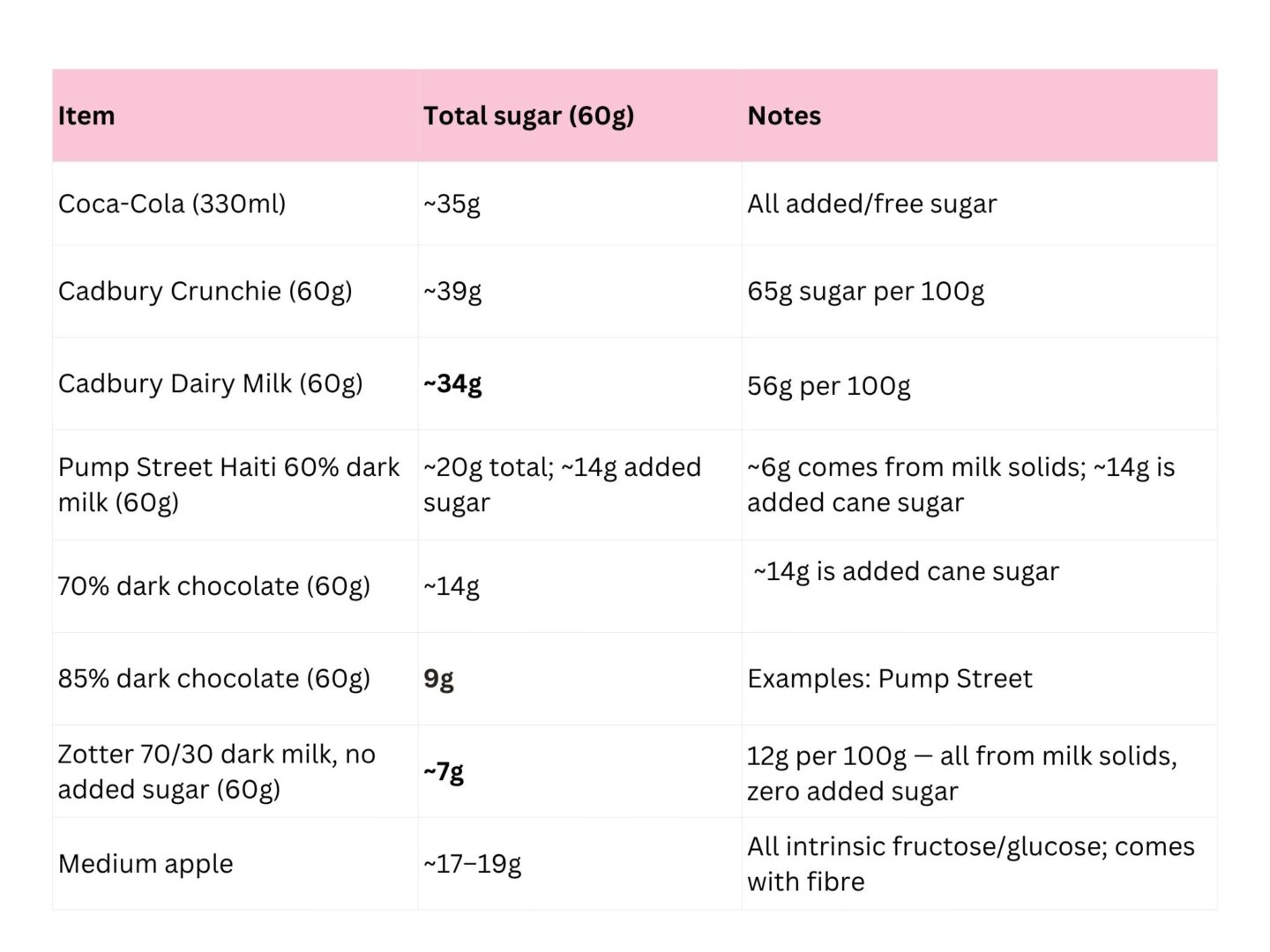
- How some “dark milk” craft chocolates have less added sugar than many dark chocolate bars
- Why vegan “mylk” chocolate can’t use the term “milk” (lactating animals need to be involved)
- How adding milk to chocolate can add even flavour complexity that can’t be replicated in dark chocolate
- How milk chocolate can act as a great gateway and bridge not just into Craft Chocolate but savouring in general
And do try some of these great bars, many of which have won awards galore – and are ALL team favourites.
From Cup to Bar: Grinding, Conching and the Milk Revolution
For most of chocolate’s history, we drank chocolate. Just over a century ago, we also started to eat chocolate thanks to a couple of major industrial leaps in the Netherlands, UK and Switzerland. Following the invention of the cocoa press (a Dutch innovation built on a British one — see here), and the ability to separate cocoa butter from the bean, Joseph Fry made a pivotal further innovation in 1847. He discovered that mixing some of the cocoa butter pressed out via the Dutch Cocoa Press back into cocoa cakes produced a paste firm enough to mould into bars. The result was grainy and gritty, much like today’s stone-ground bars from Taza, but it could be marketed and sold as an edible treat.
The transformation into the silky, melt-in-the-mouth texture we know came in 1879, when Rodolphe Lindt, allegedly by accident, left his grinder running over a weekend. The result — extra-fine cocoa particles with cocoa butter distributed evenly throughout — was the conche, and it dramatically changed both the texture and flavour of the chocolate, making the smooth, gooey chocolate we now all love. “Conching” in addition to creating smooth chocolate that also helped drive off unpleasant volatiles and flavours, and also reduced bitterness and astringency, making milk an even more natural partner for the smoothed-out flavour profile that emerged.
Even though chocolate had been drunk with milk, adding it into the newly designed chocolate bar proved tricky as chocolate making reacts badly to liquids. So it took a couple of decades of experimentation by Swiss chocolatier Daniel Peter, working alongside his neighbour Henri Nestlé, to combine condensed milk powder with cocoa solids and cocoa butter.
Together, conching and milk transformed chocolate from being a drink to an edible treat that made chocolate into a mass market treat. More significantly for the wider food world, chocolate pioneered the “scoffing” that underpins today’s ultraprocessed foods. Much is made of innovations in the late 20th century like Howard Moscowitz’ bliss point (the optimisation of sugar, salt and fat that humans instinctively find irresistible) and Eric and Barbara Rolls “sensory specific satiety” (aka the buffet effect, we like diversity so adding chewy bits and different textures and tastes makes us eat more). Before these were discovered, and then applied in everything from crisps to sandwiches, milk chocolate experimented and exploited all these tricks (for more on ultraprocessed foods, see here).
Craft milk chocolate is not just delicious, it also rewards savouring. It showcases why there is more to chocolate than scoffing, and thereby helps you being “gamed” by Big Food to constantly, and often unconsciously, overeat. For more on this, please come to a tasting!
Adding milk to chocolate opens up a bunch of other flavours – for example, butterscotch, biscuit, toffee, fudge — that have no equivalent in dark chocolate. But before exploring the way flavours are enhanced by milk in chocolate, a quick diversion to explain the differences between US and UK milk chocolate.
The American Milk Chocolate Mystery: Baby Vomit and Cheesy Feet
America and Great Britain are often described as being “divided by a common language” – for an even more immediate division, try favourite national milk chocolates. The average American is often puzzled by the likes of Dairy Milk or Galaxy, something appears missing. The average Brit is bamboozled by a Hershey, often asking if the chocolate is “off” and, if they are feeling expressive, why it resembles baby vomit.
This baby vomit smell is the result of lipolysis and butyric acid, a compound produced when dairy fat breaks down. It’s also found in parmesan, rancid butter, and via a bacterial infection on sweaty feet.
The history here is “complex”. When Milton S. Hershey was building his chocolate business in the early 20th century, he adopted Swiss-inspired chocolate-making technology, including conching and also used powdered milk. It appears that he wasn’t aware of Daniel Peters’ innovative use of condensed milk (which gave it a far longer shelf life) and instead developed what he called the “Hershey Process”. Although the exact method remains proprietary, food historians and dairy scientists believe it involved controlled lipolysis and partial souring of the milk, generating butyric acid and helping extend shelf life.
The result was the tangy flavour still associated with classic American milk chocolate. Because many US consumers grew up with that profile, it became a standard flavour reference for mass-market chocolate in the United States. Some American manufacturers are still thought to use butyric acid directly or indirectly to reproduce that flavour (Note: it’s not easy to check this via the ingredient list as butyric acid doesn’t need to be listed as an additive or extra ingredient, it can be covered as a “processing agent”).
Definitions are another problem; for more on this see here. But for a quick summary of the difference in what can be called “milk” chocolate in the UK, US and EU, read on.
- UK — Milk chocolate must contain at least 20% total cocoa solids and 20% milk solids. Up to 5% of the cocoa butter can be replaced with vegetable fats (such as shea or illipé), but this must be declared on the front of the pack. Governed by SI 2003/1659, retained post-Brexit. Sugar can be added to the milk before the milk is added, making it appear that the primary ingredient in many “classic” milk chocolates is milk even though sugar is often more than 50% of the ingredients
- EU — Sets the strictest cocoa threshold: a minimum of 25% total cocoa solids and 14% dry milk solids. A lower tier — “family milk chocolate” — is permitted for products with 20–24% cocoa. As part of the UK and Portugal joining the EU, up to 5% “alternatives” to cocoa butter can be added (although many French still regard this as “vegolate”. Governed by Directive 2000/36/EC.
- USA — Has the most permissive definition: milk chocolate need only contain 10% cocoa solids and 12% milk solids. Cocoa butter equivalents are widely used with no equivalent labelling requirement, meaning consumers have far less visibility of what fats are in their bar. Governed by 21 CFR Part 163.
Dark Milk’s Dirty Little Secret: The Sugar Comparison
As hinted at in these definitions, the most common challenge for milk chocolate is sugar. One of the biggest criticisms of ultra processed foods is their use of “excessive sugar”. The reasons why Big Food uses sugar are straightforward. Sugar is something we instinctively like (to the extent that many researchers argue often but meets several criteria associated with addiction) – so it’s something that consumers are drawn to. Sugar also acts as a great textural enhancer (especially for “low fat” foods) plus acts as a preservative and stabiliser. Above all, sugar is very cheap. Consequently it’s in LOTS of products, not just confectionery and fizzy drinks but also low fat yogurts, breads and even engineered fruits. To put it in context, sugar can be over 50% of the ingredients in many mass market chocolate bars but the cost of this ingredient accounts for less than 2% of the retail price.
Craft chocolate is different.
More Than Fat: Milk Chocolate’s Layered Flavour Release
Cocoa butter is a remarkable fat — one of the very few that is solid at room temperature (barring heat waves) but melts at body temperature. And this melt from well tempered bars produces that singular “melt on the tongue” sensation from well tempered dark craft chocolate that is so unctuous and delicious – and so amazing at allowing all the aromas and flavours of a chocolate bar to slowly reveal themselves.
Milk chocolate introduces an entirely different fat matrix into the equation. Milk fat melts at a slightly lower temperature than cocoa butter, meaning milk chocolate begins releasing its first wave of flavour compounds almost before you’ve registered it in your mouth. Then, as the cocoa butter fraction takes over, a second, deeper wave of roasted, fruity and earthy cocoa notes begins to emerge — a true two-stage flavour journey.
The milk proteins and sugars add yet another layer. During crafting, they undergo Maillard browning and caramelisation, generating a palette of new aroma compounds — butterscotch, biscuit, toffee, fudge — that have no equivalent in dark chocolate. These same milk proteins also bind to some of the more aggressive tannins in cocoa, softening astringency and giving craft milk chocolate its characteristic roundness on the finish.
The Gateway: Milk Chocolate and the Art of Savouring
For many of us, our first introduction to chocolate was milk chocolate — and there’s no shame in that origin story.
Smart Craft Chocolate makers treat this as a “feature, not a bug”. Craft milk chocolate is one of the most powerful, and accessible, entry points into the world of savouring. It’s familiar. It’s nostalgic. It’s easy.
When you’re not being shocked by unfamiliar astringency and/or bitterness, you have more cognitive bandwidth to notice everything else — the fruit, the floral notes, the length of the finish, the way the texture changes as it melts.
Craft chocolate has over 400 distinct flavour compounds — as many (or more?) than fine wine. And just as with wine, coffee, tea, etc. learning to savour is like learning a new language. It’s not like “scoffing” as fast as possible to keep bombarding your taste buds with immediate hits. Savouring is about slowing down to uncover the flavour, balance, length and complexity of your treat.
Even though craft milk chocolate is wonderfully moreish (arguably more so than dark chocolate), it also rewards savouring. It rewards slowly. You need to allow it to melt so as to release all the complex flavours, and to appreciate the way it cools and melts on the tongue.
A final clarification: Mylk, MLK, MILQ: Why Vegan Chocolate Has a Naming Problem
The rise of plant-based eating has created a booming market for dairy-free “milk” chocolate, with oat, coconut, hazelnut, rice, buckwheat and even tiger mylk all standing in for traditional dairy. Around a quarter of consumers now opt for non-dairy alternatives in their morning coffee, and chocolate makers are chasing that same audience. The results can be extraordinary — buckwheat, for instance, develops deep, almost malty dairy-like flavours during conching that make it a surprisingly convincing substitute.
But there’s a legal tangle: under European Union law, the word “milk” is legally reserved for “the normal mammary secretion obtained from one or more milkings” — i.e. it must come from a lactating animal. A 2017 ruling by the Court of Justice of the EU confirmed that terms like “almond milk,” “soya milk,” and “rice milk” cannot legally be used on packaging, with limited exceptions (coconut milk being one). This means a chocolate bar made with oat milk cannot be called “milk chocolate” — because “milk chocolate” is defined in law as containing “cocoa products, sugars and milk or milk products”. Vegan makers are therefore left improvising and inventing terms like “mylk,” “m!lk,” “MILQ,” and other creative spellings.
To add to the confusion, many supermarket “dark” chocolate bars (e.g. Bournville) contain dairy based products (in particular buttermilk).
Some final thoughts
Craft milk chocolate is way, way more than a “guilty secret”. Milk chocolate played a key role in helping chocolate reach a mass audience. As part of this, it did kick off many of the tricks used by big food to get us to scoff (the bliss point, hyper-palateability, sensory specific satiety, etc. – and see here for why mass market chocolate arguably was the pioneer of today’s ultra processed foods over 100 years ago).
But it also shows that chocolate, especially craft chocolate, deserves savouring and sharing. Craft Milk Chocolate offers delightful flavour adventures (and yes, even some healthy nutrients in moderation). So, let’s celebrate both types! If you’re curious, come to a tasting (or join our Virtual Chocolate Tasting) or try our new Intro to Craft Chocolate Mixed box.
FURTHER READING
An Industrial History of Chocolate
Explaining the Wonders of Craft Milk Chocolate
Cadbury Darkmilk: The Real Deal or Just a Sham?
How Much Sugar Is in Your Chocolate?
Cutting Down on Sugar?
Vegan Milk Chocolate — The New Kid on the Block
Taste, Flavour, Texture and Mouthfeel
How to Taste Chocolate Like a Pro
Investigating Ultra-Processed Chocolate
Bubbles, Froth and Chocolate
Flavour, Memory and Craft Chocolate
Savouring for Christmas
Tastings & Events
Virtual Craft Chocolate Tasting
Taste & Flavour Hub
All Taste & Flavour Articles