Crafting hope in Ukraine and exposing the hypocrisy of Big Chocolate in Russia
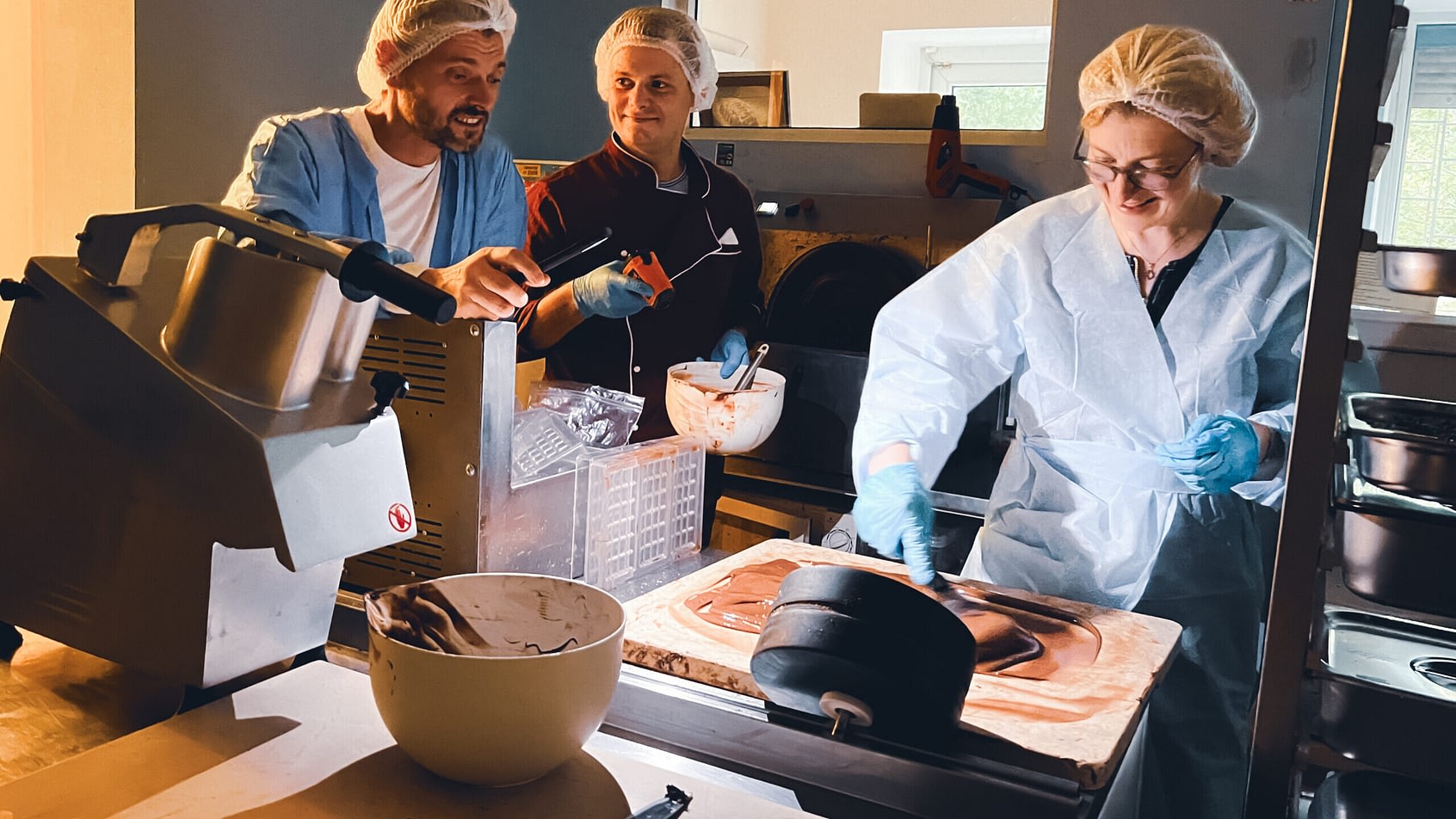
Celebrating Ukraine’s inspiring chocolate makers - and calling out the cynicism of Big Chocolate in Russia.
Print / PDFFrom Empire Treats to Bean-to-Bar: Two Centuries of Ukrainian Chocolate
The first record of chocolate being made in Lviv dates back to 1803, when Dominik Andreolli – a Swiss-Italian émigré – opened the city’s first chocolate “house” selling drinking chocolate directly and for home use. Such was his popularity that locals renamed the passage to his shop as “Andreolli Arcade”, and chocolate’s popularity has never looked back.
By the end of the 19th, and start of the 20th century, Lviv was up there with Vienna and Prague as chocolate powerhouses. Family-run factories like Branka (established 1882) and Hazet (early 20th century) adopted modern steam-driven grinders and began exporting pralines to Paris and New York. Then after World War I, several of these enterprises merged into new ventures such as Fortuna Nova, who sold not just in the USSR but also exported gift boxes that narrated “The Sweet History of Ukraine” for émigré communities abroad. (Note: In 1962, these factories were consolidated as Svitoch, which remains a household name in Ukraine and is now part of Nestlé.)
Chocolate Behind the Iron Curtain
Soviet nationalisation replaced the family crests on these chocolate factories with five-pointed stars. At the same time, Ukrainian chocolate received significant investment. Annual cocoa imports soared after 1945, and brands like Strela became coveted treats across the USSR. Production lines were standardised from Kyiv to Kharkiv and all over Ukraine. Even as most Soviet chocolate became increasingly sugar-heavy, many Ukrainian chocolate makers sought another way, for example Lviv’s Svitoch retained its reputation for higher-cocoa recipes and walnut-filled truffles. Chocolate was often scarce, but Ukraine’s status as the USSR’s “chocolate basket” (and general “sweet shop”) endured.
Independence, Oligarchs, and Globalisation
The collapse of the Soviet Union in 1991 unleashed a wave of privatisation. Few navigated this new landscape as effectively as Petro Poroshenko, who in 1996 stitched together several former state factories to form Roshen Confectionery Corporation. Poroshenko went on to become President of Ukraine in the 2000s, bolstered by the financial success of Roshen. Today, Roshen produces hundreds of confectionery products and leads Eastern European export tables, with annual revenues in the hundreds of millions of euros. International giants followed: Nestlé took a controlling stake in Svitoch in 1998, Mondelez entered with Milka and Korona, and domestic rival AVK expanded across the former Soviet space. The 2014 annexation of Crimea and subsequent trade embargo with Russia abruptly cut off Ukraine’s largest foreign market, forcing firms to pivot toward the EU, Middle East, and Asia, and to invest in higher-quality cocoa and packaging to meet new standards.
The Politics of the “Chocolate King”
Poroshenko’s dual identity as both oligarch and president turned chocolate into a symbol of Ukraine’s turbulent politics. Although he pledged to sell Roshen while in office, he ultimately placed it in a Rothschild-managed blind trust—a move critics found, to be polite, “opaque”. In February 2025, President Zelensky’s government froze Poroshenko’s assets, including his Roshen shares, citing national security concerns; Poroshenko denounced the move as authoritarian overreach. Meanwhile, across the border, a Russian court nationalised Roshen’s Lipetsk factory in 2024, labelling the former owner an “extremist” and barring further operations. Again, chocolate shows the geographic, political and economic complexities of this war.
The Dawn of Craft Chocolate
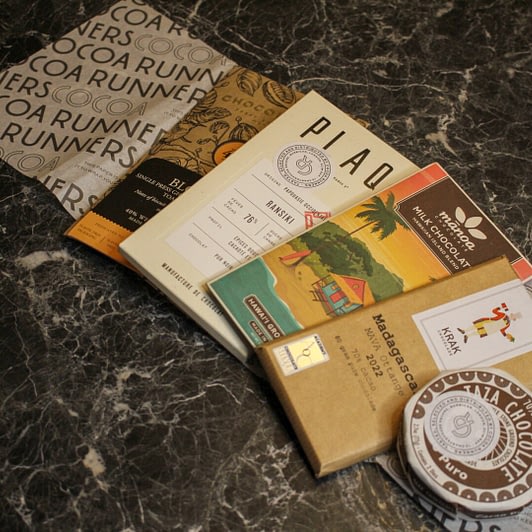
While industrial titans and politicians traded blows, another revolution was taking place in small workshops. The 2010s saw the rise of specialty coffee and craft beer in Kyiv, and fortunately a few also investigated cocoa and craft chocolate. Brothers Oleksiy and Dmytro Kolchanov of Meetty (Kremenchuk, founded 2013) imported Caribbean and Peruvian beans and became Ukraine’s first certified-organic bean-to-bar producer. Somehow Oleksiy, despite commuting hundreds of miles every weekend to mount anti aircraft and anti defense in Kyiv, continues to craft chocolate with Dmytro. Dmytro has also rigged up a remote control device so that even when they can’t be in their factory during air raids, they can still switch back on the generators that power their conches. And their solution to a lack of refrigeration? Sell even faster .. and send to the front.
The first Ukrainian craft chocolate makers we worked with were Stranger – founded by Raslan and Tatyana in Poltava in 2016. Stranger’s entry into craft chocolate is appropriately strange; when working on a university packaging project to redesign some local chocolate bar wrappers, they were horrified by how little cocoa and how much sugar were in local bars. And as they dug deeper and realised the issues of child labour and deforestation in “big chocolate” they determined to do it “the right way”. Seeing them develop, experiment with new bars and origins has been a huge honour and delight. All of us in the team look forward to their samples!
Our third Ukrainian Chocolate maker is Sisters A. As the name suggests, two sisters – Olena and Oleksandra, launched Sister Chocolate in Lutsk, western Ukraine back in 2021. A few months ago they visited our office and told us their story; how they hand-peeled their first Dominican cacao beans, learnt off internet videos and worked out how to get machinery and beans into, and now finished bars out of, Ukraine.
Note: a final MASSIVE thank you to “Mike and Becky”; aka Bjorn and Julia, who have been tireless in promoting Ukrainian craft chocolate in the EU and UK – and who made all our initial introductions.
The Road Ahead
Whatever happens with Poroshenko / Roshen and however Nestlé-Svitoch develop, we’re deeply honoured to be working with Meety, Stranger and Sisters. Their craft chocolate really is a taste of hope and perseverance. As you try their bars, consider the extraordinary path these makers and their chocolate has taken.
The response of Big Chocolate in Russia
Unsurprisingly since Russia’s invasion of Ukraine in February 2022, Big Chocolate has faced scrutiny over their Russia operations. Depressingly, most of the time their reaction has been to avoid making any hard decisions by referring to the likes of “food security”, “employee welfare”, “compliance with local law”, etc. and to continue on as before. Indeed a few Big Chocolate makers have seemingly seized the war as a means to grow their Russian sales – and indeed in one case to even expand.
A few, most notably Olam, Hershey and Lindt have pulled out; but they are the exceptions rather than the rule (and to be cynical, their sales in Russia don’t appear to have been that significant).
Bottom line: despite criticism by governments, campaigners, employees, and consumers arguing that Big Chocolate’s ongoing operations help finance the Russian state and undermine solidarity with Ukraine, Big Chocolate is “hanging on in”. Perhaps unsurprisingly whether the company is family owned or publicly quoted and whether they are consumer or business facing doesn’t seem to explain their stance. A better predictor seems to be the scale of their operations and sales pre the invasion.
Check how your favourite super market chocolate is responding to the russian invasion of ukraine – consumer facing companies:
Mondelez
Brands: Cadbury, Milka, Toblerone, Oreo)
Position: Mondelez, the world’s second-largest confectionery company, continues to operate three Russian factories and sell its leading brands. Initially Mondelez said it would scale back “all non-essential activities” and suspend new investment and advertising. More recently it declared an aim of making its Russian business “stand-alone with a self-sufficient supply chain”.
Despite this, it’s alleged that Mondelez is still selling imported Toblerone, and Milka sales soared by 600% in Russia in early 2024. And when criticised for “profiteering”, CEO Dirk Van de Put was brutally direct in defending Mondelez’ stance, arguing that “There has been no shareholder pressure whatsoever” to leave Russia, and investors do not “morally care” about continued business in the country.
Bottom Line: Despite employee petitions and resignations, particularly in Eastern Europe, and despite human rights groups warning that Mondelez’s tax payments and compliance with Russian labor laws could indirectly support the war effort, there’s been no change. It’s “business as usual”.
Nestlé
Brands: Kit Kat, Aero, Quality Street, After Eight Nesquick, Rossiya – Generous Soul (Russian brand)
Position: Nestlé’s position is more nuanced. Initially Nestle continued selling chocolate and other products in Russia, but under mounting pressure – including direct appeals from Ukrainian President Zelenskiy – sales of major chocolate brands like KitKat and Nesquik were suspended. Nestle is still selling “essential foods” such as baby food and medical nutrition, and claims not to be making a profit from its remaining operations.
Bottom Line:
Mars
Brands: Mars, Snickers, Twix, M&Ms, Bounty, Korkunov (Russian brand) plus Wrigleys gum
Position: Mars, Russia’s leading confectionery company, continues to operate nine factories (three for chocolate) and has invested heavily in Russian production prior to the invasion. It’s always hard to get details from family owned Mars – especially in the fog of war. The company claims to have “scaled back” activities, suspended new investment, and redirected profits to humanitarian causes, but it has not exited the market
Bottom Line: Harder to tell, but still operating at scale and still seen by Ukraine as an “international sponsor of war”
Ferrero
Brands: Ferrero Rocher, Kinder, Nutella, Thorntons, Tic Tac
Another family company, Ferrero (nutella, kinder, etc.) has seemingly seen the invasion, and early hesitancy of its rivals, as a sales opportunity.
Publicly Ferrero initially claimed to pause all non-essential activities and development plans in Russia, including advertising and promotions, while expressing deep concern for the Ukraine war and highlighting its humanitarian aid to Ukrainian children and refugees. Indeed they donated over 1m euros early in the war via Unicef to displaced and orphaned children in Ukraine.
However in practice, Ferrero has continued full-scale production and sales in Russia, with its products widely available and local hiring ongoing. Despite its stated pause on marketing, Ferrero’s advertising spending in Russia actually increased in 2023 compared to the previous year, and its Russian subsidiary’s revenue grew by 17% in 2023, with exports from Ferrero to Russia rising by 33% after the invasion.
Unsurprisingly this has not gone unnoticed – for example The boycott-russia.info and who-support-rus-war.com platforms accuse Ferrero of “conscious support” for the Russian economy, stating:
“Ferrero, you have become an accomplice in the genocide of the Ukrainian people. Are short-term profits in Russia more valuable than human lives and your reputation? You have to stop now, otherwise you risk still having the blood and tears of Ukraine in your hands”
Bottom Line: Although Ferrero early in the invasion made a series of public statements saying the likes of “All non-essential activities and development plans in Russia remain paused.” (2023) it still appears to be expanding its logistics and factories in Russia.
THE BETTER NEWS – Companies Withdrawing: Lindt, Hershey
Lindt Brands: Lindt, Ghiradelli, Lindor, Gold Bunny, Lindt Excellence
Hershey Brands: Hershey’s, Reeses, Kit Kat (in the US), Kisses York
Lindt & Sprüngli suspended deliveries to Russia and closed its eight boutiques on 9 March 2022, and, in a follow-up statement on 16 August 2022, confirmed it would exit the market entirely. The withdrawal affected about 125 employees, while management has stated that Russia and Ukraine together accounted for “less than 1 %” of group sales, so to be cynical, it wasn’t a major sales hit.
Hersheys: Hersheys has ceased supplying the distributors it used to sell into the Russian market since Putin’s “special operation”. Frustratingly, although Hershey’s files SEC reports, it’s hard to see what sort of impact this had on their “bottom line”. Hershey’s Form 10-K filings for 2022-2024 shows ≈70 % of production is U.S.-based and the reports do not list Russia as a separate market or cite the halt of shipments as material to consolidated revenue. So it’s not obvious that their March 2022 suspension of shipments to Russia caused them significant sales.
B2B Operations
Barry Callebaut
Barry Callebaut, the company that pioneered the use of “processed couverture” to everyone from chefs and branded chocolate makers, has continued to operate its three Russian factories and its Moscow Chocolate Academy. In the face of heavy criticism in the early stages of the invasion, the company suspended new investment. Since then it has continued to maintain production, citing responsibility to employees and customers.
To quote their CEO (Peter Boone) said:
“It feels right because we are in contact with our 500 colleagues in Russia, they clearly have not asked for this decision by the Russian government. For us, it feels like the right thing to do to stay close for our employees and our customers”
Facts and Figures:
As of 2022, Russia accounted for less than 5% of Barry Callebaut’s global sales volumes. However, the company’s Russian revenues have grown sharply since the invasion:
In 2022, Barry Callebaut’s main Russian subsidiary reported revenues of 21.9 billion rubles (approx. $312 million), with net profits up 59% to 2.7 billion rubles.
In 2023, Barry Callebaut imported goods worth over $94 million into Russia—more than triple the $29 million imported in 2022
Unsurprisingly Barry Callebaut is high up on Ukraine’s list of “international sponsors of war” for paying millions in taxes to the Russian government and for its products being found in Russian army rations.
Cargill
Even though they are a family owned / private business, Cargill has been relatively open about its position and plans for Russia as a few quotes show:
“We will continue to operate our essential food and feed facilities in Russia. Food is a basic human right and should never be used as a weapon. This region plays a significant role in our global food system and is a critical source for key ingredients in basic staples like bread, infant formula and cereal.”
— Official Cargill statement, March 2022
“[A]s grain export-related challenges continued to mount, Cargill will stop elevating Russian grain for export in July 2023 after the completion of the 2022-2023 season.”
— Cargill spokesperson, March 2023
“We’re engaged in the region. We continue to operate in Ukraine. And we continue to operate in Russia, which has been controversial.”
— Brian Sikes, CEO of Cargill, January 2023
Bottom line: Cargill is one of the world’s largest private companies – and it’s very, very hard to obtain much information on their operations. It is reported Cargill’s Russian operations generated $2.1 billion in revenue in 2022, with cocoa and chocolate ingredients forming a significant, though not separately reported, part of this business. Despite scaling back some activities (especially grain), and despite overall sales in Russia seemingly declining both in 2023 and 2024, Cargill continues to supply cocoa products widely in Russia, and remains a major player in the market.
OLAM
The third of Big Chocolate’s “B2B” players, OLAM has been clearest in its withdrawal from Russia (and Ukraine). To be cynical, this may reflect the relatively unimportance of these markets for them. According to investor presentations “In 2021, Olam’s direct exposure to Russia and Ukraine accounted for 1.0% of Group volumes, 0.8% of Group revenue, and 2.7% of Group invested capita”
Bottom line: Whatever the case, Olam has largely exited or scaled back its Russian operations, focusing only on essential activities such as its dairy farm supplying the domestic market, while ceasing imports and export terminal operations. And it’s not competing with Callebault in this market
Summary
Bottom line: I’m rarely surprised by Big Chocolate. But even I’m taken aback by the cynical and callous stance of the likes of Mondelez, Ferrero Rocher and Callebault to single out a few of the more egregious actions of “Big Chocolate” in Russia. If you need another reason to wean yourself, friends or family off Kinder Eggs, Cadbury’s Dairy Milk or Nutella, cite their behaviour in this “special operation” by Putin.
On a more positive note, the wider food story told by Felicity – and the actions of Ukrainian chocolate makers, give a lot more hope
Please do add your comments; it’s hard to understand all that is going on and I’ll try to update as I get more information.
Thanks!
Sources
Major News and Industry Reports
https://www.just-food.com/ukraine-crisis/mondelez-to-spin-off-russian-operations-into-stand-alone-entity/
https://www.grocerygazette.co.uk/2024/07/01/mondelez-sale-toblerone-russia/
https://euromaidanpress.com/2024/08/01/mondelez-expands-russian-chocolate-sales-sixfold-classifies-earnings/
https://www.grocerygazette.co.uk/2024/05/20/cadbury-owner-inquiry-russia/
https://www.zawya.com/en/world/uk-and-europe/oreo-maker-nestle-pepsi-face-pressure-from-european-employees-over-russia-rjwrxqtz
https://b4ukraine.org/what-we-do/sweet-disgrace-of-mondelez
https://cnycentral.com/news/nation-world/will-russians-be-losing-their-sugar-fix-nestle-pulls-major-chocolate-items-off-shelves
https://www.rte.ie/news/business/2022/0413/1292071-barry-callebaut-staying-in-russia/
https://www.investing.com/news/stock-market-news/barry-callebaut-ceo-says-staying-in-russia-feels-right-2802974
https://nazk.gov.ua/en/the-aggressor-and-chocolate-factories-nacp-adds-barry-callebaut-the-world-s-leading-chocolate-manufacturer-to-the-list-of-international-sponsors-of-war/
https://globalaginvesting.com/mars-invests-53-million-in-russian-expansion-despite-western-sanctions/
https://www.confectioneryproduction.com/news/24336/ferrero-prepares-for-major-multi-million-expansion-in-russian-market/
Ukrainian and Chocolate Industry References
https://ukrainian-recipes.com/delish-lviv-chocolate-why-it-is-so-popular-all-over-the-world.html
https://lia.lvivcenter.org/en/themes/reherit/branka/
https://lia.lvivcenter.org/en/organizations/13-svitoch/
https://www.gw2ru.com/russian-kitchen/3168-soviet-chocolate-candies
https://chocolateclass.wordpress.com/2019/05/03/the-rise-of-roshen/
https://en.wikipedia.org/wiki/Roshen
http://ek-visnik.dp.ua/wp-content/uploads/pdf/2019-1/Slyuta.pdf
https://www.npr.org/sections/parallels/2013/11/12/244819611/ukraine-a-chocolate-factory-and-the-fate-of-a-woman
https://eatorganic.in.ua/en/stories/4
https://observer.co.uk/news/international/article/ukraine-oleksiy-kolchanov-meetty-chocolatier-at-war
https://coolbrandz.com/sisters-a-chocolate/
https://www.beantobarstool.com/blog/sisters-a-chocolate
https://cocoarunners.com/maker/stranger-chocolate/
https://www.beantobarstool.com/blog/stranger-chocolate
Wikipedia and Archival Entries
https://en.wikipedia.org/wiki/Svitoch
https://en.wikipedia.org/wiki/Petro_Poroshenko
Asset Freezes and Legal Actions
https://kyivindependent.com/whats-at-stake-for-poroshenko-ex-president-sanctioned-by-zelensky/
https://yoursukrainian.substack.com/p/why-did-zelensky-sanction-his-political
https://www.occrp.org/en/project/paradise-papers/candy-company-plans-haunt-ukrainian-president
https://euromaidanpress.com/2016/04/05/expert-journalists-falsely-accused-poroshenko-in-corruption/
https://www.confectionerynews.com/Article/2014/06/03/Roshen-owner-wins-Ukraine-election-so-will-he-sell/
https://english.nv.ua/nation/former-ukrainian-president-poroshenko-saved-his-business-from-seizure-by-signing-it-over-to-son-50208666.html
https://www.kyivpost.com/analysis/47089
https://jamestown.org/program/russian-factory-ownership-hurts-ukraines-president-poroshenko/
https://www.confectionerynews.com/Article/2014/03/21/Russia-seizes-Roshen-chocolate-factories/
https://www.rise.md/english/poroshenko-sheriff-business-connections/