Drinking chocolate and philosophy
As the nights draw in, and the temperature dials down, it’s DEFINITELY time for hot chocolate.
Print / PDFUnlike tea, coffee, wine, beer, cider and many other favourite tipples from the past, chocolate in the 19th century went down a new path – it moved from being primarily drunk to becoming primarily eaten (and eaten not just in bars, but also biscuits, cakes, ice creams and more). It’s hard to think of other products that have followed a parallel path; maybe milk to cheese? (although in this case it was arguably more cheese eating to milk drinking after pasteurisation?).
Anyhow, we are fortunate that more and more craft chocolate makers are now crafting wonderful drinking chocolates. These hot chocolates can be massively different – as the selections of each of our team members testifies (see below). And the difference between a great craft hot chocolate and a sugar laden and/or alkalised mass produced hot chocolate is just as profound as the difference between a great craft chocolate bar and mass produced chocolate bar.
Unlike bars, where the product comes as “ready to eat” where “all” the customer needs to do is unwrap the bar and then share and savour it, hot chocolate is a bit different. It needs – like coffee or tea – to be “made” or brewed. This shouldn’t put anyone off – it’s really easy to do; we’ve a simple guide (see here) and also a video by a pro (see here). Plus below are some quick dos and don’ts.
In addition, below and on the blog, we’ve also pulled together a few historical “curiosities” around drinking chocolate and some reflections on why hot chocolate has lots of lessons for students of philosophy.
The Dos
- Do take a moment to take a few sniffs and inhale the aromas of your cup before you take a sip – unlike a chocolate bar, it’s far easier to appreciate the amazing aromas of a great drinking chocolate; so start by losing yourself in those delicious smells.
- Do savour and share, and do think about the “flavour wave” and journey. A great hot drinking chocolate will also have layers of flavours and should have “BLIC” (balance, length, intensity and complexity).
- Do also compare the different aromas, flavours, and textures, as the hot chocolate cools (if you can wait that long!). As it cools, all sorts of different volatiles are released to create multiple waves and experiences. And hats off to Jens Knoop who carefully tests all Knoops’ drinking chocolates at specific heats as a matter of course.
- Do be generous with the amount of chocolate or cocoa powder you use; 20, 25 or even 30g per 150 ml all work.
- Do use old bars; even those that may have gone a little out of temper (ie become a bit brittle), can also be used to make some great hot chocolate.
Some Don’ts (in an ideal world)
- Don’t use boiling water or milk either to make the ganache or finished drink; it’ll burn the chocolate and potentially destroy much of the flavour.
- Don’t be a snob about microwaves .. they work fine (as long as you don’t boil the milk).
- Don’t be a snob about using some labour saving devices like a battery operated nano-foamer or hot chocolate maker; they work great (see team recommendations).
- Don’t use alkalised cocoa powder (if you can possibly avoid it). Alkalisation may reduce some bitterness, and produce an interesting reddish colour, but it destroys most of the nutritional benefits (like polyphenols).
- Don’t spill it on your bed sheets … learn the lessons from French boudoirs (see below on why hot chocolate spawned the invention of the cup and saucer).
Hot Chocolate – Historical curiosities to ponder
- Predating the innovation of frothers and foamers by at least 500 years, the Aztecs above all prized the foam of hot chocolate. The famous description of Montezuma’s gold goblets of drinking chocolate before retiring to his wives and mistresses specifically notes how he delighted in the foam from his drinking chocolate, leaving the actual drink to the courtiers who remained feasting.
- The spread of drinking chocolate in Europe in the late 16th and 17th centuries was helped enormously by the fact that it could be consumed in Catholic churches on saints’ days and on Fridays, when fasting rules barred meat and other animal-based foods. Because chocolate could be made as a water-based drink, it was seen not to break the fast – the same logic that keeps fish on many Friday tables today. A number of clerics and cardinals endorsed the practice, and several popes may well have done so too.
- The invention of cups and saucers is generally attributed to the dangers of drinking chocolate, by French aristocratic ladies in their beds, with their “trembling” hands, spilling chocolate all over their bed linen. Some historians argue that this inspired the development of a “trembleuse” (high lipped saucer) which, paired with their cups of drinking chocolate, countered the dangers of trembling hands. Note: some Spanish historians challenge this interpretation, pointing out that their 17th century nobility would often drink chocolate at dances, and suggest that it was there that the cup and saucer was developed so as to stop chocolate spilling as they twirled on the dancefloor.
- During the 19th century the British Navy served drinking chocolate as a daily ration for sailors. A number of food historians now suggest that this naval consumption accounted for up to a fifth of national chocolate imports in the early 1800. And the Navy’s increasing demand made chocolate one of the pioneers of “industrialised” foods via the creation of various chocolate factories at Deptford in the 1830s.
- The “Dutch” hydraulic press invented by Conrad Van Houten was actually an innovation “borrowed” from Britain where Joseph Bramah, best known as a locksmith, developed the first hydraulic press to provide a means to flush another late 18th century invention, the cistern toilet.
Our team’s drinking chocolate recommendations
Spencer
Drinking Chocolate: Piura Porcelana 75% (shop here)
How to make it: The ganache method and a nanofoamer
Favourite occasion: The end of a meal (especially a Sunday night)
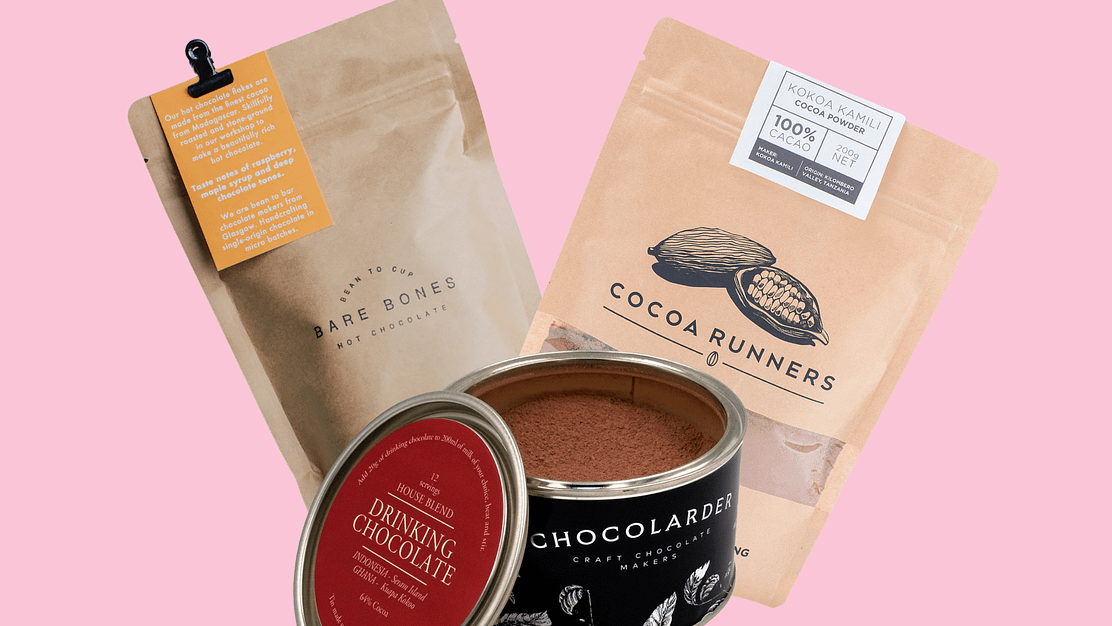
Drinking Chocolate: Unsweetened cocoa powder from Kokoa Kamili (shop here)
How to make it: The ganache method and use whole fat milk
Favourite occasion: After a morning swim
James
Drinking Chocolate: Bare Bones – 68% Dominican Republic Salted Hot Chocolate Flakes (shop here)
How to make it: The ganache method and oat milk
Favourite occasion: On a very cold day!
Nina
Drinking Chocolate: Pump Street West Papua 70% (shop here)
How to make it: Oat milk and a little sugar. Flakes melted down over the stove (or in the microwave)
Favourite occasion: Post-dinner sweet treat in the winter
Gen
Drinking Chocolate: Chocolarder – House Blend Drinking Chocolate 64% (shop here)
How to make it: Oat milk and the Dualit Cocoatiser
Favourite occasion: Warming afternoon treat after a chilly countryside walk
James on Bare Bones – Dominican with Salt, 68% Dark drinking chocolate
This is my personal favourite drinking chocolate that we stock. And to be honest, there isn’t much (if anything) about Bare Bones I don’t like.
The first bar I had tried was their Honduras Milk Chocolate 54% with Ethiopian Coffee (one of the best coffee bars I’ve had). I’ve since tried basically them all, so I knew before slurping a cup of this drinking chocolate I would already love it.
Bare Bones is based in Glasgow, and I imagine the chilly mornings and long, dark winters inspiring the need for a proper winter warmer. Their 68% Dominican Republic Salted Hot Chocolate feels exactly like it fits that need. It’s comforting without being heavy; rich without being cloying; a little indulgent, but in all the right ways. Think salted caramel, think hazelnut, think bliss.
I had it with oat milk on the first truly cold (and dreary) day this year, and it was delightful. 10/10 – highly recommend.
Philosophers on Tea, Coffee and Chocolate
Tea and Philosophers
Tea has been a philosophical companion for more than two millennia across China and Asia. Thinkers from Confucius to Lao Tzu treated tea not simply as a drink but as a medium for clarity, restraint, and philosophical lens to view the world. Sen no Rikyū later turned his passion for Tea into an explicit philosophy: simplicity, impermanence, and the discipline of attention distilled into a bowl of tea.
In Japan, the connection between tea and thought ran so deep that when the country hurled itself into Westernisation in the late 19th and early 20th century, Okakura Kakuzō wrote The Book of Tea as a philosophical defence. He used tea to argue for an entire worldview – one that read beauty in small things, listened to the language of flowers, and understood art as a form of quiet moral and philosophical training. Tea, in his hands, became a way of thinking as much as a way of drinking.
Brits are well known for their love of tea too. Johnson drank dozens of cups a day, and as quoted in Boswell’s Life of Johnson (1791): “I am a hardened and shameless tea-drinker, who has for many years diluted his meals with only the infusion of this fascinating plant.” Adam Smith, David Hume, GE Moore and Bertrand Russell continued this tradition – with contemporaries of each describing how they appreciated a pot of tea as a lubricant and facilitator of their discussions and meetings. To quote Virginia Woolf about Russel and the Bloomsbury Group “Truth was best sought in the company of friends, with a teapot between them.”
Coffee and Philosophers
As Coffee, Tea and Chocolate “took off” in the 17th centuries, philosophers waxed lyrical about their benefits – especially coffee. To quote but a few:
Voltaire, who drank an estimated 40-60 cups of coffee a day (sometimes combined with chocolate) was a massive coffee fan. All sorts of quotes are attributed to him (e.g., “Coffee is the beverage of the thinking man” and “I have taken coffee; it makes me more serious and wise”). But these don’t appear in his essays or correspondence – although Madame Suard after visiting him in Voltaire did note that “Voltaire is never in better humour than when he has taken his coffee.”
Diderot was another coffee drinking philosopher. Again a number of quotes are often attributed to him including “an idea is born with every cup of coffee.” and “I cannot think unless my coffee is brewing beside me”. Although none of these can be found in his published works or correspondence, he definitely did write much of his Encyclopedie in French Cafes, and his love (and dependence) on coffee is frequently noted in secondary sources.
Rousseau was also a fan of coffee, in his confessions he notes “what excellent coffee I took there tete-a-tete with my Theresa” and he clearly appreciated the smell of coffee describing “Ah! what an agreeable smell; I open my door to take it in when they are roasting coffee.”
Schopenhauer was also a devotee, explaining his coffee rituals in Parerga und Paralipomena (1851). He took his coffee remarkably seriously, in his notebooks he complained about getting bad coffee in inns: “If I am served bad coffee, I feel I am wronged more deeply than by an insult.”
And more recently, Kierkegaard’s continued this philosophers love affair with coffee (although purists shudder at the amount of sugar he added to his coffee), noting in his journals (Papirer) “My coffee is not a drink; it is a need”. And Cornelius Nielsen, a contemporary, recorded Kierkegaard saying “When I drink coffee, my ideas march like a battalion.”
As coffee has overtaken tea – and certainly drinking chocolate – in many nations’ daily habits, philosophers are once again turning to the coffeehouse as a natural home for conversation and reflection. Long-time craft-chocolate supporter and philosophical heavyweight Julian Baggini, together with James Hoffmann, is about to publish a modern update of The Book of Tea – but centred on coffee. Their Book of Coffee is available for preorder here.
Chocolate and Philosophers
Chocolate had (and has!) its fans too…
We know from sculptures and pottery that drinking chocolate was central to the culture and religious practices of the Aztecs, Maya and Olmecs. But they left no philosophical writings to match Confucius on tea or the Enlightenment on coffee. Cacao does, however, play a key role in one of the few major literary works to survive the Spanish invasion: the Popol Vuh (K’iche’ Maya), where the Hero Twins, Hunahpu and Xbalanque, feature in scenes involving cacao.
By the time of the Enlightenment, chocolate had moved from the Church on fasting days to aristocratic bedrooms and then to the coffee houses (Lloyd’s of London was not just a coffee shop; it served chocolate too). Across the Channel, chocolate houses also prospered and chocolate became a household treat, including among philosophers. Montesquieu is cited as a notable fan, credited with remarks such as “Chocolate is the cordial of our age; it comforts without clouding the mind” and “Wine carries the head away; chocolate carries it to reason.” Voltaire is often quoted as saying “It is by chocolate that I live, and by coffee that I work.” Rousseau is linked to the line “Chocolate is a delicacy that cheers me without discomposing me.” Unfortunately none of these “quotes” appear in their published works or surviving correspondence, though Rousseau’s doctors did prescribe chocolate to avoid overstimulation.
Leibniz was also an avid consumer, experimenting (unsuccessfully) with chocolate recipes — including adding crushed eggshell to improve texture. But again, his quote “My chocolate must be prepared with great care, for it is a nourishment of the mind” doesn’t appear in any of his published works and seems to be a romanticised paraphrase from early 1900s German biographies, now quoted by marketeers.
More surprisingly, Nietzsche was also a chocolate supporter. One potential reason here may be that his poor digestive system meant chocolate was one of the few drinks he could (literally) stomach. In a letter to Overbeck (1879) he noted that “Chocolate is my comfort; it agrees with me when nothing else will”. Similarly in a letter to his mother (1878) he noted “They forbid me wine and coffee; fortunately chocolate remains.” At the same time, many of his biographers argue that he viewed chocolate as one of his favoured “little untruths” or “benign illusions” — things that don’t deceive catastrophically, but still gave some encouragement to continue the struggle.
It’s striking that most of these chocolate-related quotes are recorded by friends or later biographers rather than in published works or formal correspondence. Even though I’ve tried to track down philosophers who were as devoted to chocolate as British thinkers were to tea or French Enlightenment writers were to coffee, true chocolate philosopher super-fans are surprisingly hard to find.
One reason may simply be that for the last century and a half, most chocolate has been consumed privately and not in social, café-like rituals. And while it’s nutritious and filling, it doesn’t have coffee’s jolt, nor tea’s daily ritualism.
What would Epicurus have thought?
Another reason may be the shift in what philosophers write about. One of the greatest “foodie philosophers” – and one of the most misunderstood – is Epicurus. He’s now stereotyped as the champion of gourmet feasting and indulgence, largely because his rivals (especially the Stoics) caricatured him. The scraps of his actual writings that survive suggest the opposite: he was moderate, austere, almost a killjoy on food and drink. And I suspect he might have appreciated certain aspects of craft chocolate – especially if enjoyed socially. And even though this might be a bit of a stretch, arguing this case does show some of the differences between drinking chocolate, coffee and tea.
Epicurus prized three qualities in foods and drinks:
- Hēdonē katastēmatikē — stable, calm pleasure (not frenzy; not bingeing; not scoffing).
- Aponia — absence of bodily distress.
- Ataraxia — mental peace, especially freedom from anxious craving.
He distrusted luxury, over-refinement and pleasures that create dependency. He warned against kinetic pleasures – flashy, intense, short-lived feasts, spice-laden dishes, complicated cookery – that inflame desire and enslave the appetite. Epicurus would most certainly not have approved of a modern Frappuccino, oversweetened fruit tea or marshmallow-topped industrial hot chocolate. He disliked scoffing, and although in favour of savouring, he worried that even savouring might place too much weight on fleeting bodily pleasure. He famously quipped that with a “little pot of cheese” he could dine like a king – but “bread and water” were enough.
Instead Epicurus favoured Katastematic pleasures that he saw as satiating, stable, calm and enduring. So the way that great craft chocolate satiates and fulfils might have appealed to him. And his dislike of scoffing would have perhaps helped Craft Chocolate’s case. However even though he was in favour of savouring, he also worried that this put too much value on fleeting bodily pleasures. Plus Epicurus was a fan of simple living, overly concerned about luxuries of all sorts.
Above all, Epicurus believed that friendship was the greatest seasoning. Diogenes Laertius records him saying: “Of all the things which wisdom provides to make life entirely happy, much the greatest is the possession of friendship.” Food and drink taken alone were necessities; shared meals were part of the philosophical life. Epicurus regularly entertained students in his garden, and his letters show how highly he valued communal eating. Seneca even quotes him as saying, “We must not eat or drink without a friend” (Non satis facere sibi amicum dicit Epicurus, nisi et amico fecerit).
So a shared hot craft chocolate I think could have found some support from Epicurus – at least compared with the alternatives. Craft chocolate is far less jolting and dependency inducing than coffee, more filling, satiating and nutritious than tea. Plus unlike mass produced hot chocolates, Craft Hot Chocolate is not full of sugar, additives and preservatives; and they are crafted not industrially processed, pressed and alkalised. And he’d encourage you to share with friends and family.
Who knows – perhaps in a few years drinking craft chocolate will settle into a daily ritual like tea and coffee. And perhaps one day Julian Baggini will write The Way of Hot Chocolate. For now, see here
Sources
Chocolate, drinking chocolate, Mesoamerican practice, European adoption, Navy, Van Houten, trembleuse cups)
Bramah, J. (1795) Hydraulic press patent. Bramah Museum. Available at: https://bramahmuseum.co.uk/joseph-bramah/
Cadbury (2023) Our Story: History. (Includes Fry’s 1847 chocolate bar and early processing history.)
Available at: https://www.cadbury.co.uk/our-story/history
Coe, S.D. and Coe, M.D. (2019) The True History of Chocolate. 3rd edn. London: Thames & Hudson.
(Definitive modern history of cocoa from Mesoamerica through industrialisation.)
Díaz del Castillo, B. (1632) Historia verdadera de la conquista de la Nueva España. English translation.
Available at Project Gutenberg: https://www.gutenberg.org/ebooks/32474
(Primary source on Aztec cacao service, Montezuma, and prized chocolate foam.)
Getty Museum (2020) Chocolate in the 18th Century.
Available at: https://www.getty.edu/art/exhibitions/chocolate/ (Excellent material-culture history, including cups, saucers, trembleuses.)
Jack Lynch (ed.) (n.d.) ‘Samuel Johnson: Essay on Tea (1757)’.
Available at: https://jacklynch.net/Texts/tea.html (Contextual reference for 18th–19th century hot-drink culture.)
León Pinelo, A. de (1636) Questión Moral: Si chocolate quebranta el ayuno eclesiástico.
Digital edition: https://bibliotecadigital.aecid.es/webclient/DeliveryManager?pid=13965
(The classic early-modern treatise debating chocolate and Catholic fasting.)
Metropolitan Museum of Art (n.d.) ‘Trembleuse Cup and Saucer’.
Available at: https://www.metmuseum.org/art/collection/search/204362 (Historical introduction to cup-and-saucer evolution and chocolate service.)
Miller, K.B. et al. (2008) ‘Impact of Alkalization on the Flavanol Content of Cocoa Powders’, Journal of Agricultural and Food Chemistry, 56(18), pp. 8527–8533.
Available at: https://pubs.acs.org/doi/10.1021/jf800333y (Key scientific study on Dutching’s effect on polyphenols.)
National Maritime Museum (n.d.) ‘Navy Victualling and Provisions’.
Available at: https://www.rmg.co.uk/stories/topics/navy-victualling (Background on naval rations including chocolate in the 19th century.)
Norton, M. (2008) Sacred Gifts, Profane Pleasures: A History of Tobacco and Chocolate in the Atlantic World. Ithaca, NY: Cornell University Press.
Royal Botanic Gardens, Kew (n.d.) History of Cocoa Processing (includes material on Van Houten).
Available at: https://cbi-biomass.org/wp-content/uploads/History-of-Cocoa-Processing.pdf
(Summary of the industrial innovation of the cocoa press.)
Williams, K. (2012) England’s Chocolate Revolution. BBC Food History Series.
(Overview of chocolate consumption in Britain including 19th-century patterns and naval use.)
Philosophers
– The Gentleman’s Magazine, June 1846 (discussion of Mme Suard’s letter on Voltaire). https://archive.org/stream/sim_gentlemans-magazine_1846-06_25/sim_gentlemans-magazine_1846-06_25_djvu.txt
– Rousseau, Les Confessions, Livre X (University of Geneva edition).
https://athena.unige.ch/athena/rousseau/confessions/rousseau-confessions.html
– Rousseau, Œuvres complètes, vol. I, Garnier (for the coffee-aroma line).
English text: https://www.gutenberg.org/ebooks/3913
– Samuel Johnson, “Review of an Essay on Tea,” The Literary Magazine (1757).
https://jacklynch.net/Texts/tea.html
– Boswell, Life of Johnson (1791). https://classic-literature.co.uk/scottish-authors/james-boswell/life-of-johnson-vol_01/ebook-page-234.asp
– Woolf, Diary, April 1921 ( https://samueljohnsonbirthplace.org.uk/tea-amuses-the-evening-tea-solaces-the-midnight-tea-welcomes-the-morning/
– Epicurus https://newepicurean.com/suggested-reading/master-list-of-crucial-doctrines-and-sayings/
https://www.psychologytoday.com/gb/blog/hide-and-seek/201310/the-philosophy-of-epicurus
Diogenes Laertius, Lives of Eminent Philosophers, Book X, §148 (Epicurus).
– Nietzsche
https://medium.com/@aswinpradeep/why-nietzsche-felt-suffering-sharpens-the-intellect-70e6966cd573