Nine Predictions for Chocolate in 2026

2026 feels less like it’s going to be more of a slow unravelling than a set of sudden changes. It doesn’t feel like a 1066, 1776 or 1789 moment is on the cards (famous last words….). But many of the long-running tensions around price, quality, ingredients, ethics, and trust are becoming harder to ignore.
Below are nine “predictions” for the year ahead. Each starts with a high-level overview, then explores what feels likely, possible, and – if things really shift – a deliberately provocative “wow, that’s unexpected” stretch outcome (and yes, some are tongue in cheek).
1. What counts as “chocolate” finally becomes contested (and clarified)
Overview: As cocoa prices remain volatile and pressure on margins persists – and as synthetic and cocoa-reduced alternatives improve – the gap between “chocolate” and “chocolate-like” is becoming starker; aka “how much chocolate is there in your chocolate?”.
Likely: Mass-market bars will continue to get smaller, more additives and substitutes will creep in, and retail prices will stay high. Big Chocolate pulls off the familiar “boiling the frog” trick: slowly raising prices, adding more sugar, reducing cocoa content and while continuing to delight with sugar, salt, fat – and texture.
Possible: “Non-chocolate” chocolate – cocoa-reduced, fat-substituted, flavour-boosted products – moves decisively into the mainstream, especially in ice creams, cakes, brownies and desserts. The “Big 3” cocoa buyers and processors (Cargill, Olam and Callebault) start to switch more factories and facilities to man made chocolate like alternatives. So what is currently a low end, low quality and small niche of the overall commodity market will become bigger and more mainstream as these “alternatives” are used in more and more “chocolate flavoured” snacks, bars, cakes, icecreams etc.
Stretch: 1) Big Chocolate rebrands into AI powered “chocolate-like” ag-tech companies “turning waste products into chocolate”. They’ll claim that this is “good for the environment” and “better for farmers”. King Charles III, abhorring these developments, serves Craft Chocolate at his next garden party and awards / transfers Cadbury’s Royal Warrant to the UK Craft Chocolate Association (note: the first step here, the removal of Cadbury’s Royal Warrant happened in 2025 …)
2. Prices stabilise – but the benefits don’t flow evenly
Overview: After two years of dramatic increases, many experts believe cocoa prices have peaked (for now). The bigger question is who actually benefits
Likely: Farm-gate prices fall back faster than consumer prices. West African cocoa farmers earn even less (and nowhere near enough). Consumers / shoppers see little benefit. Commodity traders and Big Chocolate benefit from the improved margins.
Possible: More farmers exit cocoa altogether, particularly in West Africa, turning instead to alternative income streams – including environmentally destructive and illegal activities such as gold mining in Ghana. More positively, craft chocolate’s value proposition becomes clearer as the price gap between supermarket dark bars and craft narrows (see below)
Stretch: Tony’s keeps up it’s amazing marketing but stops greenwashing; that is to say Tony’s begins to pay farm-gate prices that genuinely lift farmers out of poverty – and Tony’s primary ingredient shifts from sugar to cocoa (OK this is VERY much a wishful stretch – for more see here). Another similar stretch: Journalists “do their homework” and realised that for under £10, consumers can savour one of the world’s best chocolate bars – value that looks incredible once set against wine or coffee. And – even more of a stretch – these journalists, bloggers, influencers, etc. finally realise that the “finest” own label bars in supermarkets and department stores are rebadged mass produced chocolate; they “get” this for e.g., Extra Virgin Olive Oil, Cheese, Wine, Coffee etc. …. Why not CHOCOLATE?
3. We upgrade from “Percentages”
Overview: For years, cocoa percentage has been used as a proxy for quality, alongside the idea that “darker is healthier”.
Likely: Supermarkets continue to push ever-higher percentages in their own-label ranges. 85% becomes the new 70%. Podcasts and influencers continue to advise “higher percentage is better”.
Possible: Consumers who’ve “seen the light” about dark chocolate, realise that flavour is about far more than percentages – and that obsessing over numbers is like choosing wine solely by alcohol level. They increasingly switch to Craft Chocolate for flavour and real quality. And a few podcasters and influencers, and maybe even the odd mainstream journalist help this “upgrade”.
Stretch: Thanks to a well-written comedy ad campaign shot (I THINK WITH IRONY) in the Ivy Restaurant, Bournville is successful in trying to convince people not to look for flavour or quality in their chocolate. And they shoot back to being the UK’s best-selling dark bar again (ok this is a REAL stretch, but great ad). Or – a muchn even more optimistic scenario – major supermarkets and department stores start selling branded craft chocolate bars rather than overpriced own-label (and largely mass-processed) “finest” dark chocolate bars (sadly this too is a stretch)
4. Junk food and ultra-processed foods continue to be lambasted
Overview: Junk snacks and ultra-processed foods (UPFs) remain firmly in the firing line.
Likely: Big Food continues to take a kicking in the press and on social media. But most consumers continue to scoff at their desks, eat alone, and overall consumption patterns change only marginally.
Possible: GLP-1 weight-loss drugs (such as Wegovy and others) shift some people’s preferences away from sugar, salt and fat towards freshness and flavour. Governments tentatively introduce more anti-sugar measures. A book is written about how chocolate was a pioneer in junk food (inventing the “bliss point” of sugar, salt and fat a century before Pringles; being the first food to be “industrialised” and made in factories in the 1820s at Deptford; “patenting” soy lecithin”, etc.) – but also pointing out that craft chocolate offers a unique way to learn about flavour and savouring, and resisting the tricks of big chocolate … Note: for a draft version of this, see here.
Stretch: Consumers actively use AI-driven food apps to assess meals via their camera phones; so if you think instagrams and tiktoks of food were intrusive, just wait and see. More usefully, apps are developed to “Duolingo-ise” the language of flavour. They helping us articulate taste, texture and quality, and identify how well grown, farmed and crafted everything is. They are used to delight in everything from bread and cheese to olive oil, coffee, vegetables and chocolate. Eating becomes healthier – and more social. Note: some of this is already possible, see here. Try taking a picture of your next meal via e.g ChatGPT and asking it “how healthy is this”. The tech is there; the appetite and habit are ways away.
5. Fermentation becomes chocolate’s next obsession
Overview: Fermentation is central to cocoa quality and complexity – and let’s see if chocolate can use this as effectively as is being done by kombucha, kefir, sourdough, etc.
Likely: More craft makers experiment with fermentation techniques, appealing to a dedicated flavour-curious audience (see Fu Wan, Friis Holm, Mestico, Baiani and Ivee Promenade for early examples).
Possible: New forms of fermentation permeate craft chocolate. And for example, anaerobic fermentation becomes as widely discussed in chocolate as washed versus unwashed processing is in coffee. Note: in our masterclass we explore “heap” versus “box” fermentation, and we know that the complexities and rewards are there .. we just need to widen the audience the same way coffee, and arguably natural wine, have fixated on fermentation.
Stretch: Big Chocolate gets in on the act. In an effort to resuscitate sales of Ruby Chocolate (anyone remember that?) Callebaut openly explains the fermentation process and techniques they used (including what else is added) (n0te: this is a REAL stretch but maybe the only way “ruby returns”?)
6. Geography matters more – and more uncomfortably
Likely: Ecuador edges closer to overtaking Ghana as the world’s second-largest cocoa exporter, even after some of the re-exports of Ghanaian cacao via Togo and elsewhere are added back into Ghana’s numbers.
Possible: The EUDR (EU Deforestation Regulation) comes fully into force, making origin and documentation unavoidable – favouring large, well-mapped producers over smallholders. Emily Stone (Uncommon Cacao), Meridian Cacao, Cacao Latitudes, Silva, Crafting Markets, Bertil Akesson, Original Beans and others supplying the craft chocolate sector continue, valiantly, to champion the co-operatives and farmers that underpin craft chocolate.
Stretch: Post-EUDR, a consumer backlash leads to the repeal of chocolate’s long-standing exemption from stating origin (see here). Chocolate begins – haltingly – to follow wine, olive oil and coffee, with consumers wanting to know more about farmers, regions and appellations. (NOTE: This really is a stretch: for over a decade Big Chocolate has successfully argued that, since sugar is the primary ingredient in many chocolate snacks, origin disclosure is unnecessary – and in any case, they may not be using much cocoa at all by then.)
7. Events and experiences
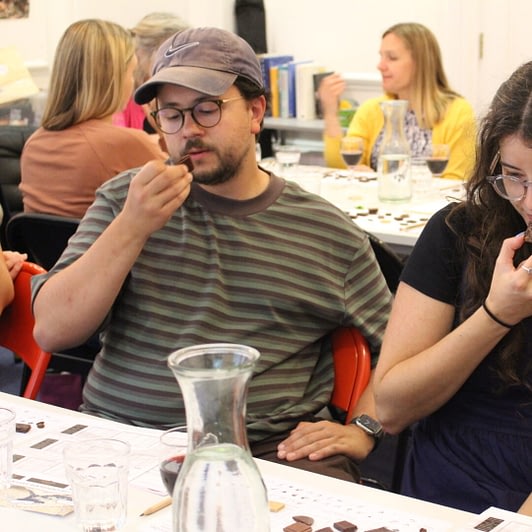
Overview: Craft chocolate needs more than great packaging.. it needs to be experienced. Hence the success of in-person tastings, farm visits, factory tours, fairs and even ceremonial cacao.
Likely: Bordeaux’s first international craft chocolate fair in March is a massive success – and the UK Craft Chocolate Association walks away with major honours.
Possible: Bordeaux Craft Chocolate show eclipses Paris’ “Salon du Chocolat” and is asked to take over Salon from 2027 (Ok, this is a bit of a stretch – but we’d love to see the big festivals focussing more on craft and less on confectionery).
Stretch: Yoga centres holding “cacao ceremonies” with mass produced 100% cocoa powder that is marketed with all sorts of nonsense claims in health food stores, Amazon, etc. “See the light”. They realise that craft chocolate tastes better, suits their clientele better, and is better for farmers and the planet. They stop using cocoa powders whose health and flavour benefits are inversely correlated with their nonsensical marketing copy. And they – and the cocoa farmers – can breathe easily. (Note: hat tip to Forever Cacao for already getting half way there). More seriously, if you know people into breathing, yoga, cocoa ceremonies etc. do please help them “see the light” – see here. That’s a stretch we could all do with!
8. Texture, shape, and the senses beyond flavour
Overview: Chocolate is delightful not just because of its complexity and depth of flavour, the intensity of taste but also because of TEXTURE and SHAPE.
Likely: Big Chocolate continues to find new shapes and formats that conveniently obscure shrinkflation (Toblerone-style spacing, segmentation, aeration), while continuing to talk about “luxury”.
Possible: Craft chocolate makers more explicitly demonstrate how form affects flavour: thin versus thick bars, rounded versus angular moulds, slow-melting versus fast-release designs – using texture and shape as a tool for education rather than concealment.
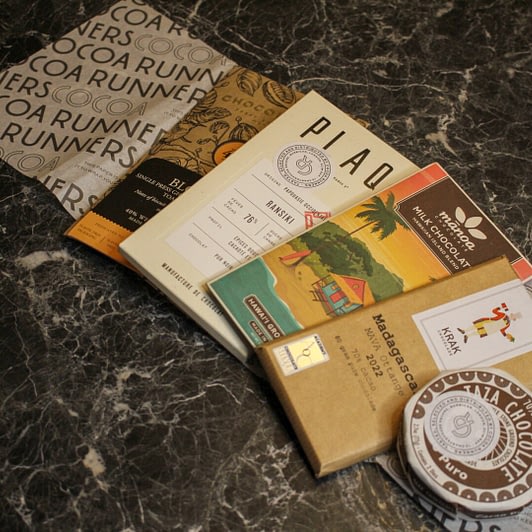
Stretch: Modernist design thinking is rediscovered by craft chocolate and museums alike. Following early experiments in Bordeaux, the Tate organises a major international exhibition inspired by Marinetti and Munari’s 1920s sensory experiments. Expect dark rooms, soundscapes, textured surfaces, communal breathing – and excellent craft chocolate. Or, failing that, something only slightly less ambitious – Cocoa Runners’ Craft Chocolate Fair in Farringdon in October 2026 explores this (this is perhaps better in the “possible” or “likely” category).
9. Language and savouring
Overview: Language shapes not just how we think, but how deeply we enjoy. Pausing to reflect on what you eat is one of the simplest ways to switch from scoffing to savouring (far easier than chewing 20 times, putting down your knife and fork between meals, etc.). It’s also far more social (especially in comparison to chewing each mouthful 20 times). And the language of flavour is a powerful way to assess a food’s “healthiness” (and maybe the only way we have to take a stab at assessing phytonutrients). Unfortunately, language can also confuse and mislead.
Likely: Big Chocolate continues to produce amazing images of chocolate melting with all sorts of great advertising copy. And they’ll continue to argue that mass produced chocolate is an everyday accessible delight that shouldn’t be taxed or regulated – despite being primarily made of sugar, having no flavour and promoting ill health and obesity. If you think these arguments sound familiar, they are the same used to “protect” online gambling, online pornography, vaping, etc.
Possible: Someone cracks how to “slay” craft chocolate, in the same way Dubai chocolate used vivid green colour and textural contrast to become an internet sensation (thanks to our resident Gen Z Nina for explaining “slay”, “no crumbs” and so much more). In parallel, craft chocolate continues to promote a shared language of flavour, echoing Ann Noble’s famous line: “You can’t talk about what you can’t name – and you can’t measure what you can’t describe.” (See our Flavour Wheel v2 here.)
Stretch: Articulating the flavours of craft chocolate becomes a tool for identifying healthier foods, eating more socially, sharing, savouring, and connecting. In doing so, craft chocolate starts to reverse the legacy of mass-produced chocolate and its role in inventing junk food, offering a route out of the UPF morass. (note: we can but dream ..)
Thanks for all your support now and going forward, your comments are welcome and please do share!
Links
https://cocoarunners.com/blog/chocolate-and-junk-food
https://cocoarunners.com/chocopedia/is-dark-chocolate-healthy/
https://cocoarunners.com/blog/magnesium-in-chocolate/
https://cocoarunners.com/chocopedia/theobromine-versus-caffeine/
https://cocoarunners.com/chocopedia/why-craft-chocolate-tastes-different/
https://cocoarunners.com/blog/fermentation-in-chocolate/
https://cocoarunners.com/chocopedia/cocoa-fermentation-and-drying/
https://cocoarunners.com/blog/using-ai-to-understand-food
https://cocoarunners.com/blog/salon-du-chocolat-and-craft-chocolate
https://www.icco.org
https://environment.ec.europa.eu/topics/forests/deforestation/regulation_en
https://www.ncbi.nlm.nih.gov/pmc/articles/PMC9776640/
https://arxiv.org/abs/1702.05957
https://arxiv.org/abs/1606.05675
https://arxiv.org/abs/1903.07437
https://arxiv.org/abs/1510.02078
Sensory science & flavour language / sensory wheels
https://www.researchgate.net/publication/10681161_Science_and_society_Challenges_for_the_sensory_sciences_from_the_food_and_wine_industries
https://www.researchgate.net/publication/328034447_Development_of_a_sensory_wheel_and_lexicon_for_chocolate
Food systems / sustainability context
https://easac.eu/fileadmin/PDF_s/Journal_Articles/978-3-031-15703-5.pdf
Italian Futurists (sensory / design context)
https://archive.org/details/manifestofuturis00futu
https://monoskop.org/images/3/31/Marinetti_Filippo_Le_Manifest_du_Futurisme.pdf