Ceremonial Cacao: Magic, Myths, and Mayan Realities
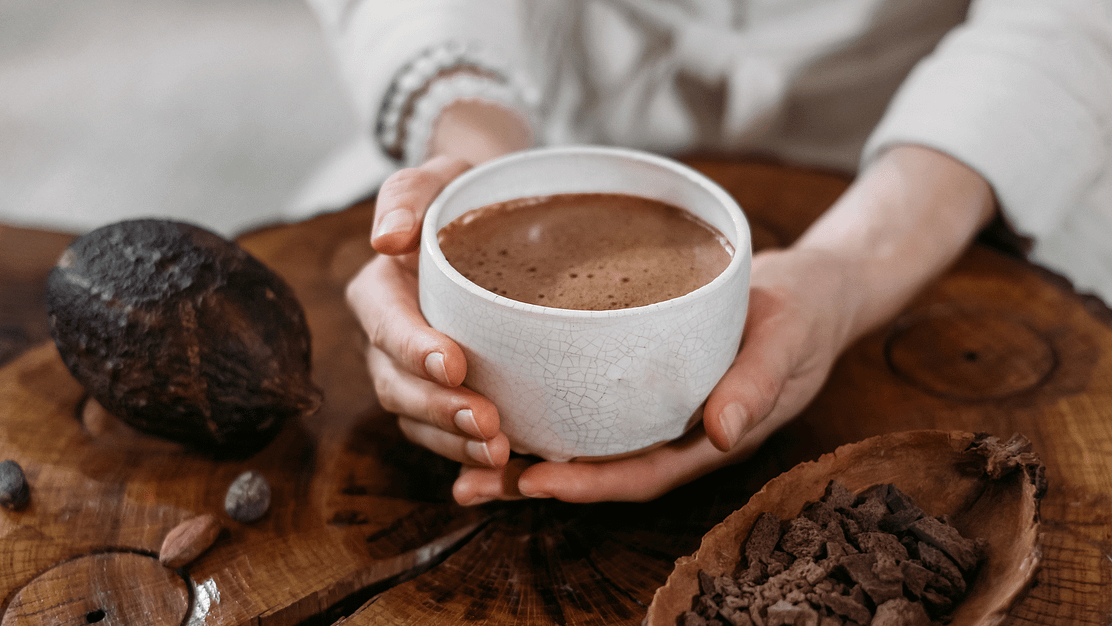
“Ceremonial grade” is pure marketing, right? Well that’s not the whole story and it’s worth a go
Print / PDFInitially I was pretty (actually very) sceptical about “ceremonial cacao”.
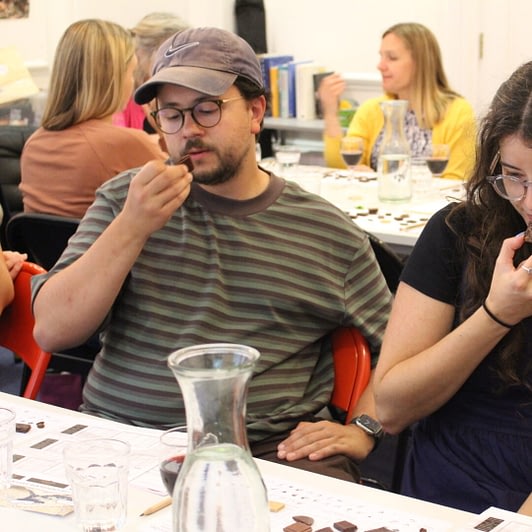
But that was before I experienced a couple of “ceremonies” with the amazing Pablo Spaul. The first of these was online. And then we asked Pablo to last year’s Craft Chocolate Fair at Fidelio, Farringdon. Everyone enjoyed it so much that we are doing it again. And if you hurry, you should still be able to get a ticket. High quality cacao (from the Ashaninka in Peru) in a calm, relaxing atmosphere with lots of breathwork, reflection and gratitude cultivated by Pablo, WORKS a treat.
So I’ll be there – and hope you can join us!
At the same time, I’m still very, very sceptical about many of the claims made for Ceremonial Cacao. Here are a few myths that should be busted from the get go:
Myth 1: Ancient Maya (or Inca, or any other tribes) held, and hold, “cacao ceremonies” just like today’s.
Fact: Maya and Mexica (Aztec) peoples used cacao in many sacred ways – as offerings to gods, in rites of passage, and as a drink for elites and armies. But there is no historical evidence of modern-style “cacao ceremonies” with meditation and sharing circles. Today’s formats are contemporary creations (2000s onward). At best they are inspired by Indigenous uses of other substances (e.g. ayahuasca, peyote, psilocybin) and – more often than not – spectacles put on for tourists.
Myth 2: “Ceremonial grade” cacao is a formal standard.
Fact: There’s no certification or agreed definition. Most suppliers mean minimally processed cacao from carefully fermented beans. But quality varies widely. The term “ceremonial” is pure marketing gobbledegook. Buyer beware / Caveat Emptor! Use the same guidelines as you would in selecting a bar (i.e. check down to the farm or co-op where the beans are from, how and where it’s been crafted and above ensure it’s not been alkalised, and what is “in it”). And Pablo’s powder meets all these criteria.
Myth 3: Cacao is a psychedelic.
Fact: Unlike ayahuasca, peyote or magic mushrooms (psilocybin), cacao is not hallucinogenic. It contains theobromine and caffeine (stimulants). In the right setting, calming music, breathwork drinking unsweetened cacao can work wonders. Hopefully you’ll experience some relaxation, heart-opening, focus, gentle euphoria. But if you are getting visions, something else has been added to your drink!
Myth 4: Ceremonial cacao is all about health and spirituality.
Fact: Ceremonial cacao is also about politics and economics. At its best it creates demand for ethically sourced beans, often from Indigenous farmers. But there are also questions: who benefits most – growers, or Western brands and facilitators? And does it create a view of the Maya designed to appeal to well meaning tourists, distracting the very real challenges for today’s Maya, glossing over for example, the ongoing Zapatista conflict and challenges for many cocoa farmers?
Having done this debunking, I’m still a fan. I’m convinced that there are lots and lots of benefits to savouring high quality drinking chocolate in a mindful way.
I also think that a “mindful” deep dive into the history of ceremonial cacao and the other “gifts of the gods” enjoyed by the Aztecs and Mayans (such as ayahuasca, peyote, psilocybin and ololiuqui) provides a very different perspective on Mayan history and their current situation.
Why the conquistadors exported cacao but banned mushrooms (and more)
Long before Spanish ships appeared on Mesoamerican shores, cacao was already woven into sacred and social life. The earliest evidence of cacao use dates back to around 1900–1500 BC in Mesoamerica, with even earlier finds (~3500 BC) in Ecuador. Among the Maya, it was offered to deities, served at elite banquets, and exchanged as currency. For example, glyphs (think cartoons) on vessels and references in the Popol Vuh show cacao as a drink of fertility, rebirth, and divine communion. Among the Mexica (Aztecs), it was equally prized: courtly accounts describe Emperor Moctezuma consuming vast quantities of frothy cacao, sometimes spiced with chilli or flowers.
Yet cacao was only one part of a broader sacred pharmacopoeia. Nahua priests also used teonanácatl (“flesh of the gods,” psilocybin mushrooms) and ololiuhqui (morning glory seeds – another hallucinatory substance) in divinatory ceremonies. Farther south, Indigenous peoples of the Amazon basin prepared ayahuasca brews to access visionary realms, heal illness, and maintain cosmological balance. These substances, in their very different ways, were anchors of both civilization, ritual, memory, and cultural order.
When conquistadors and missionaries confronted both Mayan and Aztec civilizations they reacted with awe, and a mixture of fascination and fear. The line they drew between what was acceptable and what was forbidden would shape the trajectory of sacred plants for centuries.
- Suppression of hallucinogens: Psilocybin mushrooms, peyote, and ayahuasca were branded tools of the devil. In the Florentine Codex, Sahagún records Nahua mushroom ceremonies, but is always framed with disapproval. By the late 16th century, Inquisitors prosecuted Indigenous people for consuming “diabolical herbs.” The Church perceived these substances, and their role in creating visions, as threatening Catholic orthodoxy, suggesting access to revelation that wasn’t controlled by the Church. Similarly, when Catholic missionaries came across ayahuasca, they denounced it as witchcraft. These substances were driven underground, surviving only in discrete Indigenous contexts until their rediscovery in the second half of the twentieth century (see below).
- Appropriation of cacao: Cacao, however, was different. At first, Spaniards misunderstood it – mistaking it as “merely” a unit of currency. Then they confused its use, associating it primarily with sacrifice and blood. Then they realised how powerful it was in nutritional terms – and how literally the Aztec army “marched on it” for breakfast. And because cacao is stimulating, not hallucinogenic, it was more easily reframed as a food and medicine. The addition of sugar, cinnamon, and vanilla turned cacao into a palatable colonial luxury. By the 17th century, Jesuit scholars, securing support from the Papacy, won their debates as to whether drinking chocolate could be consumed on “fasting days”. By the early 17th century, cacao was a key export crop from Ecuador, Venezuela, and later the Caribbean.
In short: cacao was domesticated into the empire, while visionary plants were driven underground.
Commoditisation, dormancy and rediscovery
For centuries, the story of cacao was one of commoditisation. Chocolate spread across Europe, first as an aristocratic drink, later as an industrial product that was both drunk and eaten. Cacao’s cultural, religious and sacred links were stripped away. Psilocybin and ayahuasca, meanwhile, were driven underground, surviving only among Mazatec curanderos or Shipibo shamans, largely invisible to outsiders.
This began to change in the late 20th century. In particular, R. Gordon Wasson’s 1957 Life magazine article introduced the Western public to Mazatec mushroom ceremonies with María Sabina, sparking both fascination and a huge boom. In Brazil, new syncretic churches like Santo Daime and União do Vegetal wove ayahuasca into Christian ritual, eventually securing legal protections. In North America and Europe, psychedelic research in the 1950s and 60s briefly flourished before being shut down by prohibition.
Cacao, by contrast, remained seen as a commodity ingredient, and indeed was a pioneer in what we now call “Ultra Processed Foods”, effectively inventing the bliss point and sensory-specific satiety generations before junk foods rediscovered them. Then, in the late 20th, century wellness movements began to rediscover chocolate as a “superfood” and spiritual supplement.
Seeds of the Modern Cacao Ceremony (1980s–2000s)
In the 1980s and 90s, Western New Age and alternative-spiritual circles began adapting Indigenous-coded rituals into yoga, meditation, and retreat contexts. Herbalism, shamanism, and “plant medicine” entered the wellness vocabulary. Cacao began to resurface. After Mars discovered the power of marketing chocolate as “good for your heart” (for more see HERE), it perhaps became inevitable that “cacao” would also become celebrated as, for example, a heart-opening elixir too.
The raw-food movement of the early 2000s, propelled by figures like David Wolfe, also played into this trend. “Raw cacao” was marketed as a superfood, with extraordinary claims made for its magnesium, potassium, ORACs (sic); polyphenols, antioxidants, levels. For a fuller rant on raw chocolate see HERE But arguably the movement to higher percentage “raw” bars helped lay the groundwork to persuade this consumer base willing to drink thick, bitter cacao brews outside of conventional confectionery and tap into the appeal of “healthy” treats.
In the annals of the ceremonial cacao, one of the pivotal moments came in San Marcos La Laguna, Lake Atitlán, Guatemala in the early 2000s. The aptly self-titled “Keith the Cacao Shaman” (an American expatriate named Keith Wilson) began hosting cacao-based meditation circles around 2003. These gatherings used cacao as a catalyst for intention-setting, breathwork, and song. For visiting travellers and tourists, the experience carried the aura of “authentic” Maya heritage, even though the format was largely Wilson’s innovation. And rapidly participants exported the template to Europe, North America, and Australia.
By the 2010s, “cacao ceremonies” had become staples of yoga studios, ecstatic dance festivals, and retreat centres. The format typically included:
- A thick, unsweetened cacao drink, often from Guatemalan or Peruvian beans
- Guided meditation or breathwork
- Collective sharing, chanting, and/or dance
These “ceremonies” proved super popular. And a bunch of entrepreneurial makers and traders emerged to supply this new market. Even Covid failed to dent the popularity of ceremonial cacao. Ceremonies went online (here is a video of one we did).
Today the phrase “ceremonial grade” is a powerful buzzword. Unfortunately it lacks any independent certification. At best, “ceremonial cacao” means carefully fermented, minimally processed, small-batch cacao that isn’t alkalised and is (mainly) flash roasted. But there is an awful lot of “ceremonial cacao”, and much of it has minimal provenance but plenty of marketing sizzle. So again, check where your beans come from, how it’s been crafted and what’s in the ingredient list.
An Opportunity lost?
Within the craft-chocolate community the popularity of “ceremonial cacao” has aroused both amazement and bemusement. Makers are inundated with requests for 100% cocoa liquor that is repackaged and sold by savvy marketeers as “ceremonial grade cacao”. And yes, the pro-tip is to purchase directly from the likes of Pablo (and if you want some great non alkalised Tanzanian powder, please try the Kokoa Kamili powder here).
And there is another, far deeper and more significant, irony here. In popular imagination, the Maya are often frozen in time: builders of temples, scribes of glyphs, keepers of cacao rituals. Tourists flock to Chichén Itzá and Palenque; wellness seekers sip “ceremonial cacao” while invoking ancient wisdom.
Yet as Emily Stone of Uncommon Cacao, and any Craft Chocolate makers like Patrick and Peggy from Choco Del Sol, who’ve been working in Guatemala and Belize for over two decades, the Maya cocoa farmers are not “relics”. They have a proud and long lineage, for example the Q’eqchi’ growers in Guatemala represent a lineage of fine craft chocolate that stretches back to the K’iche’ nobles who, in 1544, first introduced prepared chocolate to Europe.
The Mayan are living peoples across southern Mexico, Guatemala, Belize, and Honduras — more than six million strong. And for centuries, they have fought not just to preserve rituals but to defend their land, labour, and their culture. That story, less marketable than their pyramids, plant medicines and cacao ceremonies, has all too often been sidelined. So here is a very simplified attempt to celebrate the ongoing Mayan struggle for recognition and their culture since the mid 19th century.
An alternative history of the Mayans
The fall of the Mayan, Aztec, and Incan empires is often portrayed as a swift conquest where the Spanish elite quickly took control, subjugated native populations, forced labor in mines and plantations, and caused massive deaths from diseases like smallpox. However, the remarkable achievements of the Mayans, Olmecs, and Aztecs are frequently overlooked. For example, the world’s largest pyramid by volume is not in Egypt but the Great Pyramid of Cholula in Mexico, built by the Olmecs and Mayans.
The true history of these empires is complex and devastating for indigenous peoples. Despite overwhelming odds, the Mayans have preserved their culture, though at great suffering, as shown in the late 19th-century Caste War and the 20th-century Zapatista movement.
After two centuries of colonization, Maya villagers endured debt peonage in Yucatán, paying rent and taxes with labor. Forced into growing export crops like henequen and losing communal lands to cattle ranching, they rose up in the Caste War (1847–1901), rallying around the Cruz Parlante (Talking Cross) cult. For decades, the Maya controlled most of the peninsula, maintaining a state-within-a-state in Chan Santa Cruz until repressed by Mexican forces.
In Guatemala and Chiapas, Maya communities faced similar exploitation under the coffee boom, losing lands and being crushed by harsh wage labour. Laws criminalizing Indigenous non-compliance and violent suppression of revolts further entrenched poverty and marginalization.
The Mexican Revolution promised Indigenous land reforms, but large landholders retained power and Maya voices remained marginalized. It was not until January 1, 1994 – when NAFTA came into effect – that the Zapatista uprising began. The mostly Indigenous Ejército Zapatista de Liberación Nacional (EZLN) demanded land reform, Indigenous autonomy, cultural rights, and opposed NAFTA, which threatened peasant livelihoods. Zapatistas established autonomous municipalities governed by community assemblies, prioritized women’s rights, Indigenous education, and collective land use. With Subcomandante Marcos as their spokesperson, they became icons of global anti-globalization activism. Despite fading media attention, their autonomous zones persist amid ongoing challenges from military and paramilitary pressures.
And this is where “ceremonial cacao”, and its Disneyfication, is historically problematic. In mainstream Mexican and international narratives, the Maya are more often portrayed as “ancient” than as political actors of the present. Tourism brochures highlight ruins and rituals, not the struggles of the Mayans, and cacao farms, to survive. Wellness industries celebrate cacao ceremonies, rarely (if ever) mentioning the Maya who’ve been fighting since the Conquistadors invaded, right though to 1847, 1994 and even today.
If ceremonial cacao today offers a chance for connection and reflection, it should also remind us of these political struggles. To drink cacao without remembering the Talking Cross or the Zapatistas is to taste only half the story.
And if you want to celebrate Mayan culture, why not also try a bar made from cacao grown by today’s Q’eqchi’ farmers in Guatemala – descendants of a civilisation whose K’iche’ nobles first presented finished chocolate to Europe in 1544. Hat tip to Uncommon Cacao for supporting these farmers, and to makers like Standout, Sirene, Fresco, Boho, and Chocolarder for transforming their beans into exceptional bars:
Standout – Lachuá, Guatemala 70 % Dark — sourced from Lachuá, Guatemala
Sirene – Lachua, Guatemala 73 % Dark — from the same region
Fresco – Guatemala Polochic Valley 70 % Light Roast — Polochic Valley is known for Q’eqchi’ Maya cultivation
Fresco – Guatemala 100 % Dark — the full-strength variant
Sirene Dark Milk (Lachua origin) — a dark milk bar with same bean origin