Nostalgic Chocolate bars done right – with some unexpected twists!
Dig into the history of some of your childhood favourites -- from Fruit and Nut to Toblerone, Bounty to Mars and Caramac to Terry's Chocolate Orange (and lemon, apple and more). Find out which country has a cherry Bounty, why Dairy Milk wasn't accepted as chocolate by the EU, why Toblerone can't show the Matterhorn any more on their packaging, the real history of the Mars Bar icecream, and much more. Plus we've assembled a series of wonderfully nostalgic ads to remind you. Finally, and more importantly, discover a few canny Craft Chocolate bars that taste even better than you remembered.
Print / PDFThe flavours and smells of childhood
Few impressions are as powerful, and nostalgic, as smells and flavours from our childhood And this is particularly true for foods and drinks – including chocolates and confectionery – as we come across them in later life.
We all have our “go to” bar, and it’s often associated with an experience and even some advertising. But sadly very often when we again try those childhood treats, they don’t quite taste as we remembered or hoped. But fear not! Intrepid craft chocolate makers have taken inspiration from these past treats, and created wonderful alternatives.
To rejog your memories, we’ve not only created a list of “grown up, as they should be” craft chocolate equivalents, but we’ve also dug into the peculiar history of your childhood favourites and have a few nostalgic videos for you to peruse and take a trip down memory lane.
Dairy Milk .. did you know?
- Dairy Milk was launched in June 1905 by George Cadbury Jr. to resounding success in the UK; rapidly becoming the most popular milk chocolate bar in the UK
- How the name came about is still disputed; some argue it came from combining two “front runner” names; “Highland Milk” and “Dairy Maid”, while Cadbury’s suggests it came from a customers daughter
- When Britain joined the Common Market (as it was then called), various European countries argued that Dairy Milk could not be called “milk chocolate” as i) it contained vegetable fats rather than “just” cocoa butter, and ii) it contained too much milk (Cadbury’s “glass and a half” means it contains 25% milk, versus the 14-15% in most continental milk products. This dispute rumbled on with various flare ups (e.g., 1997) and wasn’t solved before the UK exited the EU.
- In 2017, Cadbury launched a “Dark Milk” initially in Australia, and then later in the UK as a range extension. Cadbury Darkmilk is made with 40% cocoa solids and 14% milk solids – in comparison, the standard Cadbury Dairy Milk bar contains 23% cocoa solids and 20% milk solids. And in Craft Chocolate, most “milks” are over 40% cocoa solids; with “Dark Milks” being over 50% cocoa (so more than e.g., Cadbury’s best known dark bar, Bournville)
Alternative Bars:
Choco Del Sol – Tanzania Dark Milk
Original Beans – Esmeraldas Milk
Caramac .. did you know?
- White chocolate was originally developed as a vitamin supplement, and sold as Nestrovit, by Nestle at the request of the Swiss Government after World War 1 to persuade Swiss Children to consume more milk. After five plus years Nestle realised that “Nestrovit” could also be sold as confectionery, originally calling it Galat
- Seeing the success of “Milky Bars, the the British confectionery company Mackintosh’s in 1959 launched “Caramacs”. The name Caramac was created by Barbara Herne, who won a competition held at the Mackintosh’s factory in Norwich
- Mackintosh’s merged with Rowntree’s in 1969 to form Rowntree Mackintosh, which was in turn acquired by Nestlé in 1988, who in 1996 moved production from Norwich to Nestlé’s Fawdon factory near Newcastle
- Following Nestle’s announcement of plans to close he Fawdon Factory in 2002, a year later – citing falling sales – Nestle’ announced the “difficult decision to discontinue it” arguing that “his change will enable us to focus on our best-performing brands, as well as develop exciting new innovations to delight consumers’ tastebuds.”
- Nestle were rushed into announcing the ending of Caramac after a baker in Midlothian (Paula Swan) posted on facebook that she’d stockpiled twenty cases of Caramac to make more of here eclairs and doughnuts after her supplier warned her that the bar was about to be discontinued
The good news: Chocolarder’s Blonde is AMAZING as an alternative.
Chocolarder – Blonde
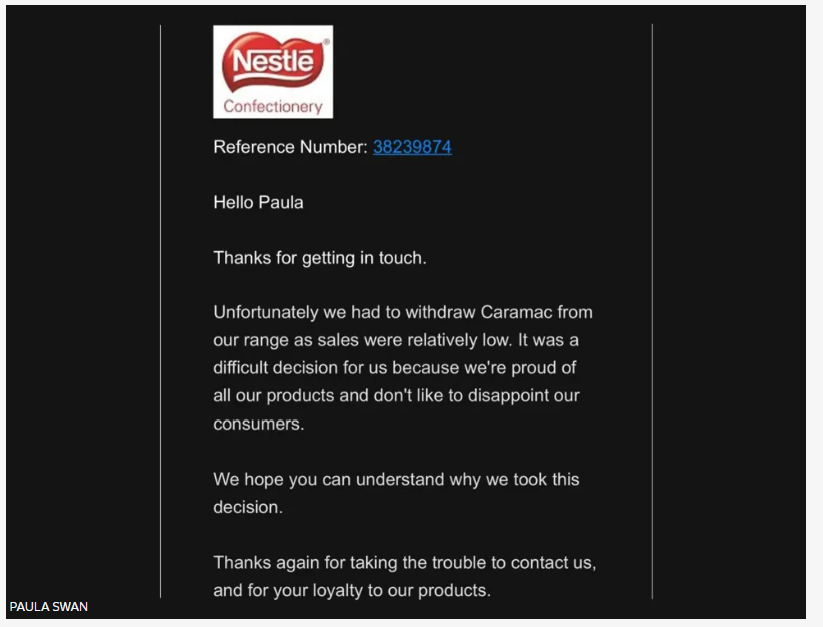
Nestle announcing ending of Caramac to Paula Swan on social media
Cadbury Fruit and Nut .. did you know?
- In 1928, as part of plans to “extend” the success of Cadbury’s Dairy Milk bar (see above), the Cadbury’s product development team launched their “Fruit and Nut” bar, followed in 1933 by a “Whole Nut” Dairy Milk
- In the same year (1928) as launching Fruit and Nut, Cadbury also launched the purple and fold packaging we still associate with Dairy Milk and Fruit and Nut
- Cadbury’s powerful use of Phil Collins’ music (and a gorilla) for Dairy Milk was predated by Fruit and Nut with the iconic “Everyone’s a fruit and Nut” song (see below)
- When first launched Fruit and Nut was made with raisins and almonds and this format continued for over 90 years. However in 2015 – Cadbury announced it was changing the recipe to include sultanas in addition to the raisins
- And in case you were wondering :
- Raisins can be made from any variety of grape, while sultanas are specifically made from seedless green grapes, often the Thompson Seedless variety
- Whereas raisins are typically dried naturally in the sun for around 3 weeks, sultanas are often dipped in an oil-based solution to speed up the drying process
- In terms of appearance, raisins are typically larger and darker in color, ranging from dark brown to black. Sultanas are smaller, lighter in color, and can range from pale green to golden to black
- This announcement was met with a strong consumer backlash, despite Cadbury’s arguing that consumers couldn’t tell the difference. And today, Cadbury’s Fruit and Nut bars contain EITHER raisins OR sultanas (but not both), and you need to check the ingredients to see which is included in the bar.
Alternative:
Choco Del Sol Trail Mix
TOBLERONE .. did you know?
- Toblerone was invented in 1908 by chocolatier Theodor Tobler and his cousin Emil Baumann. Tobler had inherited his family’s chocolate shop in Bern, Switzerland and began experimenting with new recipes. He and Baumann created a unique chocolate bar made with honey, almond, and nougat, and shaped it into a distinctive triangular prism design
- Tobler named the new chocolate bar by combining his family name with the Italian word “torrone” for nougat to create the name Toblerone (so no, despite Simon Rimmer’s protestations on Sunday Brunch it’s not because Tobler was planning to launch a “Toblertwo”, “Toblerthree”, etc.
- Toblerone was the first patented milk chocolate bar, and there have been some far fetched claims that Albert Einstein could have potentially been involved in the patenting process as he working at the Swiss Federal Institute of Intellectual Property during this time
- The inspiration behind the triangular shape of Toblerone is generally thought to have been inspired by the Matterhorn mountain, one of the most famous peaks in the Swiss Alps. However, some sources suggest the shape was actually based on the pyramids formed by dancers at the Folies Bergère cabaret in Pari
- In 2017, Switzerland passed the “Swissness” law, which requires that products marketed as “Swiss made” must contain at least 80% Swiss raw materials, and 100% for milk and dairy products. This law restricts the use of Swiss national symbols like the Matterhorn mountain on product packaging if the product is not made entirely in Switzerland. In 2023, Toblerone’s parent company Mondelez announced it would be moving some Toblerone production from Switzerland to Slovakia. As a result, Toblerone is having to remove the iconic Matterhorn image from its packaging and replace it with a more generic mountain shape, as the chocolate bars will no longer meet the “Swissness” criteria
Alternative:
Pralus – Barre Infernale Nougat
BOUNTY BAR .. did you know?
- Bounty was first launched by Mars in 1951 in the UK and Canada as a rival to the American Mounds bar, which paired dark chocolate with shredded coconut. Bounty Bars were initially sold with a coconut-flavored filling covered in milk chocolate, and then later a dark chocolate version was also launched in the UK
- Bounty was designed, and marketed to appeal to the postwar optimism and desire for exotic travel in the UK and other markets. And to appeal to the sense of “exotic”, alternative “flavours” have been launched in specific markets. For example since 2013 Australians have been able to purchase a cherry version. And before this Mango was available as a limited edition version in Russia, Ukraine and Europe, and a pineapple version was made available in Russia only during 2014.
- Bounty’s coconut filling is remarkably divisive. According to a survey conducted for the “Celebrations” range (small taster bars of Mars, Bounty’s etc.), 48% of respondents disliked the taste. However, 18% said it was their favourite out of the eight varieties available and 38% of over-55s chose the mini Bounty as their preferred bar.
- While Bounty has a loyal following in the UK and Canada, it has struggled to gain the same popularity in the United States, where it is seen as less desirable than similar coconut-chocolate bars like Almond Joy. As a result, Mars no longer sells Bounty in the US, though it can still be found in the international section of some American grocery stores
Alternatives:
Marou – Popped rice coconut milk bar
Marou – Coconut milk Ben Tre
MARS BAR .. did you know?
- The Mars bar was invented in 1932 by Forrest Mars Sr., the son of American candy maker Frank C. Mars. Following a family disput, Forrest Mars had moved to Slough, England the prior year and started a small chocolate factory with just 4 employees, using second-hand equipment and a cold kitchen.
- The original Mars bar was modeled after his father’s successful Milky Way bar, but with a recipe adapted to suit European tastes
- The name “Mars” simply comes from Forrest Mars Sr.’s surname, and there is no evidence that the name was chosen to evoke the planet Mars or the Roman god of war, despite some initial speculation about those connections (sidenote: The Mars family was known to be big fans of horses, with the Snickers bar named after one of their favorite horses)
- During World War II, Mars bars were successfully distributed to troops in the UK and prisoners of war in Germany, despite wartime rationing and shortages. Following this international success, Mars expanded globally including in the US (the UK Mars never sold that well, and was discontinued in 2002 and later revived in a slightly different form as the “Snickers Almond”)
- In the 1970s Dan Jacoby – a well known UK ice cream inventor – started to investigate the possibility of a “mars bar icecream”. Initially he was rebuffed, but Jacoby persisted, perfecting the recipe in his own kitchen with the help of his children and eventually Mars agreed, creating a new ice cream category.
- Alongside it’s confectionery business (Mars also now owns Wrigleys Chewing Gum), the MArs corporation – which is privately owned – has massive pet and veterinary businesses, having a market share in the global pet food industry of over 40% (it owns brands like Pedigree, Whiskas, Temptations, Crave, etc.
Alternative:
Zotter – Salted Caramel
Zotter – Butter Caramel
Terry’s Chocolate Orange .. did you know?
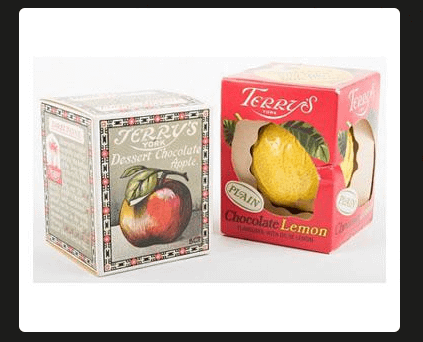
- Before launching Terry’s Chocolate Orange in 1931, Terry’s had launched a Chocolate Apple in 1926 from their York Factory (the Chocolate Apple continued until 1954)
- Terry’s also, unsuccessfully, launched a Terry’s Chocolate Lemon in 1979, but withdrew this after three years of poor sales
Over 20 different Terry’s Chocolate “flavours” have been launched as limited editions – including, raspberry, birthday cake, toffee crunch, cookies, etc. But none (including the Apple and Lemon) have “stuck” - Terry’s was originally founded in 1767 when Robert Berry opened a shop in York selling candied peel, sweets, and cough lozenges. In 1823, Joseph Terry joined Berry’s business, and it was renamed “Terry & Berry”. After After Berry’s son left in 1828, Joseph Terry took over the company and renamed it “Terry’s of York”
- Since the 1970’s the Terry’s brand has been through multiple hands .. Colgate-Palmolive, United Biscuits, Kraft, Mondelez and most recently (2017) it became part of Carambar & Co.
- Fun fact – UK craft chocolate makers Chocolarder have a two roll refiner from the original Terry’s of York factory. So the same machine which made those chocolate oranges is now making delicious, ethical craft chocolate down in Cornwall! As with all of their antique machinery, the machine has a name – no prizes if you guessed it’s Terry.
Alternative:
MIA 65% with Orange
Ocelot – 70% with Blood Orange