Peeling back the paint of greenwashing
...Despite being a huge, complicated, and at times infuriating topic, I want to share some ideas that might help you spot greenwashing in chocolate...
Print / PDFHello again!
I’m stepping in again for Spencer this week, as he’s off representing the UK craft chocolate industry at San Francisco’s ‘Craft Chocolate Experience’.
Hopefully we’ll have some intriguing insights from him when he gets back. But in the meantime, in this week’s Craft Chocolate Matters, I want to talk to you about “greenwashing”; how we might spot it, and why we should care.
So what is greenwashing? The term itself originated in a 1986 essay critiquing how hotels urge guests to reuse towels for environmental reasons, when in reality it’s all about cost-saving. Since then, the term has morphed and stretched and divided to mean many different things; but at its core, it’s about how businesses mislead consumers over their sustainable practices and credentials (or lack thereof).
Sadly, the ‘big chocolate’ industry is so greenwashed that it’s practically impossible for a conscientious consumer to navigate. But I’d like to try and help. Despite being a huge, complicated, and at times infuriating topic, I want to share some ideas that might help you spot greenwashing in chocolate.
Look at labels with a critical eye
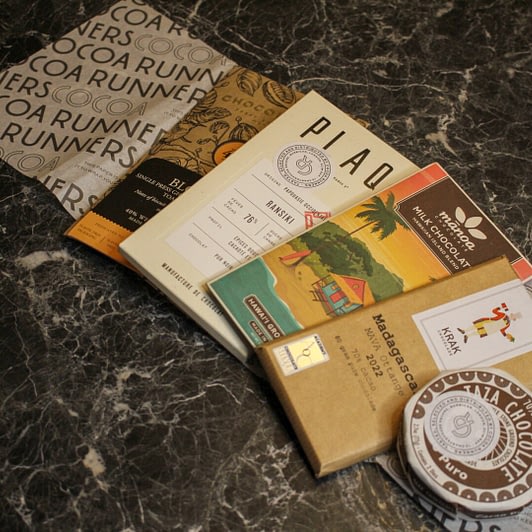
Where to even begin. Some of the best advice that we give budding chocolate enthusiasts is to read labels. Chocolate labels are oftentimes a bit bamboozling, but once you get in the habit, you can at least become familiar with what to look for on ingredient lists; less-is-more when it comes to good chocolate.
But in the cacophony of information that a chocolate label throws at you, you’ll find all sorts of clues about the nature of the chocolate, and the company trying to sell it to you.
One of the most powerful ways that chocolate brands communicate with consumers is through their ‘certifications’. You’ll have seen products being “certified organic”, or a company being “certified B corp status”, but there are myriad forms and functions of these certification programmes.
Not every bite is as sweet as the next
Probably the most widely recognised (and respected) certification is ‘Fairtrade’. This a specific certifying organisation, but for most people “Fairtrade” is just a labelling short-hand for “ethical” and/or “sustainable”. Fairtrade is a very admirable institution, and they’ve achieved a great deal, and we’ve written about them at Cocoa Runners before, so I don’t want to critique them here. But there is one practice of theirs which is worth highlighting; ‘mass balancing’.
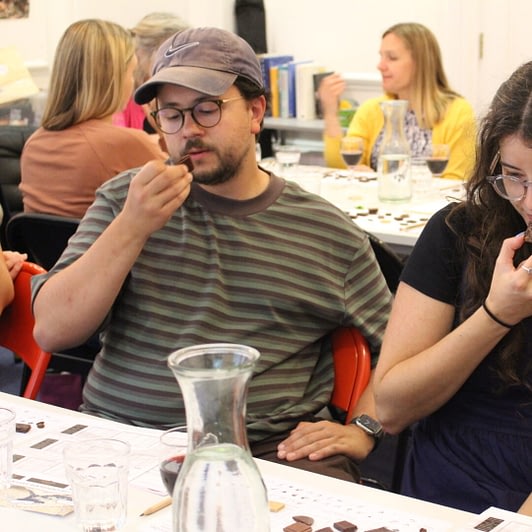
Especially at our tasting sessions, discovering what “mass balance” means for chocolate is one of the biggest surprises for many people. This is essentially the practice of certifying a particular amount of cocoa beans, but then mixing them into a much wider supply.
So let’s imagine a chocolate company might buy 100 tonnes of Fairtrade cocoa to produce their specific ‘Fairtrade bar’, but they have to buy another 400 tonnes of non-Fairtrade cocoa to make all the rest of their products. All 500 tonnes are used together to make the entire product line. Suddenly that dilutes how “fairly traded” you might consider that Fairtrade product.
Mars have played this trick recently too, in a huge announcement that they are moving all of their European production to “responsibly sourced cocoa”. As Mars explains; “this means the company will purchase a volume of responsibly sourced cocoa equivalent to the volumes used in its European production”. Is it a positive step? Probably. But I hope you agree it’s offputting that they need to use this slightly gross strategic language to explain (and I haven’t even delved into what “responsibly sourced” is supposed to mean!).
Look for the small print. If a chocolate is certified in some way, look for an asterisk which may lead you to more details.
I think I’m sustainable, therefore I am
Mass balancing is, in reality, a nuanced and complex issue. But something a bit more straightforwardly unpleasant is ‘self-certification’. This is a growing trend in the ‘big chocolate’ industry, whereby companies create their own sustainability labels, and apply them to their own products.
Perhaps the most visible example of this is ‘Cocoa Life’. You may have spotted a little green circle containing these words on some of the most popular supermarket chocolate brands, notable Cadbury products. Cocoa Life is the programme set up by Mondelēz (Cadbury’s parent company) after they stopped using Fairtrade. It’s an entirely Mondelēz owned and operated programme, but, on the chocolate packaging in your local supermarket, you could be forgiven for thinking that it’s some sort of 3rd party certifier, endorsing the sustainability practices for the brand. And of course that’s what they want you to think!
Make no mistake; Mondelēz are one of the chocolate industry titans; a multi-billion dollar company. They might be able to show you some of the positive work that they do in cocoa growing regions, but they are ‘big chocolate’. The deforestation, the poverty, the exploitation; it lands on their doorstep. Would you buy a henhouse which was fully certified-secure by the fox?
Always take a look behind the scenes where you can. If something doesn’t seem quite right on a chocolate label, give it a Google and try and find out who’s behind it.
Get some context
Big chocolate wants a slice of the ‘ethical consumer market’ pie. In this highly competitive space, every chocolate brand deploys their marketing skills to convince you that THEY are the ones saving the planet, so you should buy their bars.
Don’t get me wrong; big businesses making progress towards ethical and sustainable practices is a good thing. But if you put into context the scale of their impact, it’s suddenly not too impressive, and you might think twice before making an “ethical” purchase with them.
It’s no secret that most cacao farmers in the ‘bulk cocoa’ supply chain live in poverty. Many chocolate brands are open about how they are “working towards solutions”, “committed to change”, “pledging to improve”, etc. etc. (insert your preferred PR phrasing here).
But most of these companies consider ‘living income an aspiration target. And what is ‘living income’? The Global Living Wage Coalition’s definition says that a “decent living” includes “food, water, housing, education, health care, transportation, clothing, and other essential needs”. That’s a pretty low bar I hope you’d agree; so think twice when a chocolate brand tells you how hard they’re working towards achieving living income, and ask why (when they’re making record profits year-on-year) they aren’t just doing it anyway!
An even bigger brand which is complicit in this vaguery is Galaxy. This is one of Mars’ flagship retail brands, and you may have noticed that they’ve recently gone all-in on corporate social responsibility and ethical consumption in their advertising campaign.
The big flagship idea is that they pledge to “help one million people thrive by 2030”. Well that sounds great! A million is lot of people! …But how is Mars going to count the one million people exactly? And what does it mean to help them “thrive”? It’s asking these questions that makes you a more savvy conscientious consumer.
As a little side note: It’s interesting that Mars’ pledge to spend $1b this decade on improving farmers’ lives is less than the $1.5b they spend EVERY YEAR on marketing alone! When you put the figures from these companies’ ESG programmes into the context of the gargantuan chocolate industry, their scale certainly diminishes significantly.
Maybe probably somehow some day
One of the biggest red flags for greenwashing is vagueness. The chocolate industry, and the wider cocoa value chain, is complex. Even most of the people who work within it don’t fully understand it all, so how can a casual consumer be expected to? This impenetrability is armour that marketers can use to play some tricks with you.
Green & Black’s is a brand which carries the perfume of being ethical (a quick reading of the history will give you some idea why that’s maybe not as deserved as it once was). But they often a phrase that I find frustrating; they state that their “farming and harvesting follows nature’s way”. …Well, Green & Black’s aren’t doing either of those things… so what are they saying!? It’s, of course, a vague nothing-statement. And good luck finding specific information about where their beans come from, or how much they paid for them!
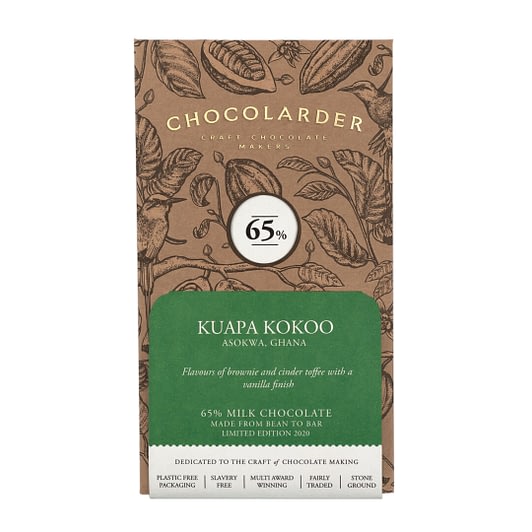
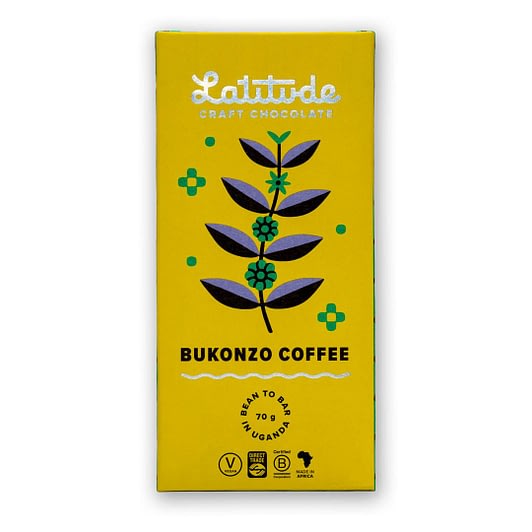
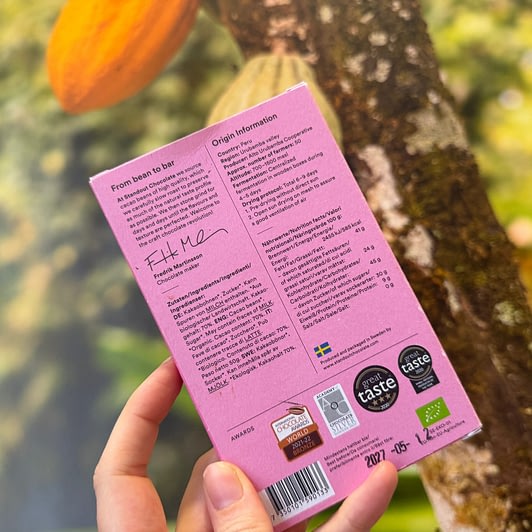
If a brand is making a statement about their positive impact, then they should be able to back it up. Craft chocolate makers often include details about their relationship with cacao farmers right on the packaging itself. Even more commonly, their websites will provide detailed information about where their cocoa comes from, and who’s been involved along the value chain.
If you find yourself coming up with questions about a brand’s claims, but coming up short with answers, then maybe they don’t you to have the answers.
How many words is a picture worth?
In all honesty, for most of us purchasing a bar of chocolate isn’t a laborious and intellectual undertaking; it’s usually a quick decision based on something looking or sounding tasty.
But this is where the power of images comes in. A quick flash of a photo can implant all sorts of ideas, even feelings, in us. So it’s worth deploying a bit of visual intelligence when it comes to images that we’re shown by chocolate companies.
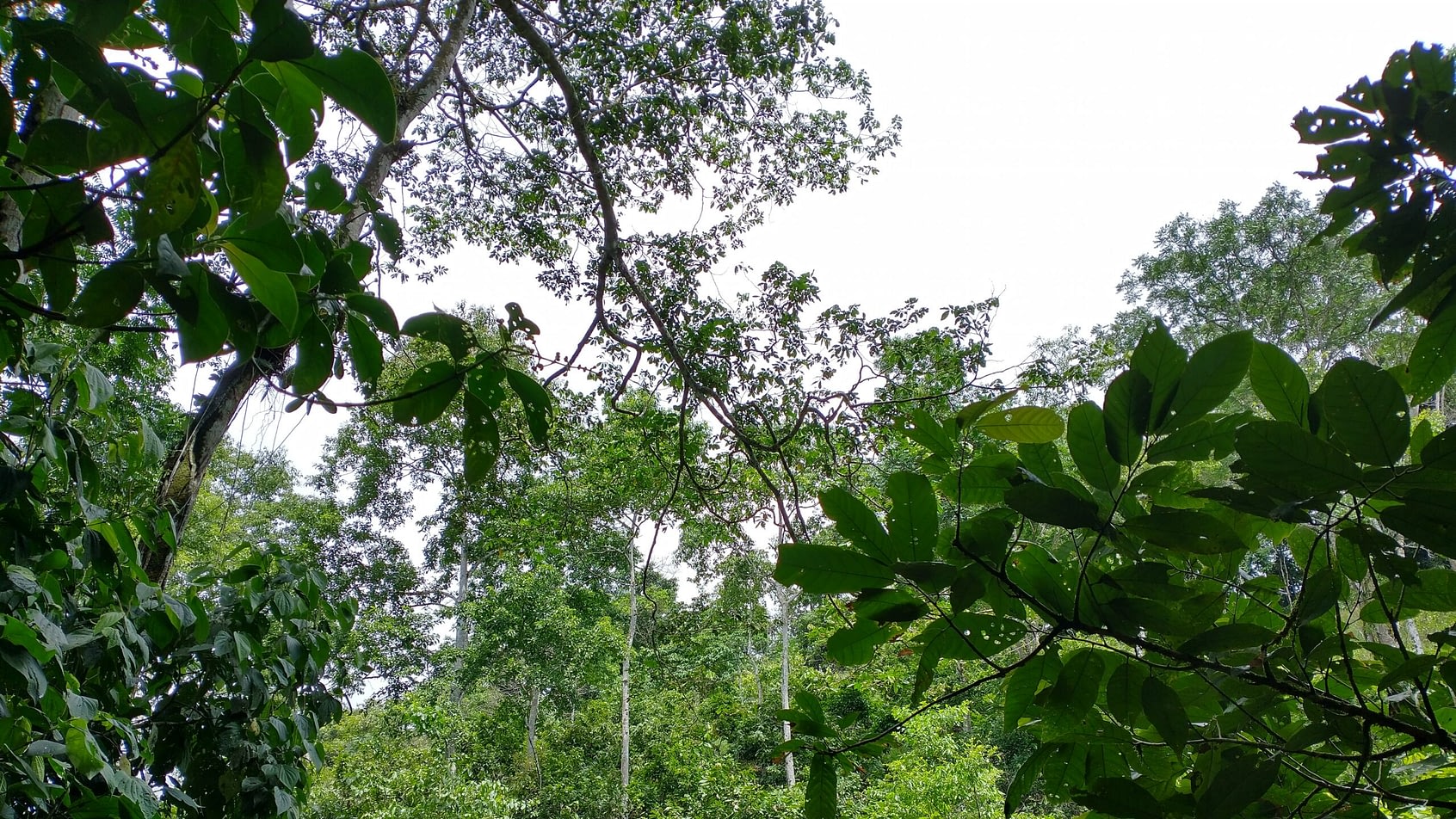
Just as a little case study, let’s have a look at this photograph which caught my eye recently:
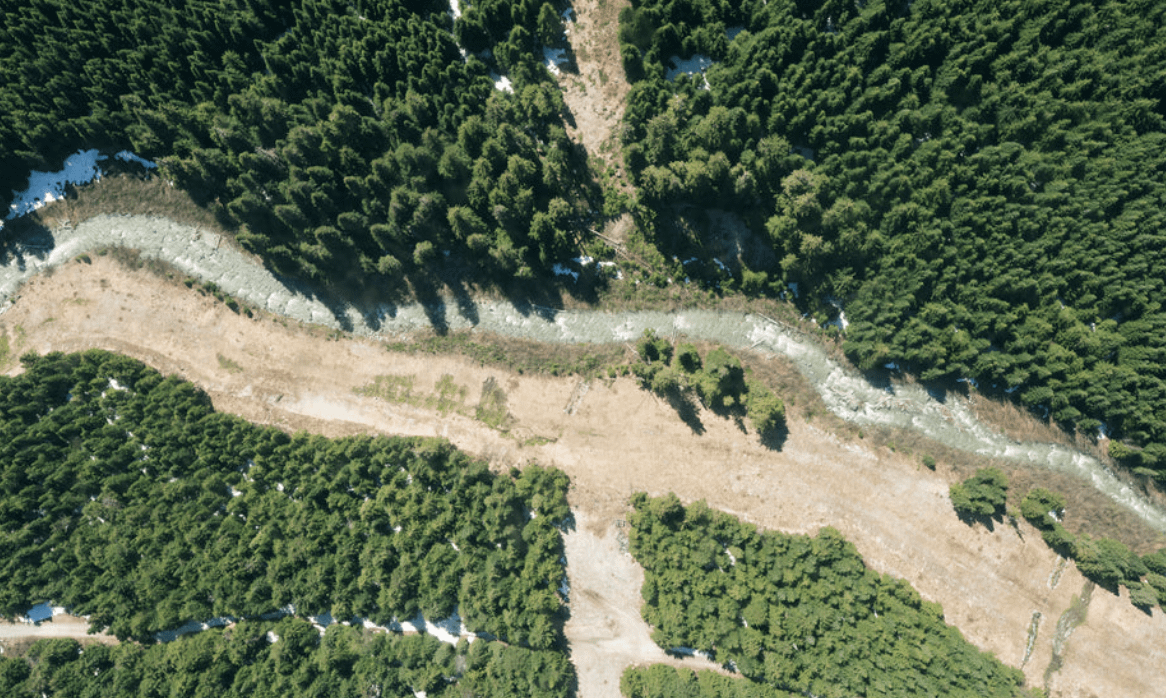
This is taken from the “sourcing and sustainability” page of a chocolate brand’s website (and not one that we work with I might add).
This brand leverages their participation in a tree-planting project to show off their sustainability values. All well-and-good; there are plenty of great tree-planting programmes around the world.
But hang on; something’s not quite right here. Look at bit closer and you’ll see that this is a forest of coniferous trees; not what you’d expect to find in the tropical climes of the cocoa belt.
Sure enough, after a little bit of digging, we can find that this is a stock photo by alpine photographer Andrew Gosine, and it’s a photo of a mountain river in Canada; thousands of kilometres away from the nearest cacao farm.
But why does this matter? It’s just about looking at things with a critical eye. Brands will use stock images like this to suggest values that might not have any material grounding. They want to give you some ‘sustainability vibes’, but sometimes this is entirely superficial. Be on the look out for images of out-of-place wildlife and cocoa farmers too.
Unwrapping real value
Wow. What a palaver. It’s certainly not easy being a conscientious chocolate consumer, but all of this really does matter.
You don’t want to be taken advantage of. A huge number of well-meaning chocolate fans are led to believe that their choices are ‘good enough’, when the reality might not stack up against their values.
Craft chocolate isn’t cheap either; we’re proud of the “fair for all” pricing in the craft chocolate industry, which reflects the amazing artisanality of chocolate makers, and the tremendous technical undertaking of speciality cacao farming. Chocolate bars (like those in our library) can be ethical and sustainable, but you’ll want to be confident that you’ve paid a price worth paying.
Ultimately, as a consumer, you’re voting with your wallet. When you purchase a product you’re endorsing its production. We can make change in the chocolate industry, and the wider cocoa value chain, by purchasing ethically and sustainably produced chocolates, where we’re confident in the impact of our choices. To that end, my vote is for ‘craft chocolate’; a world of chocolate built on the foundation of equitable direct trade, forest-positive farming practices, and extraordinary flavour.
Keep savouring!
-Nick