Unlocking the invention of Dutching and cocoa pressing: A tale of British ingenuity?

This week is a celebration of DRINKING CHOCOLATE, the launch of our home hot chocolate frother and a debunking of "dutching" .. and how a British inventor laid the groundwork for the "dutch" cocoa press
Print / PDFThis week is a celebration of DRINKING CHOCOLATE, the launch of our home hot chocolate frother and a debunking of “dutching” .. and how a British inventor laid the groundwork for the “dutch” cocoa press. Not only do we have a range of great chocolate and cocoa powders, but we’ve also a frother made by Dualit (who also make the well-advertised, and far more expensive, frother of a well-known high street brand who have recently been taken over by Mars…).
So, as the days and nights continue to chill, why not explore (and gift) some great drinking chocolate?
And on the subject of wonderful drinks; we’re also delighted to be announcing a virtual tasting with Square Mile Coffee on January the 24th at 3pm. To ensure the optimum freshness of the coffee, we won’t be shipping until early January, but it still makes a great gift.
Also, please read on to discover why the invention of the cocoa press may well owe as much to the British locksmith, Joseph Bramah, as to Caspurgus Van Houten’s innovation of the (hydraulic) cocoa press. We’ll also continue the Dutch debunking here as we explore why another Van Houten invention, the so-called “Dutching” of pressed cocoa mass (the washing of cocoa mass and powder in an alkaline solution to reduce bitterness and improve solubility) has numerous nutritional disadvantages.

The history of the cocoa press
When you come to one of our in person, or virtual, craft chocolate tastings you’ll know that we try to explain a bit about the history of chocolate; for example, exploring the link between fish and Fridays, and the spread of drinking chocolate in Europe via the church. And we also discuss how beards and moustaches helped inspire the innovation of the cocoa press (quick spoiler: When people drink hot chocolate, if they aren’t very careful they can end up with congealed cocoa butter in their beards, moustaches, etc. as cocoa butter doesn’t easily dissolve in water or milk).
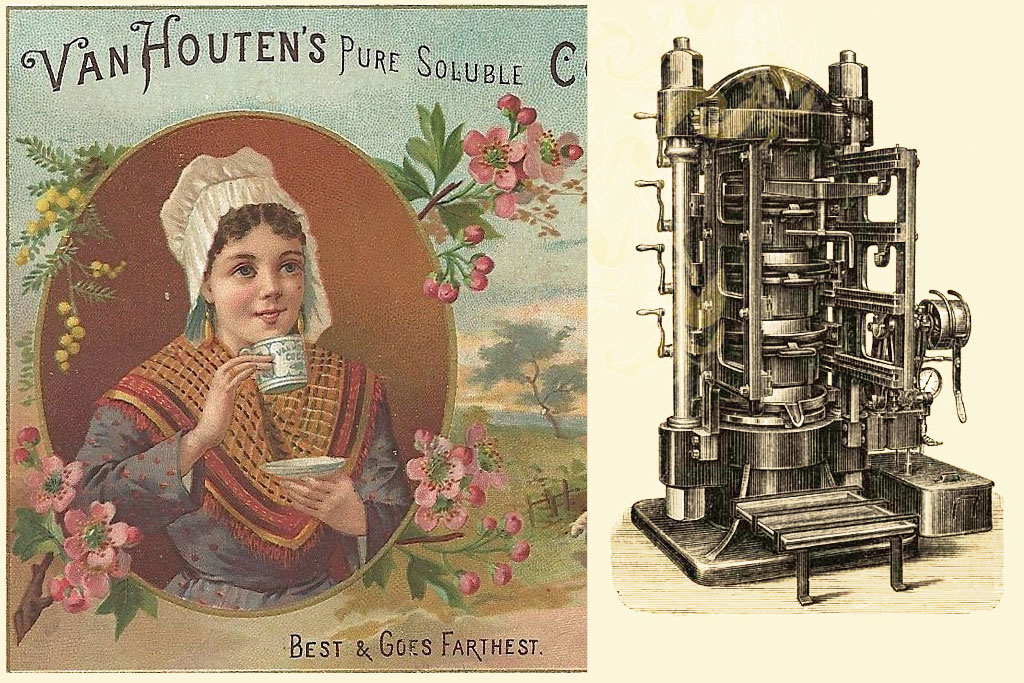
However, in 1828 Caspardus Van Houten, a Dutch spice and coffee merchant living in Amsterdam, launched a hydraulically powered ‘cocoa press’ that went a long way to solving this issue. By squeezing cocoa beans, or the finished drinking ‘cakes’, in a specially designed press, Van Houten was able to vastly reduce the amount of cocoa butter that could get stuck in his fellow countrymen’s beards, as well as producing a far more palatable and smoother hot chocolate. Before Caspardus van Houten’s cocoa press, the main workarounds to reduce cocoa butter involved hanging cocoa beans in large sacks for weeks, and then letting gravity drip out some of the cocoa butter, or using mechanical presses. What really “juiced” up’s Van Houten’s cocoa press was his adoption of hydraulic, as opposed to simple screw based, pressing. His hydraulic press was a game change in terms of speed and power. Moreover, the resulting ‘cake’ was far easier to transport, turn into a powder, and (indirectly) contributed to the development of chocolate bars (a British invention, this time by Joseph Fry in 1847)
How Van Houten came up with the idea of upgrading his mechanical presses and use of a hydraulic press to squeeze out cocoa butter from cocoa beans and semi-processed chocolate is not well documented. He left no diaries, and there are no contemporary biographies. Consequently, many history books, chocolate timelines, corporate biographies, etc. describe his invention as appearing almost out of the blue, not exploring his antecedents.
The hydraulic press: An invention by the British locksmith Joseph Bramah?
The key to Van Houten’s cocoa press was the invention of the hydraulic press, patented in 1795 by a Briton, Joseph Bramah. Bramah was an inveterate inventor, filing patents for products including; a beer engine (1797), a paper-making machine (1805), a new flushing approach for toilets, a machine for automatically printing bank notes with sequential serial numbers (1806), a machine for making quill pen nibs (1809), and a hydrostatic press capable of uprooting trees (1814) which indirectly led to his death later that year from pneumonia. Today, Bramah is best known for his locks, and his “unpickable” lock of 1784 wasn’t cracked for over 67 years, spawning the British lock industry, and indeed the Bramah lock brand is still in use.
Even more than his contribution to the lock industry, Bramah’s most important invention was the hydraulic press; patented in 1795, and inspired by some of his work on toilet-flushing. Bramah’s work to improve toilet flushing led him to realise that he could apply “Pascal’s principle” (that pressure change throughout a closed system is constant) to create the hydraulic equivalent of a mechanical lever.
Hydraulic presses are now used in all sorts of industrial applications, including food manufacturing. For example, one of the hydraulic press’ immediate applications was in replacing the mechanical ‘stamper presses’ used to extract oil from nuts, olives, and other oilseeds. And then later in the 19th century, hydraulic presses were being used in cheese production to help press curds into desirable textures and consistencies that had been hard to achieve by hand or with mechanical presses. Similarly, hydraulic presses rapidly became crucial to pasta production; shaping the dough into various pasta types and facilitating efficient drying processes for consistent quality. Then, in the late 19th and early 20th century, hydraulic presses were applied more and more in the mass production of food, enabling the emergence of the ultra-processed junk food industry of snacks, crisps, the innocuously named “meat and poultry processing” (i.e. chicken nuggets), and other “food-like substances”.
Given that Caspardus Van Houten initially set up his company to sell spices and nuts, the early application of hydraulic presses to process nuts may well be the route that he discovered the great BRITISH invention of the hydraulic press. Having said this, it was clearly Van Houten’s smarts to apply this technology, via his cocoa press, to lay the groundwork to create a far smoother, and more soluble, drinking chocolate. To do this, he needed the support of his son, Conrad.
Dutching AKA Alkalinisation
The Van Houten contribution to cocoa and chocolate wasn’t ‘just’ the hydraulic cocoa press. Caspardus’ son Conrad built upon his father’s work by alkalinising the cocoa cakes and powder that his father’s press produced. And indeed this is where the term “Dutching” originates.
The newly pressed cakes and powders from Van Houten’s press produced a far less gritty and fatty drink. But they still didn’t dissolve that easily to make hot chocolate; firstly because cocoa powder does not dissolve in water, and secondly because cocoa butter, which is still present in cocoa powder even after pressing, does not easily integrate with water (the fat in milk makes it somewhat easier to dissolve the cocoa powder, but it’s still a problem).
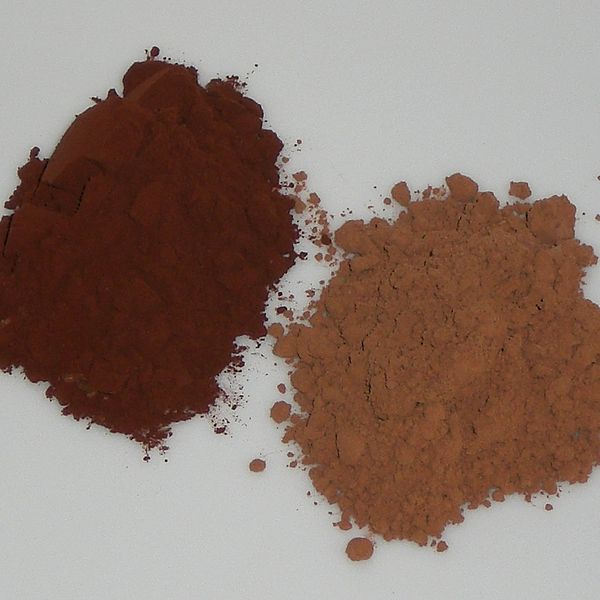
Conrad figured out how to solve these problems, and a few others, with a process we now call “Dutching”. Essentially, Conrad realised that if he washed the cocoa cakes coming out of the hydraulic cocoa presses in an alkaline solution he could reduce both the bitterness of the resulting powder AND improve the solubility of the resulting cocoa cakes and powder. Plus this Dutching turns the powder into an attractive reddish colour.
The third generation
Conrad’s son Caspardus (confusing the first and third generation of the Van Houten dynasty; both have the same name; and all have the same initials) continued in the family firm. And as a genius at marketing, he was able to catapult both of these discoveries into massive commercial success throughout Europe and even the US. Even today Van Houten’s use of tram billboards and posters are cited in advertising history texts, along with their successful positioning of Van Houten drinking chocolate as “healthy, filling and revitalising”.
As Van Houten started expanding, it also explored new packaging formats, and started to use tins to distribute cocoa in 1865, and expand production facilities all over the world.
In the last few decades, the brand has been transferred numerous times. The Van Houten family firm was sold in 1962 to WR Grace, and its key Dutch factories were shuttered in 1971. The Van Houten brand name is still in use, and has been transferred several times since its sale in 1962, with Jacobs Suchard selling it to Philip Morris in 1990, and then Callebault acquiring the company and brand in 2002.
The challenges of Dutching
Although Dutching does reduce bitterness and astringency, increase solubility, and make the cocoa powder an attractive red hue, washing cocoa powder in an alkaline solution does have some significant downsides.
Cocoa is naturally high in flavonoids, a diverse group of phytonutrients with antioxidant properties. And many studies have documented the benefits of these flavonoids; varying from improving cardiovascular health, lowering blood pressure, improving blood flow (including to the brain), lowering levels of oxidation-prone LDL cholesterol, reducing inflammation, etc.
Unfortunately, alkalinisation severely damages cocoa’s phenolic acids and flavonoids, destroying any potential health benefits. In addition, if you read the ingredients of most ‘alkalinised’ hot cocoa, in many cases the primary ingredient is sugar… and that certainly isn’t great for health, nor are all the other preservatives, emulsifiers, etc. used in most high street and supermarket hot chocolate powders and drinks.
The good news!
We’ve sourced some non-alkalinised/non-Dutched cocoa powder from Kokoa Kamili in Tanzania (with huge thanks to Gino from Meridian Cacao). This non-alkalanised powder doesn’t have any preservatives, emulsifiers, or added sugar, unlike well-known high street brands. And it has a fantastic flavour!
Similarly, our hot chocolate drinking buttons from Original Beans, Pump Street and Menakao, and powders from Chocolarder, also make great drinking chocolate in our “frother” (and they too aren’t ultra-processed, full of sugars, emulsifiers, etc.).
One further observation: One great use of ‘bloomed‘ (i.e. out-of-temper bars) can be to make a hot chocolate with them (or brownie etc.). However, if you plan to turn your favourite bar into hot chocolate, we’d recommend you follow Evelina (ex-Prufrock, and barista extraordinaire) and melt the bar chunks in hot water before placing them into our frother.
Check out our guide to the ultimate hot chocolate →
Finally, do think about any of these bundles as being a great Christmas gift… and unlike well-known high street brands, we aren’t running hugely expensive advertising campaigns and charging a massive markup on our Dualit milk frother / hot chocolate maker. And you don’t have to worry about having missed some “amazing Black Friday deal”; we didn’t do any, and aren’t going to discount this either!
Keep savouring!
Spencer
Try our new hot chocolate machine in different ways
Sources and further reading:
https://www.barry-callebaut.com/en-US/vending/van-houten/history
https://www.ncbi.nlm.nih.gov/pmc/articles/PMC6245372/
https://www.mdpi.com/2076-3921/11/1/133
https://www.ncbi.nlm.nih.gov/pmc/articles/PMC4696435/
https://www.britannica.com/biography/Joseph-Bramah
https://www.britannica.com/science/fat-processing/Hydrogenation