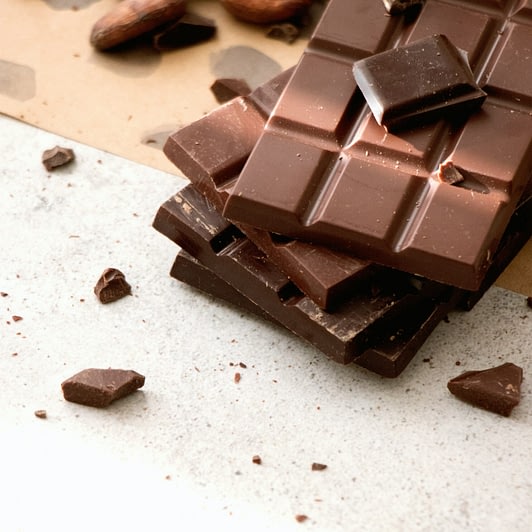
Happy treating and Halloween history
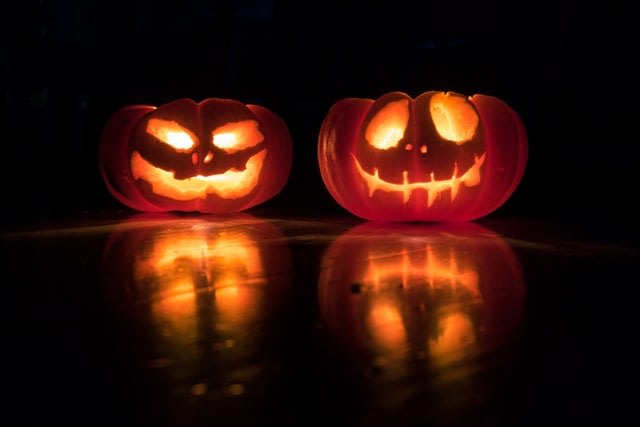
To date, craft chocolate has not found a way into guising, mumming or even trick or treating. To address this we’ve pulled together bars in orange, black and purple for you to make your own traditions...
Print / PDFSuddenly here in the UK the weather has changed. We are still enjoying some sunny days, but it’s getting noticeably colder. Over the space of the weekend swimming in the ponds has gone from a balmy(ish) 16.5 degrees to just under 12 degrees on Monday.
Which means we are almost officially in winter, and that means we are almost at Halloween; first celebrated by the Celts on the “first day of winter”, i.e. the midpoint of summer and winter equinoxes. For more on the history of Halloween and why it is associated with the colour orange (and increasingly black, purple, and even green), why we “trick or treat” and how it links to “guising” and “mumsing”, read on.
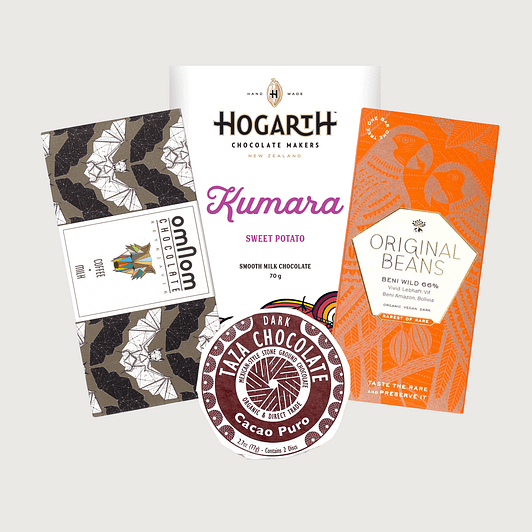
Although we’ve done a lot of research into Halloween, we’ve not found any great connection between craft chocolate and Halloween. However, we’ve a bunch of great bars for Halloween that either contain orange or pumpkin, or are coloured orange, black or purple; and even one crafted by Omnom that is decorated with bats. Plus there is no scary stuff on the list of the ingredients of any of these treats.
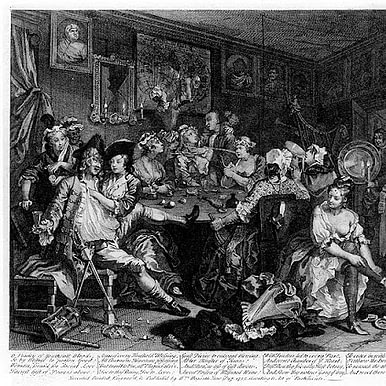
Plus we’ve even found an orange wine that pairs brilliantly with Hogarth’s buttered toast and sea salt bar.
So if you want to impress your friends and family with your knowledge of Halloween, or even better treat them to some amazing bars, please savour some craft chocolate and read on.
Etymology
The word “Halloween” can be dated back to the early 18th century Scotland. And the publication of Robert Burns’ poem “Halloween” in 1785 catapulted the term into general usage.
Literally the word “Hallowe’en” means “saints’ evening” and is the Scottish term for All Hallows’ Eve (the evening before All Hallows’ Day), with the Scots changing “eve” to “e’en” or “een”.
At the same time, Halloween has been celebrated in various forms far earlier, with various traditions going back even further. For example, the phrase “all hallows'” is found in Old English, “All Hallows’ Eve” as early as 1556. And Shakespeare includes “souling” (the custom of baking and sharing soul cakes, which became “trick or treating”) in his play Two Gentlemen of Verona.
Origins and history
Whilst the term Halloween is credited to the Scots, credit for the origins and customs of Halloween needs to be shared more widely across the Celts of Wales, Ireland, Brittany, Cornwall, and Scotland. Each of these Celtic peoples used different names for what became Halloween; Samhain in Ireland, Scotland and the Isle of Man, Calan Gaeaf in Wales, Kalan Gwav in Cornwall, and Kalan Goañv in Brittany. In all cases the term meant the same; “first day of winter”; half way between summer and winter equinoxes. And the festival was used firstly to entreat the gods, fairies, and spirits (the Aos Si) for their support during the winter months and secondly to offer succour to the souls of the deceased. As part of the prayers and celebration, offerings of food and drink were left outside the house, or even extra places in the meal were set.
As with a few other festivals, Christianity appears to have subsumed (aka appropriated) this festival. The early Christian festivals to celebrate saints and martyrs were mainly during the springtime. However, in the late 8th century, Gregory III and Gregory IV pulled many of these together and established the Christian holy days of “AllHallowtide” to “honour the Saints of the Church and pray for the recently deceased”. AllHallowtide spanned three days; All Hallows’ Day (also known as All Saints’) on the 1st November, All Soul’s Day on the 2nd November, and All Hallows’ Eve on the 31st October. Today, claims of cultural appropriation might be raised. But as the Church was trying to convert the Celtic tribes, it clearly made sense to leverage the festivals and practises of Samhain, Calan/Kalan etc.
Check out our Halloween bar picks →
Customs and traditions
Samhain, Calan Gaea, Kalan Gwav, and Kalan Goañv all involved food offerings and prayers. And it’s not hard to see how these food evenings first morphed into “souling” and “mumming” which then became “trick or treating”.
As early as the 15th century there are records of poor folk promising to pray and sing for the souls of their richer neighbours in return for “soul cakes” on All Hallows’ Eve. Indeed the custom still exists in various parts of the world; for example, in the Philippines, they have a custom called Pangangaluwa where kids drape themselves in white cloths on All Hallows’ Eve where they visit neighbours, sing, and ask for prayers and sweets.
A similar practice of singing and praying, this time in fancy dress, can be found in Germany, Scandinavia, and other parts of Europe in the 15th and 16th centuries (and probably even earlier) and is known as “mumming”. Scotland developed a practice called guising at the same time, and added in the practice of carrying turnip lanterns late 19th century along with lanterns.
19th century immigrants to North America brought these traditions with them to Canada and the US. The practice of “guising” was first reported in 1911 in Kingston Ontario (Canada). And over the next decades guising gradually morphed into trick or treating during the 1930s, with the term “trick or treating” first appearing in 1934.
All sorts of other customs and traditions have also been added; many borrowed from other nearby festivals (e.g. caramel and toffee apples from Bonfire Night here in the UK). And the practice of lighting candles to pray for the dead incorporated into pumpkins and turnips via an Irish legend of “Jack” tricking the devil out of a lump of hot coal to help him survive in a limbo between heaven and hell.
Increasingly Halloween has been commercialised and sanitised. The US now has “trunk or treat” parties to keep kids safe and handle the logistics of American suburbs where many houses are miles apart. Halloween has become a huge card-giving market, and even pets are now part of the massive Halloween commercial opportunity.
To date however, craft chocolate has not found a way into guising, mumming or even trick or treating. To address this we’ve pulled together bars in orange, black and purple for you to make your own traditions (and read my earlier blog for more on why these colours are associated with Halloween; orange is because of autumn, black for similarly obvious reasons, but purple is more mysterious).
Shop our Halloween collections →
Happy treating!
Keep savouring!
Spencer
p.s. Do please keep your comments flowing on our new website, and thanks for all your encouragement!
p.p.s. If you are in Porto this weekend, do come and say hi to us at the Chocolat Festival.
p.p.p.s. I was on a podcast with Steve and Dave of The Happy Pear discussing craft chocolate and flavour; available here: https://thehappypear.ie/episode-140-spencer-hyman/
Further reading:
https://www.history.com/topics/halloween/history-of-halloween